
How much does eBay charge new sellers?
eBay fees can vary depending on what you sell, your selling price, your Store plan, and how the order is completed.
For new sellers, that can make pricing confusing. A product may look profitable at first, but fees and other selling costs can quickly reduce the amount you actually keep.
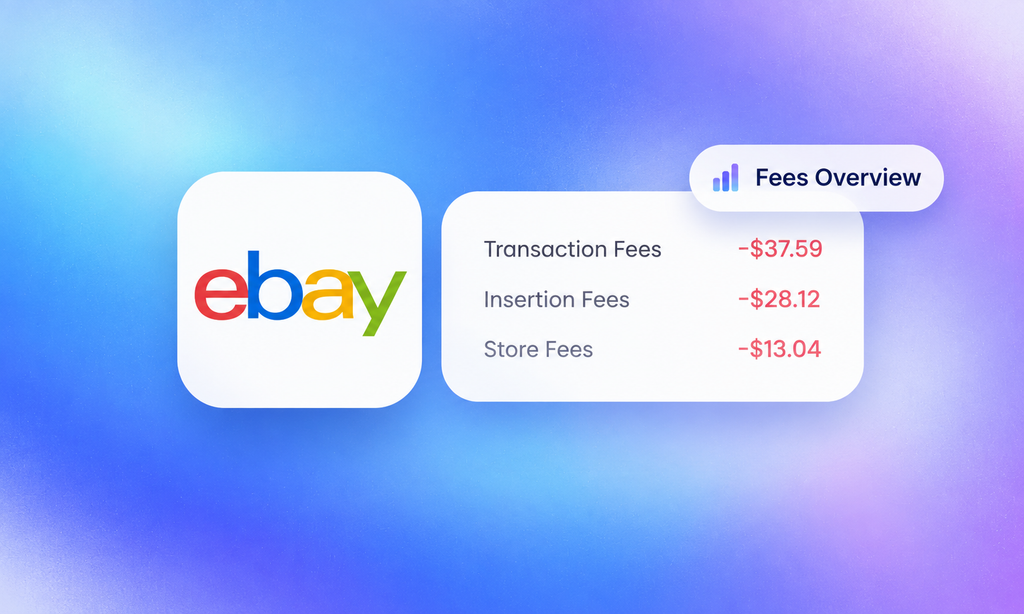
Knowing these charges before you list helps you price more accurately, choose better products, and avoid margins that are too thin.
In this guide, we break down the main eBay fees in 2026 with simple explanations and practical examples, so you can clearly see what eBay may charge on each sale.
How Much Does eBay Take From a Sale in 2026?
For many U.S. sellers without an eBay Store, or with only a Starter Store, the standard rate for most categories is: 13.6% of the total amount of the sale up to $7,500 per item + $0.40 per order
For the portion above $7,500, the rate generally drops to 2.35%. Orders of $10 or less use a $0.30 per-order fee instead of $0.40.
However, 13.6% is not a universal eBay fee. Your actual cost can change based on:
- Product category
- Selling price
- Store subscription
- Listing format and upgrades
- Promoted Listings
- International sales
- Currency conversion
- Seller performance
- Refunds and disputes
- eBay Live or eBay Motors
So, two sellers making the same $1,000 in sales can still end up paying different amounts in fees.
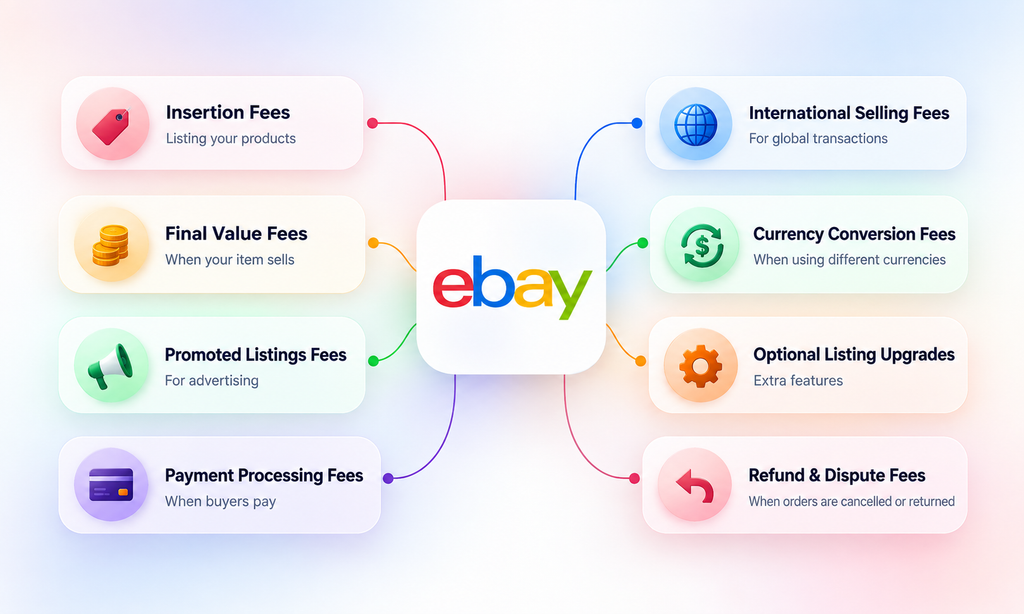
eBay Fees in 2026
| Fee | When It Applies | Typical Cost |
| Insertion Fee | When monthly free-listing allowance is exceeded | Usually $0.35 without a Store |
| Final Value Fee | When an item sells | Category-dependent; 13.6% is common for non-Store sellers |
| Per-Order Fee | Added to final value fee | $0.30 for orders ≤$10; $0.40 above $10 |
| Store Subscription | If you subscribe to an eBay Store | From $4.95/month on annual Starter plan |
| Promoted Listings – General | Attributed promoted sale | Seller-selected percentage of total sale |
| Promoted Listings – Priority | Buyer clicks the ad | Cost per click |
| International Fee | Certain international sales | 1.65% for qualifying U.S. sellers |
| Currency Conversion | eBay converts seller funds | 3% conversion charge for U.S.-registered sellers |
| Optional Listing Upgrades | Subtitle, Bold, Reserve Price, etc. | Varies |
| Dispute Fee | Seller is responsible for qualifying payment disputes | $20 |
| Performance-Related Fee | Below Standard or Very High service metrics | Additional percentage may apply |
eBay automatically deducts selling costs from seller funds. Listing charges are generally assessed when listings are created, transaction charges at the time of sale, Store subscriptions monthly, and other costs as they occur.
eBay Insertion Fees Explained
An insertion fee is the fee eBay may charge when you create a listing after using your monthly free-listing allowance.
For sellers without a Store subscription, eBay currently includes up to 250 zero-insertion-fee listings per month in eligible categories. After that, the standard insertion fee for most categories is $0.35 per listing.
How Are Insertion Fees Calculated?
Insertion fees are mainly based on how many eligible listings you create beyond your monthly free allowance.
| Listings | Charged Listings | Total Fee |
| 250 | 0 | $0.00 |
| 270 | 20 | $7.00 |
| 300 | 50 | $17.50 |
Formula: Listings above 250 × $0.35
If you create 270 listings, the first 250 are free, and the remaining 20 are charged: 20 × $0.35 = $7.00
Actual insertion fees can still vary depending on your category, Store plan, listing format, and optional upgrades.
Listing in Two Categories Can Cost More
If you list the same product in two categories, eBay may charge an additional insertion fee for the second category.
Optional listing upgrades may also be charged again. If the product sells, eBay generally applies the higher final value fee associated with the selected categories.
Multiple Units Do Not Mean Multiple Listing Fees
If one listing contains 20 identical phone cases, you are generally charged for the listing itself, not separately for all 20 units.
This makes multi-quantity fixed-price listings more cost-efficient than creating unnecessary duplicate listings.
For sellers managing a larger catalogue, tracking monthly listing volume matters because insertion fees can add up once you exceed the free allowance.
Final Value Fees: The Main eBay Selling Fee
The final value fee is usually the main fee eBay charges when an item sells.
For most non-Store sellers on eBay.com, the current standard rate is: 13.6% of the total amount of the sale up to $7,500 per item plus 2.35% on the applicable portion above $7,500 plus the applicable $0.30 or $0.40 per-order fee.
The important phrase here is ‘total amount of the sale’. eBay does not always calculate the fee from the item price alone.
What Does eBay Include in the Total Amount of the Sale?
Depending on the transaction, the fee calculation can include: Item price + shipping charged to the buyer + handling charges + applicable sales tax + other applicable amounts
So, if you sell a $50 product, eBay may calculate the fee on more than just that $50.
Example: Final Value Fee on a $50 Product
Suppose you sell an item for $50, charge $8 shipping, and the order has 8% sales tax.
| Calculation | Amount |
| Item price | $50.00 |
| Shipping | $8.00 |
| Sales tax | $4.64 |
| Total amount of sale | $62.64 |
| 13.6% final value fee | $8.52 |
| Per-order fee | $0.40 |
| Estimated final value fee | $8.92 |
Here, the fee is calculated on $62.64, not just the $50 product price.
That difference matters because shipping, tax, and other applicable charges can increase the fee base and reduce the margin you actually keep.
For sellers working with low-margin products, even a small change in the fee calculation can have a noticeable impact on profitability.
Final Value Fees by Category
Not every eBay product is charged the standard 13.6% final value fee. Rates vary by category, and some products can have much lower or higher fees.
Here are several important examples for sellers without a Store or with a Starter Store:
| Category | Current Final Value Fee |
| Most Categories | 13.6% up to $7,500; 2.35% above |
| Books & Magazines | 15.3% up to $7,500; 2.35% above |
| Movies & TV – most categories | 15.3% up to $7,500; 2.35% above |
| Music – most categories except Vinyl/NFTs | 15.3% up to $7,500; 2.35% above |
| Coins & Paper Money – except Bullion | 13.25% up to $7,500; 2.35% above |
| Women’s Bags & Handbags | 15% if sale ≤$2,000; 9% if above $2,000 |
| Jewelry & Watches – most categories | 15% if sale ≤$5,000; 9% if above $5,000 |
| Guitars & Basses | 6.7% up to $7,500; 2.35% above |
| NFT Categories | 5% |
| Selected Athletic Shoes ≥$150 | 8%; no per-order fee |
| Selected Heavy Equipment/Commercial Equipment | 3% up to $15,000; 0.5% above |
Why Category Selection Affects Profit
Two products selling for the same price can have very different eBay fees.
A $1,000 item in a 13.6% category will cost more to sell than a $1,000 item in a lower-fee category.
Always choose the correct product category, rather than simply looking for the lowest fee. Incorrect categorisation can reduce visibility, confuse buyers, and create listing issues.
Before sourcing or pricing a product, check its applicable eBay category fee so you know how much margin will remain after the sale.
eBay Store Fees in 2026
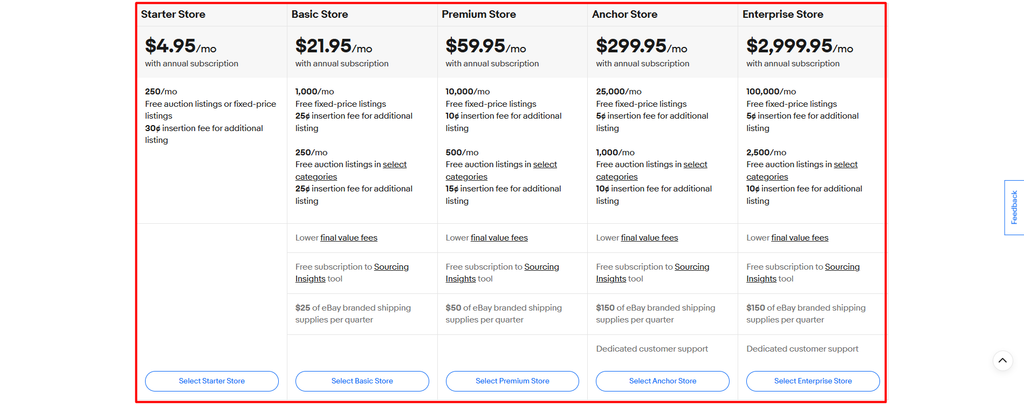
An eBay Store is not free.
You pay a subscription in exchange for benefits such as additional zero-insertion-fee listings, lower insertion fees after those allowances, Store tools, and reduced final value fees in many categories.
Current U.S. Store subscription pricing is:
eBay Store Listing Allowances
Store subscribers can also receive much larger zero-insertion-fee allocations.
| Store | Selected Auction Listings | Fixed-Price Listings |
| Starter | 250-listing allowance structure | Included within Starter allowance |
| Basic | 250 in selected categories | 1,000 all-category + 10,000 selected-category allowance |
| Premium | 500 in selected categories | 10,000 all-category + 50,000 selected-category allowance |
| Anchor | 1,000 in selected categories | 25,000 all-category + 75,000 selected-category allowance |
| Enterprise | 2,500 in selected categories | Up to 100,000 under applicable allocation rules |
After the included allocation, insertion charges can fall as low as $0.05 per qualifying fixed-price listing on higher Store tiers.
Exact allowances depend on format and category, so sellers with large catalogues should check which of their products qualify rather than looking only at the headline listing number.
How Much Can a Basic eBay Store Reduce Final Value Fees?
For many categories, a Basic or higher Store can reduce the final value fee from 13.6% to 12.7%. That 0.9% difference may look small, but it can add up as monthly sales grow.
Simple Break-Even Example
An annual Basic Store costs $21.95 per month.
If your fee drops by 0.9%, the subscription can roughly pay for itself at around: $21.95 ÷ 0.009 ≈ $2,439 in monthly sales
For the $27.95 monthly plan, the break-even point is about: $27.95 ÷ 0.009 ≈ $3,106
So, sellers doing around $2,500–$3,000 per month in qualifying categories may already see value from the lower fee rate, even before counting extra zero-insertion listings.
Promoted Listings Fees

eBay selling fees are only part of the cost of making a sale. Many sellers also pay for Promoted Listings to increase product visibility.
eBay currently offers two main campaign strategies: General and Priority.
General Campaign Strategy
General campaigns use a percentage-based advertising fee.
You choose an ad rate, currently from 2% to 100% of the total sale amount, and you are charged when a promoted listing generates an attributed sale under eBay’s attribution rules.
The fee is calculated from the total sale amount, which can include the item price, shipping, taxes, and other applicable charges.
Priority Campaign Strategy
Priority campaigns use a cost-per-click (CPC) model. This means you can pay for clicks even if the shopper does not purchase the product.
The actual CPC depends on factors such as:
- Your bid
- Competition
- Keyword relevance
- Listing quality
- Marketplace conditions
So, General campaigns charge mainly when a promoted sale is attributed, while Priority campaigns can generate advertising costs from clicks alone.
How Promoted Listings Affect Profit
Suppose you sell an item for $100 with free shipping, and the total sale amount becomes $108 after an example 8% sales tax.
| Calculation | Amount |
| Final value fee: $108 × 13.6% + $0.40 | $15.09 |
| General ad fee at 5% | $5.40 |
| Total eBay + advertising cost | $20.49 |
And that is before deducting product cost, shipping, packaging, returns, Store fees, labour, or software.
That is why Promoted Listings should be measured by profitability, not just sales or revenue. A campaign only makes sense if the extra visibility still leaves enough margin after all selling costs are deducted.
International Seller Fees on eBay
Selling internationally can add another cost to an eBay transaction.
For sellers with a U.S.-registered address, eBay currently charges a 1.65% international fee when they are not using eBay International Shipping and either:
- The delivery address is outside the U.S., or
- The buyer’s registered address is outside the U.S., even if the delivery address is domestic.
The fee is calculated on the total amount of the sale, including applicable shipping, handling, sales tax, and other charges.
International Fees by Seller Country or Region
International fee rates vary according to the seller’s registered address.
| Seller Registered Address | International Fee |
| United States | 1.65% |
| Japan | 1.35% |
| South Korea | 1.45% |
| India | 1.70% |
| New Zealand | 1.00% |
| Rest of APAC | 1.30% |
| Europe Unsited – excluding EU | 1.30% |
| Rest of World | 1.55% |
eBay’s Rest of World group includes countries such as Bangladesh, Pakistan, Brazil, Mexico, South Africa, and many others.
EU Unsited sellers follow a different destination-based structure: 0% for the Eurozone and Sweden, 1.2% for the UK, 1.6% for certain European destinations plus the U.S. and Canada, and 3.3% for other countries.
What Happens With eBay International Shipping?
For eligible items sold through eBay International Shipping, U.S. sellers are not charged the normal 1.65% international fee.
The shipping portion of the final value fee is also based on what the seller pays to send the item to eBay’s U.S. shipping hub. If shipping to the hub is free, there is no buyer-paid domestic shipping amount to add to that part of the fee calculation.
eBay Currency Conversion Fees
An international fee and a currency conversion fee are two different charges.
A currency conversion fee can apply when eBay needs to convert money between the currency used on an international eBay site and your payout currency. For example, a U.S. seller listing on eBay Germany (eBay.de) may have funds converted between EUR and USD when fees are collected, or sales proceeds are paid.
For U.S.-registered sellers, eBay currently applies a 3% seller currency conversion charge to the base exchange rate when eBay performs the conversion.
Currency Conversion Charges by Seller Region
| Seller Registered Address | Conversion Charge |
| United States | 3% |
| Malaysia & Israel | 2.5% |
| Latin America | 3.5% |
| Other eBay Global Countries | 3% |
So, for cross-border sales, sellers may need to account for: eBay selling fees + international fee + currency conversion + shipping/import costs
These costs can quickly reduce margin, so international orders should be priced with the complete cross-border cost in mind.
Optional eBay Listing Upgrade Fees
You can sell successfully on eBay without purchasing every available listing enhancement. However, eBay offers optional features that can add cost before or during the listing lifecycle.
Current examples include:
Auction-Style Listings
| Upgrade | Current Fee |
| 1- or 3-day auction duration | $1.00 |
| Bold | $2.00 |
| Gallery Plus | $0.35 in applicable categories |
| Subtitle – starting price up to $150 | $1.50 |
| Subtitle – starting price above $150 | $3.00 |
| Reserve Price | $5 or 7.5% of reserve price, whichever is greater, max $250 |
| International Site Visibility | $0.10–$0.40 depending on starting price |
Fixed-Price / Good ‘Til Cancelled Listings
| Upgrade | Current Fee |
| Bold | $4.00 |
| Gallery Plus | $1.00 in applicable categories |
| International Site Visibility | $0.50 |
| Subtitle – item price up to $150 | $2.00 |
| Subtitle – item price above $150 | $6.00 |
| Scheduled Listing | Free |
Some categories receive free Gallery Plus, and not every feature is available in every listing tool or category.
than subtracting ten percentage points.
eBay Dispute Fee
A payment dispute happens when a buyer challenges a transaction through their bank, card provider, or payment institution.
If eBay determines that the seller is responsible for the disputed amount, it can charge a $20 dispute fee per dispute, excluding applicable sales tax.
When Can the Dispute Fee Apply?
The fee may apply when a payment dispute is decided against the seller, such as cases involving:
- Item not received
- Transaction not recognized
- Refund-related disputes
- Product condition or description issues
- Other payment disputes covered by eBay’s policies
Why the $20 Fee Matters
For a high-value item, a $20 fee may be relatively small. But for low-priced products with thin margins, repeated disputes can quickly reduce profitability.
For example, if you earn only $8 profit per order, one $20 dispute fee can wipe out the profit from more than two successful sales.
To reduce dispute risk, keep tracking details, delivery confirmation, accurate product descriptions, buyer messages, and transaction records properly documented.
eBay Classified Ad Fees
eBay’s Classified Ad format works differently from a normal auction or fixed-price listing. You post the item on eBay, interested buyers contact you, and the transaction is completed outside eBay.
The current fee is $9.95 for a 30-day Classified Ad. There is no normal final value fee when the item sells through this format.
| Classified Ad Cost | Fee |
| 30-day insertion fee | $9.95 |
| Final value fee | $0 |
However, Classified Ads are only available in selected categories, including certain Business & Industrial, Specialty Services, Travel, and Everything Else categories. Real Estate also supports Classified Ads, but uses a different fee structure.
Because the transaction is completed outside eBay, sellers also do not get the same transaction features available with regular marketplace sales, such as normal feedback and unpaid-order cancellation tools.
So, Classified Ads are a special-purpose listing format, not a cheaper replacement for normal eBay listings.
eBay Real Estate Fees
Real Estate listings use a separate fee structure from normal eBay products. Instead of a standard final value fee, sellers may pay an insertion fee and, for some listing types, a notice fee.
For Land, Manufactured Homes, and Timeshares, current fees include:
| Listing Format | Insertion Fee | Notice Fee |
| Short auction | $35 | $35 |
| 30-day auction or Good ‘Til Cancelled | $50 | $35 |
| 30-day Classified Ad | $150 | $0 |
| 90-day Classified Ad | $300 | $0 |
For Commercial, Residential, and Other Real Estate, auction listings start at $100, while 30-day auction or Good ‘Til Cancelled listings cost $150. These listings currently have no notice fee.
Real Estate is therefore a good example of why eBay does not have one universal selling-fee percentage; the cost depends heavily on the category and listing format.
Taxes Can Apply to eBay Seller Fees
Sales tax paid by buyers and tax charged on eBay’s seller services are two different things. Depending on where a seller is registered, eBay may be required to apply tax to certain marketplace fees.
In the U.S., eBay currently identifies fee-tax rules affecting sellers in states including:
- Hawaii
- South Dakota
- Texas
- Washington
The taxable fee types vary by state. For example, Washington can tax certain listing upgrades and Promoted Listings charges, while Texas can apply tax to Store subscriptions, insertion fees, and part of final value fees.
International sellers may also face VAT, GST, or similar taxes depending on their registered location.
How to Calculate Your Real eBay Profit
A common mistake is calculating profit as: Selling Price − Product Cost = Profit
That leaves out many of the costs that actually reduce your earnings.
A more accurate formula is: Net Profit = Revenue − Product Cost − Shipping − eBay Fees − Advertising − Listing Costs − Store Costs − Packaging − Returns/Disputes − Other Expenses
Step 1: Find the eBay Fee Calculation Base
Start with the amount eBay may use to calculate percentage-based fees: Item Price + Buyer-Paid Shipping + Handling + Sales Tax + Other Applicable Charges
Step 2: Calculate the Final Value Fee
Apply the correct fee rate for your product category, then add the applicable per-order charge: Final Value Fee = Percentage-Based Fee + Per-Order Fee
Step 3: Add Other Selling Costs
Depending on the transaction, you may also need to include:
- Promoted Listings fees
- International fees
- Currency conversion
- Listing upgrades
- Store subscription costs
- Performance-related fees
- Returns or dispute costs
Once all of these expenses are included, you get a much clearer picture of how much profit you actually keep from each eBay sale.
How to Reduce eBay Fees Without Damaging Sales
The aim is not to avoid every fee. Focus on cutting costs that do not add enough value.
1. Use Your Free Listing Allowance
Track how many listings you create and remove slow-moving listings that keep using your monthly allowance.
2. Compare Store Costs Before Upgrading
Check whether lower final value fees and extra free listings actually save more than the Store subscription costs.
3. Avoid Unnecessary Listing Upgrades
Only pay for features such as Bold, subtitles, or extra categories if they improve visibility or sales enough to justify the cost.
4. Protect Your Seller Performance
Reduce cancellations, late handling, inaccurate descriptions, and preventable returns. Poor performance can lead to additional eBay fees.
5. Set Advertising Rates From Your Margin
Promoted Listings can increase visibility, but higher ad rates can quickly reduce profit. Set your rate based on what each product can realistically afford.
eBay Fee Mistakes Sellers Make
- Assuming eBay always takes 13.6%: Fees can vary by category, Store level, sale amount, seller performance, and transaction type.
- Calculating fees from item price only: Shipping, handling, and sales tax can also be included in the fee calculation base.
- Ignoring Promoted Listings costs: Advertising fees can quickly reduce profit, especially on low-margin products.
- Assuming a Store subscription is always cheaper: A Store only makes sense when the fee savings and listing benefits outweigh the subscription cost.
- Looking at revenue instead of real profit: Always include product cost, shipping, eBay fees, advertising, returns, and other expenses when measuring profitability.
Frequently Asked Questions About eBay Fees
Q1. How much does eBay take from a $100 sale?
It depends on the product category, Store subscription, shipping, sales tax, advertising, and other applicable charges. In a standard 13.6% category, eBay calculates the percentage fee from the total amount of the sale and then adds the applicable per-order fee.
Q2. What is eBay’s final value fee in 2026?
For many U.S. categories, sellers without a Store or with a Starter Store currently pay 13.6% on the total amount of the sale up to $7,500 per item, then 2.35% on the applicable portion above $7,500, plus the per-order fee. Some categories use different rates.
Q3. How many items can I list on eBay for free?
Sellers without higher Store allowances can currently receive up to 250 zero-insertion-fee listings per month in eligible categories.
Q4. What happens after my 250 free eBay listings?
For most standard eligible categories, sellers without a Store generally pay a $0.35 insertion fee for each additional listing after using the monthly free allocation.
Q5. Does eBay charge fees on shipping and sales tax?
Yes. Shipping charged to the buyer and applicable sales tax can be included in the total amount of the sale used to calculate the final value fee.
Q6. Does eBay charge a separate payment processing fee?
For normal marketplace transactions, eBay’s final value fee structure already incorporates payment processing, so sellers generally do not pay a separate third-party processing fee on top of it.
Q7. Are eBay Store fees lower?
Basic, Premium, Anchor, and Enterprise Store subscribers can receive lower final value fees in many categories and larger zero-insertion-fee allowances. The actual savings depend on your category, sales volume, and number of listings.
Q8. Does eBay charge extra for international sales?
Yes, in some cases. Qualifying U.S.-registered sellers can currently pay a 1.65% international fee on certain international transactions. Eligible sales using eBay International Shipping do not carry this standard international fee.
Q9. How much do eBay Promoted Listings cost?
General campaigns use a percentage-based ad rate, currently starting from 2%, while Priority campaigns use cost-per-click pricing. Your actual advertising cost depends on the campaign type, rate or bid, and buyer activity.
Q10. Can poor seller performance increase eBay fees?
Yes. eBay can apply additional final value fees to sellers rated Below Standard or those with Very High Item Not as Described service metrics. Continued poor performance can result in higher additional charges.
Know the Fee Before You List the Product
A product can look profitable on paper and still leave very little margin once eBay fees are added.
Before listing, calculate the costs that can affect your profit. This includes your category fee, Store rate, shipping, advertising, international charges, and expected returns.
Once those costs are clear, you can set a price that covers expenses and still leaves enough room for profit. This matters even more for competitive or low-margin products.
The stronger approach is to treat fees as part of your pricing strategy from the start. That helps you make better decisions about sourcing, pricing, and advertising before money is already committed.
Build a More Profitable eBay Business With Ecomclips
Strong eBay performance requires more than understanding fees. Sellers need the right mix of product research, pricing, listing optimization, SEO, advertising, Store structure, inventory planning, and seller performance. Ecomclips helps brands improve visibility, conversion, profitability, and long-term eBay growth.
Watch eBay and ecommerce tutorials on the Ecomclips YouTube channel, explore practical seller resources on the Ecomclips Blog, and read our Complete Guide to Selling on eBay in 2026 for the wider eBay selling framework.
You can also explore our How to Build an eBay Store in 2026, eBay SEO Strategy in 2026, eBay Product Research Strategy in 2026, and How to Optimize eBay Listings in 2026 for more focused guidance.
Follow the Ecomclips Facebook page and connect with Ecomclips on LinkedIn for more ecommerce insights and marketplace updates.
Need help with eBay SEO, listing optimization, Store setup, advertising, or marketplace growth? Email info@ecomclips.com or book a consultation with our ecommerce experts.