

How do you know what will sell on Etsy?
The answer starts with research. A strong product idea is not just something that looks attractive, it needs to match real buyer demand, realistic competition, clear differentiation, and enough profit potential to make the effort worthwhile.
Good product research helps you understand what shoppers are searching for, which products are already performing well, where competitors are falling short, and which trends are starting to gain attention. It gives you a much clearer picture before you spend time creating, sourcing, or promoting a product.
In this guide, we’ll break down a practical Etsy product research strategy to help you move from a simple idea to a data-backed product opportunity worth testing and launching.
What Is Etsy Product Research?
Etsy product research is the process of checking whether a product idea has enough buyer demand, manageable competition, market potential, and profit opportunity before you invest time or money into launching it.
In simple terms, it helps answer one key question: Is this product actually worth selling on Etsy?
Good product research looks at three main areas:
- Demand: What shoppers are searching for and whether interest is growing, seasonal, or consistent.
- Competition: Which products are already selling, what price points are common, and where existing listings are weak.
- Opportunity: Whether you can create a better offer through stronger design, personalisation, packaging, positioning, or pricing.

Product research is not about finding a bestseller and copying it. The real goal is to understand why buyers are purchasing, what they still want, and where your product can offer something more relevant or valuable.
Why Sellers Need Etsy Product Research
Product research helps sellers make smarter decisions before spending hours creating, sourcing, photographing, or promoting a product. It reduces guesswork and helps identify ideas with stronger commercial potential.
For example, if you want to sell a personalized pet memorial frame, research may show that buyers are actively looking for pet memorial gifts, but many existing listings offer limited customization or basic packaging. That could reveal an opportunity to offer multiple pet names, custom messages, or gift-ready presentation.
Instead of launching another generic product, you enter the market with a clearer understanding of what buyers want and what competitors may be missing.
Why Product Research Is the Foundation of Etsy Success
Etsy has over 90 million active buyers and millions of sellers competing for attention. In this crowded marketplace, success rarely comes down to luck. The sellers who consistently earn strong revenue share one thing in common: they do their homework before they list a single product.
Etsy product research is the systematic process of identifying what buyers are actively searching for, what products are generating consistent sales, and where gaps exist in the market that you can fill. Without this foundation, even the most beautifully crafted products can sit unseen in your shop.
Think of finding profitable products on Etsy like being a farmer inspecting crops before harvest. You wouldn’t invest time, money, and effort into cultivating a field without first understanding which crops are in demand, which ones fetch the best price, and which soil conditions yield the best results. The same logic applies to Etsy. Analyzing product listings, sales history, and buyer behavior helps you determine exactly which products are worth your investment.
This guide walks you through every major method and tool for conducting thorough Etsy product research, from Etsy’s own built-in features to powerful third-party analytics tools so you can make confident, data-backed decisions.
Section 1: Understanding Demand Before You Create
Before investing time into making or sourcing products, the first question every Etsy seller must ask is: Are people actually searching for this?
Demand on Etsy is driven by buyer intent. Unlike social media platforms where buyers are passively browsing, Etsy users arrive with a purpose: they are actively looking for something specific. Your job as a seller is to show up where that intent exists.
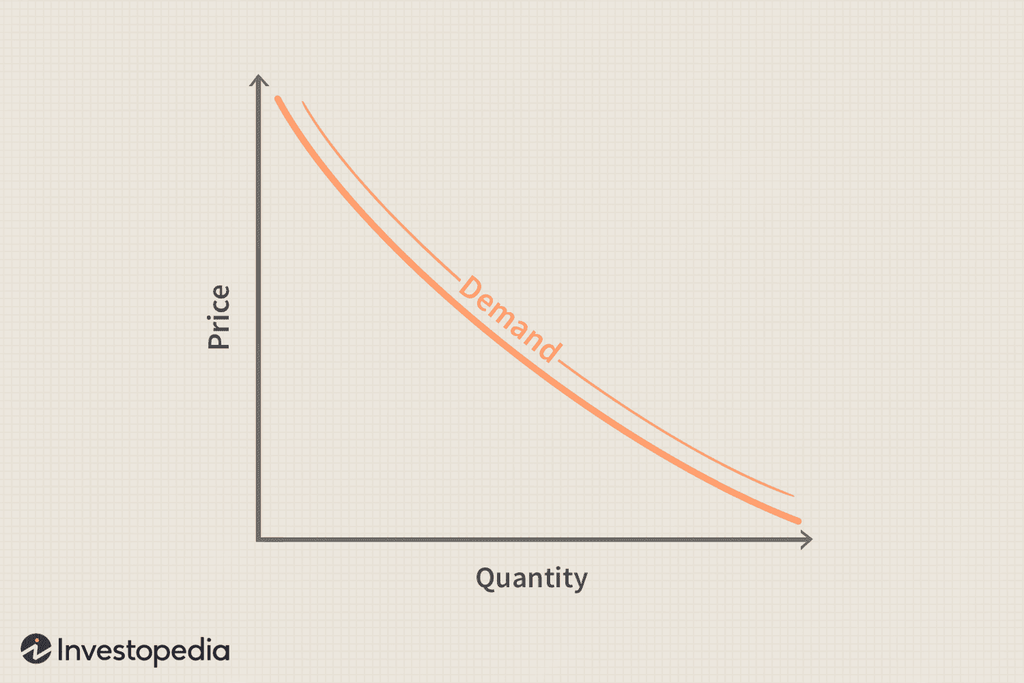
There are two types of demand you should study:
1. Active Demand: Products that buyers are searching for right now using keywords. This represents immediate purchase intent.
2. Latent Demand: Products buyers don’t know they want yet but respond to when they discover them. These are often trending aesthetics, seasonal items, or gift categories.
Both types matter. Starting with active demand reduces risk and gives you early traction, while latent demand opens doors to less competitive niches.
Understanding demand also means understanding who your buyer is. Are they shopping for themselves, for gifts, for home décor, or for a special occasion? The more clearly you understand the buyer behind the search, the better you can tailor your product and listing to convert interest into a sale.
Section 2: Using Etsy’s Auto-Suggest Feature for Keyword Discovery
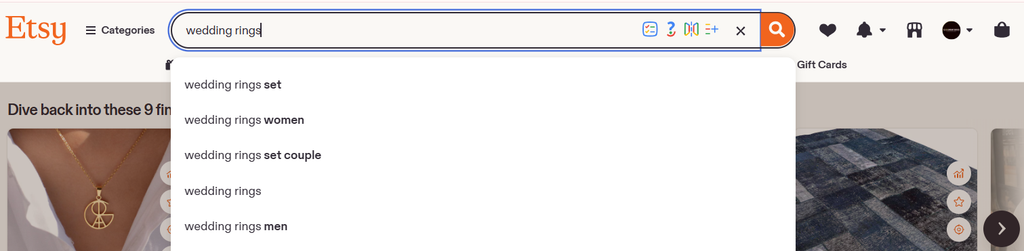
One of the most underutilized tools in Etsy product research is sitting right inside the search bar the Auto-Suggest Feature.
When you begin typing a keyword into Etsy’s search field, the platform automatically suggests popular search terms related to what you’re typing. These are not random guesses. They are real phrases that real buyers are using to find products right now. Etsy’s algorithm surfaces these suggestions based on actual search volume and buyer behavior data.
How to Use Auto-Suggest Effectively
Start by typing a broad category or product idea into the Etsy search bar, for example, ‘personalized gift’ or ‘wall art.’ Before pressing enter, pause and observe the dropdown suggestions that appear.
Each suggestion represents a keyword phrase that Etsy users are actively searching for. This gives you immediate insight into:
- What products are in demand in that category
- How buyers phrase their searches, which shapes how you should write your titles and tags
- Niche variations within a broader product type that might have less competition
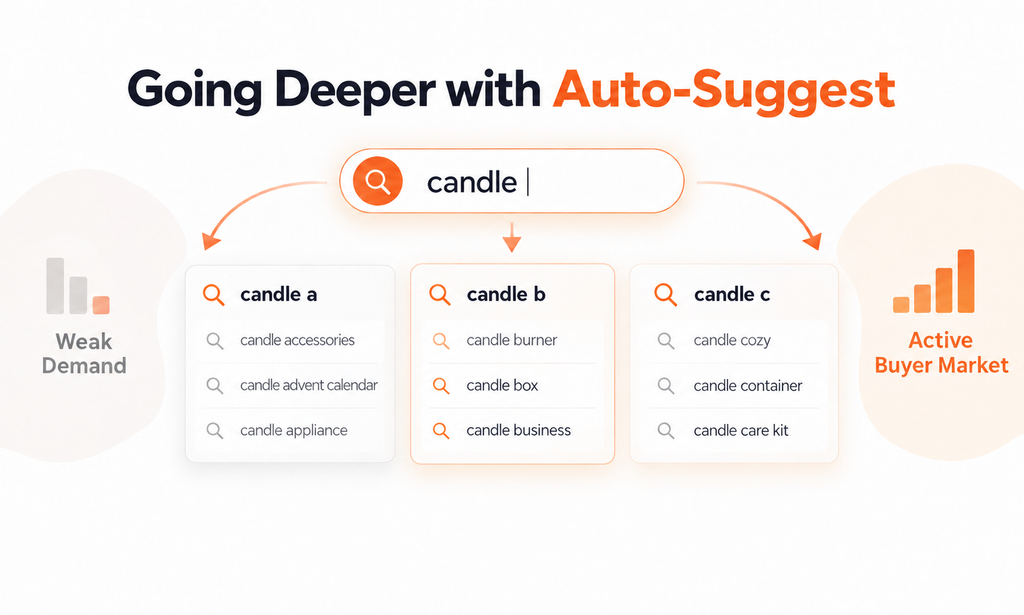
For instance, if you type ‘candle’ and see suggestions like ‘candle with wooden lid,’ ‘candle personalized name,’ or “candle gift set for women,” each of those phrases is a potential product opportunity backed by real buyer demand.
Going Deeper with Auto-Suggest
Don’t stop at the first layer. Try adding letters after your keyword to uncover more specific variations. Typing ‘candle a,’ ‘candle b,’ ‘candle c,’ and so on can reveal a wide spectrum of buyer search behavior.
The auto-suggest feature is especially powerful for validating product ideas. If your product concept doesn’t appear in any suggestion and doesn’t return substantial results, that may signal weak demand. Conversely, if dozens of relevant suggestions appear, that’s a strong indicator of an active buyer market.
Section 3: Mining the ‘Most Loved’ Section
Etsy’s Most Loved section is one of the platform’s most direct signals of what buyers are responding to emotionally and commercially.
Products featured in the Most Loved section have earned this placement through a combination of high favorites, strong sales performance, and consistent buyer engagement. When a product appears here, it means the market has already validated it; real buyers are not just viewing it, they are actively saving it as something they want.
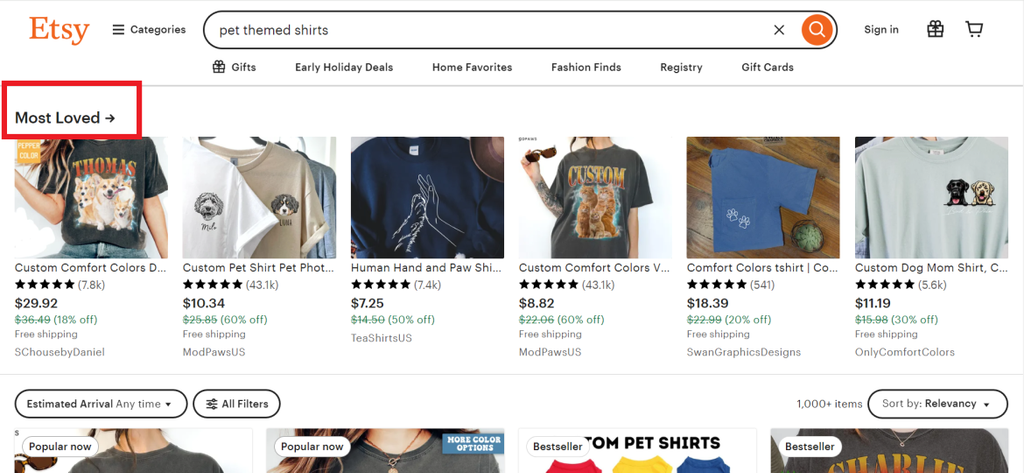
What the Most Loved Section Tells You
The Most Loved section serves as a curated snapshot of buyer desire. By spending time in this section, you can identify:
- Product styles and aesthetics that are resonating with buyers right now
- Price points that buyers are comfortable with in a given category
- Presentation patterns that show how top sellers photograph and describe their products
- Seasonal and trending themes gaining traction on the platform
How to Use It Strategically
Rather than simply browsing the Most Loved section passively, approach it as a researcher. Ask these questions as you scroll:
- What materials, colors, or styles appear repeatedly?
- Are there recurring themes or occasions (birthdays, weddings, holidays)?
- What do the top listings have in common in terms of photos, titles, and descriptions?
- Are there product ideas here that you could create with a unique twist or improvement?
The goal is not to copy existing products, it’s to understand why they’re succeeding so you can apply those insights to your own offerings.
Section 4: Key Terms Every Etsy Researcher Should Know
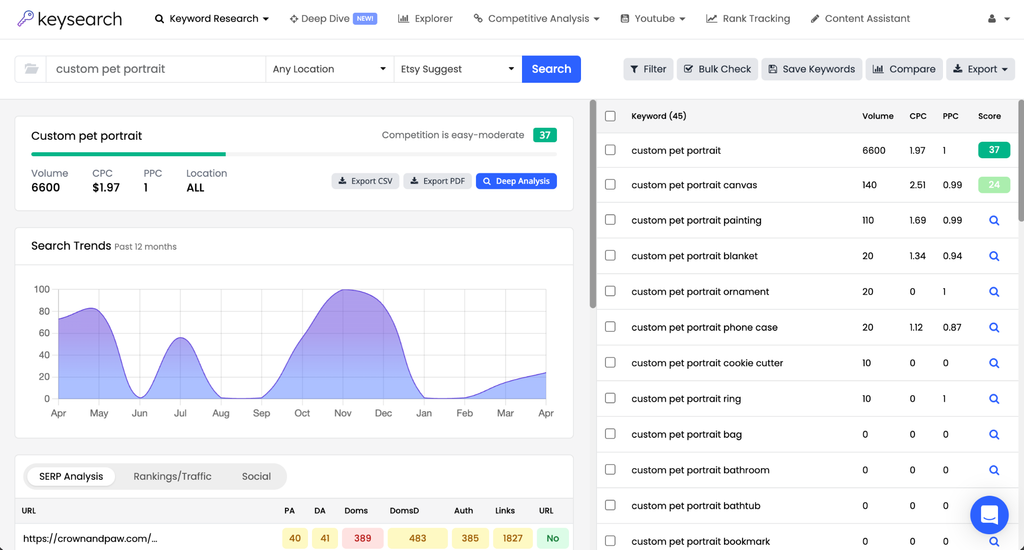
1. Auto-Suggest Feature: A built-in Etsy function that displays popular keyword suggestions as you type in the search bar. These suggestions are derived from real buyer search data and represent phrases with meaningful search volume on the platform.
2. Most Loved Section: A curated area on Etsy that highlights products receiving high levels of buyer engagement, including favorites, saves, and purchases. This section serves as a real-time indicator of which products are generating the strongest emotional and commercial responses from buyers.
3. Product Analytics: The broader process of analyzing data related to how a product performs on the marketplace, including sales numbers, views, favorites, conversion rates, and competitive positioning.
4. Cart History: A metric available through tools like Everbee that shows how many units of a product have been added to buyer carts and purchased over a given time period, providing a real-time snapshot of sales momentum.
5. Sales Velocity: The rate at which a product sells over time. High sales velocity indicates strong, consistent demand. Products with high velocity and limited competition represent the most attractive opportunities for new sellers.
6. Conversion Rate: The percentage of people who view a listing and go on to make a purchase. A listing with high traffic but low conversion may have a demand problem or a presentation problem.
Section 5: Building a Systematic Research Process
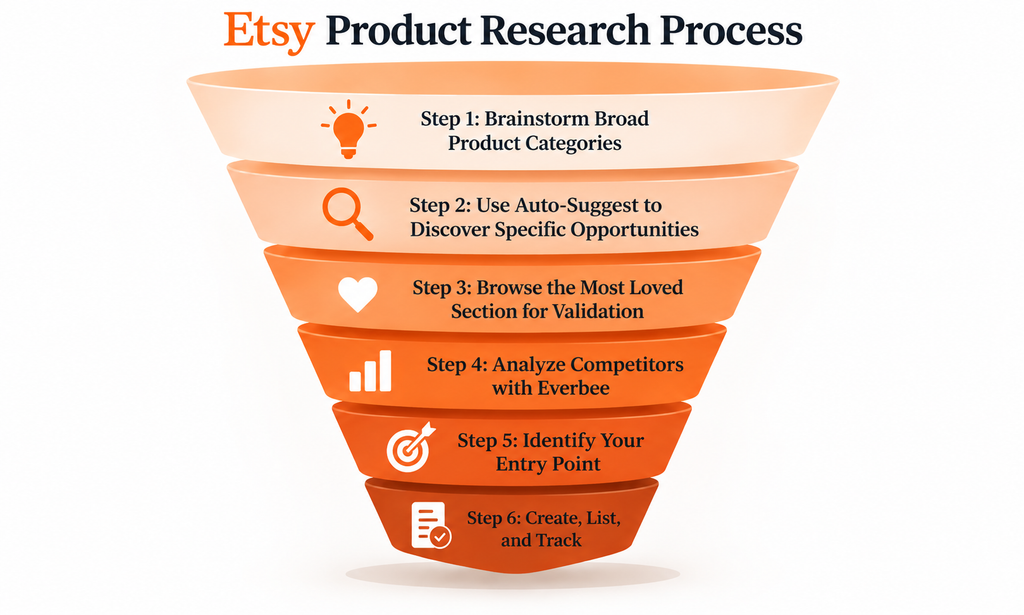
Individual tools and features become significantly more powerful when combined into a repeatable research process. Here is a step-by-step framework you can apply consistently:
Step 1: Brainstorm Broad Product Categories
Start with a general area of interest or expertise, handmade jewelry, digital downloads, home décor, personalized gifts, pet accessories, etc. At this stage, you’re not committing to anything. You’re simply establishing your starting point.
Step 2: Use Auto-Suggest to Discover Specific Opportunities
Take your broad category and start typing variations into the Etsy search bar. Document every auto-suggest phrase that appears. These phrases represent real buyer searches and will form the foundation of your keyword and product research.
Step 3: Browse the Most Loved Section for Validation
Navigate to the Most Loved section within your category. Look for patterns in the products featured there. Note the aesthetics, price points, materials, and occasions represented. This step tells you what’s already working in the market.
Step 4: Analyze Competitors with Everbee
Use Everbee to examine the revenue, sales volume, and cart history of the top listings in your target niche. Look for listings with strong revenue but fewer than 50 reviews, niches where multiple listings generate $1,000+ per month, and price points where buyers are spending consistently.
Step 5: Identify Your Entry Point
Based on your research, determine where your product can offer genuine value. This might mean a design differentiation, a better price point, superior photography, faster shipping, or a customization option that competitors aren’t offering.
Step 6: Create, List, and Track
Launch your product with a listing that incorporates the keywords you discovered through auto-suggest, the visual standards observed in the Most Loved section, and pricing informed by your Everbee analysis. Then monitor your own listing analytics to refine and improve over time.
Section 6: How to Do Etsy Product Research Using Tools
Knowing what to research is only half the process. The next step is using the right tools to validate your ideas with actual marketplace data.
A strong research process should help you answer four questions: Are buyers searching for this? How competitive is the niche? Which products are already performing well? And is interest stable enough to justify launching?
1. Start With Etsy Marketplace Insights
For Etsy-specific demand, Marketplace Insights is one of the best places to begin because it uses Etsy’s own marketplace data.
Go to: Shop Manager → Stats → Marketplace Insights. Enter your product idea or keyword and study the search activity, number of competing listings, related terms, and possible gaps in demand.
For example, instead of researching a broad term like ‘wall art,’ compare more specific searches such as:
- personalized wall art
- nursery wall art
- custom family wall art
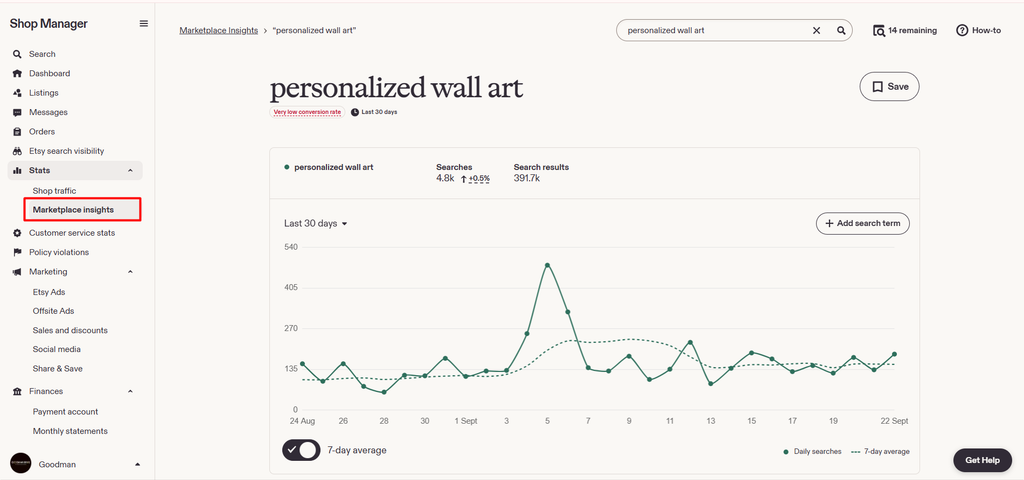
This helps you understand not only whether people are interested in the product, but also which variation has stronger buyer intent and a more realistic level of competition.
2. Dig Deeper With eRank

Once you identify a few promising keywords, use eRank to research the niche in more detail.
eRank can help you explore long-tail keywords, related search terms, competition levels, seasonal patterns, and popular tags. This gives you a broader view of how buyers search within a category.
For example, a search for ‘personalized necklace’ may lead you toward more specific opportunities such as birth flower necklaces, name necklaces, initial jewelry, or gifts for particular occasions.
The real value of eRank is that it helps you move from a broad product idea to a more focused niche where buyer intent may be clearer.
You can also use its trend data to understand whether interest in a keyword is consistent throughout the year or concentrated around certain seasons.
3. Analyze Competitors With EverBee
After validating demand, use EverBee to study what is already selling in the niche.
EverBee can help you compare listing-level information such as estimated monthly sales, estimated revenue, review counts, listing age, pricing, and other performance indicators.
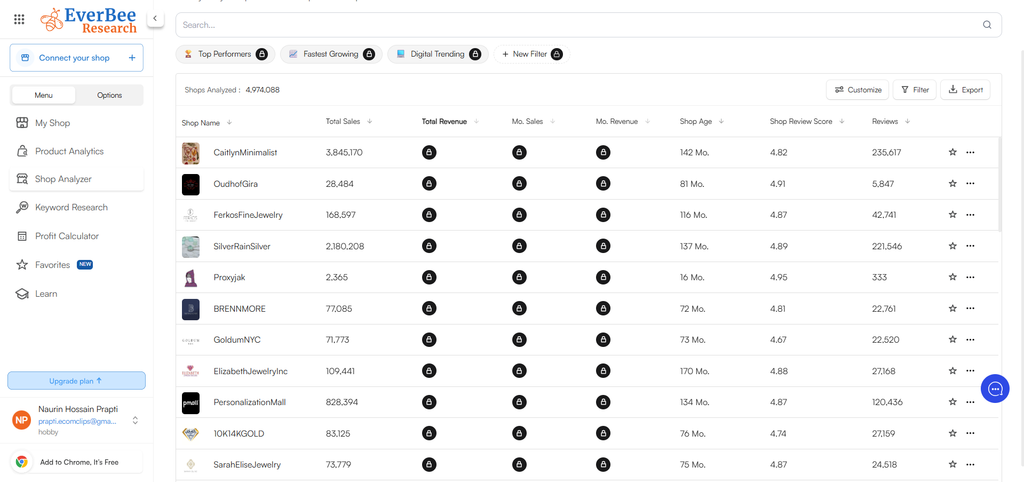
Do not focus only on the single listing with the highest estimated revenue. Instead, look for patterns across several successful products.
Ask questions such as:
- Are multiple listings generating consistent sales?
- Are newer shops gaining traction?
- What price range appears most often?
- Which product styles, bundles, or personalization options are common among strong listings?
For example, if several newer listings are performing well despite having far fewer reviews than established competitors, that may suggest the niche still has room for new sellers.
EverBee data should be treated as directional rather than exact, but it can be extremely useful for spotting patterns that are difficult to see from Etsy search alone.
4. Check Broader Trends With Google Trends
Google Trends adds another layer to your research by showing how interest in a product or keyword changes over time.
This is especially useful for identifying whether a product is:
- Evergreen: interest stays relatively stable throughout the year.
- Seasonal: demand rises during specific periods.
- Trend-driven: interest grows quickly and may fall just as quickly.
For example, a keyword connected with Mother’s Day gifts may show a clear spike every spring, while a home décor product may maintain steadier interest throughout the year.
This information can influence when you launch, how much inventory you prepare, and whether the product should become a long-term part of your shop or a seasonal collection.
Section 7: Common Product Research Mistakes to Avoid
Even with the right tools, there are pitfalls that derail many Etsy sellers. Being aware of these mistakes will help you navigate your research more effectively.

1. Relying on Feelings Instead of Data: Many sellers choose products based on what they personally love or find interesting, rather than what buyers are actively searching for. Passion for your craft matters, but it must be paired with market validation.
2. Ignoring Competition Levels: High demand is exciting, but high competition can neutralize that demand for a new seller. A product with moderate demand and low competition is often a better opportunity than a high-demand product with thousands of established competitors.
3. Stopping at Views and Favorites: Views and favorites feel encouraging, but they are not revenue. Use tools like Everbee to look beyond surface-level engagement and focus on listings that are actually generating sales.
4. Skipping Seasonal Patterns: Some products sell exceptionally well during certain times of the year and go quiet during others. Before committing to a product, consider whether demand is consistent year-round or tied to a specific season or occasion.
5. Failing to Research Keywords Thoroughly: Your product can be exactly what a buyer wants, but if your listing doesn’t include the keywords they’re using to search, they’ll never find it. Keyword research through auto-suggest is not optional, it’s the bridge between your product and your buyer.
Section 8: Advanced Research Strategies for Scaling

Once you’ve mastered the fundamentals, there are additional strategies to deepen your research and uncover opportunities that surface-level methods miss.
1. Analyze Top-Performing Shops, Not Just Listings
When a listing catches your attention during research, don’t stop at the product page. Visit the entire shop. Look at how many listings they carry, which products have the most reviews, and how long they’ve been operating. This gives you a fuller picture of what a sustainable Etsy business in that niche looks like.
2. Research Across Multiple Platforms
Buyer trends on Etsy often originate on platforms like Pinterest, TikTok, and Instagram. Monitoring these platforms for rising aesthetic trends, gift ideas, and home décor movements can give you an early signal before that demand fully materializes on Etsy.
3. Pay Attention to Review Content
Customer reviews on competing listings are a goldmine of product research information. Buyers often describe exactly what they love about a product, what they wish was different, and what occasion they purchased it for. Reading reviews attentively helps you understand buyer psychology and identify unmet needs.
4. Track Seasonal Trends in Advance
Plan your product research calendar around major gifting seasons: Valentine’s Day, Mother’s Day, graduation season, back to school, Halloween, and the holiday season. Start researching and preparing for each season at least 8–12 weeks in advance.
Frequently Asked Questions About Etsy Product Research
Q1: What is Etsy product research?
Etsy product research is the process of evaluating buyer demand, competition, pricing, trends, and profit potential before launching a product. It helps sellers decide whether an idea is worth investing time and money in.
Q2: Why is product research important for Etsy sellers?
Product research reduces guesswork. It helps sellers understand what buyers want, identify gaps in existing products, and avoid investing heavily in ideas with weak demand or excessive competition.
Q3: How do I find products people are searching for on Etsy?
Start with Etsy Auto-Suggest. Type a broad product keyword into the Etsy search bar and study the suggested phrases. These suggestions can reveal buyer language, niche variations, and possible product opportunities.
Q4: What should I look for when researching an Etsy product?
Focus on demand, competition, and opportunity. You should also examine pricing, customer reviews, seasonal trends, product presentation, and whether you can offer something different from existing sellers.
Q5: What tools can I use for Etsy product research?
Useful tools include Etsy Marketplace Insights, eRank, EverBee, and Google Trends. Together, they can help you research keywords, analyze competitors, estimate product performance, and understand seasonal or long-term demand.
Q6: Is EverBee useful for Etsy product research?
Yes. EverBee can help you compare competing listings using data such as estimated sales, revenue, reviews, pricing, and listing age. Its estimated metrics are best used as directional research rather than exact sales figures.
Q7: How can I tell if an Etsy niche is too competitive?
Look at how many strong sellers already dominate the niche, their review counts, pricing, product quality, and whether newer listings are still gaining traction. High demand can be attractive, but a smaller niche with manageable competition may offer a better entry point.
Q8: Should I research customer reviews before creating a product?
Yes. Competitor reviews can reveal what customers like, dislike, expect, or wish was different. Repeated complaints about sizing, packaging, colors, personalization, or delivery can reveal useful product opportunities.
Q9: How do I know if an Etsy product is seasonal or evergreen?
Check how demand changes throughout the year using tools such as Google Trends and keyword research platforms. Seasonal products usually peak around specific occasions, while evergreen products tend to maintain steadier demand.
Q10: How often should I conduct Etsy product research?
Product research should be an ongoing process. Regular research helps you discover new opportunities, prepare for seasonal demand, track changing buyer behavior, and improve existing products over time.
Research Is the Competitive Advantage Most Sellers Skip
The gap between Etsy sellers who struggle and those who thrive is rarely about talent, creativity, or even product quality alone. More often, it comes down to research.
The sellers consistently generating strong revenue are the ones who took the time to understand what buyers want before they invested in creating it. They used Etsy’s own tools, the auto-suggest feature, the Most Loved section to listen to the market. They leveraged analytics tools like Everbee to validate demand with data. And they built a systematic process rather than relying on intuition alone.
Product research is not a one-time event. It’s an ongoing practice that keeps your shop aligned with what buyers want, helps you anticipate seasonal shifts, and positions you to capitalize on emerging trends before the market becomes saturated.
The Etsy marketplace rewards sellers who are willing to do the work that others skip. Product research is that work, and it’s the foundation everything else is built on.
Scale Your Etsy Success With Ecomclips
Strong Etsy performance requires more than finding the right keywords. Sellers need the right mix of product research, Etsy SEO, listing optimization, pricing, branding, conversion strategy, and customer experience. Ecomclips helps Etsy sellers improve product visibility, strengthen listings, increase conversions, and build long-term marketplace growth.
Watch Etsy and ecommerce tutorials on the Ecomclips YouTube channel, explore practical seller resources on the Ecomclips Blog, and read our Complete Etsy SEO Strategy Guide for a broader framework on improving Etsy search visibility and rankings.
You can also explore our Etsy Brand Blueprint, Etsy Shop Hacks to Drive More Organic Traffic and Sales, Etsy Algorithm Update Guide, and How to Fix an Etsy Listing That Won’t Sell for more focused guidance on branding, traffic, search visibility, listing performance, and shop growth.
Follow the Ecomclips Facebook page and connect with Ecomclips on LinkedIn for more ecommerce insights, Etsy strategies, and marketplace updates.
Need help with Etsy product research, SEO, listing optimization, or marketplace growth? Email info@ecomclips.com or book a consultation with our ecommerce experts.