
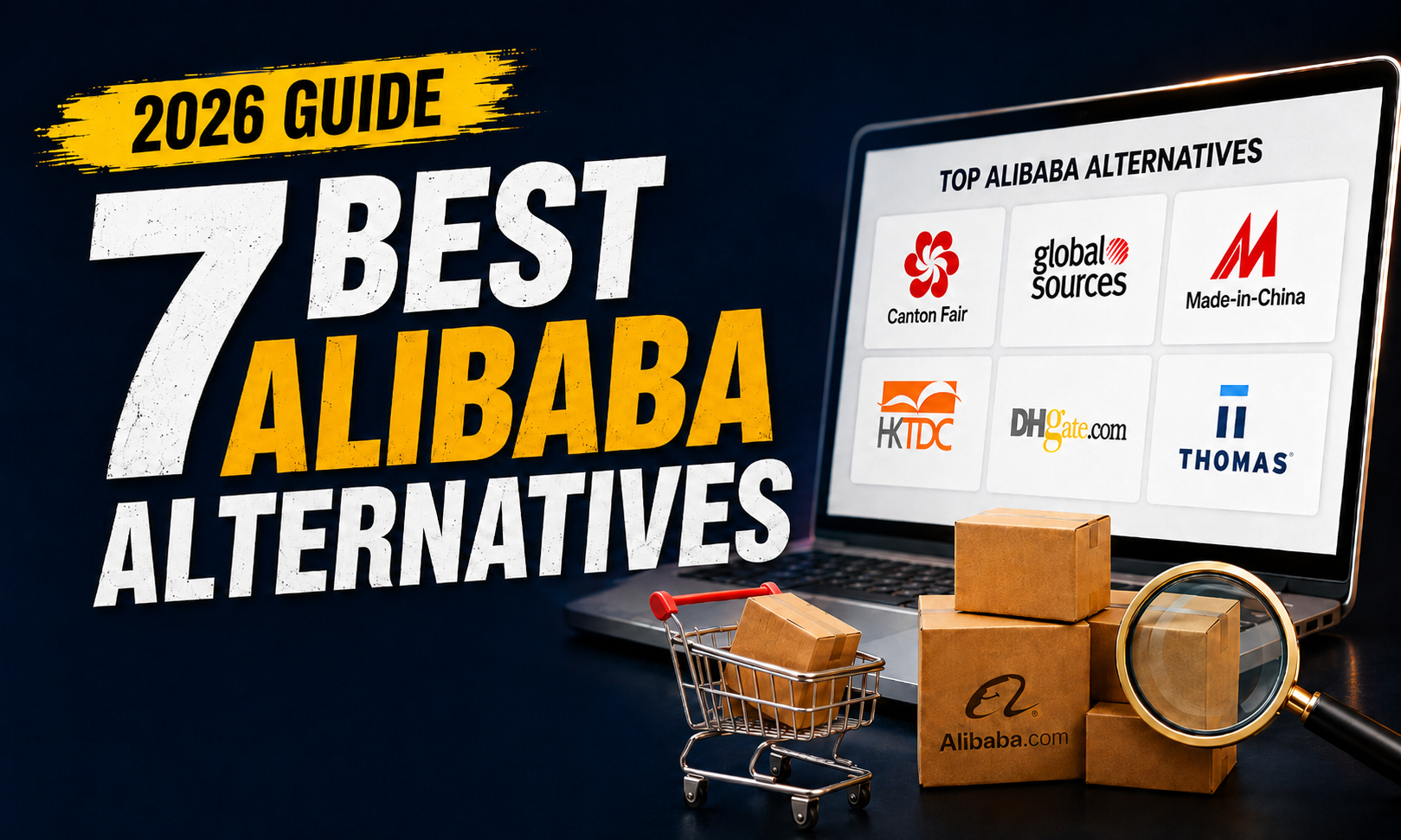
What is the first website you open when searching for a wholesale supplier? For most sellers, it is Alibaba.
That is hardly surprising. In fiscal year 2024, Alibaba.com served more than 48 million small and medium-sized businesses across over 190 countries and regions.
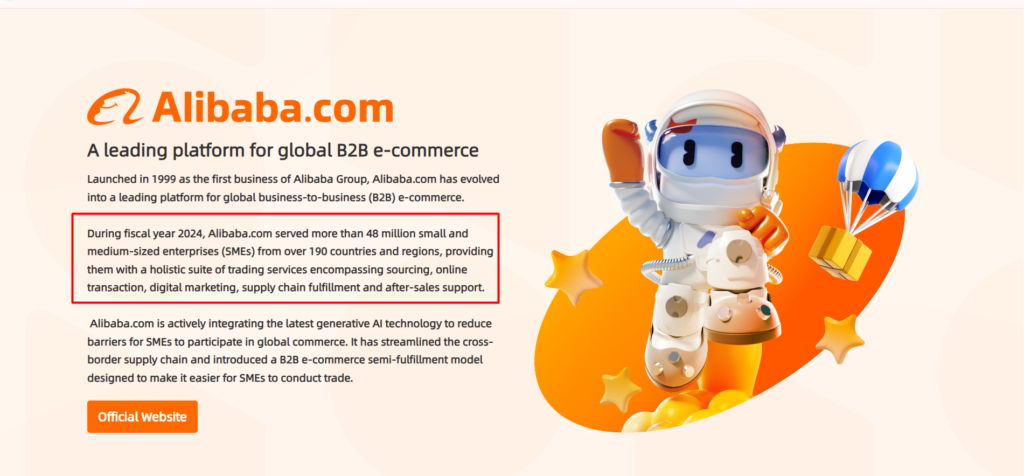
But when millions of businesses enter through the same door, things can get crowded. The same products appear everywhere. The same factories receive countless enquiries. And fresh ideas quickly become familiar listings.
Alibaba is still worth using. It just should not be your only sourcing option.
This guide will walk you through 7 Alibaba alternatives that can help you look beyond crowded marketplaces and find smarter sourcing opportunities in 2026.
Why Should You Look Beyond Alibaba?
Relying only on Alibaba can limit your options.
Let us start with a simple product. Suppose you want to sell silicone air fryer liners.
You open Alibaba and search for the product. The search page currently shows more than 999 results. You will find round liners, square liners, different colors and different pack sizes. Some listings have minimum orders as low as 10 pieces, while others require 50, 100 or 200 units.
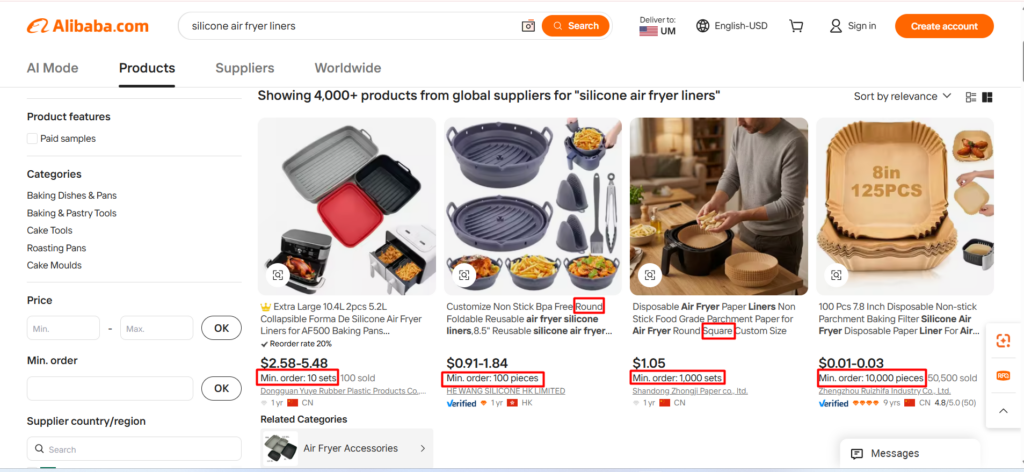
At first, everything looks promising. The products are inexpensive. The minimum orders seem manageable. And several suppliers have ratings, reviews or verification badges.
Now open Amazon and search for the same product. You will see many similar silicone liners already competing on the first page. Many have similar ribbed bottoms, handles, colors and two-pack or three-pack offers.
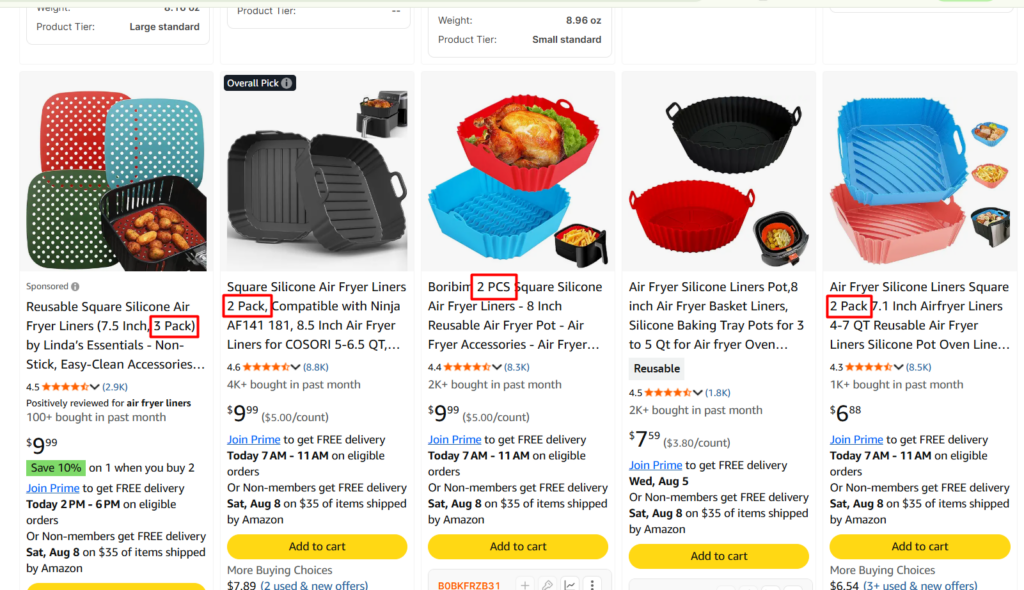
Here is where the problem begins.
If you buy another standard silicone liner and simply add your logo, why should shoppers choose your listing over the sellers already ranking on Amazon?
An established competitor may already have hundreds or thousands of reviews, strong organic rankings and years of sales history. They may also receive better supplier pricing because they place larger orders.
On top of that, experienced sellers often have more advertising data, repeat customers and stronger inventory planning. These advantages make it difficult for a new listing to compete with the same basic product.
You may have found a product. But you have not necessarily found a strong business opportunity.
7 Best Alibaba Alternatives for Wholesale Sourcing
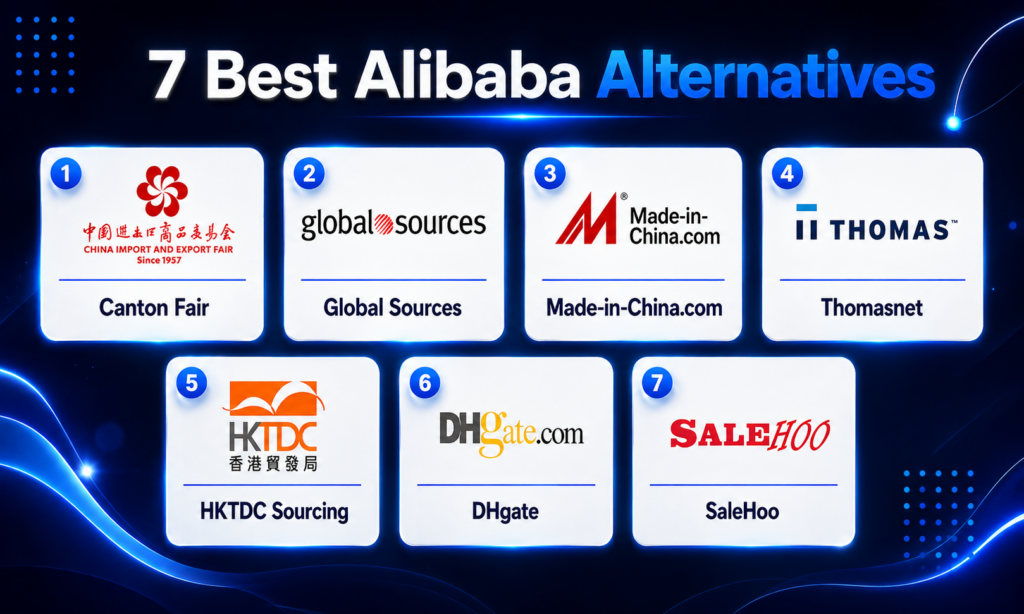
Here are 7 Alibaba alternatives to consider for your wholesale sourcing strategy.
1. Global Sources
Global Sources is one of the strongest online alternatives to Alibaba, especially for sellers looking for established Asian manufacturers, electronics suppliers and private-label products. It combines a B2B sourcing marketplace with major trade shows in Hong Kong, allowing buyers to research suppliers online and meet selected manufacturers in person.
The platform is particularly popular for consumer electronics, mobile accessories, smart-home products, electronic components, homeware, fashion accessories and lifestyle goods.
Why Does Global Sources Stand Out?
One of the main advantages of Global Sources is its structured supplier-verification process. Verified Supplier profiles may include information about business licences, manufacturing capabilities, quality control systems and other company details.
This does not guarantee that every order will be perfect. However, it gives buyers more useful information before creating a supplier shortlist.
Global Sources is also helpful for technical and private label products. Suppose you want to develop a portable power station under your own brand. You would need to check battery quality, capacity, charging speed, safety features, plug type, certifications, warranty and packaging.
Many suppliers on Global Sources already have experience working with international buyers. You can research them online, compare their capabilities and later meet them at a Global Sources trade show to inspect samples, discuss customization and arrange factory visits.
The MOQ (Minimum Order Quantity) Challenge for New Sellers
The biggest disadvantage of Global Sources is that minimum order quantities can be high.
For example, one supplier may require a minimum order of 2,000 units. Other listings may ask for 500, 600 or even 3,000 units, depending on the product and level of customization.
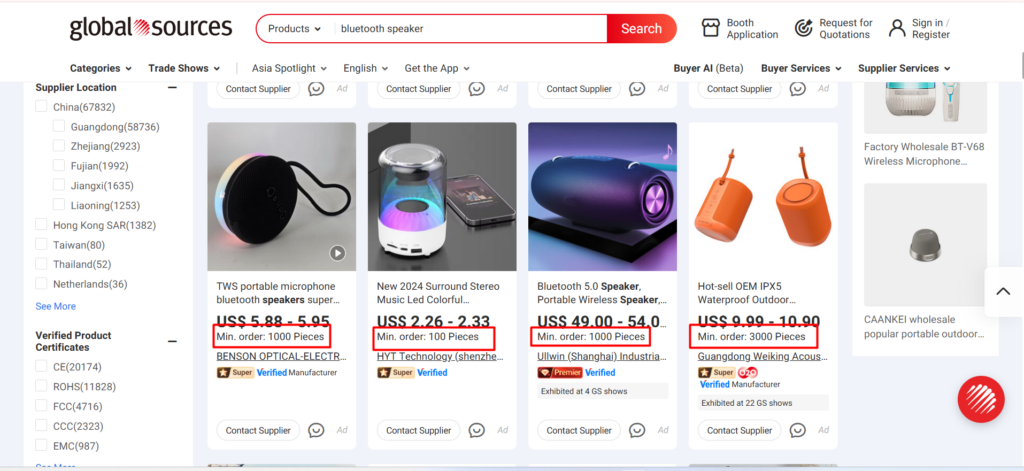
These larger minimums are common because established manufacturers may need to purchase raw materials, configure machinery, produce custom packaging, complete testing and reserve production capacity.
This can make Global Sources difficult for beginners. If you only want to place a small order or invest around $3,000 to $5,000, some suppliers may not consider the order large enough.
How to Approach Global Sources Suppliers
Avoid sending a short message such as, ‘What is your best price?’
Instead, send a detailed RFQ containing your product specifications, materials, dimensions, target quantity, packaging requirements, certifications, destination country, preferred shipping terms and planned launch date.
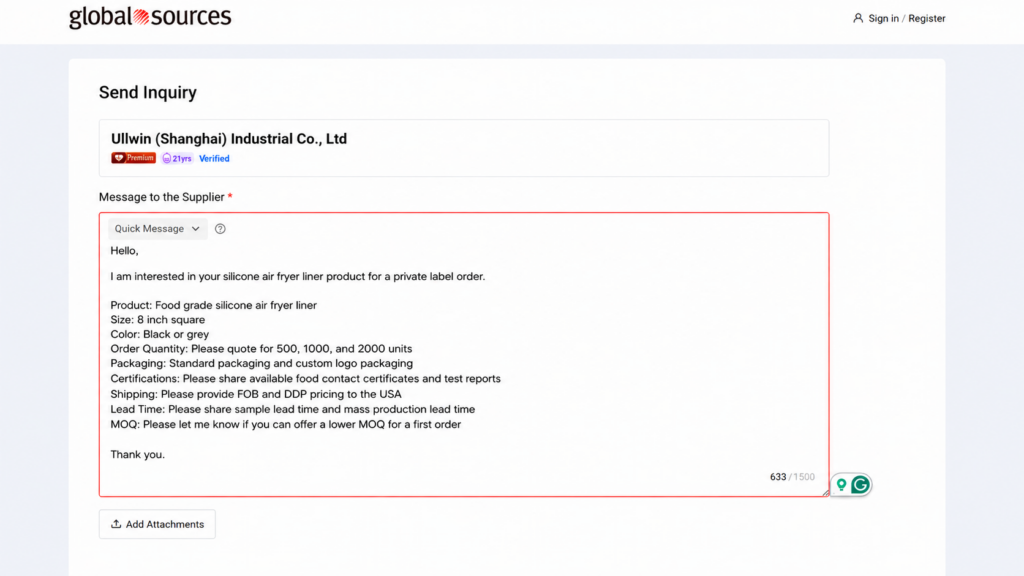
You should also ask whether the supplier can offer a lower MOQ for the first order. Some manufacturers may agree to a smaller test quantity if you choose standard materials, existing colors or ready-made packaging.
2. Made-in-China.com
Made-in-China.com is another strong Chinese B2B platform that can be useful for sellers looking beyond Alibaba.
The platform includes more than 40 million products across 27 countries, with around 6 million registered suppliers and over 14 million registered buyers. Compared with Alibaba and Global Sources, Made-in-China.com is considered one of the largest B2B platforms in China.
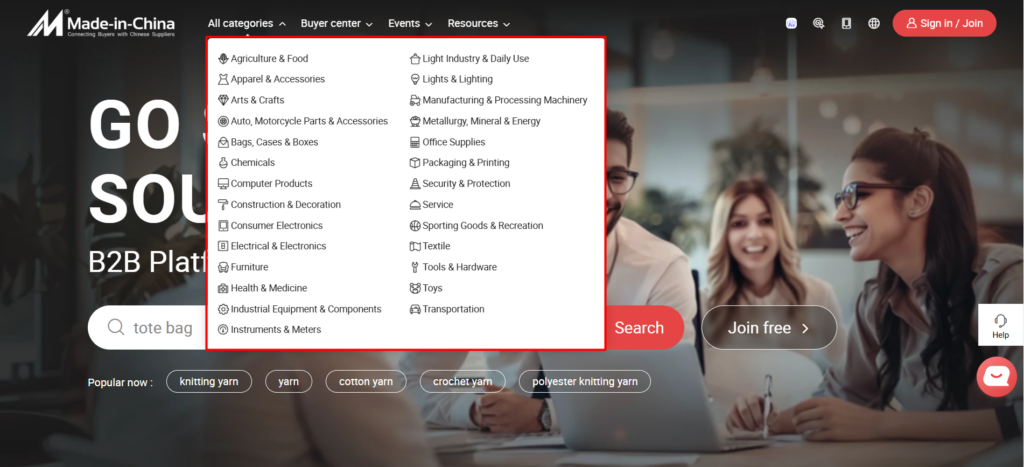
Although it covers a wide range of consumer products, the platform is especially strong in industrial and technical categories. It offers many products that may not be as easy to find on Alibaba, making it a useful option for specialised sourcing.
You can find categories such as:
- Machinery
- Tools
- Hardware
- Construction materials
- Automotive components
- Electrical equipment
- Packaging machinery
- Industrial products
- Custom manufacturing services
What Makes Made-in-China.com Different?
One of the strongest features of Made-in-China.com is its Audited Supplier programme.
The platform works with third-party inspection organisations such as SGS, Bureau Veritas, TÜV Rheinland and CTI to verify selected suppliers. Audit reports are available online, allowing buyers to review more details before starting a business relationship.
Why Is It Useful for Industrial Products?
Made-in-China.com becomes more valuable when you move into technical products where supplier capability matters.
For example, when sourcing machinery, you may need more than a product listing. You may require technical drawings, spare parts, installation support, training and after-sales service.
Because the platform has a strong focus on industrial categories, it can help buyers find suppliers specialising in specific machines, components and manufacturing processes.
What Should You Watch?
A supplier audit confirms information checked at a particular time. It does not guarantee that your individual order will:
- Match the approved sample
- Use the correct materials
- Pass product testing
- Arrive on time
- Remain free from defects
You should still evaluate the actual product by ordering samples where possible, verifying certificates and arranging inspections for larger orders.
Another limitation is pricing.
Products on Made-in-China.com may appear more expensive compared with some Alibaba listings.
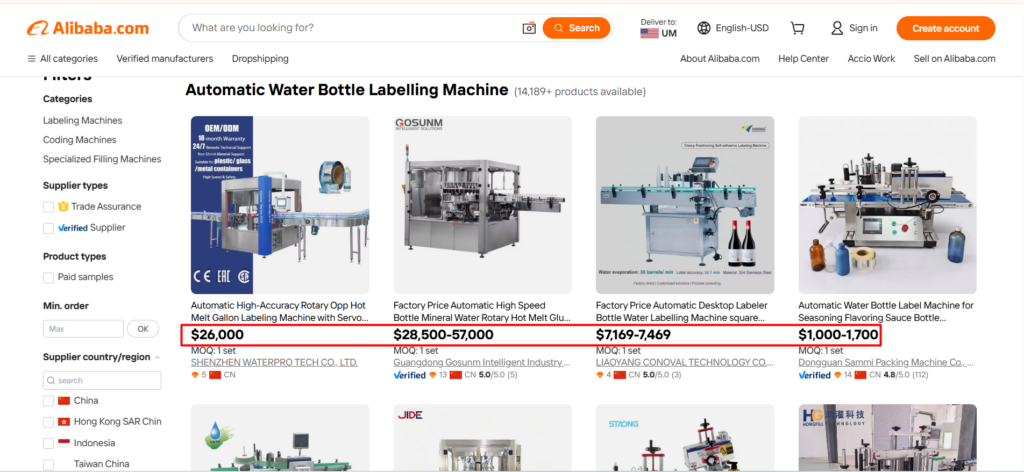
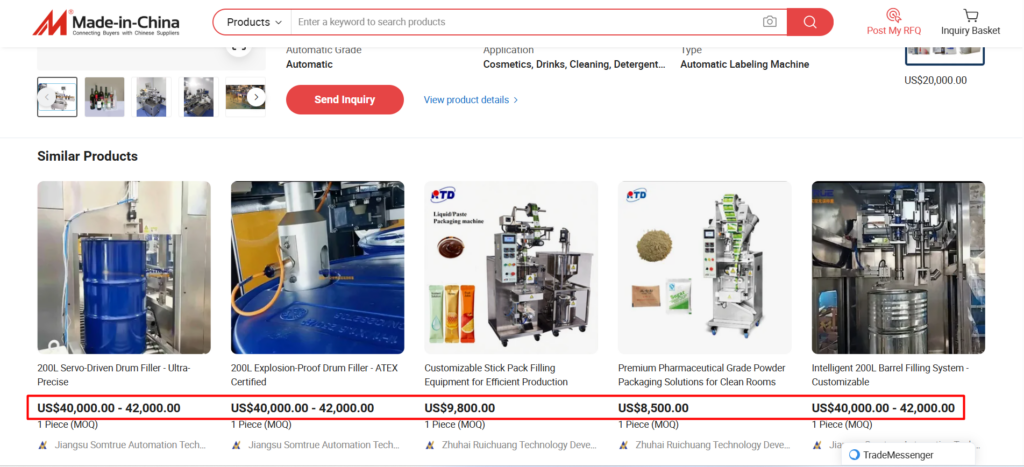
If you search for an automatic bottle labeling machine, you will find similar industrial products on both Alibaba and Made-in-China.
Alibaba listings may show prices around $20,000+ with suppliers offering small MOQs. Made-in-China also offers similar machinery, but many suppliers provide more detailed manufacturing information, customization options and industrial specifications.
Always compare:
- Product specifications
- Material quality
- Minimum order quantity
- Supplier capability
- Shipping terms
- Included services
A cheaper listing is not always cheaper if important components, quality standards or after-sales support are missing.
Made-in-China.com can be a strong option when you need specialised products, industrial suppliers or manufacturers with clearer production capabilities.
3. Thomasnet
Thomasnet is a US based sourcing platform where buyers can find American manufacturers, suppliers, distributors and custom production companies. The platform includes a search engine that allows users to search for specific products and services, along with a directory of manufacturers and distributors.
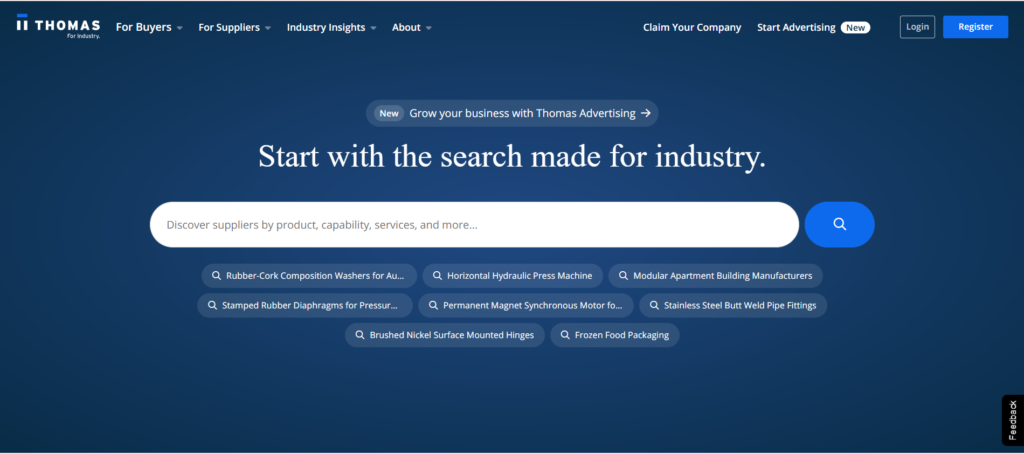
Unlike traditional wholesale marketplaces, Thomasnet focuses more on connecting buyers with companies based on their manufacturing capabilities rather than only displaying ready made products.
Thomasnet is especially useful for:
- Industrial components
- Custom packaging
- Metal fabrication
- Plastic manufacturing
- Machinery
- Electrical parts
- Medical equipment
- Automotive components
- Chemicals
- Contract manufacturing
Why Does Thomasnet Matter?
Imagine you are sourcing custom cardboard packaging for a fragile glass product.
A supplier from China may offer a lower unit price. However, the order may also involve longer production timelines, international shipping, import handling, large minimum order quantities and more complicated product revisions.
A US based packaging manufacturer may charge more per unit but could provide faster prototypes, easier communication, smaller repeat orders and quicker design changes. For businesses selling specialised or customised products, the higher unit price may reduce risk in other areas.
How Can You Find a Supplier on Thomasnet?
Thomasnet works differently from Alibaba.
Instead of searching only for the final product name, you should search by the manufacturing process or capability you need.
Suppose you want to create a custom plastic storage container for your brand. Searching only for ‘plastic storage container’ may not give you the best results because many manufacturers do not promote themselves using retail product names.
Instead, search for capabilities such as:
- Plastic injection moulding
- Custom plastic fabrication
- Plastic container manufacturing
- Product assembly
- Custom packaging manufacturing
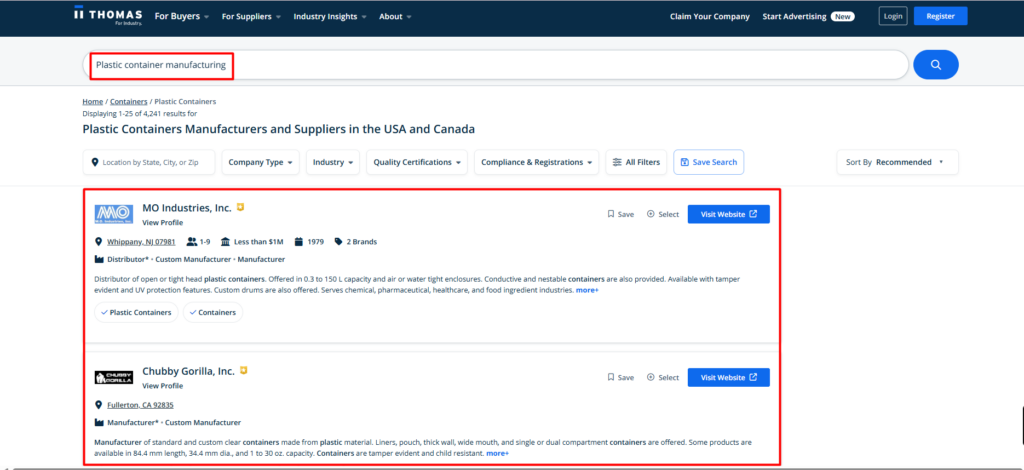
Searching ‘Plastic container manufacturing‘ on Thomasnet can help you find companies that specialize in producing custom plastic parts and containers.
4. HKTDC Sourcing
When sellers think about Asian sourcing, Alibaba is usually the first platform that comes to mind. But it is not the only option.
HKTDC Sourcing, operated by the Hong Kong Trade Development Council (HKTDC), is another platform that connects buyers with manufacturers, exporters, wholesalers and service providers from Hong Kong, mainland China and other markets.
The platform includes more than 130,000 suppliers and over 4 million product listings, covering categories such as electronics, home products, fashion accessories, gifts, beauty products and lifestyle goods.
Unlike many large marketplaces where buyers mainly compare product listings, HKTDC focuses more on supplier information, business details and certification records. This makes it useful for sellers who want to research suppliers carefully before starting a business relationship.
Why HKTDC Sourcing Stands Out?
One of the biggest advantages of HKTDC Sourcing is the ability to filter suppliers using detailed business information. Suppose you want to source an electronic desk lamp for your online store.
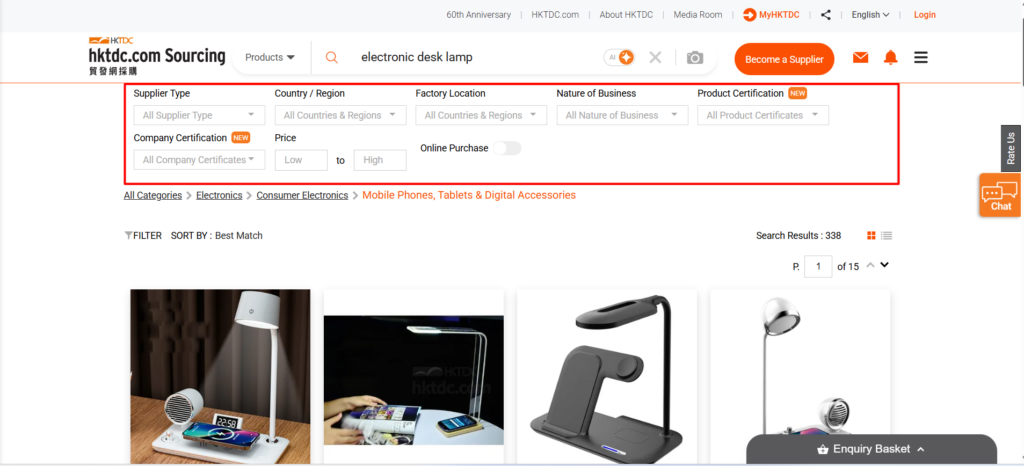
Instead of opening hundreds of supplier pages one by one, you can narrow your search using filters such as:
- Product category
- Supplier location
- Nature of business
- Product certification
- Company certification
- Exhibition participation
These filters help you create a more relevant supplier shortlist instead of choosing only based on product photos or the lowest price.
HKTDC also provides access to supplier certification information. Selected certificate labels are verified annually by organisations such as TÜV SÜD and Intertek.
How Can You Find a Supplier on HKTDC?
Finding suppliers on HKTDC Sourcing is straightforward.
Suppose you want to source mobile phone accessories. First, visit HKTDC Sourcing and select your product category or search your product keyword using the search bar.
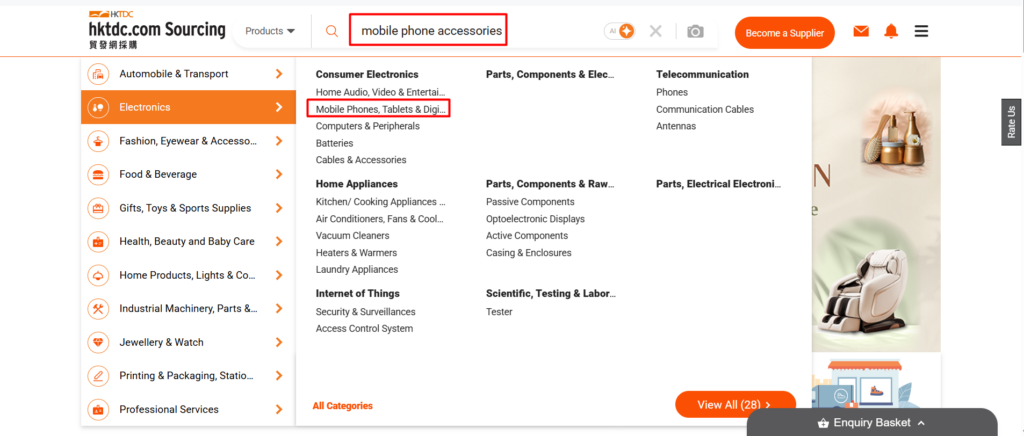
After searching, the platform will display related products and supplier listings. You can review product details, supplier information and available certifications before deciding which companies to contact.
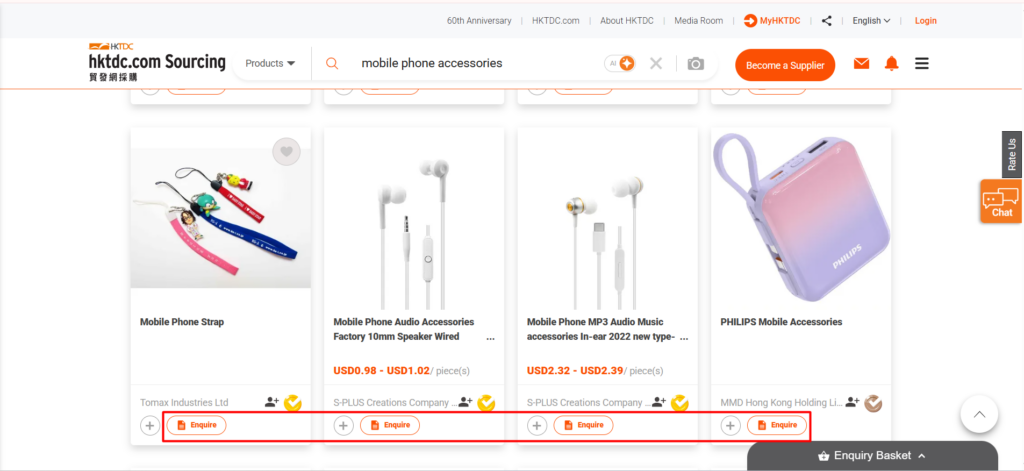
When you find a supplier that matches your requirements, click the ‘Enquire‘ option to start communication.
First, you need to provide your email address. Before sending your enquiry, provide clear details about your requirements. Mention your product specifications, materials, expected quantity, packaging requirements, certifications and destination market.
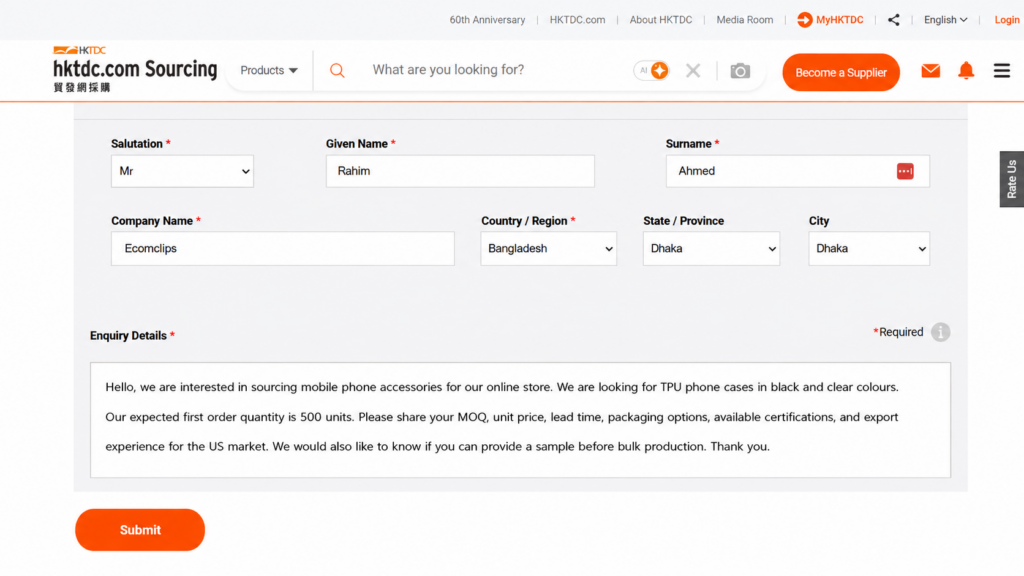
A detailed enquiry helps suppliers understand your project better and allows them to provide more accurate information about pricing, minimum order quantity, production capability and lead time.
What Should You Check Before Ordering?
A supplier profile can make your initial research easier, but it should not be the only factor behind your decision. Before placing an order, always verify:
- The exact product model
- Testing standards
- Issuing laboratory
- Certificate validity
- Destination market requirements
- Production capability
- Sample quality
- Previous export experience
A supplier profile should help you begin your research. It should not be the final reason you choose a supplier.
5. DHgate
What happens when you find an interesting product but you are not ready to invest in hundreds of units? This is where DHgate becomes useful.
DHgate is one of the closest alternatives to Alibaba because it serves both businesses and individual buyers. The platform offers a wide range of products across categories such as electronics, fashion, health and beauty, home products, sports equipment and accessories.
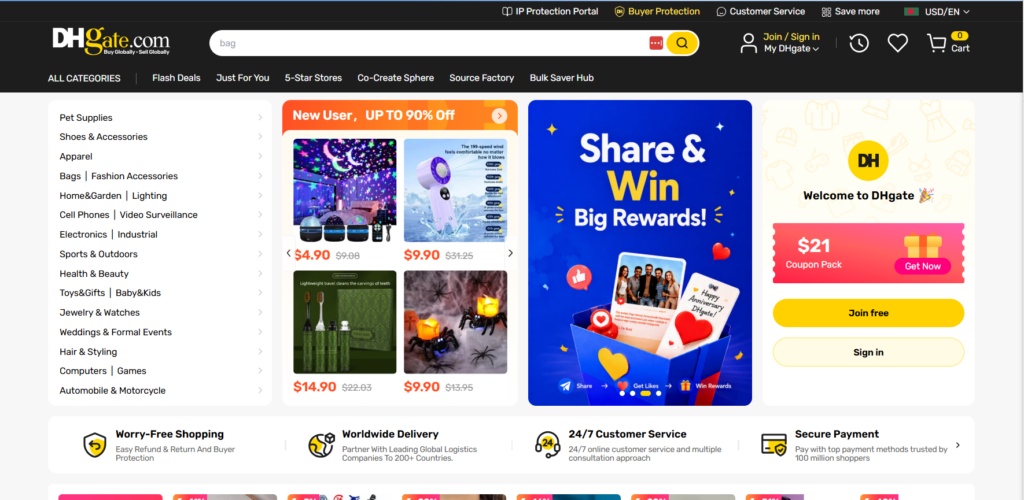
The biggest difference is the flexibility of order quantities.
While many wholesale platforms focus on bulk purchasing, DHgate allows buyers to start with much smaller orders. This makes it a practical option for beginners who want to test a product before committing a large amount of money.
Why Is DHgate Useful for Product Testing?
Suppose you find a pair of sports compression socks that looks like a good opportunity for your online store.
Before placing a large order, you may want to check:
- Product quality
- Material durability
- Customer interest
- Packaging quality
- Return risk
On many wholesale platforms, a supplier may expect you to purchase hundreds or thousands of units before production starts.
However, DHgate often allows sellers to purchase very small quantities. Some listings even allow orders starting from one piece.
A product listing on DHgate may show a price of around $0.34 per piece with a minimum order quantity of one unit.
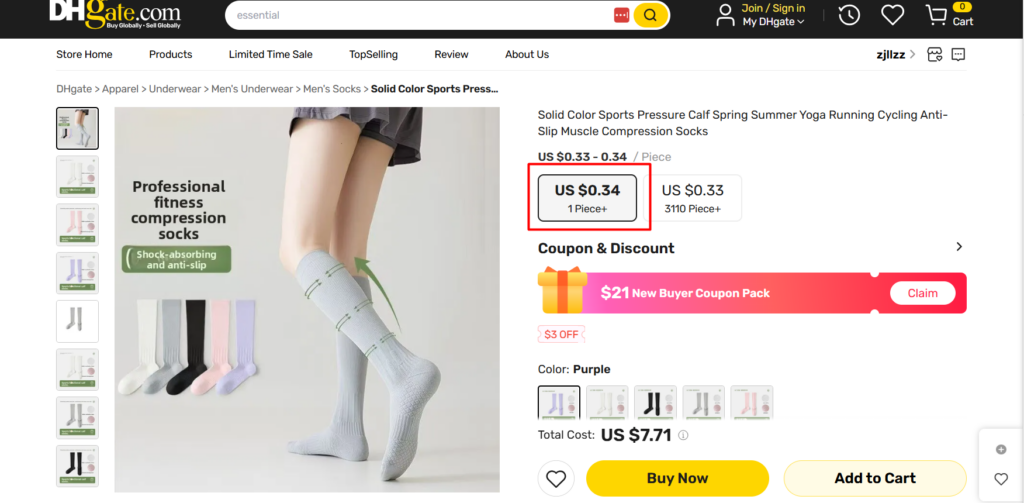
The price per unit may not be as low as a factory bulk order. However, buying a few samples first allows you to test the product, understand customer feedback and decide whether it is worth scaling.
How Should You Use DHgate?
DHgate works best when you use it as a product testing platform rather than your final manufacturing solution.
Before placing an order, review the seller’s history, customer feedback and product information carefully.
Then:
- Order the smallest practical quantity
- Compare the product with the listing description
- Test the product multiple times
- Check materials and dimensions
- Inspect packaging quality
- Record any problems or improvements
- Decide whether to reorder or find a manufacturer
DHgate also provides buyer protection features that help reduce transaction risks. However, product quality can still vary significantly between sellers, so supplier research remains important.
What Is the Biggest Limitation of DHgate?
The biggest challenge with DHgate is consistency.
Many sellers on the platform may not be the actual manufacturers. Some may operate as resellers, which means they may have limited control over:
- Raw materials
- Production process
- Packaging changes
- Product customisation
- Quality consistency
Because of this, DHgate is better suited for testing ready-made products rather than developing complex private label products.
6. SaleHoo
SaleHoo is not an open wholesale marketplace where suppliers directly compete for buyers. Instead, SaleHoo is a paid supplier directory and product research platform that helps sellers discover wholesalers, manufacturers and dropshipping suppliers.
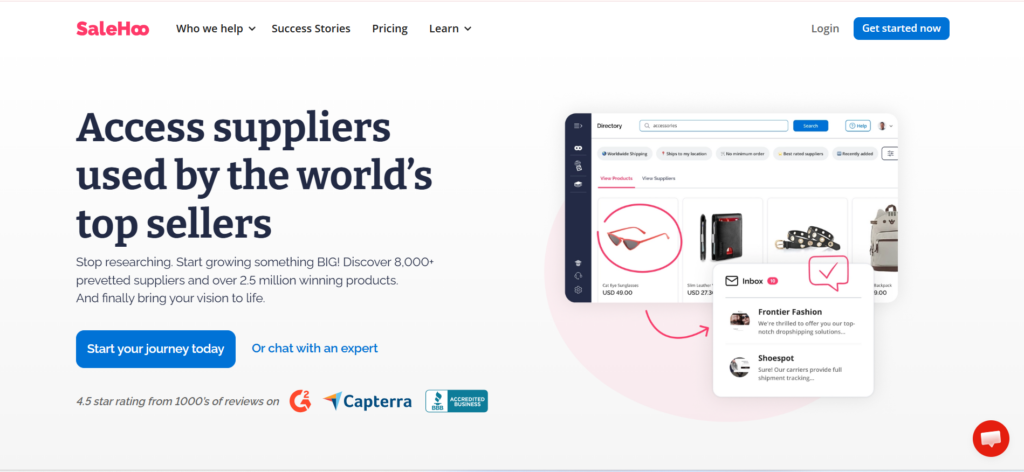
The platform provides access to more than 8,000 pre-vetted suppliers, including suppliers from the US and other regions. Buyers can search suppliers based on product categories, location, supplier type and minimum order quantity.
This makes SaleHoo useful for beginners who want a more organized way to find suppliers without spending hours searching across the internet.
Why Can SaleHoo Help Beginners?
Finding reliable suppliers online can be challenging. A simple Google search may lead you to:
- Outdated supplier websites
- Retailers pretending to be wholesalers
- Unverified directories
- Suppliers that do not ship to your market
- Unclear minimum order requirements
- Potential counterfeit products
For example, if you want to start a pet accessories store, you can use SaleHoo to search for suppliers offering products such as:
- Dog beds
- Grooming brushes
- Travel bowls
- Pet clothing
- Toys
Instead of contacting hundreds of unknown suppliers, you can compare supplier locations, product categories, minimum order quantities and business models in one place.
What Makes SaleHoo Different?
One advantage of SaleHoo is that it supports different sourcing models. You can find:
- Wholesalers
- Manufacturers
- Dropshipping suppliers
- Distributors
- Liquidators
The platform also includes suppliers from different countries, including US based suppliers. This can be useful for sellers who want alternatives to importing every product from China.
Another benefit is customer support. SaleHoo provides one-to-one assistance, which can help beginners understand supplier information, product research and sourcing decisions.
You may also find many products that are available on platforms like Alibaba or AliExpress because SaleHoo works as a directory that connects sellers with different supplier networks.
How Much Does SaleHoo Cost?
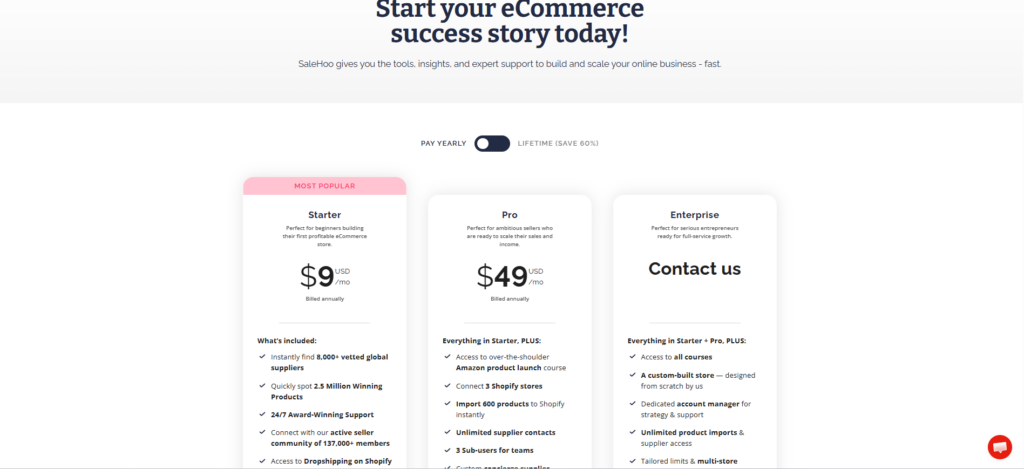
SaleHoo requires a paid subscription to access its complete supplier directory and research tools.
The pricing can change depending on the plan selected, so sellers should check the latest subscription details before joining.
While the cost is an additional expense, some beginners may find it valuable because they are paying for supplier research, organization and support rather than spending significant time finding suppliers themselves.
7. Canton Fair
If you want to find products from real manufacturers, inspect quality before ordering and build direct supplier relationships, the Canton Fair is one of the strongest sourcing options available.
Unlike Alibaba and other online marketplaces, Canton Fair is not a website. It is one of the largest trade exhibitions in the world, held in Guangzhou, China, every spring and autumn.
Instead of judging a product through photos, videos and messages, you can physically see the product, check the quality and communicate directly with factory representatives.
Why Is Canton Fair Different?
Let us return to the silicone air fryer liner example. Online, two products may look almost identical.
But when you hold them in your hands, you can immediately compare differences in:
- Thickness
- Flexibility
- Material quality
- Odour
- Finish
- Handle strength
- Packaging quality
- Color consistency
You can ask the supplier important questions that are difficult to answer online.
For example:
- Do you manufacture this product directly?
- Do you own the mould?
- Can you create a custom design?
- Can you produce a dual-basket version?
- Can you arrange food-contact testing for my target market?
These conversations help you understand the supplier’s actual capability and avoid working with unnecessary middlemen.
What Can You Do at the Canton Fair?
By attending the fair, you can:
- Inspect physical product samples
- Meet manufacturers face-to-face
- Compare multiple suppliers in one location
- Discuss private labelling options
- Negotiate minimum order quantities
- Review packaging options
- Ask technical questions
- Discover new product designs
- Arrange factory visits
- Build long-term supplier relationships
One major advantage is that you may discover manufacturers that are not heavily promoted on Alibaba.
This can help you find unique products and suppliers that your competitors may not have already contacted.
Canton Fair Autumn 2026 Schedule
| Phase | Dates | Main Product Categories |
| Phase 1 | October 15–19, 2026 | Electronics, appliances, machinery, vehicles, energy, lighting and hardware |
| Phase 2 | October 23–27, 2026 | Housewares, gifts, decorations, furniture and building materials |
| Phase 3 | October 31–November 4, 2026 | Fashion, textiles, toys, health, food, personal care and lifestyle products |
The Canton Fair is divided into different phases, so choosing the correct phase is important. If you are sourcing beauty products or fashion items, attending a machinery-focused phase will not be useful.
How Should You Prepare Before Visiting?
The Canton Fair is massive, so arriving without a plan can waste valuable time.
Before attending, prepare:
- A clear product brief
- Target materials
- Expected order quantity
- Target product cost
- Required certifications
- Packaging requirements
- Supplier questions
- Business cards
- Supplier evaluation checklist
- Digital copies of your RFQ
Research exhibitors before your visit whenever possible. This allows you to create a shortlist and spend more time with suppliers that match your requirements.
What Is the Downside?
The biggest challenge of the Canton Fair is the cost and preparation required. You need to consider:
- Flights
- Hotels
- Local transportation
- Time away from your business
- Sample costs
- Travel planning
Language can also be a challenge when discussing technical requirements. Many exhibitors have English-speaking representatives, so basic communication is usually possible. However, for complex products or detailed negotiations, having a translator can make the process smoother.
Learning some basic Chinese can also help build stronger relationships and make better deals, but it is not necessary to start sourcing. Many suppliers are experienced in working with international buyers.
The Canton Fair is not the best option if you only want to test a small number of inexpensive products.
However, if you are ready to build serious manufacturer relationships, improve product quality and negotiate directly with factories, it can be one of the most valuable sourcing opportunities available.
Supplier Research Tools
Find Competitor Suppliers with Jungle Scout Supplier Database
Jungle Scout is not another Alibaba alternative. It is a supplier research tool that can complement the platforms listed above.
Jungle Scout Supplier Database helps Amazon sellers research potential suppliers by analyzing US import records. It is not a wholesale marketplace like Alibaba or Made-in-China.com, and you cannot place an order directly through it.
Instead, it helps you discover supplier information connected with products, brands and import activities.
You can search using:
- Product names
- Company names
- Supplier names
- Amazon ASINs
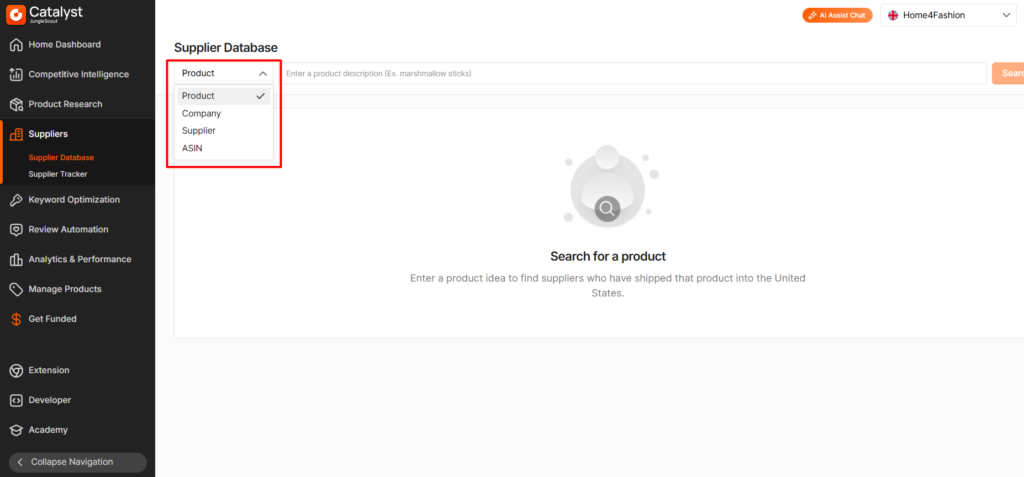
Finding Suppliers Through Product Search in Jungle Scout
Suppose you find a successful dog harness listing on Amazon. The product has strong reviews, good branding and consistent sales.
Instead of guessing where the seller sources the product, you can use Jungle Scout Supplier Database to investigate possible supplier connections.
For example, you can enter ‘dog harness’ and review suppliers connected with similar imported products.
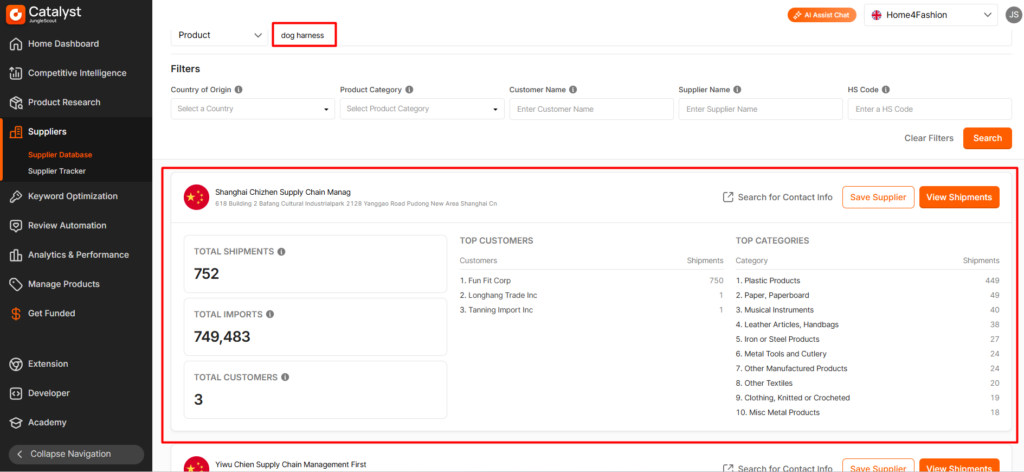
The results may show:
- Supplier names
- Shipment records
- Customer information
- Country of origin
- Total imports
This gives you a better understanding of how established sellers may be sourcing similar products.
Investigating Established Brands
Jungle Scout can also help you research specific companies behind successful Amazon listings. The brand name displayed on Amazon may not always be the same as the legal importing company.
You may need to check:
- Seller websites
- Trademark information
- Business details
After identifying the company, you can search it in Jungle Scout to explore possible supplier relationships.
Checking Potential Suppliers
Already found a supplier through Alibaba, Global Sources or Made-in-China.com? You can also investigate that supplier in Jungle Scout.
Searching the supplier’s legal company name may help you understand:
- Whether they have export experience
- What products they usually ship
- Whether they work with international buyers
Using an Amazon ASIN for Research
Another useful method is searching by Amazon ASIN.
You can copy the ASIN from a product listing and enter it into the Jungle Scout Supplier Database.
For example, if you find a successful dog harness listing on Amazon, the ASIN search may help identify import information connected with that product.
This can reveal possible suppliers or manufacturers linked to similar products.
Find Potential Suppliers with Helium 10
Helium 10 offers another way for Amazon sellers to move from product research to supplier discovery.
Unlike Global Sources, Made-in-China.com or DHgate, Helium 10 is not a wholesale marketplace. Its Supplier Finder is built into the Helium 10 Chrome Extension and connects Amazon product research with relevant supplier listings on Alibaba.
How to Find Suppliers Using Helium 10
Install the extension and sign in to your Helium 10 account. The Chrome Extension includes Xray, Supplier Finder and other product-research tools.
1. Search for a Product on Amazon
Open Amazon and search for the type of product you are considering.
For example, suppose you want to source a women’s sandal. Search for the main product keyword and review the products appearing in the results.
You can also open a specific Amazon product listing when you want to find suppliers offering a similar design.
2. Launch Xray
Open the Helium 10 Chrome Extension and launch Xray on the Amazon search-results page or product listing.
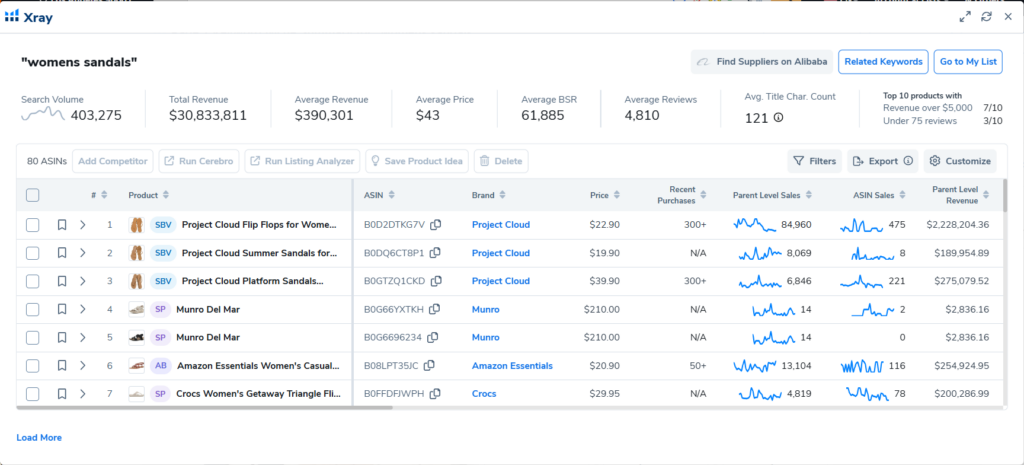
Xray displays product-research information that can help you assess demand, estimated sales, pricing and competition before moving forward with supplier research.
3. Select the Supplier Finder Option
Inside Xray, select ‘Find Suppliers on Alibaba’ or ‘Source on Alibaba.com.’ The exact button wording may vary depending on the current extension interface.
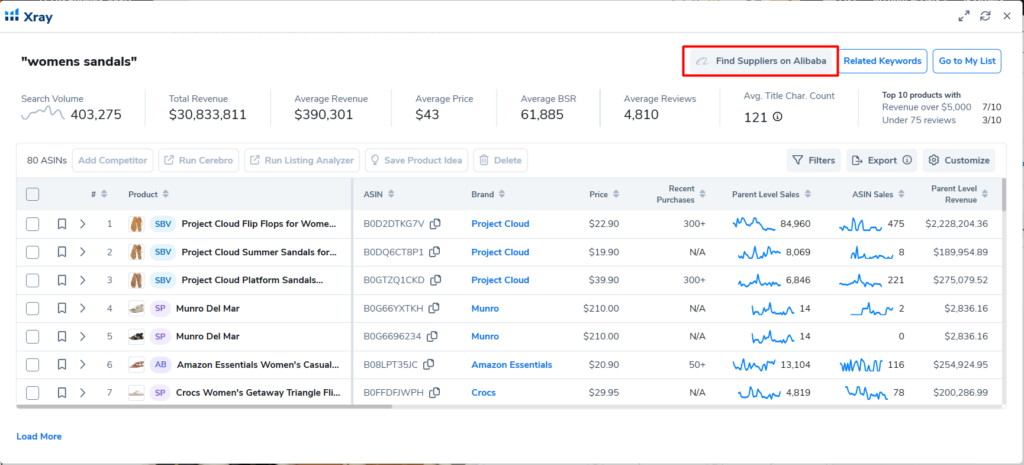
Helium 10 then displays Alibaba listings related to the product or keyword you are researching. The tool can show potential sourcing options without requiring you to begin a separate search manually.
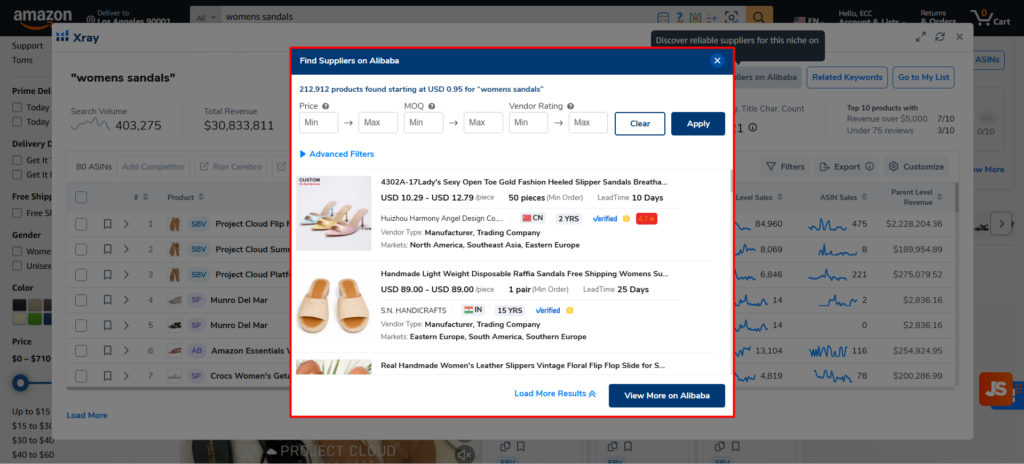
4. Compare the Supplier Results
Review the available listings and compare factors such as:
- Product price range
- Minimum order quantity
- Supplier rating
- Supplier country
- Vendor type
- Length of time on Alibaba
- Product images and specifications
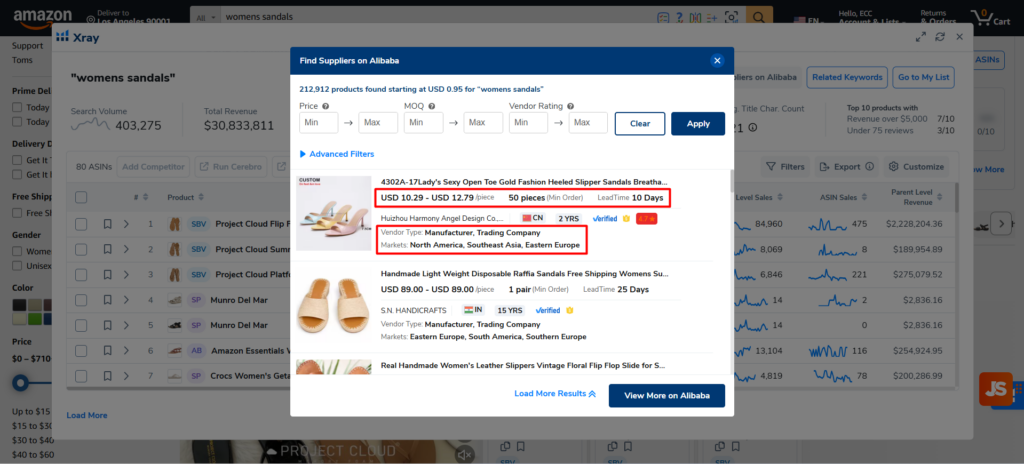
Helium 10 provides filters for factors including price, MOQ, vendor rating, supplier country, vendor type and account age.
Do not choose a supplier based only on the lowest displayed price. Check whether the materials, dimensions, accessories, packaging and customisation options match your requirements.
5. Open the Supplier Listing
Select a promising result to open its Alibaba product page.
From there, review the supplier’s company profile, product range, verification information, transaction history and available certifications. You can then contact the supplier to request:
- A detailed quotation
- Sample pricing
- Production lead time
- Packaging options
- Customisation costs
- Certification documents
- Shipping terms
6. Estimate the Potential Profit
After identifying an approximate sourcing cost, open the Helium 10 Profitability Calculator from the Chrome Extension.
Enter the estimated product cost and other relevant expenses to see whether the product could meet your target profit margin. Helium 10’s official workflow recommends using Supplier Finder and the Profitability Calculator together when evaluating a product opportunity.
What Is the Limitation?
Helium 10 can make supplier discovery faster, but it does not remove the normal risks of sourcing.
The results are primarily connected with Alibaba, so the tool does not help you discover completely separate sourcing channels in the way Thomasnet, Global Sources or HKTDC Sourcing can.
A supplier appearing through Helium 10 should not automatically be considered suitable for your business. Before ordering, you should still:
- Request and inspect samples
- Confirm exact product specifications
- Verify relevant certificates
- Check manufacturing capability
- Compare several suppliers
- Use a secure payment method
- Arrange an inspection for larger orders
Who Should Use Helium 10 Supplier Finder?
Helium 10 Supplier Finder is most useful for Amazon sellers who have already identified a possible product and want to move quickly from competitor research to supplier shortlisting.
It is less useful for sellers specifically trying to avoid Alibaba or discover manufacturers through completely different sourcing channels.
Use Helium 10 when: You find a product opportunity on Amazon and want a faster way to compare related Alibaba suppliers and estimate potential profitability.
Which Alibaba Alternative Should You Choose?
There is no single sourcing platform that works best for everyone.
The right choice depends on your product, order requirements, budget and business goals. Some platforms are better for finding manufacturers, some for testing products with smaller quantities, and others for researching suppliers or exploring local sourcing options.
Instead of depending on one platform, compare multiple options, review supplier information, request quotations and evaluate factors like quality, MOQ, pricing and reliability before making your final decision.
Common Wholesale Sourcing Mistakes
- Choosing the Cheapest Supplier: Low prices may come with weaker materials, poor packaging, missing accessories or lower quality standards. Compare the full product specifications, not just the price.
- Skipping the Sample: Product photos cannot show actual quality, weight, texture or performance. Always test a physical sample before placing a large order.
- Assuming Verification Means Risk Free: Supplier badges do not guarantee product quality. Use verification, samples and inspections together.
- Ignoring Product Compliance: Check import and selling requirements before ordering, especially for electronics, toys, cosmetics, batteries, food contact products and medical items.
- Paying an Unrelated Account: Confirm any unexpected payment changes through trusted communication channels before sending money.
- Approving Production Without Final Specifications: Confirm materials, dimensions, colors, labels and packaging before mass production begins.
- Depending on One Supplier: Maintain backup suppliers to reduce risks from delays, shortages, equipment issues or quality problems.
Frequently Asked Questions
Q1. What Is the Best Alibaba Alternative?
There is no single best option for everyone. The right choice depends on your product, sourcing goals and order requirements.
Q2. Which Alibaba Alternative Is Best for Beginners?
DHgate is useful for testing ready-made products with small orders. SaleHoo can also help beginners find pre-vetted suppliers through an organized directory.
Q3. Which Platform Is Best for High Quality Manufacturers?
Global Sources is strong for established exporters and private-label products. Made-in-China.com is useful for reviewing supplier audit information.
Q4. Which Alibaba Alternative Is Best for US Suppliers?
Thomasnet is one of the strongest platforms for finding US and North American manufacturers, distributors and custom-production companies.
Q5. Why Is eWorldTrade Not Included?
eWorldTrade is not included because its marketplace domain was seized by US authorities in 2025 following legal action against its operator.
Q6. Is Jungle Scout an Alibaba Alternative?
Not exactly. Jungle Scout Supplier Database is a research tool that helps sellers investigate suppliers behind existing Amazon products.
Q7. Are Alibaba Alternatives Automatically Safer?
No. A different platform does not remove sourcing risks. Always verify suppliers, test samples and check compliance before ordering.
Q8. Is a Manufacturer Always Better Than a Trading Company?
Not always. Manufacturers may offer more production control, while trading companies can provide flexibility, lower MOQs and easier sourcing.
Need Help Finding the Right Supplier?
Finding the right supplier takes more than comparing prices. Product research, supplier verification and market understanding are essential for building a successful ecommerce business.
At Ecomclips, we help sellers with product research, supplier sourcing, marketplace management, listing optimization, creative content and growth strategies across major ecommerce platforms.
If you need help reviewing suppliers or building a smarter sourcing strategy, contact the Ecomclips team. For more practical ecommerce insights, explore the Ecomclips Blog and discover more selling strategies through the Ecomclips YouTube Channel.
Contact us today at info@ecomclips.com or visit Ecomclips to start building a more scalable ecommerce business.
Build a Smarter Sourcing Strategy
Alibaba is still a valuable sourcing platform, but it should not be your only option. Exploring different sourcing channels can help you find better suppliers, unique products and more suitable business opportunities.
Each platform has its own strengths. Some help you meet manufacturers directly, some support smaller product tests, and others make supplier research easier through verified information.
The goal is not to find the cheapest supplier. It is to find the right supplier by comparing quality, reliability, pricing, MOQ and production capability.
A smarter sourcing process means researching multiple options, requesting samples, verifying suppliers and calculating the complete cost before making a decision.