
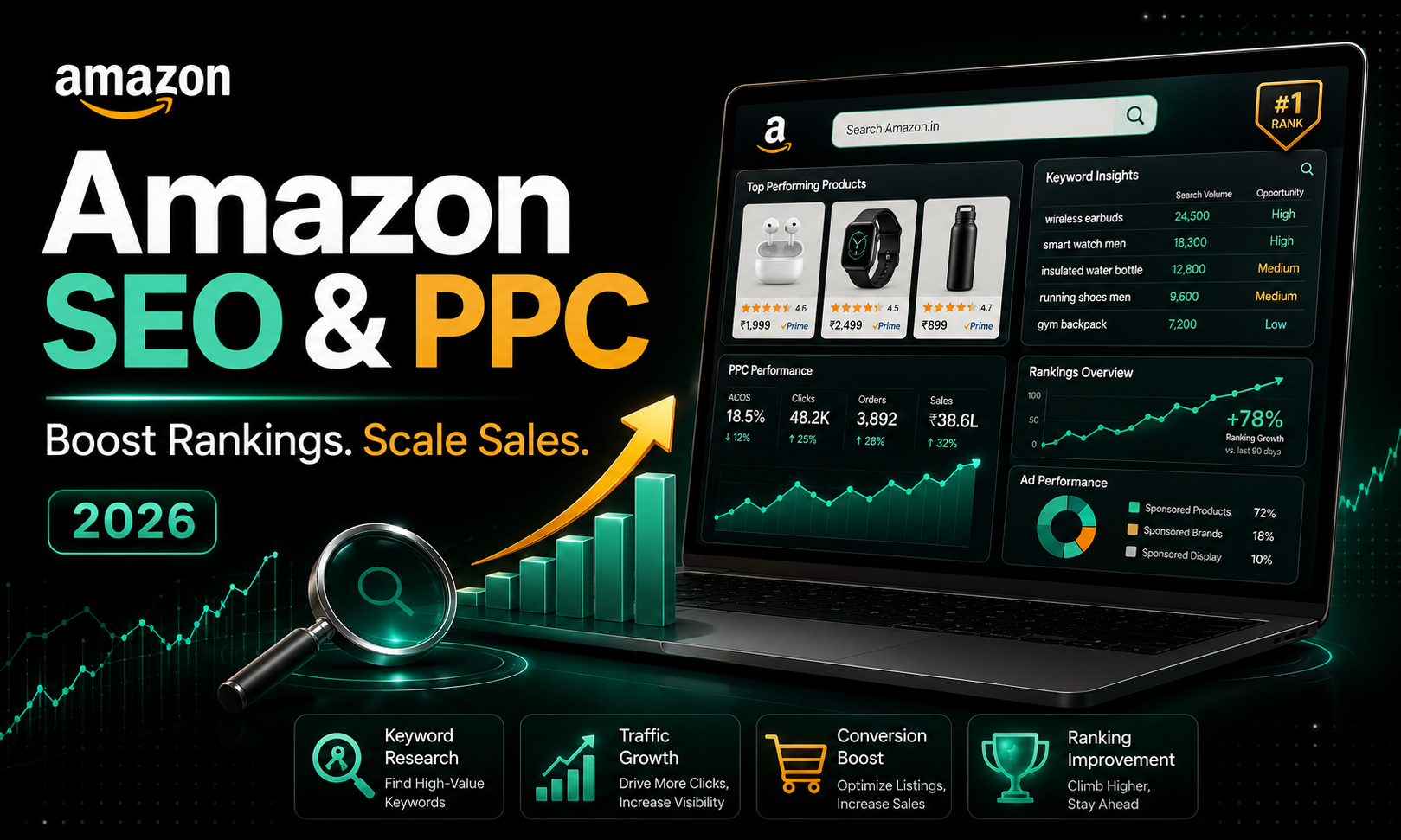
Are your Amazon ads helping you grow, or just increasing your costs?
Many sellers run PPC and SEO as separate strategies. They pay for traffic through ads but miss the valuable search data that could improve their organic performance.
PPC shows what shoppers are searching for, which keywords convert, and what drives sales. SEO turns those insights into better listings, stronger relevance, and long-term visibility.
When both work together, PPC becomes more than a sales channel. It becomes a powerful research tool that helps improve rankings, increase conversions, and reduce wasted ad spend.
In this guide, we’ll explore how to integrate Amazon SEO and PPC step by step, so your campaigns generate smarter insights and your listings build sustainable growth on Amazon.
Understanding the SEO–PPC Connection
Should I invest in Amazon SEO or PPC? Many sellers ask this question as if they have to choose one strategy over the other.
But SEO and PPC are not competitors. They are two parts of the same growth system, each solving a different challenge.
Think of it like opening a physical store. A great location brings people through the door, but the product, pricing, and presentation decide whether they make a purchase.
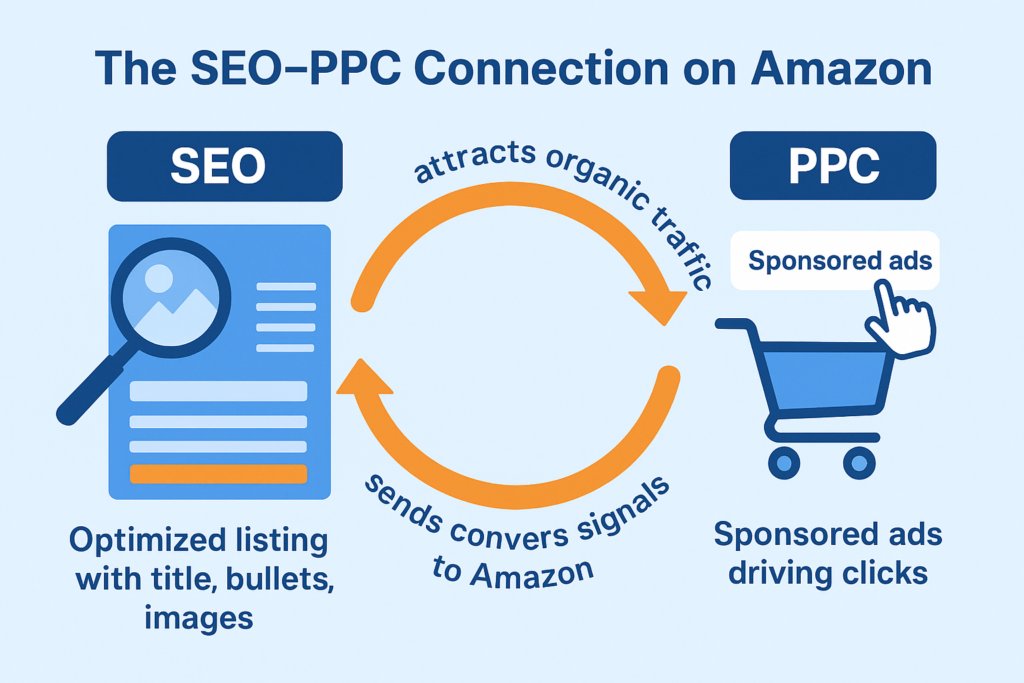
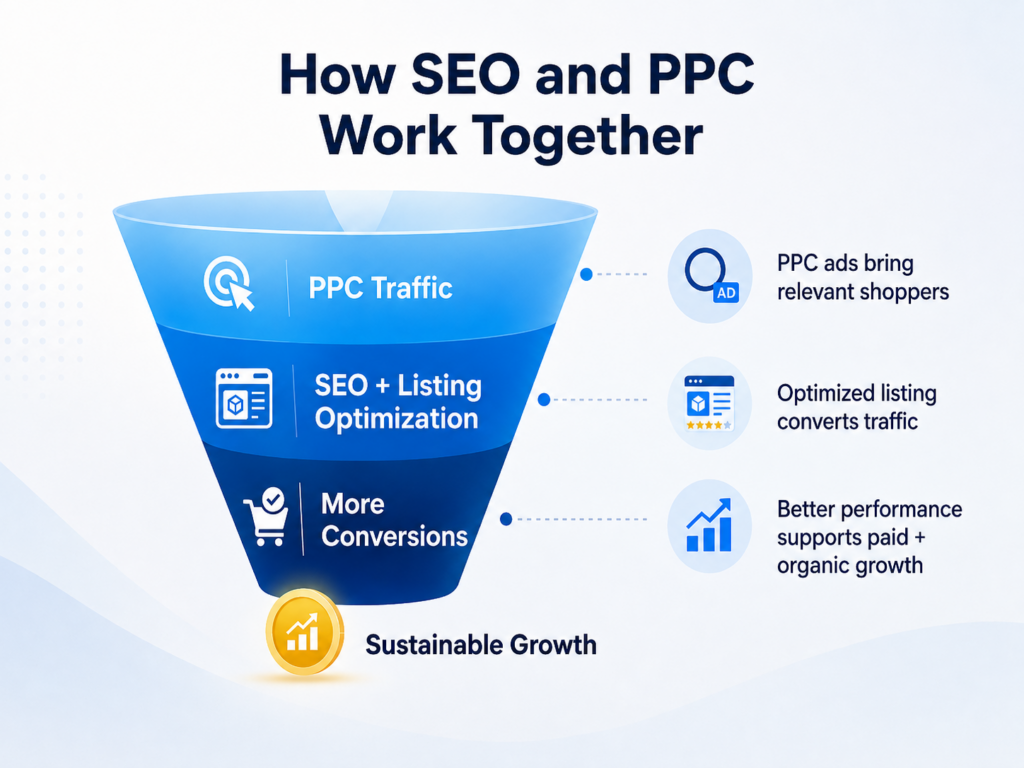
Amazon works the same way. PPC brings shoppers to your product, while SEO helps your listing convince them to click, trust, and buy.
PPC can give a new product the visibility it needs before it builds organic momentum. But ads cannot fix a weak listing, unclear images, poor reviews, high pricing, or missing product information.
At the same time, SEO alone cannot instantly push a new ASIN above established competitors. Even a well-optimized listing needs traffic, conversions, and performance history before Amazon gains stronger confidence in ranking it.
That is why successful sellers do not treat SEO and PPC as separate activities. They create a connected system where advertising data improves SEO, and stronger SEO makes advertising more effective.
How SEO and PPC Work Together
Imagine a seller launching a new stainless steel water bottle on Amazon.
The seller creates a well-optimized listing targeting keywords like ‘insulated water bottle’ and ‘water bottle with straw’. However, because the product is new, it has no sales history and struggles to appear organically in search results.
The seller launches PPC campaigns to generate visibility. After collecting data, the ads reveal that shoppers are converting most often for searches like ‘32 oz insulated water bottle with straw’ and ‘leakproof gym water bottle’
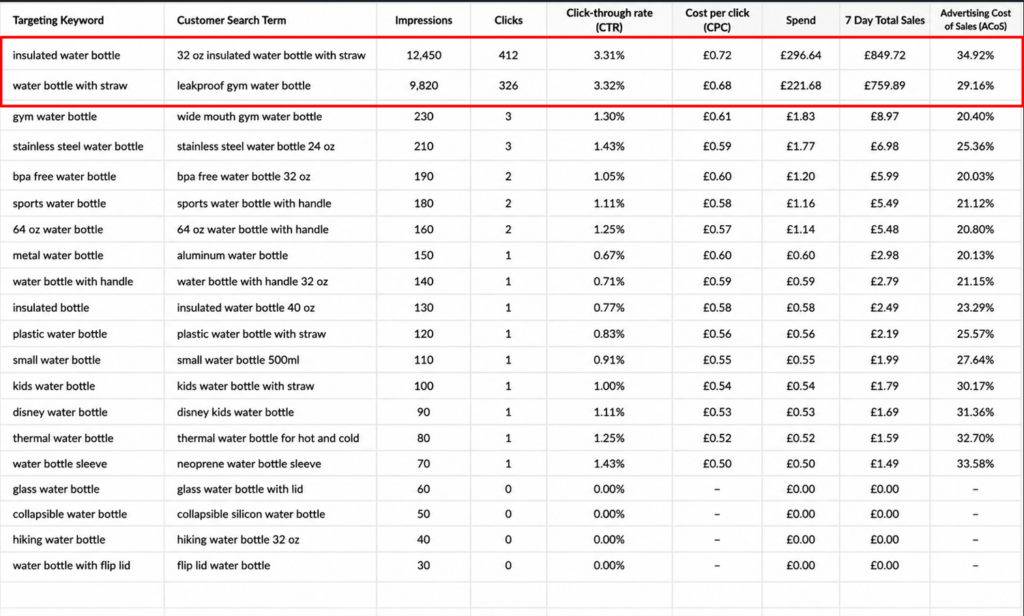
Instead of only increasing the ad budget, the seller uses these insights to improve the listing. The product images highlight the leakproof feature, the bullets explain the 32 oz capacity, and relevant keywords are added naturally to the content.
Now PPC is doing more than generating sales. It is helping the seller understand customer demand, while SEO turns those insights into long-term organic growth.
This is the real power of integrating Amazon SEO and PPC: ads discover opportunities, and SEO helps capture them.
The PPC Metrics That Matter for SEO
ACoS alone does not show whether PPC is supporting long-term growth. Sellers should review multiple metrics to understand how advertising performance connects with organic visibility.
1. Impressions:
Impressions show how often your ad appears in search results or placements.
Low impressions may indicate:
- Low bids or limited budget
- Weak relevance
- Low search demand
- Narrow targeting
- Indexing or catalog issues
2. Click-Through Rate (CTR)
CTR measures how many shoppers click after seeing your ad.
Formula: CTR = (Clicks ÷ Impressions) × 100
A low CTR may indicate problems with:
- Main image
- Title
- Price
- Reviews
- Targeting relevance
3. Conversion Rate
Conversion rate shows how effectively clicks turn into orders.
Formula: Conversion Rate = (Orders ÷ Clicks) × 100
A low conversion rate may point to:
- Weak listing content
- Poor pricing
- Missing information
- Low reviews
- Irrelevant traffic
4. Cost Per Click (CPC)
CPC shows the average amount paid for each ad click.
Formula: CPC = Ad Spend ÷ Clicks
A higher CPC is not always negative if those clicks generate profitable sales.
5. Advertising Cost of Sales (ACoS)
ACoS measures how much advertising spend is used to generate ad-attributed sales.
Formula: ACoS = (Ad Spend ÷ Ad Sales) × 100
Lower ACoS generally means better advertising efficiency.
6. Return on Ad Spend (ROAS)
ROAS shows the revenue generated for every dollar spent on ads.
Formula: ROAS = Ad Sales ÷ Ad Spend
Example: $100 ad spend generating $400 sales = 4 ROAS
7. Total Advertising Cost of Sales (TACoS)
TACoS measures advertising spend against total Amazon revenue, including organic sales.
Formula: TACoS = (Ad Spend ÷ Total Sales) × 100
Example:
Ad Spend: $1,000
Total Sales: $10,000
TACoS = 10%
TACoS helps sellers understand whether PPC is supporting overall business growth, not just paid sales.
Build an Amazon PPC Structure That Supports SEO
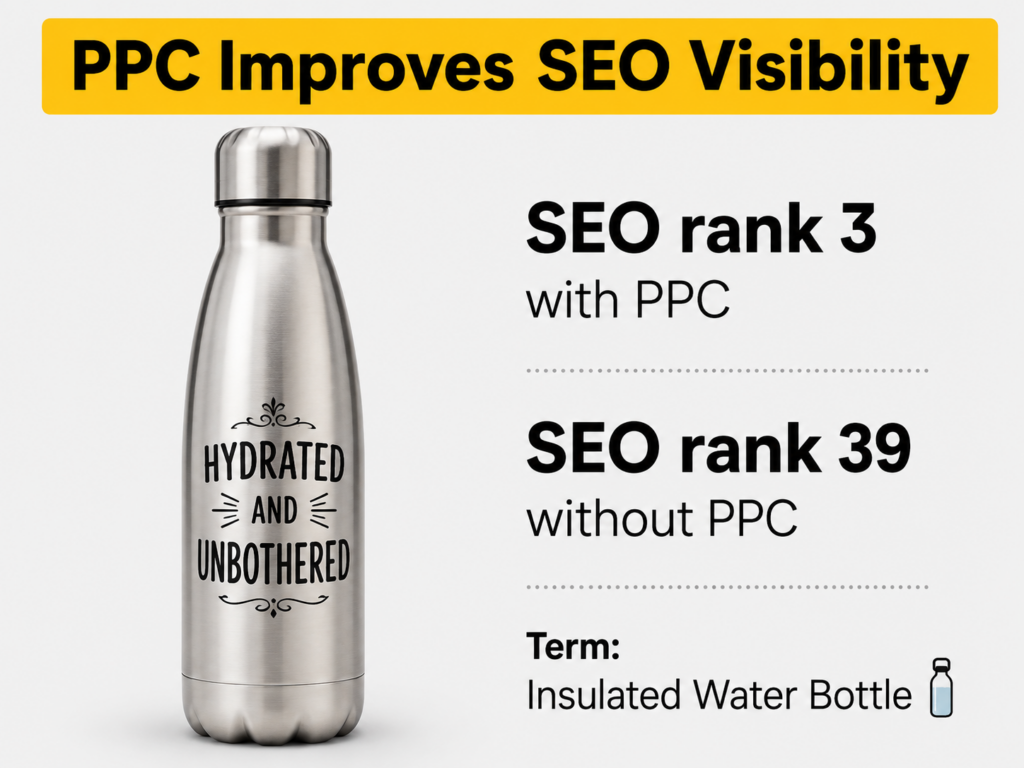
There is no single PPC structure that works for every Amazon brand. The right approach depends on your product, goals, and growth stage. However, each campaign type should have a clear purpose.
A strong PPC strategy is not only about generating sales. It is about collecting valuable customer data that can improve your SEO strategy over time.
1. Automatic Campaigns for Discovery
Automatic targeting allows Amazon to match your ads with relevant customer searches and products based on your listing information and shopper behaviour.
Automatic campaigns should not be treated as “set and forget” campaigns.
How an Automatic Campaign Reveals Hidden Opportunities
Imagine a seller launches a new AirTag wallet on Amazon.
The seller starts with an automatic PPC campaign to discover how shoppers are searching instead of guessing every keyword.
After reviewing the Search Term Report, the seller finds that customers are converting not only for ‘AirTag wallet’ but also for specific searches like ‘AirTag slim wallet’ and ‘AirTag card holder wallet’
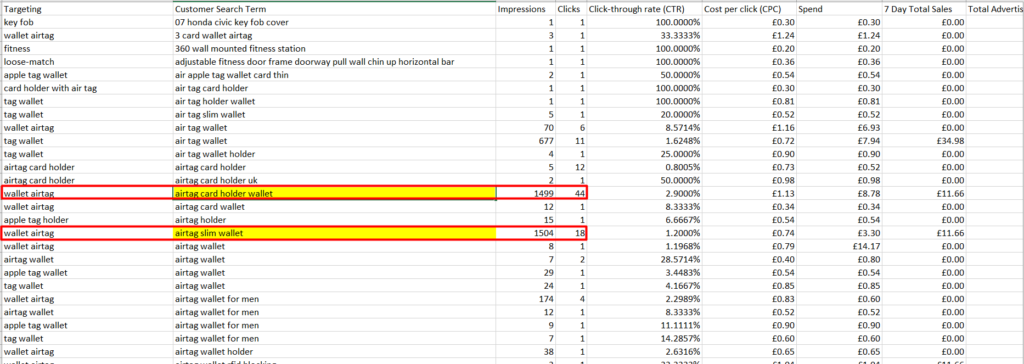
The seller moves these high-performing terms into manual campaigns and naturally adds them to the listing content.
2. Broad-Match Campaigns for Expansion
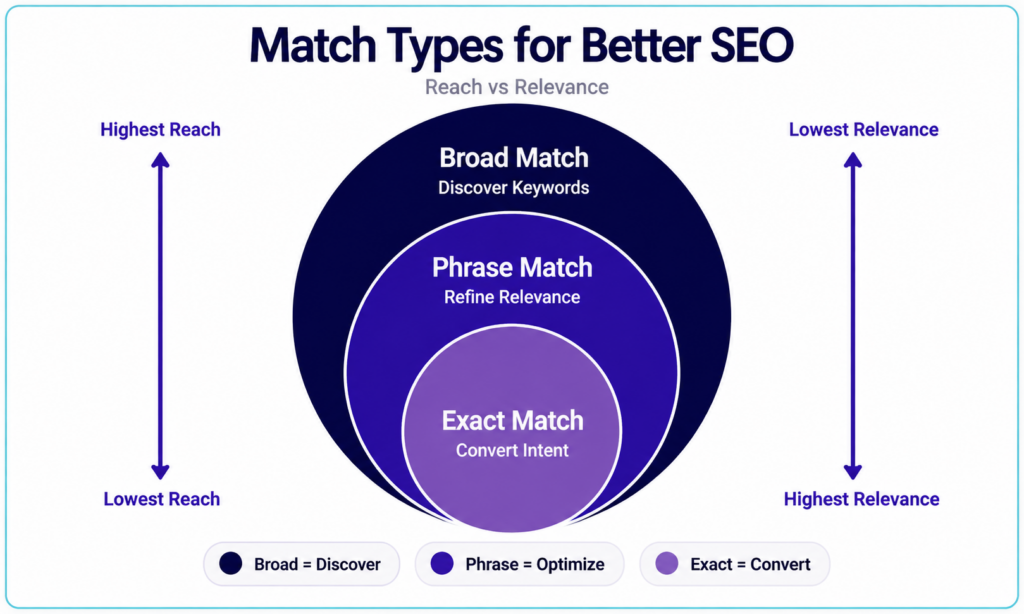
Broad match helps sellers discover new keyword variations around a main search term. Instead of targeting only one exact phrase, Amazon can match the keyword with related customer searches that include additional words, similar phrases, and variations.
For example, a seller targeting the broad keyword ‘insulated bottle’ may appear for searches like:
- 32 oz insulated water bottle with straw
- leakproof insulated bottle for gym
- stainless steel bottle for travel
- large water bottle for workouts
Using Broad Match to Discover New Keywords
A seller launches a 32 oz insulated water bottle with straw and starts a broad-match campaign using the keyword ‘insulated water bottle.’
At first, the seller does not know which variations will drive sales. After running the campaign for a few weeks, they review the Search Term Report and discover that some specific customer searches are performing better than the original keyword.
Searches like ‘32 oz insulated water bottle with straw’ and ‘leakproof gym water bottle’ are generating clicks and conversions, while broader searches like ‘metal water bottle’ and “kids water bottle with straw” are receiving clicks but no conversions.
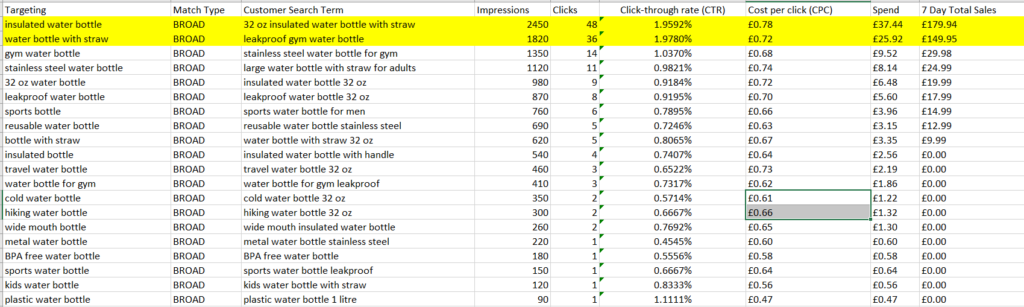
Instead of continuing to spend equally on every variation, the seller takes action:
- Moves high-performing search terms into exact-match campaigns
- Adds relevant keywords naturally to the listing
- Creates negative keywords for irrelevant searches
- Adjusts bids based on performance
3. Phrase-Match Campaigns for Controlled Discovery
Phrase match gives sellers more control than broad match while still allowing Amazon to discover variations around a known customer search.
A seller targeting the phrase keyword ‘RFID card holder’ may appear for searches like:
- slim RFID card holder
- RFID card holder for men
- credit card RFID holder
Discovering Customer Search Variations with Phrase Match
A seller running a phrase-match campaign for ‘RFID card holder’ reviews the Search Term Report and finds that shoppers are converting more often for specific searches like ‘RFID blocking card holder’ and ‘slim RFID wallet card holder.’
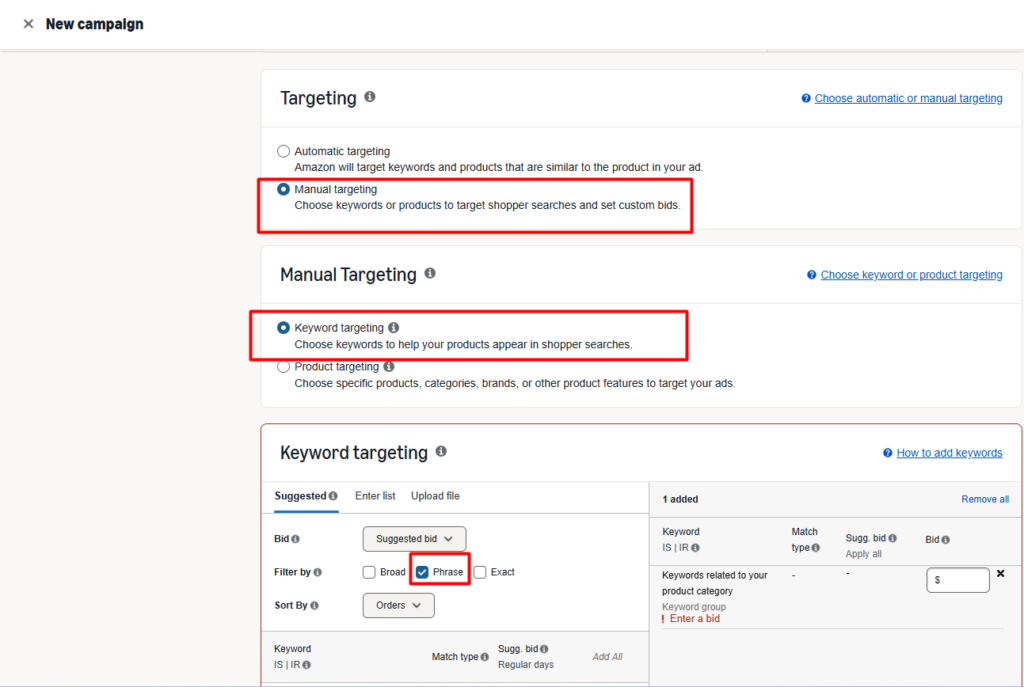
The seller moves these high-performing search terms into exact-match campaigns and uses them to improve the listing.
Phrase match works well when the seller understands the main customer intent but wants to discover additional words shoppers use before and after the core keyword. It helps expand keyword coverage while keeping targeting more focused than broad match.
4. Exact-Match Campaigns for Proven Terms
Exact match is the most controlled keyword-targeting option in Amazon PPC. It allows sellers to focus their budget on search terms that have already shown strong performance and buying intent.
Instead of letting Amazon discover new variations, exact match gives sellers more control over:
- Keyword bids
- Campaign budget allocation
- High-value search terms
- Performance tracking
- Comparison between paid and organic results
A keyword should not be moved into an exact-match campaign just because it generated one sale.
Scaling Proven Keywords with Exact Match
A portable espresso maker seller on Amazon starts with automatic, broad, and phrase-match campaigns.
After reviewing the Search Term Report, they find that ‘portable coffee maker for travel’ consistently generates clicks and sales with a profitable ACoS.

Instead of keeping this keyword inside discovery campaigns, the seller creates a separate exact-match campaign for ‘portable coffee maker for travel’
This allows the seller to increase the bid, dedicate more budget, and monitor performance separately. The seller can also track whether stronger paid visibility helps improve organic ranking for this important search term.
5. Product-Targeting Campaigns for Competitor and Category Visibility
Product-targeting campaigns allow sellers to place ads on competitor product pages, related products, and relevant categories.
Sellers can target:
- Competitor ASINs
- Complementary products
- Relevant categories
- Products within specific price or rating ranges, where available
Using Product Targeting to Win Competitor Traffic
A seller launches a new premium RFID wallet with an AirTag holder on Amazon.
Instead of targeting only keywords like ‘AirTag wallet’, the seller creates a product-targeting campaign and places ads on competitor ASINs selling similar AirTag wallets.
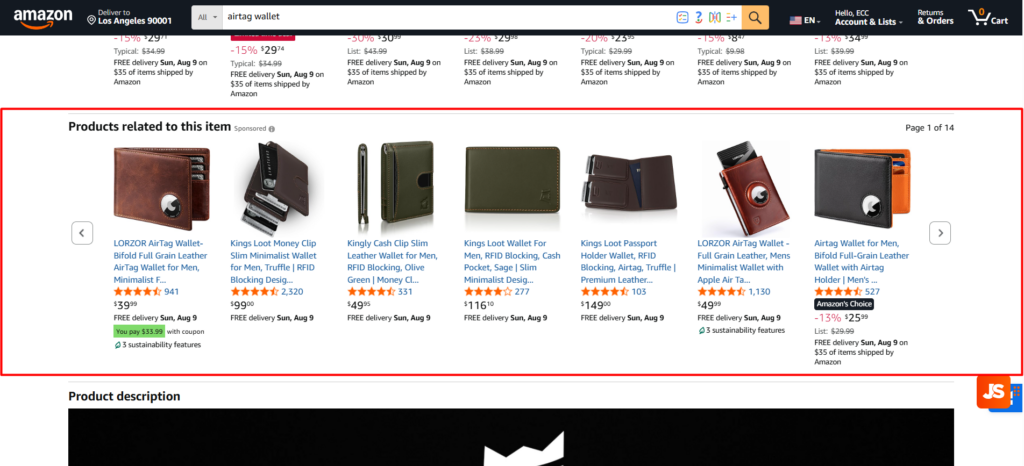
After running the campaign, the seller reviews performance data and discovers that shoppers viewing certain competitor wallets are clicking and purchasing their product more frequently.
The seller then increases bids for those high-performing competitor ASINs and reduces spending on placements that generate clicks without profitable conversions.
Product targeting is not only a way to steal competitor visibility. It is also a research tool that helps sellers understand where their product fits in the marketplace and which competitor audiences are most likely to convert.
Amazon SEO and PPC Integration Strategy for 2026
A successful Amazon growth strategy is not about choosing between SEO and PPC. It is about creating a system where each channel improves the other.
Phase 1: Build the SEO Foundation Before Scaling Ads
Before spending heavily on PPC, make sure the listing can convert traffic.
Focus on:
- Optimizing the title, bullets, and description with relevant keywords
- Creating clear product images that communicate benefits quickly
- Improving product information, attributes, and backend keywords
- Ensuring competitive pricing, reviews, and inventory availability
A well-optimized listing helps convert the traffic generated through PPC.
Phase 2: Use PPC for Keyword Discovery
At the beginning, PPC should be treated as a research tool.
Run:
- Automatic campaigns to discover customer search behaviour
- Broad campaigns to find keyword variations
- Phrase campaigns to explore longer search terms
Monitor:
- Search terms generating clicks
- Search terms generating sales
- Customer language that is missing from the listing
Phase 3: Move Winning Search Terms Into Controlled Campaigns
Not every keyword deserves the same budget. When a search term consistently generates sales, move it into:
- Exact-match campaigns for better control
- Higher bids for valuable terms
- Dedicated budgets for profitable keywords
A seller discovers ‘portable coffee maker for travel’ generates consistent sales through broad and phrase campaigns.
The seller then:
- Creates an exact-match campaign
- Adds the keyword naturally to the listing
- Improves images around travel use cases
- Monitors organic ranking movement
Phase 4: Turn PPC Insights Into SEO Improvements
PPC data should influence listing decisions. Use advertising data to improve:
- Titles
- Bullet points
- Images
- Product descriptions
- Comparison charts
- Product positioning
If PPC data shows shoppers frequently search: leakproof gym water bottle
the seller can:
- Highlight leakproof features in images
- Add the benefit naturally to bullets
- Improve content around gym usage
Phase 5: Reduce Dependence on Paid Traffic Over Time
The long-term goal is not to increase PPC spending forever.
A strategy focuses on:
- Growing organic sales
- Improving TACoS
- Maintaining profitable advertising
- Expanding into new keywords
- Defending important search positions
PPC should continue supporting growth, but organic visibility should gradually carry more of the sales responsibility.
The PPC to SEO Conversion Loop: How Paid Ads Support Organic Growth
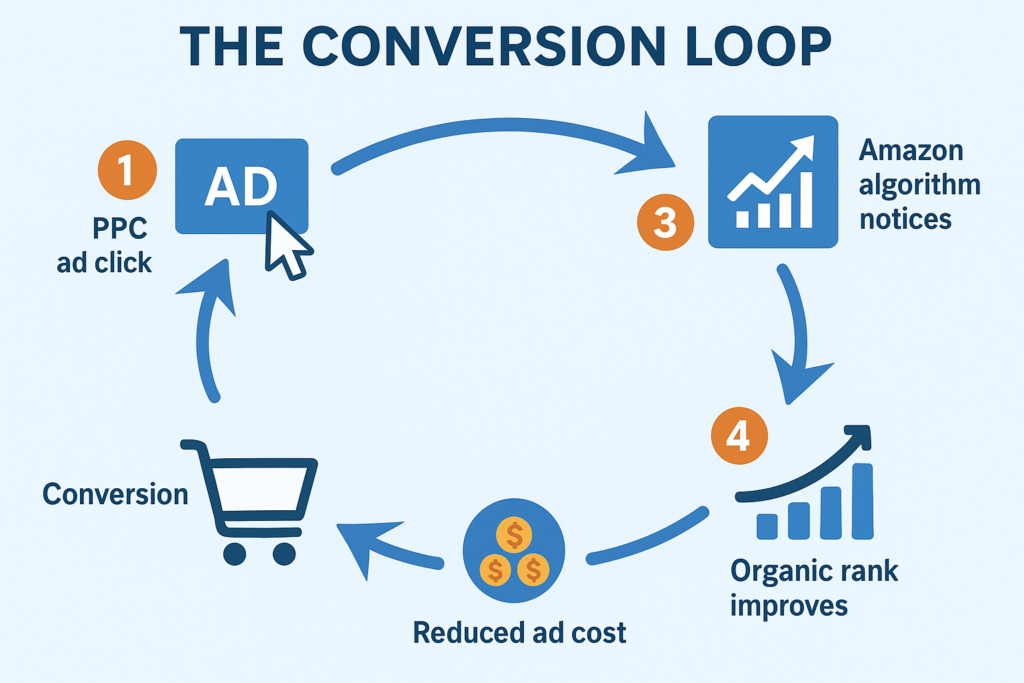
Amazon PPC and SEO work best when they support each other. PPC does not directly buy organic rankings, but it can create the traffic, sales, and performance data that help a product build stronger organic momentum.
1. PPC Brings Relevant Shoppers
PPC gives products immediate visibility by placing ads in front of shoppers who are actively searching for related products.
When sellers target relevant keywords, competitor products, or customer search terms, they attract shoppers with higher purchase intent.
An AirTag wallet seller targeting searches like “AirTag wallet for men” can reach customers already looking for that type of product instead of waiting for organic rankings to develop.
2. Clicks Create Opportunities for Conversion
A click alone does not improve performance. The listing must turn visitors into buyers.
Strong product images, clear benefits, competitive pricing, positive reviews, and relevant keywords help convert PPC traffic into sales.
When shoppers click an ad and purchase, Amazon receives valuable information that the product is satisfying a specific customer need.
3. Amazon Learns From Customer Behaviour
Every click, conversion, and search interaction provides Amazon with performance data.
When a product consistently converts for a relevant search term, Amazon has stronger evidence that the product is a good match for that customer query.
This does not guarantee a ranking increase, but it can contribute to stronger organic performance signals over time.
4. Organic Visibility Can Improve
As a product builds sales history and demonstrates relevance for important search terms, it may gain stronger organic visibility.
Higher organic placement can bring more unpaid traffic, creating additional sales without paying for every visitor. This reduces the seller’s dependence on advertising and can improve overall advertising efficiency.
5. Lower Ad Dependence Creates Sustainable Growth
When SEO improves, sellers can rely less on PPC for every sale. Instead, advertising can focus on discovering new keywords, defending important searches, and supporting growth opportunities.
The result is a healthier cycle:
More relevant PPC traffic → More conversions → Stronger Amazon signals → Better organic visibility → More organic sales → Lower reliance on paid traffic
PPC is not a shortcut to organic rankings. It is a tool that helps sellers collect data, validate keywords, and accelerate the growth of products that already provide a strong customer experience.
How AI Shopping Changes Amazon SEO and PPC in 2026
Amazon shopping is becoming more conversational.
On May 13, 2026, Amazon introduced Alexa for Shopping, combining Rufus and Alexa+ to help customers ask questions, compare products, and receive AI-powered shopping guidance directly in Amazon search.
Amazon Ads has also introduced AI-powered features like Sponsored Products prompts and Sponsored Brands prompts, helping connect shoppers with relevant products through conversational experiences.
This does not make keywords irrelevant. Search terms still play a major role in Amazon SEO and PPC. However, sellers now need to optimize for the questions shoppers ask, such as:
- Which water bottle keeps drinks cold all day?
- Will this charger work with my laptop model?
- Is this lunch box dishwasher safe?
The future of Amazon SEO is not just about adding keywords. It is about creating listings that clearly answer customer questions.
Product pages should provide accurate details about:
- Compatibility
- Materials
- Dimensions
- Package contents
- Use cases
- Care instructions
- Limitations and safety information
The clearer the product information, the easier it becomes for shoppers and AI-powered shopping tools to understand, compare, and recommend products.
Common Amazon SEO and PPC Mistakes
- Using PPC to Rescue a Weak Listing: Ads can bring traffic, but they cannot fix poor images, weak copy, low reviews, or an uncompetitive offer.
- Targeting Only High-Volume Keywords: Popular keywords may bring higher competition and costs, so focus on relevance, intent, and conversion potential.
- Pausing Keywords Too Quickly: Give keywords enough time and data before deciding whether they are profitable or not.
- Judging Success Only by ACoS: A low ACoS does not always mean growth; also track TACoS, profit, sales, and organic performance.
- Copying Every PPC Search Term Into Listings: Search terms are customer insights, not phrases to force into titles and bullets..
- Making Changes Without Tracking: Changing SEO, PPC, pricing, and creatives together makes it difficult to identify what impacts performance.
Frequently Asked Questions
Q1. Does Amazon PPC Help Organic Ranking?
Amazon PPC can support organic performance by creating relevant visibility, traffic, sales and keyword data. However, advertising does not directly purchase organic rank and cannot guarantee ranking improvement.
Q2. Should I Start With Amazon SEO or PPC?
Start with retail readiness and basic SEO. The listing should be accurate, relevant and conversion-ready before significant advertising spend begins. PPC can then test and expand the strategy.
Q3. Should PPC Keywords Be Included in the Listing?
The product page should accurately support the important concepts being targeted. A keyword does not always need to appear as an exact phrase, but the listing should clearly demonstrate why the product is relevant to the search.
Q4. Should I Stop PPC After Reaching Page One?
Not automatically. Ads may still defend visibility, support sales velocity, reach new shoppers and protect branded or category positions. Test reductions gradually while monitoring total sales, profit and organic rank.
Q5. What Is a Good Amazon ACoS?
A good ACoS depends on product margin, business goals and lifecycle stage. Calculate the approximate break-even ACoS first, then set separate targets for launches, ranking campaigns, brand defence and profit campaigns.
Q6. Is TACoS More Important Than ACoS?
They answer different questions. ACoS measures ad-campaign efficiency. TACoS shows advertising spend relative to total sales. Use ACoS to optimize campaigns and TACoS to understand broader paid dependency.
Q7. How Long Does PPC Take to Affect Organic Ranking?
There is no guaranteed timeline. Results depend on relevance, sales volume, conversion, competition, price, reviews, inventory and existing organic position. Review sustained trends instead of expecting a fixed number of days.
Q8. Are Automatic Campaigns Better Than Manual Campaigns?
They serve different purposes. Automatic campaigns are useful for discovery, while manual campaigns provide greater control. Amazon recommends using automatic-campaign insights to develop manual targeting.
Q9. Can PPC Replace Amazon Listing Optimization?
No. PPC can generate traffic, but listing optimization helps turn that traffic into sales. Advertising a weak listing often increases spend without solving the underlying conversion problem.
Q10. How Does Alexa for Shopping Affect SEO and PPC?
Alexa for Shopping introduces more conversational questions, comparisons and AI-assisted product discovery. Sellers should continue targeting relevant keywords while making product content more complete, specific and easy to interpret.
How SEO and PPC Work Together to Grow Amazon Sales
Amazon PPC should do more than create short-term sales. It should reveal what shoppers search for, which benefits influence purchases, and which keywords deserve long-term investment. It should reveal what shoppers search for, which benefits influence purchases, and which keywords deserve long-term investment.
PPC brings relevant shoppers to the listing, while SEO helps convert that traffic through optimized content, strong visuals, and clear product information. Advertising creates visibility, while an optimized listing turns that visibility into conversions.
When SEO and PPC share the same keyword strategy, customer insights, and conversion goals, advertising becomes more than clicks. It becomes a growth system that strengthens the listing, improves the customer journey, and creates a healthier balance between paid and organic sales.
Turn Your Amazon SEO and PPC Data Into Profitable Growth
Running ads is easy. Building a system that improves rankings, controls costs and protects profit is much harder.
Ecomclips helps Amazon sellers connect keyword research, listing optimization, catalog data, Sponsored Ads, creative content and performance analytics into one coordinated growth strategy.
Whether your campaigns are wasting spend, your organic rankings are stuck or your listings are receiving traffic without converting, our team can identify where the customer journey is breaking and develop a practical improvement plan.
Contact Ecomclips today at info@ecomclips.com to discuss your Amazon SEO and PPC strategy.
You can also explore more practical selling guides on the Ecomclips Amazon seller blog and watch step-by-step marketplace videos on the Ecomclips YouTube channel.