
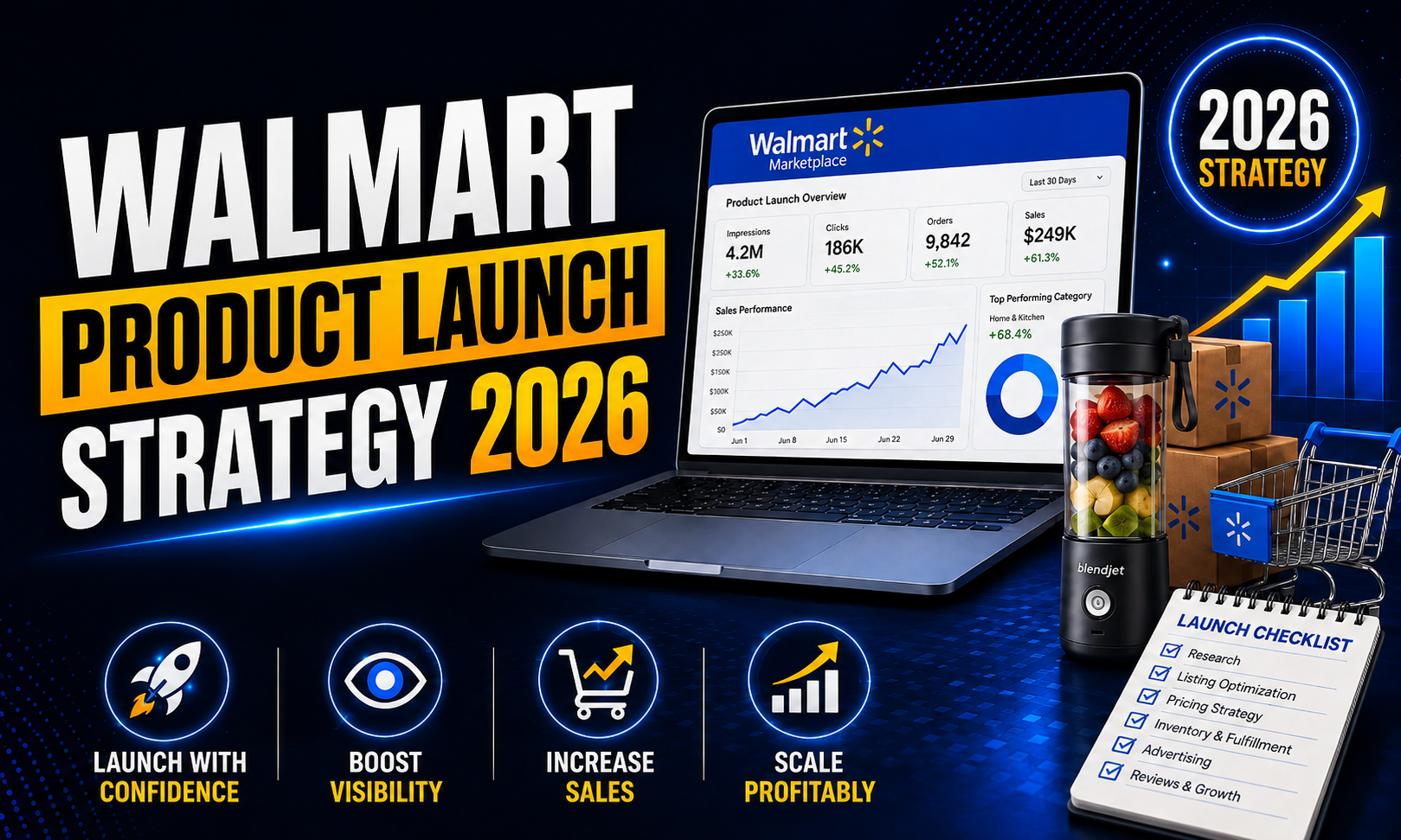
Walmart Product Launch Strategy 2026
10 Strategies to Launch, Grow, and Scale
The biggest Walmart launch mistake happens before you launch. Most sellers think success starts with ads, traffic, and sales — but the real game is decided earlier, before inventory arrives and before PPC starts. This guide breaks down 10 Walmart product launch strategies for 2026 to help you launch smarter, avoid expensive mistakes, and build a product ready to scale.
A successful Walmart product launch starts before you list the product: validate real Walmart-specific search demand, calculate your contribution margin and break-even ROAS, and make the listing retail-ready before sending traffic. Sellers who prepare pricing, inventory, and keyword strategy up front consistently avoid the costly early mistakes that stall a launch in its first 90 days.
📋 In This Guide
- 1What Is a Walmart Product Launch Strategy?
- 2The Walmart Product Launch Flywheel
- 3Strategy 1: Validate the Opportunity
- 4Strategy 2: Build the Launch Economics
- 5Strategy 3: Make the Product Retail Ready
- 6Strategy 4: Build a Walmart SEO Foundation
- 7Strategy 5: Price and Promotion Strategy
- 8Strategy 6: Inventory and Fulfilment
- 9Strategy 7: Walmart Connect for Launch Traffic
- 10Common Walmart Launch Mistakes
- 11Frequently Asked Questions
What Is a Walmart Product Launch Strategy?
A Walmart product launch strategy is the plan for taking a product from market opportunity to sustainable sales on Walmart.com. It connects the key elements that determine whether a new product gains traction: market and competitor research, product positioning and keyword strategy, catalog and listing setup, pricing and profitability, inventory and fulfilment, advertising and promotions, reviews and customer trust, and search, conversion, and post-launch performance.
SEO helps shoppers find the product. Listing optimization helps them understand it. Pricing, fulfilment, and reviews strengthen the offer, while advertising creates early visibility. A strong launch brings all of these together, and if one stage is weak, generating profitable growth becomes much harder.
💡 Key Takeaway: A product launch strategy helps sellers know what to prepare before launch, what to measure after launch, and what to fix when performance is weak. Amazon success does not guarantee Walmart demand — the two marketplaces have different shoppers, search behavior, and competitors.
The launch sequence
Validate
Confirm real Walmart-specific demand before committing to inventory.
Prepare
Build the unit economics and pricing structure the launch will run on.
Position
Make the listing retail-ready with content built around the buying decision.
Stock
Plan inventory and fulfilment for multiple demand scenarios.
Activate
Turn on Walmart Connect to create controlled, measurable traffic.
Learn → Optimize → Scale
Use the data from every stage to reinvest in what’s actually working.
The Walmart Product Launch Flywheel
Before getting into the individual strategies, think of a Walmart launch as a flywheel rather than a one-time event. It starts with customer demand. When the right product meets that demand with a relevant listing, competitive offer, and strong search visibility, more shoppers begin to notice and click.
Those clicks lead to consideration and purchases. A positive customer experience then generates reviews, sales data, and search insights that show you what’s working and what needs improvement — which you use to make better pricing, listing, advertising, and inventory decisions, attracting even more qualified shoppers.
🔄 The Cycle: Customer Demand → Relevant Product → Competitive Offer → Search Visibility → Click → Consideration → Purchase → Customer Experience → Reviews & Data → Better Decisions → More Qualified Demand.
A strong launch keeps this flywheel moving. A weak one forces you to keep paying for traffic without building enough organic visibility, conversion, or customer trust.
Strategy 1: Validate the Walmart Opportunity Before Launching
The strongest Walmart launches begin before you even create the listing. Many sellers skip this step because the product already performs well on Amazon — but Walmart has its own shoppers, search behavior, competitors, price expectations, and fulfilment standards. Treat Amazon data as evidence, not proof.
Start with Walmart-specific search demand
Understand whether Walmart shoppers are actually searching for the product or for the problem it solves. For a rechargeable portable blender, that means starting broad (“portable blender,” “personal blender,” “rechargeable blender”) and moving into purchase-intent searches (“portable blender for protein shakes,” “compact blender for work”). Walmart’s Related Keyword Report inside Search Insights also surfaces related queries, frequency rank, top-clicked products, and competitive pricing.
Don’t chase search volume alone
A high-volume keyword can look attractive, but large search demand doesn’t automatically mean a strong launch opportunity. A useful launch opportunity balances four factors:
Demand
Are enough people actually searching for this?
Product Relevance
Does your product strongly match the search?
Conversion Potential
Is the shopper likely to buy this type of product?
Competitive Opportunity
Can your offer realistically compete with what’s already winning?
Find the competitive gap, then mine reviews
Once you confirm demand, study the products already earning visibility: price range, capacity, features, ratings, review volume, images, and delivery speed. You’re not just noting what competitors do well — you’re finding what customers are still missing. Competitor reviews are one of the most useful sources of launch intelligence: positive reviews show what shoppers already value, negative reviews show where products are failing to meet expectations. A complaint like “the lid leaks in my bag” reveals a portability problem you can turn directly into a positioning advantage.
💡 Key Takeaway: Once you understand demand, competitors, and customer pain points, summarize the whole opportunity in one clear sentence — your launch thesis. It should define the product, the customer, the problem it solves, what makes it different, and how it’s positioned on price. Every launch decision, from your hero image to your pricing, should align with that one sentence.
Most Sellers Skip Validation — And Pay For It Later
Ecomclips has managed $2.7B+ in marketplace revenue across 1,000+ brands, and validation is the step that separates a profitable Walmart launch from a costly one.
Get My Free Walmart Launch AuditStrategy 2: Build the Launch Economics Before Spending on Traffic
A product can generate sales and still be a poor business decision. Before spending money on Walmart Ads, promotions, or discounts, you need to know how much contribution remains after all major costs are deducted — this determines how aggressively you can advertise, promote, discount, and absorb returns.
Build a contribution model
Here’s an illustrative example for a premium daily wellness supplement launching at $29.99. Actual costs will vary by category, fulfilment method, and Walmart fees.
| Cost | Amount |
|---|---|
| Selling price | $29.99 |
| Product + packaging | –$6.50 |
| Walmart marketplace fee | –$4.50 |
| Fulfilment | –$4.00 |
| Inbound freight | –$0.75 |
| Return allowance | –$0.50 |
| Contribution before advertising | $13.74 (≈46%) |
That 46% contribution is what’s available for customer acquisition, promotions, and growth — and it sets your break-even ROAS: 1 ÷ contribution margin. In this example, 1 ÷ 0.46 ≈ 2.17. A ROAS below that consumes more money than the contribution available; a ROAS well above it signals room to increase budget.
Define three prices before launch
Target Price — $29.99
The normal selling price you want to maintain once the product gains traction, balancing customer expectations, competitors, and profitability.
Tactical Launch Price — $26.99
A temporary promotional price to reduce hesitation and generate early sales data — controlled and time-boxed.
Floor Price — $24.99
The lowest price you’ll accept while staying sustainable, so you never react to a price war without a limit already set.
Strategy 3: Make the Product Retail Ready Before Sending Traffic
Many sellers activate Walmart Connect while the product page is still incomplete — missing images, unfinished attributes, temporary titles. This is a costly mistake: you’re paying to send customers to a page that isn’t ready to convert. Traffic doesn’t fix a weak listing; it only exposes the problems faster.
Build the catalog foundation first
Before optimizing titles or descriptions, make sure Walmart has a clear understanding of what your product is: product type, category, brand, GTIN/UPC, variation relationships, dimensions, and technical specifications. Your title is written for shoppers, but structured product information is what helps Walmart categorize and match your product to relevant searches.
Build the listing around the buying decision
A listing should answer the customer’s most important question: why choose this over the other options? Using a men’s bifold wallet as an example — the title should immediately communicate what the product is and its main benefit (a slim, RFID-blocking leather wallet, not just “another wallet”). Key features should connect to real benefits, not just list specs: not “RFID protection included,” but “helps protect your cards from unauthorized scans while keeping your everyday essentials secure.”
Build an image story, not just an image gallery
Most sellers upload images without giving each one a clear purpose. A strong listing needs images that answer questions and remove objections, in sequence:
Capture attention
A clean, premium shot that builds trust within seconds.
Highlight the main advantage
Show the key differentiator — e.g. slim profile + RFID protection.
Show storage capacity
Card slots, cash compartment, ID window — how much it holds.
Show real-life use
Business, travel, everyday carry — help shoppers picture using it.
Explain material and quality
Close-ups of texture, stitching, and finishing that justify the price.
Address concerns
RFID explanation, durability, weight — reduce hesitation directly.
Show what’s included
Product, packaging, and accessories, so expectations are clear.
We increased the team’s workload across design, PPC, and website marketing — and saw a real 40% uplift in sales.
Strategy 4: Build a Walmart SEO Foundation Before Launch Day
SEO shouldn’t be treated as a post-launch fix. Your keyword strategy influences the title, key features, description, attributes, images, and advertising campaigns — so build the keyword map before writing the product page. Not every keyword has the same value: a shopper searching “blender” and one searching “blender for protein shakes” have very different buying intent.
Primary Product Terms
“Portable blender,” “personal blender” — define your category.
Feature Terms
“USB rechargeable blender,” “24 oz portable blender” — comparison shoppers.
Use-Case Terms
“Blender for protein shakes,” “blender for travel” — lifestyle intent.
Problem-Solution Terms
“Blender without outlet” — customers who don’t know the exact product yet.
Supporting Terms
“Personal smoothie maker” — broadens coverage without being a primary target.
Build a launch keyword map
Don’t force every keyword into the title — place keywords naturally based on their role.
| Keyword | Role | Placement |
|---|---|---|
| Portable blender | Primary | Title + Description |
| Rechargeable blender | Primary secondary | Title + Key Features |
| Personal blender | Secondary | Features + Description |
| 24 oz | Attribute | Title + Attributes |
| Protein shakes | Use case | Features + Description |
| Travel | Use case | Description + Images |
| USB-C charging | Feature | Features + Images |
💡 Key Takeaway: Keyword optimization isn’t repeating the same words as many times as possible. Customers don’t buy keywords — they buy products that solve their problems. Use search terms naturally while explaining real benefits, features, and use cases.
A Retail-Ready Listing Is the Foundation Every Other Strategy Depends On
Ecomclips builds catalog, SEO, and listing content together so your Walmart page is ready before a single ad dollar goes out.
Talk to a Walmart StrategistStrategy 5: Build a Price and Promotion Strategy That Protects Margin
Many new sellers make a common mistake: no reviews + new product = lowest price wins. A lower price can reduce hesitation during launch, but competing only on price creates a weak advantage. Before setting your launch price, study the current market range and ask where your product logically belongs — not just where it can undercut.
Give promotions a clear purpose
| Launch Objective | Encourage initial trial and reduce hesitation from new customers |
|---|---|
| Regular Price | $39.99 — the long-term target price |
| Promotional Price | $35.99 — temporary introductory offer |
| Duration | Limited period to create urgency without eroding long-term position |
💡 Key Takeaway: For Walmart Sponsored Products, products generally need to be published, in stock, and Buy Box eligible. Pricing, inventory, and fulfilment directly affect advertising opportunity — if the offer isn’t competitive, more ad spend won’t create the expected results.
Strategy 6: Make Inventory and Fulfilment Part of the Launch Strategy
A successful launch creates the problem every seller wants: demand. But demand only becomes an opportunity when inventory and fulfilment can support it. If a product goes out of stock during early growth, momentum can disappear quickly — so inventory planning belongs in the launch strategy from day one, not as an operational afterthought.
Forecast multiple demand scenarios
Example: 500 units available before launch. Modeling three demand scenarios shows how quickly your inventory window can close.
| Scenario | Coverage window |
|---|---|
| Conservative — 5 units/day | 100 days |
| Base — 10 units/day | 50 days |
| Upside — 20 units/day | 25 days |
If your supplier lead time is 45 days, the upside scenario alone could create a stockout before your next shipment arrives — which is exactly why all three scenarios need to be modeled before launch, not discovered after.
📐 Formula: Weeks of Cover = Available Units ÷ Expected Weekly Sales. Compare that number against your real supply chain timeline — manufacturing, freight, customs, and Walmart receiving time — not just your optimism about sales.
WFS or seller fulfilment?
WFS May Make Sense When…
Your current shipping is slower, fast delivery matters for your category, you want Walmart to manage operations, or you don’t have an efficient fulfilment network yet.
Seller Fulfilment May Make Sense When…
You already run efficient warehouse operations, need greater inventory control, have a product size that inflates WFS fees, or sales volume is still uncertain.
The best fulfilment model isn’t always the fastest option — it’s the one that supports profitable growth for your specific product and margins.
Free Download: The Walmart Launch Readiness Checklist
Validation, economics, listing, SEO, pricing, and inventory — everything to check before you spend on traffic.
Strategy 7: Use Walmart Connect for Controlled Launch Traffic
Even a well-researched, retail-ready product faces one challenge at launch: nobody knows it exists yet. Walmart Connect helps create controlled traffic while collecting data on search behavior, keyword performance, and conversion patterns. But one principle should guide every launch: advertising amplifies what’s already there. A strong offer plus advertising creates growth. A weak offer plus advertising only spends money faster.
Give campaigns two different jobs
Discovery Campaigns
Purpose: find where customers respond. Broader targeting built to surface new search terms, long-tail opportunities, and unexpected customer needs — collecting information, not maximizing efficiency yet.
Control Campaigns
Purpose: scale proven opportunities. Once a keyword consistently converts, move it here to manage budget efficiently, protect profitable terms, and reduce wasted spend.
Let PPC data guide your positioning
PPC isn’t only an advertising tool — it’s customer research. After two weeks of testing a portable blender, the pattern below revealed that customers valued rechargeable convenience and specific daily use more than the idea of “travel” itself, which reshaped the whole positioning.
| Search Term | Traffic | Conversion |
|---|---|---|
| Portable blender | High | Moderate |
| Rechargeable blender | Medium | Strong |
| Travel blender | Low | Poor |
| Portable blender for protein shakes | Lower | Excellent |
Common Walmart Product Launch Mistakes
These are the mistakes we see most often derail an otherwise promising Walmart launch.
- Launching because the product works on Amazon — Amazon success doesn’t guarantee Walmart demand.
- Starting PPC before the listing is finished — ads can’t fix an incomplete product page.
- Going cheap because you have no reviews — compete on value, not just price.
- Treating every problem as a keyword problem — low visibility is SEO, low conversion is usually something else.
- Treating every problem as a PPC problem — more traffic can’t fix a weak offer.
- Ignoring inventory during launch — running out of stock can destroy early momentum.
- Optimizing too many variables at once — change one thing at a time to know what worked.
- Measuring only sales — track the full journey from impressions to profit.
- Manipulating reviews — build customer trust through legitimate methods only.
- Scaling before understanding why customers buy — scale proven reasons, not temporary results.
How Ecomclips Helps Sellers Launch and Grow on Walmart
Launching on Walmart requires more than creating a listing and running ads — it takes a connected strategy across product research, catalog setup, SEO, pricing, fulfilment, advertising, and performance optimization.
Product Research & Launch Planning
Identify market opportunities, analyze competition, and build a launch strategy based on real customer demand.
Listing Optimization & SEO
Improve titles, attributes, key features, and keyword targeting to connect shopper searches with product visibility.
Walmart Advertising Management
Build and optimize Sponsored Products and Walmart Connect campaigns for qualified traffic and efficiency.
Catalog & Content Support
Structure product information, images, and listing assets correctly for customer experience and marketplace performance.
Inventory & Fulfilment Strategy
Evaluate fulfilment options, inventory planning, and operational requirements before scaling demand.
Performance Analysis & Growth
Use sales data, advertising insights, and customer behavior to find improvement opportunities and build a sustainable growth plan.
A successful Walmart launch isn’t a single event — it’s a continuous process of testing, learning, and improving. Book a consultation with our ecommerce experts to build your launch strategy.
Frequently Asked Questions
Here are the questions sellers ask most often about launching on Walmart Marketplace.
Start by validating Walmart demand, competition, and product economics before launch. Then build the listing, fulfilment, pricing, and advertising strategy around real customer data.
There’s no fixed launch period, but the first 60–90 days are usually treated as a learning and optimization phase used to test demand, improve conversion, and identify scaling opportunities.
Sponsored Products can generate early traffic and search data once your listing and inventory are ready, but advertising should never be used to compensate for an incomplete product page or weak offer.
WFS can be valuable when fast delivery and Walmart-managed fulfilment improve customer experience. Compare fulfilment costs, product size, margins, and operational needs before deciding.
There’s no universal inventory number for every product. Forecast conservative, base, and upside demand scenarios, and factor in lead time, receiving time, and safety stock requirements.
Your launch budget should depend on product economics, CPC, category competition, and learning goals — focus on collecting useful data rather than spending a fixed percentage of revenue.
Identify where the problem occurs in the funnel — impressions, clicks, cart activity, or purchases. Diagnosing the stage first helps you fix the real issue instead of making random changes.
Who This Playbook Is For
Sellers Launching Their First Walmart Product
Brands moving from Amazon-only or launching a brand-new SKU on Walmart for the first time.
Sellers Whose Last Launch Stalled
Products that got traffic but never built momentum, usually due to a weak offer or incomplete listing.
Sellers Unsure of Their Real Margins
Teams that haven’t calculated contribution margin or break-even ROAS before setting an ad budget.
Sellers Planning Inventory for a New SKU
Anyone who needs a demand-scenario model before committing to a production run.
Want more practical strategies for Amazon, Walmart, and ecommerce growth? Follow Ecomclips on YouTube, the Ecomclips Blog, Facebook, and LinkedIn — or email info@ecomclips.com with questions about your launch.
Stop Guessing About Your
Walmart Launch
Ecomclips partners average 81% year-over-year profit growth
🚀 Get My Free Launch AuditNo obligation · Real dedicated account manager · Insights delivered in your first audit call