
Walmart Marketplace has evolved dramatically heading into 2026. With over 150,000 sellers now competing for visibility, simply uploading a product and setting a competitive price is no longer enough to drive sales. The platform has become increasingly sophisticated in how it evaluates, ranks, and displays products to millions of daily shoppers.
If you’re a new seller wondering why your products aren’t getting impressions, or a struggling seller confused about why competitors with similar pricing are winning the Buy Box, the answer almost always lies in listing quality. Walmart’s algorithm doesn’t just look at price anymore. It evaluates content completeness, offer competitiveness, and seller reliability as interconnected signals that determine whether your product deserves visibility.
What is Walmart listing optimization? It’s the process of structuring your product data, content, pricing, and seller performance to meet Walmart’s ranking criteria and maximize both search visibility and conversion rates.
Why do Walmart listings matter? Because even the best products fail without proper optimization. Your listing is the bridge between Walmart’s search algorithm and the customer’s purchase decision. If that bridge is weak, incomplete, or poorly constructed, your product simply won’t be found or trusted.
This guide is built for sellers in 2026 who want to understand exactly how Walmart evaluates listings, what mistakes to avoid, and how to systematically improve rankings and sales.
What Walmart Considers a High-Quality Listing
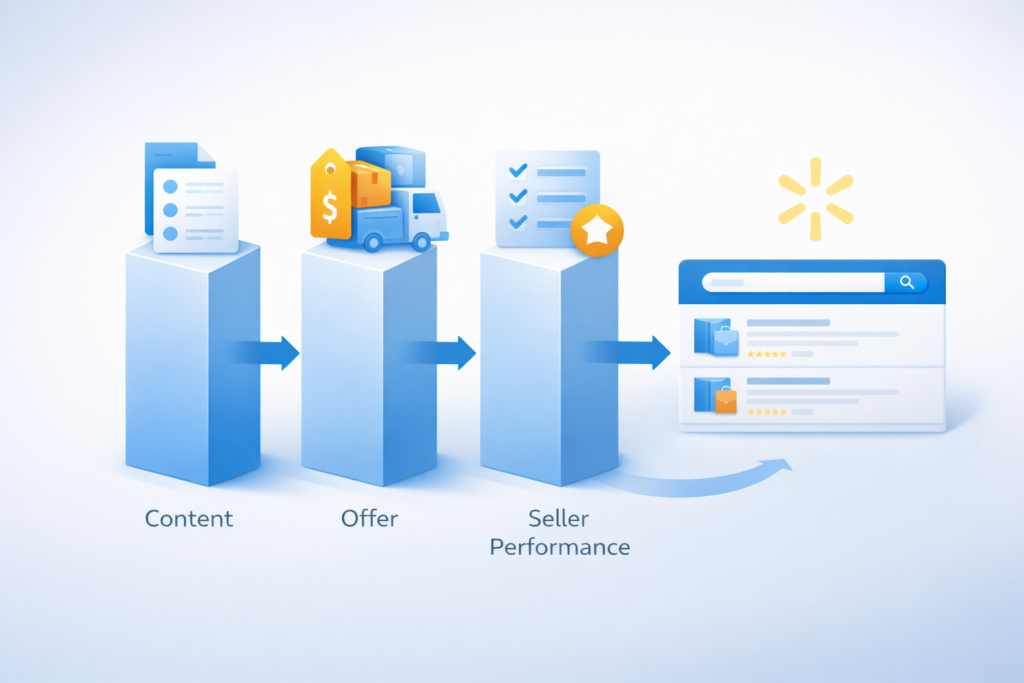
Walmart doesn’t use a single metric to decide which products rank higher or win the Buy Box. Instead, it evaluates listings across three interconnected dimensions that work together to signal quality, reliability, and customer value.
The Three Core Evaluation Factors
1. Content Strength: This measures how complete, accurate, and useful your product information is. Walmart looks at title quality, description depth, attribute completeness, image standards, and category accuracy. Listings with missing or low-quality content are deprioritized in search results because they create poor customer experiences.
2. Offer Competitiveness: Your offer includes pricing, shipping speed, inventory availability, and fulfillment method. Walmart favors listings that provide strong customer value through competitive pricing and fast, reliable delivery. Even perfectly optimized content won’t win the Buy Box if your offer isn’t competitive.
3. Seller Performance: This reflects your track record as a seller. Walmart monitors metrics like Order Defect Rate (ODR), on-time shipping, response time, and customer feedback. Poor performance can suppress even well-optimized listings because Walmart prioritizes reliable sellers who consistently deliver positive experiences.
These three factors don’t operate in isolation. A listing with excellent content but poor seller performance will struggle. Similarly, competitive pricing can’t compensate for incomplete product information. Walmart’s algorithm is designed to reward sellers who excel across all three dimensions simultaneously.
Walmart Content Requirements for Optimized Listings
Content is the foundation of listing optimization. It directly impacts discoverability, conversion, and long-term ranking stability. Understanding Walmart’s content requirements isn’t just about compliance; it’s about creating listings that both the algorithm and customers can trust.
Product Title Requirements
Your product title is the most heavily weighted content element for Walmart SEO. It needs to balance keyword optimization with readability.
Ideal Length: 50-75 characters is the sweet spot. Titles that are too short miss keyword opportunities, while titles over 100 characters often get truncated in search results and mobile displays.
Keyword Placement: Lead with your primary keyword and brand name. The first 50 characters carry the most SEO weight and are guaranteed to display across all devices.
Formatting Rules: Use title case capitalization. Avoid ALL CAPS, special characters, promotional language (“SALE!”), or subjective claims (“Best,” “Amazing”). Walmart’s content standards prohibit these and may flag your listing for review.
Common Title Mistakes:
- Keyword stuffing that makes titles unreadable
- Including size or color variations in the main title (use variants instead)
- Adding shipping or promotional details
- Using competitor brand names
Thinking About Hiring an Expert?
Ecomclips’ Partners Achieve an Average 85% Profit Increase!
Product Description & Key Features
Walmart’s search algorithm reads both your short description (bullet points) and long description. Many sellers underestimate how much content depth matters for ranking.
1. Minimum Content Expectations: Walmart requires at least 1,000 characters in your product description for most categories. However, listings with 1,500-2,000 characters tend to rank better because they provide more keyword context and answer more customer questions.
2. How Walmart Reads Descriptions: The algorithm scans for semantic relevance, not just exact keyword matches. It looks for product benefits, use cases, specifications, and answers to common customer questions. Descriptions that naturally incorporate related terms and answer search intent rank higher.
3. Bullet vs Paragraph Usage: Use bullet points (Key Features) for scannable product highlights and primary benefits. Use paragraph format in the long description for detailed explanations, materials, dimensions, care instructions, and usage scenarios. Both sections contribute to SEO, but bullets drive conversion while paragraphs build ranking depth.
Categories & Attributes
Incorrect categorization is one of the most common reasons listings fail to gain visibility, yet it’s often overlooked by new sellers.
Why Correct Category Selection Matters: Categories determine which browse pages your product appears on and which filters customers can use to find it. A product in the wrong category won’t appear in relevant searches, even with perfect keyword optimization.
Required vs Optional Attributes: Walmart mandates certain attributes based on category (brand, size, color, material, etc.). Listings missing required attributes may be unpublished or hidden from search. Optional attributes aren’t just extra work; they create additional pathways for discovery through filtered search.
Attribute Impact on Filters and Visibility: When customers filter search results by size, color, price range, or features, Walmart only shows listings with those attributes properly filled. Incomplete attributes mean you’re invisible to filtered searches, which represent a significant portion of customer behavior.
Images & Rich Media Standards
Visual content directly impacts both click-through rates and conversion, making it essential for competitive listings.
Image Quantity and Quality: Walmart requires at least one image but recommends 6-8 high-quality images showing different angles, use cases, and scale. Listings with more images consistently outperform those with minimal visuals.
Resolution Requirements: Main images must be at least 2000 x 2000 pixels for zoom functionality. Images below 1000 pixels may display poorly on desktop and create a low-quality impression that hurts conversion.
Role of Videos and Enhanced Media: Video content can increase conversion rates by 30-50% for complex or high-consideration products. Enhanced media like 360-degree views, lifestyle images, and comparison charts signal listing quality to both customers and Walmart’s algorithm.
Offer Competitiveness: Pricing, Shipping & Inventory
Content optimization gets your listing in front of customers, but your offer determines whether you win the sale. Walmart’s algorithm continuously evaluates offer quality as part of its Buy Box and ranking calculations.
Competitive Pricing Expectations
Walmart doesn’t require you to have the lowest price, but it does require your pricing to be competitive within your category. The algorithm compares your price to similar listings, marketplace averages, and Walmart’s own retail pricing. Significant overpricing can suppress your listing or prevent Buy Box eligibility.
Does price affect Walmart ranking? Yes, indirectly. While price isn’t a direct ranking factor in search results, it heavily influences Buy Box eligibility and conversion rate. Lower conversion rates signal poor listing performance, which can reduce your visibility over time.
Shipping Speed Programs
Shipping speed has become increasingly important as customer expectations rise. Walmart prioritizes sellers who can deliver quickly and reliably.
Does shipping speed affect Buy Box? Absolutely. Walmart gives preference to Two-Day Shipping and Walmart Fulfillment Services (WFS) listings. Sellers using economy shipping face a significant disadvantage in Buy Box competition, even with lower prices.
Fast shipping isn’t just about winning today’s sale; it’s about building algorithmic trust. Consistent fast delivery improves your seller score and increases long-term visibility.
Inventory Accuracy
Out-of-stock listings lose ranking momentum and Buy Box eligibility. When your product becomes available again, you’re starting from a weakened position.
Maintain healthy inventory levels and use Walmart’s inventory forecasting tools to avoid stockouts. If you must go out of stock, mark the listing as unavailable rather than leaving it active with zero inventory, which can trigger performance penalties.
How Offer Quality Impacts Conversion
Walmart’s algorithm tracks conversion rate as a key performance indicator. Listings with strong offer competitiveness naturally convert better, which signals quality to the algorithm and creates a positive feedback loop of improved visibility and sales.

Seller Performance Metrics That Affect Visibility
Many new sellers focus exclusively on content and pricing while ignoring the performance metrics that can make or break their visibility. Walmart monitors seller reliability closely because poor performance directly harms the customer experience.
Order Defect Rate (ODR)
Your ODR represents the percentage of orders with problems: cancellations, returns, negative feedback, or chargebacks. Walmart requires sellers to maintain an ODR below 2%.
Why ODR below 2% matters: Exceeding this threshold can result in account suspension, listing suppression, or Buy Box removal. Even approaching the limit (1.5-1.9%) can reduce your competitive standing.
Response Time
Walmart expects sellers to respond to customer inquiries within 48 hours. Faster response times (within 24 hours) correlate with better seller scores and improved Buy Box eligibility.
Fulfillment Accuracy
This measures your on-time shipping rate, valid tracking rate, and delivery performance. Walmart expects 95%+ fulfillment accuracy. Falling below this threshold triggers performance warnings and can lead to listing suppression.
Reviews and Ratings
While not as heavily weighted as on Amazon, product reviews and seller ratings do influence both conversion and algorithmic trust. Products with higher ratings and more reviews tend to rank better in competitive searches.
How Performance Protects Buy Box Eligibility
The Buy Box isn’t awarded solely on price. Walmart’s algorithm balances price competitiveness with seller reliability. A seller with excellent performance metrics can win the Buy Box even with slightly higher pricing because Walmart trusts them to deliver a positive customer experience.
Do’s and Don’ts for Walmart Sellers
Understanding what works and what hurts your listings can save months of trial and error. These guidelines reflect Walmart’s content policies and algorithmic preferences as of 2026.
What to Do
Category Accuracy Always select the most specific, accurate category for your product. When multiple categories seem to fit, choose the one where similar products rank highest and have the most complete attribute options.
Complete Attributes Fill every available attribute field, not just required ones. Each attribute creates another potential discovery pathway and signals listing quality to Walmart’s algorithm.
Clean Titles and Images Use clear, professional product titles that prioritize clarity and keywords. Ensure all images have white backgrounds, proper lighting, and high resolution. Remove any watermarks, borders, or promotional text.
Competitive Offers Regularly benchmark your pricing against competitors. Monitor shipping options and adjust inventory to maintain consistent availability. Use automated repricing tools if managing large catalogs.
What to Avoid
Keyword Stuffing Don’t cram titles or descriptions with repetitive keywords. Walmart’s algorithm recognizes over-optimization and can penalize listings that prioritize keywords over readability.
Wrong Categories Never intentionally miscategorize products to appear in higher-traffic categories. Walmart detects category abuse and will unpublish listings or penalize your seller account.
Duplicate Listings Creating multiple listings for the same product to increase visibility violates Walmart’s policies and will result in listing removal. Use variant grouping for size, color, and style differences instead.
Outdated Inventory Don’t leave out-of-stock items active with zero inventory. This creates a poor customer experience and can trigger performance penalties. Mark items unavailable or remove the listing until restocked.

7 Best Practices for Walmart Listing Optimization in 2026
These practices represent the difference between sellers who struggle for visibility and those who consistently rank well and win the Buy Box.
8.1 Prepare Structured Product Data Before Listing
Don’t upload products haphazardly. Create a standardized product data sheet that includes titles, descriptions, attributes, keywords, and image URLs before you begin listing. This ensures consistency across your catalog and prevents errors that lead to unpublishing.
Use Walmart’s bulk upload templates to maintain data quality at scale. Structured preparation also makes it easier to update multiple listings when you need to adjust keywords or content strategy.
8.2 Standardize Titles, Features & Images
Develop content templates for different product types in your catalog. Standardization improves efficiency, ensures compliance, and creates a professional brand presence across all your listings.
For example, all your shoe listings should follow the same title structure: [Brand] [Product Type] [Key Feature] [Gender]. This consistency helps both customers and Walmart’s algorithm understand your product hierarchy.
8.3 Use Variant Grouping Correctly
Products with multiple sizes, colors, or styles should be grouped as variants under a single parent listing, not created as separate listings. Proper variant grouping consolidates reviews, improves SEO, and prevents the duplicate listing violations mentioned earlier.
Walmart’s variant system allows up to two variation types (like size and color). Ensure all variants share the same core product attributes and differ only in their variation-specific attributes.
8.4 Treat Attributes as a Ranking Tool
Attributes aren’t just compliance checkboxes; they’re sophisticated ranking signals. The more completely and accurately you fill attributes, the more search queries and filtered results your product can appear in.
Pay special attention to attributes like material, features, age range, and intended use. These create semantic connections between your listing and customer search intent.
8.5 Keep Pricing & Inventory Consistent
Use inventory management software that syncs across all your sales channels. Price fluctuations and inventory errors damage customer trust and algorithmic performance.
If you sell on multiple platforms, ensure your Walmart pricing remains competitive without creating race-to-the-bottom situations. Monitor competitor pricing weekly and adjust strategically rather than reactively.
8.6 Use Rich Media to Improve Conversion
Invest in professional product photography and consider adding video content for products where demonstration or scale matters. Enhanced media directly improves conversion rates, which indirectly improves your search ranking through performance signals.
Lifestyle images showing products in use can increase conversion by 20-40% compared to basic product shots alone. This investment pays for itself through improved visibility and sales.
8.7 Prevent Unpublishing with Validation Workflows
Create a checklist system that validates content compliance before publishing. Common unpublishing triggers include missing required attributes, prohibited keywords, image policy violations, and category mismatches.
Use Walmart’s Listing Quality Dashboard to identify and fix issues before they result in unpublishing. Unpublished listings lose all ranking momentum and require time to regain visibility after republishing.
Walmart Keyword Research: What Most Sellers Get Wrong
Keyword research is where most sellers either build a strong foundation or sabotage their entire optimization strategy. The mistakes are predictable and costly.
Why Amazon Keyword Strategy Fails on Walmart
Amazon and Walmart have fundamentally different search algorithms and customer behavior patterns. Keywords that perform well on Amazon often have different search volumes and intent on Walmart.
Amazon customers tend to browse and research extensively. Walmart customers are often more price-conscious and purchase-focused. This means high-converting Walmart keywords tend to be more specific and purchase-intent driven than their Amazon equivalents.
Don’t simply copy your Amazon keyword strategy. Walmart’s search engine interprets queries differently and values different ranking signals.
How Walmart Understands Search Intent
Walmart’s algorithm has become sophisticated at distinguishing between research queries and purchase queries. Someone searching “laptop” is likely browsing, while someone searching “Dell Inspiron 15 3000” is ready to buy.
Your keyword strategy should prioritize purchase-intent keywords, especially in titles and primary attributes. Save broader category keywords for descriptions where they add semantic context without diluting your primary focus.
Difference Between Traffic vs Buying Keywords
Traffic keywords generate impressions but low conversion. “Home decor” is a traffic keyword. Buying keywords indicate specific purchase intent: “farmhouse wall clock 24 inch” is a buying keyword.
New sellers often optimize for traffic keywords because they show higher search volumes in research tools. Experienced sellers know that 100 impressions from buying keywords convert better than 1,000 impressions from traffic keywords.
How to do Walmart keyword research? Start by analyzing competitor listings that rank well for your product type. Use Walmart’s autocomplete suggestions to identify what customers actually search for. Tools like Helium 10, Jungle Scout, and Sellics now include Walmart-specific keyword data. Focus on keywords with clear purchase intent and manageable competition levels.
How to find high-volume Walmart keywords? Balance search volume with relevance and competition. A keyword with 5,000 monthly searches and 50 competitors is often more valuable than one with 20,000 searches and 500 competitors. Look for keywords where you can realistically rank in the top 20 results within 30-60 days.
How to Optimize Walmart Listings to Rank Higher
Understanding optimization principles is one thing; implementing them systematically is another. Here’s how to translate knowledge into ranking improvements.
Keyword Placement Strategy
Not all content fields carry equal SEO weight. Walmart’s algorithm prioritizes title, then category/attributes, then bullet points, then description.
Place your highest-priority keyword in the first 50 characters of your title. Include 2-3 related keywords in your bullet points naturally. Use semantic variations and long-tail keywords in your description to capture additional search queries.
Don’t repeat the exact same keyword phrase more than 2-3 times across your entire listing. Walmart’s algorithm recognizes semantic relationships and doesn’t require exact repetition.
Content Hierarchy
Structure your content to serve both the algorithm and human readers. Your title should immediately communicate what the product is. Your bullets should highlight key benefits and features. Your description should answer detailed questions and provide usage context.
Think of your listing as a funnel: title for algorithm discovery, bullets for customer interest, description for final conviction.
Updating Existing Listings
You can optimize existing listings, but be strategic about it. Major content changes can temporarily destabilize rankings as Walmart’s algorithm re-evaluates your listing.
Make updates during slower sales periods if possible. Change one element at a time (title, then bullets, then description) so you can measure impact. Allow 7-14 days between major updates for the algorithm to adjust.
Avoiding Over-Optimization
More keywords aren’t always better. Titles stuffed with keywords read unnaturally and can trigger content policy violations. Descriptions that repeat the same phrases sound robotic and hurt conversion.
Optimize for humans first, algorithms second. If your content sounds forced or unnatural when read aloud, you’ve over-optimized.
Walmart Seller Readiness Checklist 2026
Use this checklist to evaluate whether your listings meet Walmart’s quality standards and your seller account is positioned for success.
Content Readiness
- Titles are 50-75 characters with primary keyword in first 50 characters
- All required attributes are completed for each product
- Optional attributes are filled where relevant
- Bullet points highlight 4-6 key features/benefits
- Description contains 1,500+ characters with natural keyword integration
- Product is in the most specific, accurate category
- 6-8 high-quality images at 2000×2000 resolution minimum
- Main image has white background and shows product clearly
- No prohibited content in titles or descriptions (promotional language, competitor names)
Offer Readiness
- Pricing is competitive within category (within 15% of market average)
- Shipping method offers 2-day delivery or WFS when possible
- Inventory levels can support 30+ days of forecasted sales
- Buy Box-eligible on primary SKUs
- No pricing errors or extreme fluctuations in last 30 days
Performance Readiness
- Order Defect Rate (ODR) is below 1.5%
- On-time shipment rate is above 95%
- Valid tracking rate is above 95%
- Average customer response time is under 24 hours
- Product ratings are 4.0+ stars where available
- No policy violations or account warnings in last 90 days
Compliance Readiness
- All listings comply with Walmart’s prohibited items policy
- Product claims are accurate and not misleading
- No duplicate listings for same product
- Variant grouping is used correctly for size/color variations
- Brand registry is complete (if selling branded products you own)
- Tax settings are configured correctly for all states
Who This Walmart Listing Optimization Guide Is For
This guide is designed specifically for sellers at different stages of their Walmart journey who need practical, actionable optimization strategies.
New Walmart Sellers If you’re just starting on Walmart Marketplace, this guide provides the foundation you need to launch listings correctly from day one. Understanding these principles early prevents costly mistakes that take months to fix.
Sellers with Low Visibility If you’ve been selling on Walmart but aren’t getting the impressions or sales you expected, this guide helps diagnose what’s missing. Most low-visibility issues trace back to incomplete content, poor keyword targeting, or category mismatches.
Amazon Sellers Moving to Walmart If you’re expanding from Amazon, you’ll discover why your existing optimization strategy needs adaptation. Walmart’s algorithm, customer behavior, and content requirements differ significantly from Amazon’s, and this guide highlights exactly where to adjust.
Brands Scaling SKU Volume If you’re managing dozens or hundreds of SKUs, this guide helps you build systematic, scalable optimization processes. The checklist and best practices are designed to maintain quality as your catalog grows.
Frequently Asked Questions
Q. What is Walmart listing optimization?
Walmart listing optimization is the process of structuring your product content, pricing, and seller performance to meet Walmart’s ranking criteria and maximize both search visibility and sales conversions. It involves optimizing titles, descriptions, images, attributes, pricing, and fulfillment to align with how Walmart’s algorithm evaluates and ranks products.
Q. How long does Walmart SEO take?
Most listings begin showing ranking improvements within 7-14 days of optimization. Significant visibility gains typically occur within 30-60 days, depending on competition level and how comprehensively you’ve optimized. Ongoing optimization is continuous, not a one-time fix.
Q. What causes Walmart listings to be unpublished?
Common causes include missing required attributes, prohibited content in titles or descriptions, category violations, image policy violations (backgrounds, text overlays, watermarks), duplicate listings, and excessive negative seller performance. Regular compliance checks prevent most unpublishing issues.
Q. Can beginners do Walmart SEO?
Yes. Walmart listing optimization is more accessible than many sellers assume. The platform provides clear content guidelines, and the optimization principles in this guide don’t require technical expertise. Beginners who follow systematic processes often outperform experienced sellers using outdated strategies.
Q. What tools help Walmart keyword research?
Helium 10, Jungle Scout, and Sellics offer Walmart-specific keyword research features. Walmart’s own autocomplete suggestions provide valuable customer search data. Free alternatives include analyzing competitor listings and using Google Trends with “Walmart” as a filter to identify seasonal patterns.
Q. Why is my product not ranking?
The most common reasons are incorrect categorization, incomplete attributes, weak keyword targeting in the title, poor seller performance metrics, or uncompetitive pricing/shipping. Use Walmart’s Listing Quality Dashboard to identify specific issues affecting your listings.
Q. Is Walmart listing optimization free?
The core optimization process is free and can be done entirely within Walmart Seller Center. Optional paid tools like keyword research software, professional photography, or listing optimization services can accelerate results but aren’t required. Most sellers achieve strong results with time investment rather than financial investment.
Turning Listing Quality into Long-Term Walmart Growth
Walmart listing optimization in 2026 isn’t about gaming an algorithm or finding shortcuts. It’s about understanding what creates value for customers and structuring your product data to communicate that value clearly to both Walmart’s search system and the shoppers who ultimately make purchase decisions.
The sellers who succeed long-term on Walmart Marketplace are those who view optimization as an ongoing discipline, not a one-time checklist. They monitor performance metrics, adapt to algorithm updates, and continuously refine their content based on customer behavior and competitive changes.
Your listing quality directly determines your visibility, which determines your sales volume, which determines your profitability and growth potential. Every hour invested in proper optimization returns multiples in improved rankings, conversion rates, and reduced customer acquisition costs.
Start with the fundamentals covered in this guide: accurate content, competitive offers, and reliable performance. Build systematic processes using the checklists and best practices outlined here. Measure results consistently and adjust based on data rather than assumptions.
The Walmart Marketplace opportunity in 2026 is substantial, but it rewards sellers who approach optimization strategically and commit to excellence across content, pricing, and customer experience. Whether you’re launching your first product or optimizing your hundredth, these principles create the foundation for sustainable growth.
Read more, how we help sellers in their Walmart Business:
Walmart Ads Tutorial | Beginner’s Guide to Walmart PPC, Campaign Setup, and Keyword Research in 2025
Walmart SEO Tutorial 2025: Rank on Page 1 & Boost Sales Fast
Walmart Just Plugged ChatGPT Into Shopping… The Future Starts Now
Stop Losing Money! Run #Walmart Ads the Right Way
Ecomclips: Your Complete eCommerce Solution Under One Umbrella
At Ecomclips, we bring every eCommerce service you need under one roof — strategy, operations, design, marketing, and growth, all seamlessly connected to help your brand thrive across every marketplace.
Since 2012, we’ve been helping businesses of all sizes launch, scale, and dominate online. From Amazon, Walmart, eBay, and Etsy to Shopify and WooCommerce, our team of marketplace experts, designers, developers, and marketers works together to deliver measurable results.
Our services span the full eCommerce lifecycle:
- Account Setup & Product Listing Management: We handle registrations, compliance, and product data optimization across all marketplaces.
- Amazon Optimization Service: From keyword-rich titles and A+ content to PPC campaigns and storefront design, we craft listings that convert.
- Creative Design & Content Production: A+ visuals, infographics, brand stores, and product videos built to boost engagement.
- Advertising & PPC Management: Smart, data-driven ad strategies for Amazon, Walmart, and Google that maximize ROI.
- Web Development & Store Design: Shopify, WooCommerce, and Magento websites built for performance and conversion.
- Data Management & Automation: Streamlined product feeds, catalog syncing, and inventory control for effortless scalability.
- Customer Service & Order Fulfillment: End-to-end support that enhances customer satisfaction and builds long-term loyalty.
- Analytics & Growth Strategy: Real-time insights and ongoing optimization to ensure consistent, profitable growth.
Whether you’re launching a new store or managing multiple global marketplaces, Ecomclips acts as your single strategic partner, simplifying complexity and driving sustainable revenue growth.
Ready to Start Growing Your Brand?
Ecomclips’ Partners Achieve an Average 85% Profit Increase!