
Is Amazon FBA still worth it in 2026, or did rising fees, brutal competition, and Amazon’s nonstop changes quietly kill the opportunity? If you’ve been scrolling through YouTube lately, you’ve probably seen two completely opposite narratives. One side screaming “Amazon is dead, don’t even try,” and the other promising “easiest money ever, just copy this.”
Here’s the honest truth: neither of those extremes is accurate. The reality of selling on Amazon in 2026 is far more nuanced, and understanding what’s actually happening in the marketplace is critical before you invest a single dollar.
The Numbers That Tell the Real Story
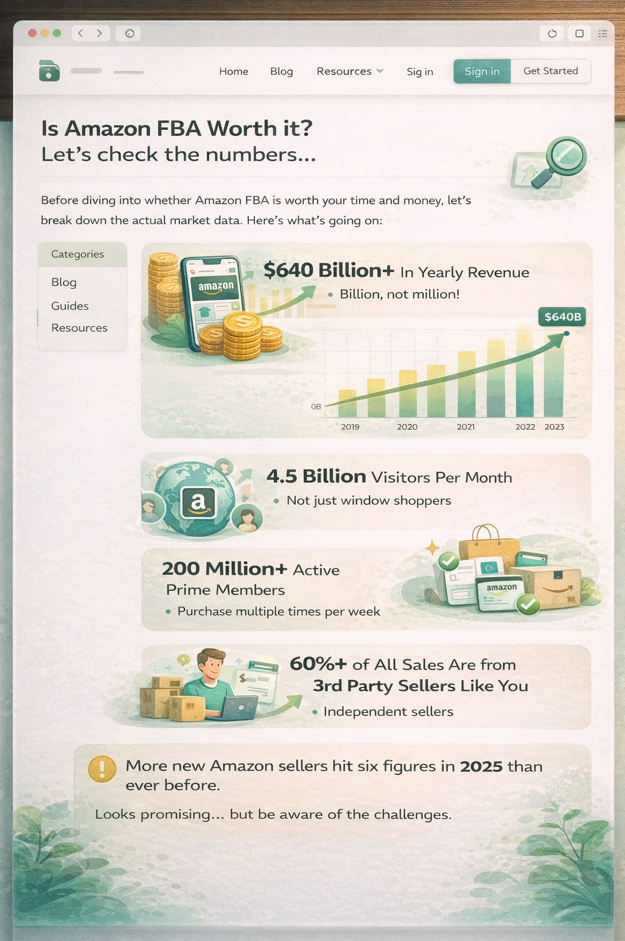
Before we dive into whether Amazon FBA is worth your time and money, let’s look at the actual data. Because context matters when evaluating any business opportunity.
Amazon is pulling in over $640 billion in revenue every single year. Not million—billion. The platform attracts 4.5 billion visitors every month. These aren’t casual browsers; Amazon now has over 200 million active Prime members who buy multiple times per week with their credit cards ready.
Here’s the most important statistic: third-party sellers—people like you and me—now make up over 60% of everything sold on Amazon. That’s not Amazon’s own inventory. That’s independent sellers building profitable businesses on the platform.
And perhaps most encouraging: more new sellers hit six figures in 2025 than in any previous year.
So on paper, the opportunity looks massive. But there’s a catch.
The Harsh Reality: Why Amazon FBA is Harder Than Ever in 2026
The same factors that make Amazon this incredible opportunity are also the exact reasons most sellers fail. If you don’t understand what’s changed in the Amazon ecosystem, you’re going to waste months, lose money, or worse—get your Amazon account suspended before you even get started.
Rising Fulfillment Fees Are Eating Into Margins
Amazon raised fees again at the end of 2025. Effective January 15, 2026, fulfillment fees increased across multiple product categories. For standard-size products priced between $10-$50, fees went up by 8 cents. Products below $10 saw a 5-cent increase, while items above $50 experienced an average increase of 31 cents per unit.
These aren’t massive amounts individually, but they add up quickly. If you don’t know how to source properly or manage your margins with precision, you’re going to feel the pressure. Many sellers who were marginally profitable in 2024 found themselves losing money in 2026 because they didn’t account for these fee increases.
Amazon’s Stricter Enforcement Policies
Amazon rolled out sophisticated detection systems in 2025 designed to catch suspicious listings, low-quality suppliers, review manipulation, intellectual property violations, and poor account health metrics. The platform cares more about customer trust than seller convenience, and they’re not afraid to show it.
Even innocent sellers are getting flagged. One small mistake in your documentation, one IP complaint from a competitor, one batch of products that doesn’t match your listing—and your entire operation can come to a grinding halt. Amazon account management has become a full-time job for serious sellers.
Competition Has Evolved Beyond Recognition
You’re not competing with random people drop-shipping cheap products from AliExpress anymore. In 2026, you’re up against sellers using AI tools for product research, sellers with deep supplier relationships who get better pricing, sellers with actual brand equity, and experienced wholesalers with substantially bigger budgets.
The barrier to entry might look low, but the barrier to profitability has never been higher.
Thinking About Hiring an Amazon Expert?
Ecomclips’ Partners Achieve an Average 85% Profit Increase!
Bad Products Don’t Survive Anymore
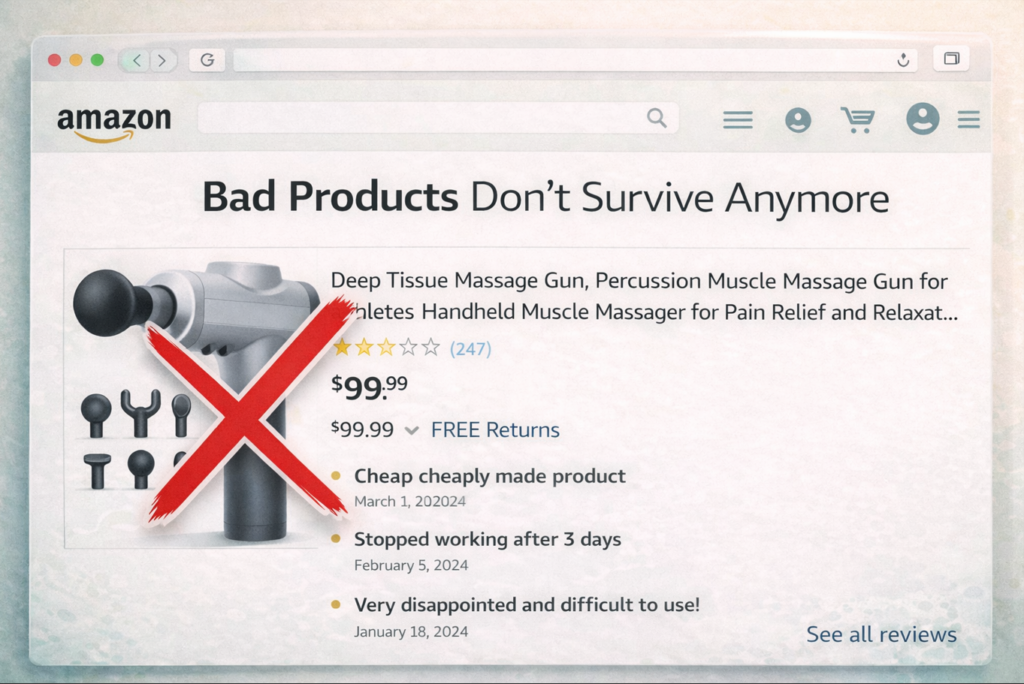
Back in 2018, you could throw up a private label garlic press with mediocre photos and still make sales. In 2026, customers demand strong branding, professional A+ Content design, healthy profit margins, competitive pricing, and genuine value. Without these elements, your product simply won’t survive in today’s marketplace.
Amazon Controls Everything
Storage limits. Inbound shipment rules. Account health standards. Seller verification requirements. Amazon has become a corporate machine, and if you break a rule—even accidentally—they won’t hesitate to shut you down.
Why Most Amazon Sellers Will Fail in 2026
Let’s be brutally honest about something: most sellers don’t fail because Amazon is being unfair. They fail because their business math was broken from the beginning.
Weak Profit Margins
Many private label sellers launch products with 20% to 30% gross margins, thinking that’s sufficient. Then they add advertising costs, returns, storage fees, fulfillment fees, and all the other Amazon expenses. By month two, they’re losing money on every sale.
Ad Dependency
If your product only sells when you’re running Amazon PPC campaigns, you don’t have a business—you’re just renting customers from Amazon. The moment you turn off ads, sales stop. That’s not sustainable.
The Hidden Cost of Returns
Amazon doesn’t show you upfront how much returns will devastate your profitability. In high-return categories, you can appear profitable on paper while actually bleeding cash every single month.
Inventory Costs Eat Your Cash Flow
If your inventory moves slowly, you’re paying placement fees, storage fees, and your cash is locked up doing nothing. This is where many sellers run out of money before they ever become profitable.
Account Risk Is Real
Amazon monitors everything now. They want proper invoices. They watch for IP complaints. They check listing compliance. They track account health metrics. One mistake can suspend your entire account and wipe out months of work.
This is why you hear so many people saying Amazon is dead. It’s not dead—it just stopped rewarding sellers who don’t take it seriously.
The AI Revolution: How Product Discovery Changed Forever in 2026
Here’s the biggest shift that most Amazon sellers are completely missing: AI has fundamentally changed how customers find products.
People aren’t really searching for products anymore. They’re asking AI.
If I need a thermal coffee mug, I don’t scroll through Amazon search results. I ask ChatGPT: “What are the best thermal coffee mugs on Amazon?”
ChatGPT doesn’t just throw random products at me. It asks questions to understand exactly what I need—size, heat retention, budget, design preferences. Once I answer those questions, it filters everything and recommends the best option based on my specific requirements.
Amazon has its own AI assistant called Rufus. Instead of typing keywords into the search bar and manually filtering through hundreds of results, customers just ask Rufus. The AI analyzes their needs and suggests the best products.
This is a seismic shift in how e-commerce works.
How to Optimize Your Amazon Listings for AI in 2026
Old-school search optimization won’t help you anymore. If you want to compete in 2026, you need to optimize your Amazon listings for AI recommendation engines.
AI doesn’t care about keyword stuffing or outdated listing hacks from 2018. AI cares about clarity, confidence, and conversion signals.
Here’s the blueprint we follow at Ecomclips to make our clients’ listings AI-optimized:
1. Your Title Must Explain, Not Impress
AI reads your title like a summary, not an advertisement. Put the product type first, core benefit second, and key variation last. If AI can’t instantly understand what your product is and who it’s for, you’re invisible in AI recommendations.
2. Bullet Points Must Answer Real Questions
Don’t list features—describe use cases. AI looks for “why would someone buy this” signals. Who is this product for? When do they use it? What problem does it remove from their day?
3. Your Description is Now Training Data
Most sellers treat the product description like dead space. That’s a massive mistake in 2026. Write your description like you’re explaining the product to a smart friend. Use natural language, clear scenarios, and simple benefits. That’s exactly how AI learns what your product solves.
4. Backend Search Terms Matter Differently Now
You’re not feeding keywords anymore—you’re feeding context. Related problems, synonyms, situations, buyer intent phrases. AI connects dots. Help it connect the right ones.
5. Reviews Are Ranking Signals, Not Just Social Proof
AI scans reviews to understand product strengths, weaknesses, and customer satisfaction levels. If customers consistently mention the same benefit, AI trusts that information. If they complain about the same issue repeatedly, AI avoids recommending your product.
Your product experience is your SEO now.
6. Conversion Is the Ultimate Signal
If AI recommends your product and people buy it, AI recommends it more. If people skip your listing, you’re done. In 2026, you’re not optimizing for an algorithm—you’re optimizing for a decision-making assistant.
The sellers who understand this fundamental shift are the ones who will dominate Amazon in 2026 and beyond.
The Opportunity in 2026 is Bigger Than Ever (For the Right Sellers)
Despite everything we’ve discussed about increased difficulty, rising fees, and stricter policies, the demand on Amazon hasn’t slowed down at all. In fact, it’s exploding.
More people shop on Amazon today than ever before. More Prime customers. More repeat buyers. More orders placed every single day.
While everyone keeps saying “Amazon is saturated,” the actual numbers tell a completely different story. Over 60% of all products sold on Amazon now come from third-party sellers. And last year, more new sellers hit six figures than in any previous year.
Here’s the critical insight: all these new rules and higher standards are actually good for serious sellers.
Why? Because they remove the people who just buy random stuff off AliExpress and pray it works. They eliminate sellers who can’t follow basic compliance requirements. The more Amazon raises the bar, the less real competition you actually face.
What’s left are sellers who pick the right business model, build real supplier relationships, understand margin calculation, and treat Amazon like an actual business.
Those sellers are still winning. Massively.
The Right Amazon FBA Business Model for 2026: Wholesale
If I had to start selling on Amazon all over again today, there’s only one model I would use: wholesale. Also called the middleman business model.
This is the easiest and safest way for beginners to start in 2026.
Instead of creating your own product, building a brand from scratch, paying for advertising to generate initial sales, or guessing what might sell, you simply sell products that already have proven demand.
How the Wholesale Model Works
Step One: Find brand-name products that people already buy every day on Amazon. Think Dettol, Colgate, Duracell—trusted brands with established customer bases.
Step Two: Contact suppliers who sell those products. You can go directly to the brand or work with wholesale distributors and local suppliers. Ask to open a trade account.
Step Three: Request their price list. This shows you everything they sell and what they charge for each product.
Step Four: Use software like Keepa to analyze Amazon sales data. You’re looking at sales history, price trends, and demand patterns. You’re not guessing—you’re working with real numbers.
Step Five: Compare the supplier’s price with the Amazon selling price. If there’s profit after Amazon fees, you buy the inventory.
Step Six: Ship the products to Amazon’s warehouse. Amazon handles all the packing, picking, and shipping. You don’t touch inventory after it leaves your hands.
Step Seven: Repeat and scale.
You’re not building a brand. You’re not spending money on Amazon advertising. You’re not trying to generate reviews from zero. You’re simply acting as the middleman between established brands and Amazon customers.
In 2026, this strategy works better than ever because customers want safe, trusted products. They’d rather buy Dettol than risk trying some random no-name brand.
Product Research Strategy for Wholesale in 2026
Product research for wholesale doesn’t require expensive tools or complicated processes. We do it manually using Alibaba and cross-reference everything on Amazon using Keepa.
Here’s the process:
Search for product categories on Alibaba—kitchen tools, baby products, electronics accessories, whatever interests you. Browse suppliers and look for branded products or those with strong supplier relationships.
Cross-reference those products on Amazon using Keepa. Check if they’re selling consistently, review the price history, analyze the sales rank, and evaluate listing competition.
If the numbers look promising, reach out to the supplier. Negotiate pricing, request a complete price list, and calculate your margins after all Amazon fees.
If it works on paper, order a test batch. Send it to Amazon FBA. Monitor performance closely. If it sells well, scale your orders.
It’s methodical. It’s not glamorous. But it works consistently.
Frequently Asked Questions About Amazon FBA in 2026
Is Amazon FBA still profitable in 2026?
Yes, Amazon FBA remains highly profitable for sellers who choose the right business model, understand margin management, and treat it as a real business rather than a get-rich-quick scheme. The sellers hitting six figures increased in 2025 compared to previous years, proving the opportunity still exists for those willing to approach it seriously.
What are the biggest challenges facing Amazon sellers in 2026?
The primary challenges include increased fulfillment fees, stricter account health enforcement, evolved competition using AI tools, the shift toward AI-based product discovery, and Amazon’s tighter control over inventory and compliance standards. Sellers must adapt to these changes rather than using outdated strategies from 2018 or 2020.
How much money do I need to start Amazon FBA in 2026?
For wholesale FBA, you can start with $2,000 to $5,000 for initial inventory, though having $10,000+ gives you more flexibility and room for testing. Private label requires significantly more capital—typically $10,000 to $25,000 minimum when accounting for product development, inventory, photography, and initial advertising.
Should I do private label or wholesale on Amazon in 2026?
For beginners in 2026, wholesale offers lower risk, faster results, and proven demand. Private label provides higher profit margins but requires more capital, longer timeframes, and greater expertise. Most successful sellers start with wholesale to generate cash flow, then expand into private label once they understand Amazon’s ecosystem.
How has AI changed Amazon selling in 2026?
AI has fundamentally transformed product discovery on Amazon. Customers now use ChatGPT and Amazon’s Rufus AI to find products rather than manually searching. This means sellers must optimize listings for AI recommendation engines, focusing on clarity, use cases, natural language, and genuine value rather than keyword stuffing and outdated SEO tactics.
What’s the best way to avoid Amazon account suspension in 2026?
Maintain impeccable account health by ensuring proper supplier documentation, avoiding IP violations, monitoring performance metrics closely, following all compliance requirements, keeping authentic invoices for all inventory, and partnering with experts who understand Amazon’s current policies and enforcement systems.
Can you still make money on Amazon without paid advertising?
Yes, particularly with wholesale products from established brands. These products already have customer awareness and organic search traffic. While advertising accelerates growth, it’s not absolutely required if you choose products with existing demand and optimize listings properly for both traditional search and AI discovery.
What are the most important metrics to track as an Amazon seller in 2026?
Focus on net profit margin (after all fees), inventory turnover rate, return rate by product, advertising cost of sale (ACoS), account health rating, customer feedback score, and cash flow. Many sellers track revenue but ignore profitability, which leads to business failure despite appearing successful.
How Ecomclips Can Help on the Issue
When you’re staring at that yellow banner or worse, a suspension notice, every decision matters. One wrong move in your appeal can be the difference between reinstatement and permanent deactivation. This is where Ecomclips steps in as your strategic partner.
We’ve successfully resolved hundreds of account health issues for Amazon sellers, from straightforward metric problems to complex intellectual property disputes. Our team understands Amazon’s internal review processes because we’ve navigated them countless times. We know what appeals officers look for, which documentation carries weight, and how to craft Plans of Action that get accounts reinstated.
But our relationship with sellers doesn’t stop at crisis management. We work proactively to prevent issues before they escalate, implementing monitoring systems and compliance protocols that keep your account in good standing month after month.
Whether you’re facing your first policy violation or dealing with a suspended account, Ecomclips brings the expertise to guide you through Amazon’s complex requirements and get your business back on track.
Ecomclips: Your Complete eCommerce Solution Under One Umbrella
At Ecomclips, we bring every eCommerce service you need under one roof—strategy, operations, design, marketing, and growth, all seamlessly connected to help your brand thrive across every marketplace.
Since 2012, we’ve been helping businesses of all sizes launch, scale, and dominate online. From Amazon,Walmart,eBay, and Etsy to Shopify and WooCommerce, our team of marketplace experts, designers, developers, and marketers works together to deliver measurable results.
Our services span the full eCommerce lifecycle:
Account Setup & Product Listing Management: We handle registrations, compliance, and product data optimization across all marketplaces.
Amazon Optimization Service: From keyword-rich titles and A+ content to PPC campaigns and storefront design, we craft listings that convert.
Creative Design & Content Production: A+ visuals, infographics, brand stores, and product videos built to boost engagement through our creative graphics services.
Advertising & PPC Management: Smart, data-driven ad strategies for Amazon, Walmart, and Google that maximize ROI.
Web Development & Store Design: Shopify,WooCommerce, and Magento websites built for performance and conversion.
Data Management & Automation: Streamlined product feeds, catalog syncing, and inventory control for effortless scalability.
Customer Service & Order Fulfillment: End-to-end support that enhances customer satisfaction and builds long-term loyalty.
Analytics & Growth Strategy: Real-time insights and ongoing optimization to ensure consistent, profitable growth.
Whether you’re launching a new store or managing multiple global marketplaces, Ecomclips acts as your single strategic partner, simplifying complexity and driving sustainable revenue growth.
Conclusion: The Truth About Amazon FBA in 2026
So is Amazon FBA worth it in 2026? Absolutely—but only if you approach it as a real business rather than a side hustle or passive income scheme.
The opportunity is bigger than ever. The platform generates over $640 billion annually, attracts 4.5 billion monthly visitors, and third-party sellers control 60% of all sales. More sellers hit six figures in 2025 than any previous year.
But Amazon has evolved. Fees are higher, enforcement is stricter, competition is smarter, and AI has changed how customers discover products. The sellers who ignore these changes will fail. The sellers who adapt will thrive.
Success in 2026 requires choosing the right business model (wholesale for beginners), understanding the new AI-driven discovery landscape, optimizing listings for clarity and value, managing margins with precision, maintaining account health obsessively, and treating Amazon like the sophisticated platform it has become.
If you’re ready to commit to doing things properly, Amazon FBA in 2026 offers one of the most accessible paths to building a substantial online business. But if you’re looking for easy money with minimal effort, you’ll be disappointed.
The choice is yours. Amazon hasn’t killed the opportunity it’s simply raised the standards. And for serious sellers willing to meet those standards, the rewards have never been greater.
Ready to Start Growing Your Brand?
Ecomclips’ Partners Achieve an Average 85% Profit Increase!