
If you run an Etsy shop, you already know that having beautiful products is only half the battle. The other half is making sure people can actually find them. That’s where Search Engine Optimization or SEO comes in.
Etsy SEO is not just a buzzword. It is a powerful, systematic process that can dramatically improve the visibility of your shop and listings not only within Etsy’s own search results but also on major search engines like Google, Bing, and Yahoo. In a marketplace with millions of active sellers, appearing at the top of search results can be the difference between a thriving shop and one that barely gets noticed.
The goal of any search engine is simple: help people find exactly what they are looking for. But SEO can feel overwhelming, especially because search engines frequently update how they rank results. While there is no guaranteed way to claim the top spot in search results, there are proven best practices that consistently help sellers improve their shop’s discoverability.
In this guide, we will break down the complete Etsy SEO strategy, from understanding the two types of SEO relevant to your shop to optimizing every element of your listings and shop pages for maximum visibility.
The Two Types of SEO on Etsy
Before diving into tactics, it is essential to understand that there are two distinct types of SEO relevant to Etsy sellers:
1. Etsy SEO
Etsy SEO refers specifically to searches that happen directly on Etsy.com. When a shopper types a query into Etsy’s search bar, Etsy’s internal algorithm determines which listings appear first. This algorithm considers factors like keyword relevance, listing quality score, shipping price, recency, and customer review history.
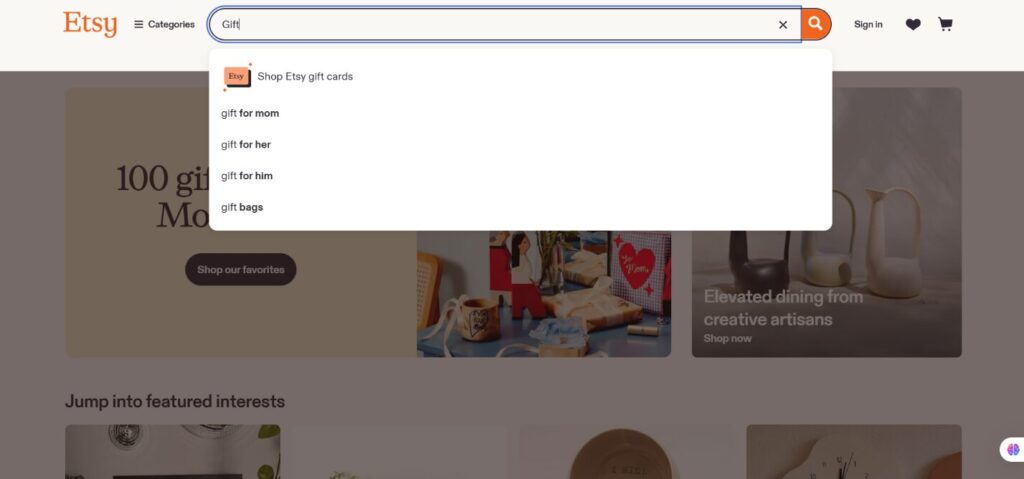
Etsy SEO is the foundation of in-platform discoverability. If your listings are not optimized for Etsy search, you are missing out on shoppers who are already on the platform and ready to buy.
2. Google SEO
Google SEO refers to searches that happen on Google, the world’s largest search engine by a significant margin. Optimizing your Etsy shop for Google searches unlocks an entirely new audience of potential buyers who may never have visited Etsy directly but are actively searching for the types of products you sell.
While other search engines like Bing and Yahoo also index Etsy listings, Google dominates global search traffic. Optimizing for Google is the most impactful external SEO investment you can make as an Etsy seller.
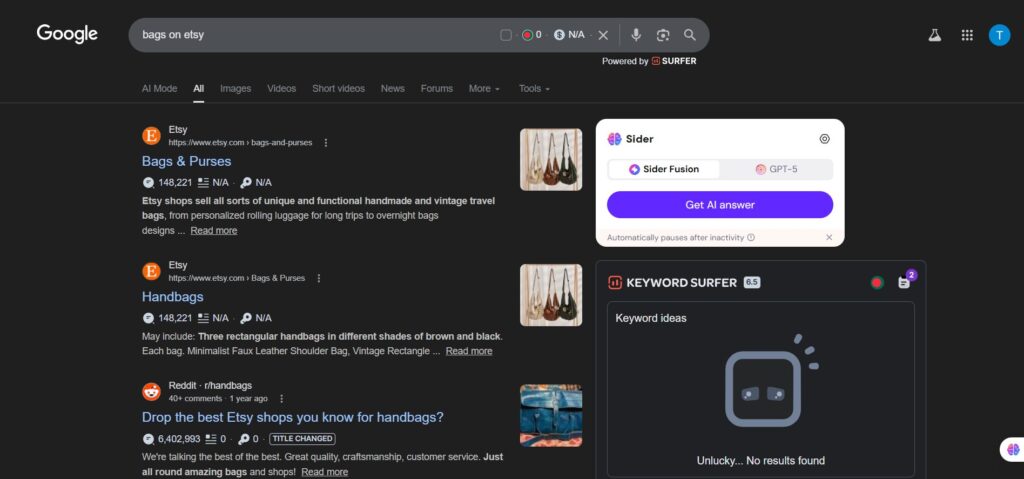
The good news is that the optimization strategies for both Etsy SEO and Google SEO are largely aligned, with a few additional considerations for Google that we will cover throughout this guide.
| Area | Etsy SEO | Google SEO |
| Search location | Etsy search bar | Google search results |
| Main goal | Match buyer searches inside Etsy | Bring external traffic to Etsy listings |
| Key optimisation areas | Titles, tags, attributes, categories, listing quality | Titles, descriptions, image SEO, shop content, backlinks |
| Buyer intent | Usually closer to purchase | Can be research-based or purchase-based |
| Best strategy | Optimise listings for conversion and relevancy | Make listings clear, descriptive, and indexable |
How Etsy Search Actually Ranks Listings
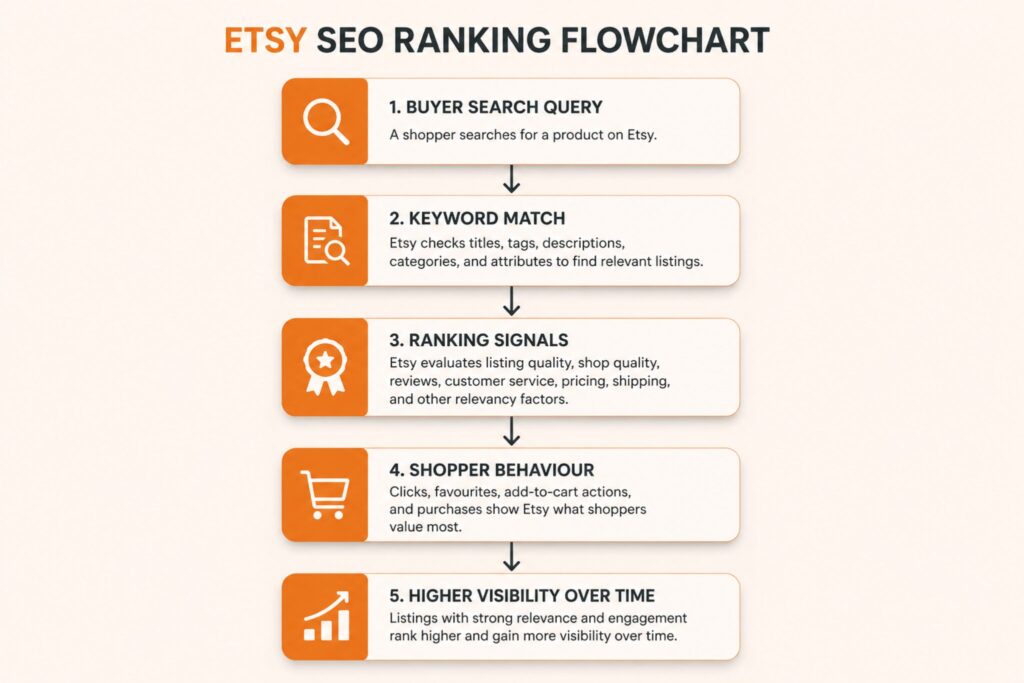
Etsy SEO is not only about adding keywords to your title and hoping your product appears at the top. Etsy search works in a more layered way. First, Etsy looks at the shopper’s search query and checks which listings are relevant to that search. Then, from those relevant listings, Etsy decides which products are most likely to satisfy the buyer.
This means your listing needs to do two things at the same time: it must clearly match what the shopper is searching for, and it must show Etsy that buyers are likely to click, engage, and purchase.
For example, if someone searches for “personalised silver necklace”, Etsy will first look for listings that include related terms in important areas such as the title, tags, description, categories, and attributes. But matching the keyword alone is not enough. Etsy also considers how strong the listing is overall, including product images, pricing, reviews, shipping details, customer service history, and past buyer behaviour.
That is why a well-optimised Etsy listing is not just keyword-rich. It is also complete, clear, trustworthy, and attractive to real shoppers. A listing with a relevant title, accurate tags, detailed attributes, high-quality images, positive reviews, and a strong conversion rate has a better chance of performing well in search over time.
You can think of Etsy ranking as a simple process:
Search match → Listing quality → Shopper engagement → Purchase potential
The stronger each part is, the more competitive your listing becomes. This is why Etsy SEO should never be treated as a one-time title update. It is an ongoing process of improving your keywords, content, visuals, shop experience, and customer trust.
How to Get Started with Etsy SEO
Before you begin optimizing individual listings and shop pages, there are two foundational steps that will shape your entire SEO strategy.

Think About What Makes Your Product Great
The very first step in any effective SEO strategy is also the simplest: understand what makes your products and shop genuinely valuable. SEO is not about tricking search engines. It is about clearly communicating the authentic value of what you offer so that both algorithms and shoppers can recognize it.
Take time to carefully review every item in your shop and ask yourself:
- What makes this product different from similar items?
- Who is the ideal buyer for this product?
- What specific problem does this product solve or what experience does it create?
- What materials, techniques, or stories make this product unique?
These answers will directly inform the language you use in your titles, descriptions, and tags the core building blocks of your SEO.
Think Like a Shopper: Keyword Research
Keywords are the words and phrases that shoppers type into search engines when looking for products. Selecting the right keywords is one of the most critical and impactful steps in your Etsy SEO strategy.
The most important mindset shift here is this: stop thinking like a seller and start thinking like a buyer. A seller might describe a handmade item as “artisan ceramic vessel with organic glaze.” A buyer, however, might simply search “handmade coffee mug” or “rustic pottery gift.” The keywords that matter are the ones your customers naturally use.

To identify the best keywords for your shop and listings:
- Brainstorm terms a shopper would use to search for your product
- Use Etsy’s search bar to explore auto-suggestions
- Study the titles and tags used by top-ranking competitors
- Consider occasion-based terms like “mother’s day gift” or “wedding favor”
- Include descriptors like color, material, size, and style
Keyword research is not a one-time exercise. As trends shift and new search patterns emerge, revisiting and refreshing your keywords regularly will keep your listings competitive.
Useful Etsy SEO Tools: EtsyHunt and Alura
While you can start Etsy keyword research manually using Etsy’s search bar, competitor listings, and customer behaviour, SEO tools can make the process faster and more data-driven. Two popular tools many Etsy sellers use for research and optimisation are EtsyHunt and Alura.
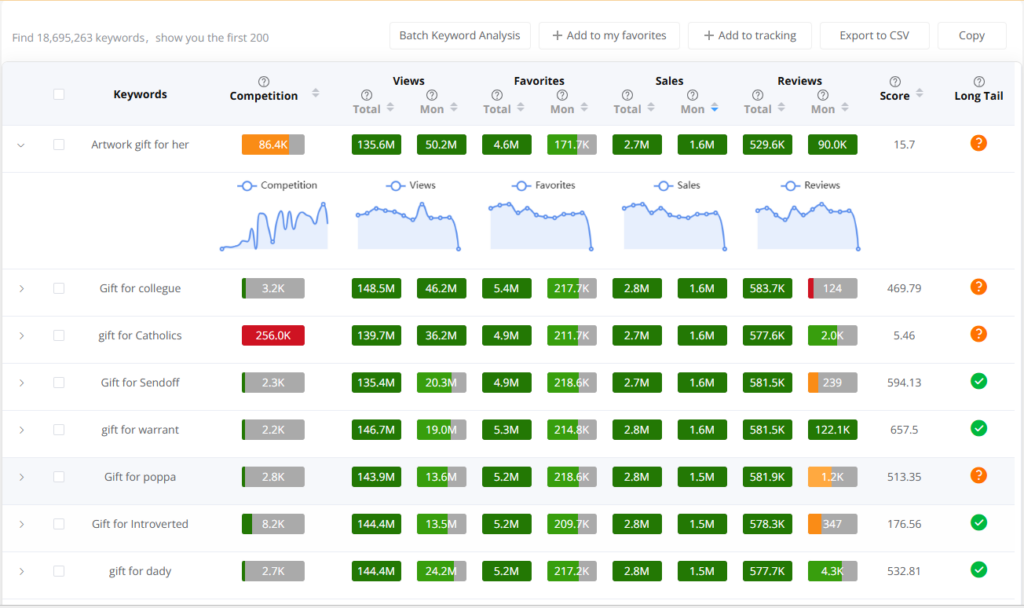
EtsyHunt can be useful when you want to explore Etsy keywords, analyse product trends, study competitor listings, and identify keyword opportunities with stronger demand. Instead of guessing which terms buyers might use, sellers can use EtsyHunt to look at keyword ideas, tags, product performance patterns, views, favourites, pricing, and other listing-related data.
Alura is another helpful Etsy seller tool, especially for sellers who want keyword research, product research, listing optimisation, and shop management features in one place. It can help sellers discover product opportunities, optimise listings with better keywords, and manage parts of their Etsy workflow more efficiently.
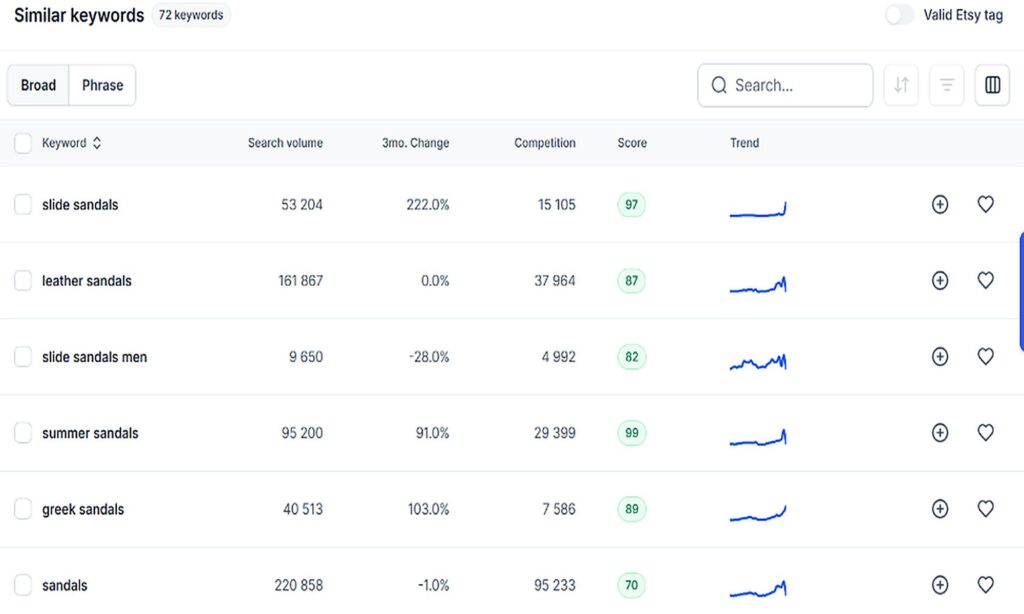
However, tools should support your strategy, not replace your judgement. A keyword may look attractive in a tool, but it still needs to match your product, your buyer intent, and your shop positioning. The best approach is to combine tool-based research with real Etsy search behaviour,
EtsyHunt and Alura can help you find better keyword opportunities, understand the competitive landscape, and make smarter optimisation decisions. But strong Etsy SEO still depends on relevance, clarity, product quality, conversion-focused images, reviews, and ongoing testing.
How to Optimize Your Etsy Shop Pages
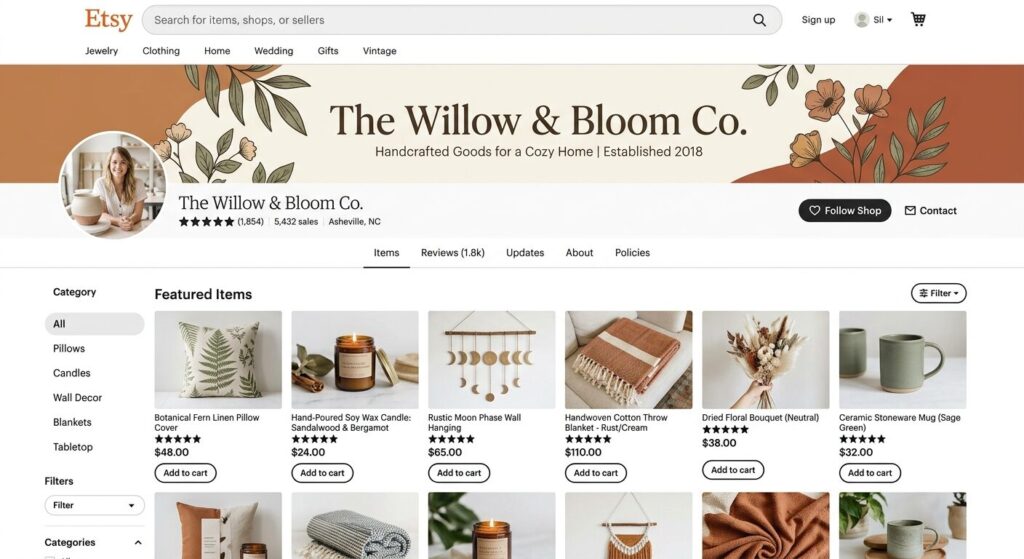
Your shop page is your storefront. Just like a physical shop, first impressions matter and for search engines, the content on your shop page signals what your business is about and how trustworthy you are. There are four key SEO elements on your shop page that you should optimize.
1. Shop Title
Your shop title is one of the first things Google sees when it crawls your Etsy shop. It appears directly beneath your shop name on your homepage and can be up to 55 characters long.
Use this limited space wisely. Your shop title should briefly but clearly describe your shop and the products you sell. This helps Google understand the category and nature of your business, which improves the relevance of your shop in search results.
A weak shop title: “Jane’s Creations”
A strong shop title: “Handmade Ceramic Mugs & Pottery Gifts | Jane’s Creations”
The stronger title immediately communicates the product category, material, and use case, all of which are likely to be searched by potential buyers.
2. Shop Description
Your shop description is prime real estate for SEO. It appears beneath your shop name on your homepage and gives you the opportunity to tell your story, demonstrate expertise, and naturally incorporate relevant keywords.
Google places significant value on expertise, authoritativeness, and trustworthiness often referred to as E-A-T. A well-written shop description helps establish all three. Use it to:
- Share your background and how you got started
- Describe your creative process and craftsmanship
- Highlight your years of experience or specialization
- Mention the materials, techniques, or inspirations behind your work
- Naturally include keywords relevant to your product category

To update your shop description, go to Shop Manager, select your shop name under Sales Channels, select Edit Shop, then click Edit next to the text beneath your shop name.
3. Images and Video
Visual content plays an important but often overlooked role in SEO. Etsy allows you to add up to five images and one video to your About section. These visuals serve multiple strategic purposes:
- They increase buyer engagement and time spent on your shop page
- They build trust by showing the human side of your business
- They signal professionalism to both buyers and search engines
- They provide Google with rich media to associate with your brand
4. Shop Policies
Consider showcasing your workspace, your creative process, behind-the-scenes production, or a range of your most popular products. A short video showing how your items are made can be especially powerful for building connection and credibility.
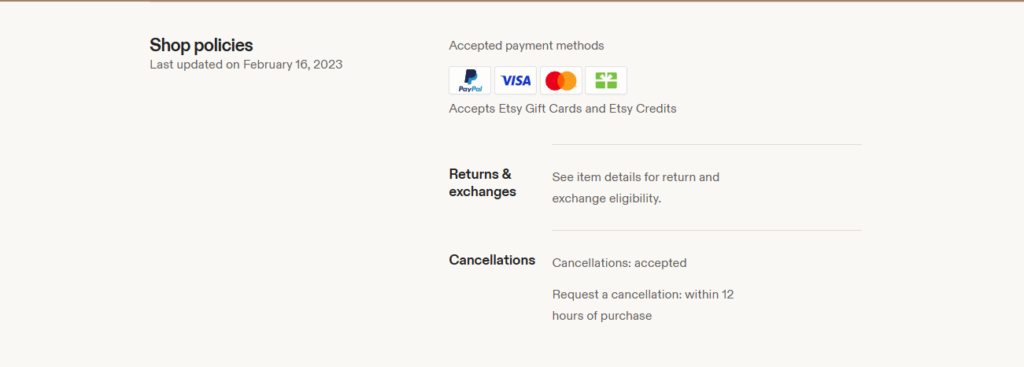
Completing your shop policies section is not just a good business practice , it is also an SEO signal. A fully completed policies section demonstrates to both Google and potential buyers that your shop is legitimate, transparent, and trustworthy.
Your policies should include detailed information about:
- Shipping methods, carriers, and estimated delivery times
- Accepted payment options
- Return and exchange conditions
- Custom order terms and timelines
- Privacy and data handling (if applicable)
Buyers frequently check return and exchange policies before making a purchase decision. A clear, customer-friendly policy can directly increase conversions and higher conversion rates positively impact your SEO performance.
How to Optimize Etsy Listings for SEO
If your shop page is your storefront, your listings are your product shelves. Each listing is an individual page that search engines can index and rank. Optimizing every listing is therefore one of the highest-impact activities you can undertake for your Etsy SEO.

Listing Titles That Search Engines Love
Your listing title is the single most important SEO element for individual product pages. It is the first thing search engines read to understand what your product is, and it heavily influences ranking in both Etsy search and Google.
Best practices for listing titles:
- Place the most important keyword at the beginning of the title
- Use all available characters (Etsy allows up to 140 characters)
- Include relevant descriptors: material, color, size, occasion, recipient
- Avoid unnecessary filler words or punctuation that reduce readability
- Write titles that are clear and readable not just keyword-stuffed
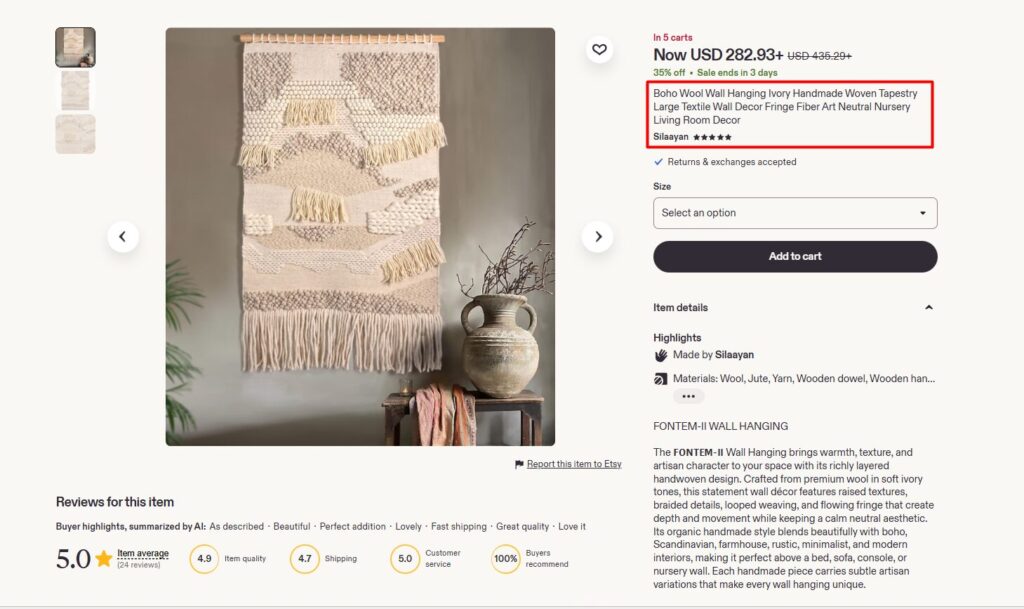
A well-crafted title communicates to shoppers and search algorithms exactly what the product is and why it is relevant to their search.
Listing Descriptions That Convert and Rank
Your product description serves two masters: search engines and human buyers. A great description satisfies both by being informative, engaging, and naturally rich in relevant keywords.
Google indexes the text content of your listing pages, so descriptions that include relevant search terms can help your listings appear in Google image search and product search results. However, keyword stuffing unnaturally forcing keywords into every sentence can actually hurt your rankings and alienates real buyers.
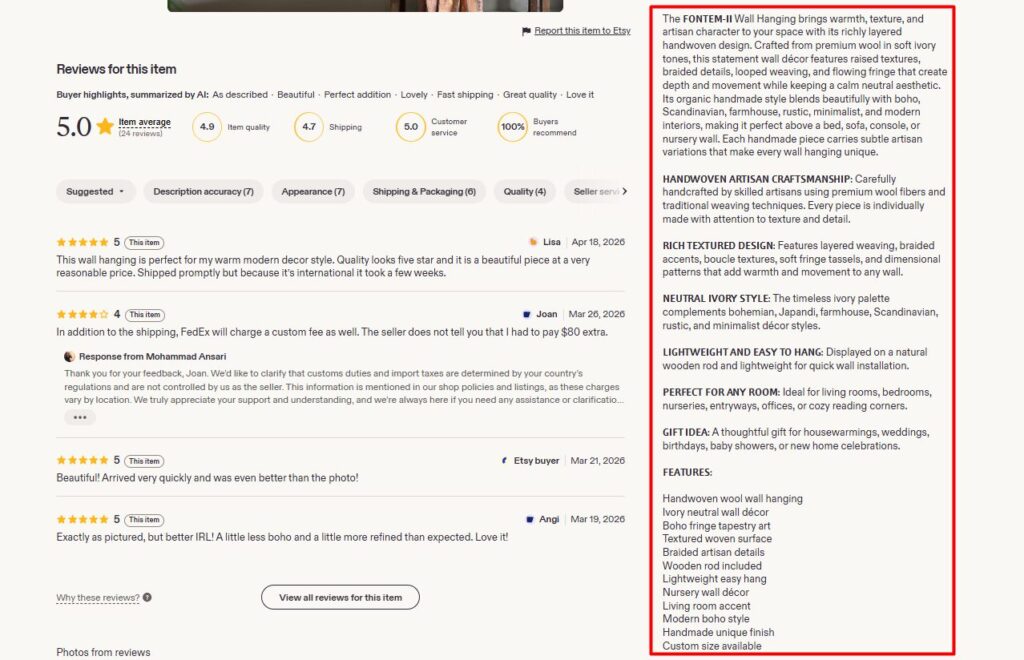
An effective listing description should include:
- A compelling opening sentence that describes the product and its primary benefit
- Detailed product specifications: size, material, weight, color options
- Use cases and occasions: who would love this and when would they use it
- Care and handling instructions where relevant
- Shipping and processing time details
- A call to action encouraging the buyer to purchase or message you with questions
Tags: Your Secret SEO Weapon
Etsy allows you to add up to 13 tags to each listing. Tags are essentially additional keywords that help Etsy’s algorithm match your listings to relevant searches. They are separate from your title but equally important.
Strategic tagging tips:
- Use all 13 available tag slots leave none empty
- Use multi-word tags (long-tail keywords) rather than single generic words
- Avoid repeating words already in your title use tags to expand your keyword reach
- Include occasion tags: birthday gift, anniversary, Christmas, housewarming
- Add style tags: minimalist, boho, vintage, modern, rustic
- Think about who the recipient might be: gift for her, gift for dad, teacher gift
Listing Images: Optimized for Humans and Algorithms
Product images are the most powerful conversion tool in your listings, but they also have an SEO dimension that many sellers overlook. Google’s image search represents a significant source of organic discovery, and optimized listing images can drive visitors directly to your shop.
Image SEO best practices:
- Use high-resolution images that clearly show the product
- Include lifestyle images that show the product in use
- Use all available image slots Etsy allows up to 10 per listing
- Add descriptive alt text to images using relevant keywords (where Etsy allows)
- Include scale references so buyers understand product size
Advanced SEO Strategies for Etsy Sellers
Once you have mastered the fundamentals, there are several advanced strategies that can give your shop a competitive edge.
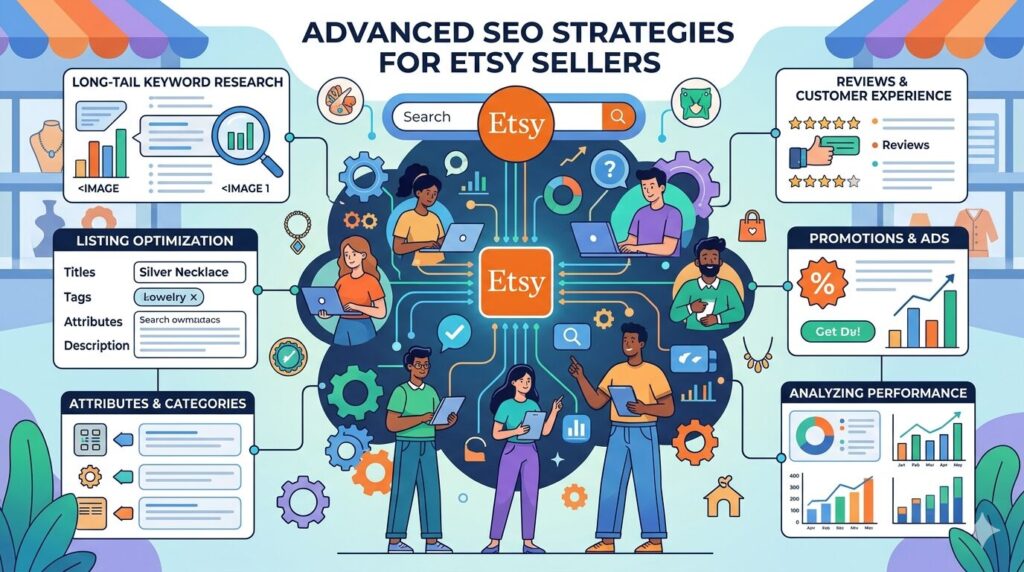
1. Leverage Seasonal and Trend-Based Keywords
Search behavior on Etsy and Google changes throughout the year. Shoppers search differently in December than they do in June. Savvy sellers adapt their keyword strategies to capitalize on seasonal demand.
Plan ahead for major shopping events and holidays such as Valentine’s Day, Mother’s Day, Christmas, and back-to-school season. Update your titles, descriptions, and tags to reflect seasonal search terms several weeks in advance to give search engines time to index your changes.
2. Maintain Listing Freshness
Etsy’s algorithm gives a ranking boost to recently updated and newly listed items. Regularly refreshing your listings even minor updates to descriptions or swapping out an image signals activity to the algorithm and can temporarily improve your visibility.
Consider creating a consistent schedule for reviewing and refreshing your listings, particularly your best sellers and highest-traffic items.
3. Build External Backlinks to Your Shop
Google ranks pages in part based on how many other credible websites link to them — a concept known as backlink authority. While Etsy’s domain authority is already strong, building external links specifically to your shop or listings can further improve their individual ranking potential.
Ways to build backlinks to your Etsy shop:
- Share listings on social media platforms (Pinterest is particularly powerful for Etsy sellers)
- Reach out to bloggers and influencers in your niche for features or reviews
- Submit your shop to gift guides and product round-up articles
- Start a blog or YouTube channel related to your craft and link back to your shop
4. Monitor and Iterate with Etsy’s Built-In Analytics
Etsy provides sellers with detailed analytics through Shop Manager. Regularly reviewing your analytics is essential for understanding which SEO strategies are working and where there is room for improvement.
Key metrics to track:
- Traffic sources: how shoppers are finding your listings (Etsy search, Google, social)
- Top search terms that drive visits to your shop
- Conversion rate per listing: which listings turn views into sales most effectively
- Favorites and wishlists as indicators of interest
Why Reviews Matter for Etsy SEO?
Customer reviews are one of the most powerful ranking factors in Etsy’s algorithm and they are also a trust signal for Google. A shop with a high volume of positive, recent reviews signals to both search engines and shoppers that it is reliable, professional, and delivers genuine value.
Reviews serve a dual purpose in your SEO strategy:
- They improve your listing quality score within Etsy’s algorithm, which boosts placement in Etsy search results
- They add fresh, keyword-rich user-generated content to your listing pages content that Google indexes and values
- They build social proof that increases click-through rates from search results
Proactively encourage satisfied customers to leave reviews. Include a friendly message in your packaging or send a follow-up Etsy message after delivery. Great reviews are a compounding asset the more you accumulate, the stronger your SEO position becomes.
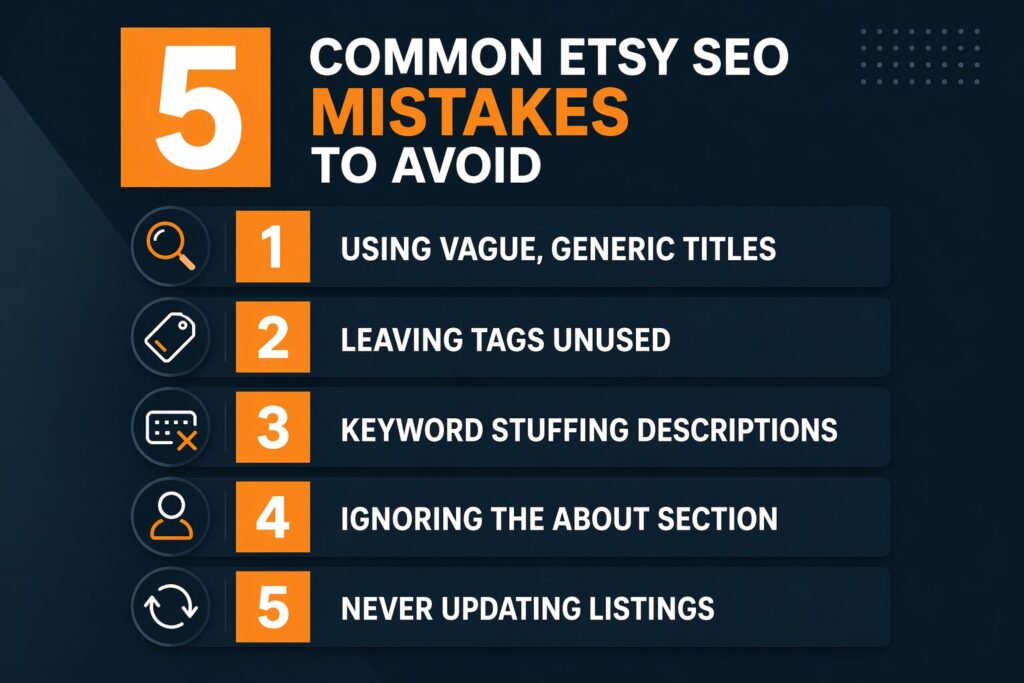
Common Etsy SEO Mistakes to Avoid
Understanding what not to do is just as important as knowing what to do. These are the most common SEO mistakes Etsy sellers make and how to avoid them.
- Using Vague, Generic Titles: A title like “Beautiful Necklace” tells neither shoppers nor search engines what makes your product unique or relevant. Always be specific: “Dainty Gold Layered Necklace | Minimalist Jewelry Gift for Women”.
- Leaving Tags Unused: Every unused tag is a missed opportunity to be discovered. Always fill all 13 tag slots with targeted, multi-word keywords that cover different ways buyers might search for your product.
- Keyword Stuffing Descriptions: Cramming every possible keyword into your description makes it unreadable for buyers and can actually trigger spam filters. Write naturally for humans first, and let keywords flow organically through the content.
- Ignoring the About Section: Many sellers skip the About section entirely, missing a valuable opportunity to build brand trust, add keyword-rich content, and showcase their story all of which contribute positively to SEO.
- Never Updating Listings: Static, unchanged listings gradually lose visibility over time. Regularly updating your titles, descriptions, and tags especially ahead of peak shopping seasons keeps your listings fresh and competitive in search rankings.
Conclusion
Etsy SEO is not a one-time task it is an ongoing strategy that rewards consistency, curiosity, and a genuine commitment to serving your buyers well. When you optimize your shop and listings with both search engines and real shoppers in mind, the results compound over time.
Start with the fundamentals: a keyword-rich shop title and description, complete shop policies, compelling listing titles and descriptions, and fully utilized tags. Build from there with strong visual content, regular listing updates, external promotion, and a strategy for generating customer reviews.
There is no shortcut to the top of search results, and there is no guarantee of a specific ranking. But sellers who apply these best practices consistently, monitor their analytics, and adapt their approach based on real data will build a shop that grows in visibility, traffic, and sales month after month.
Your products deserve to be found. With the right Etsy SEO strategy, they will be.
FAQS:
1. What is Etsy SEO?
Etsy SEO is the process of optimising your shop and listings so shoppers can find your products more easily on Etsy search and search engines like Google.
2. Why is Etsy SEO important for sellers?
It helps increase visibility, attract more relevant shoppers, and improve the chances of getting more traffic and sales.
3. What is the difference between Etsy SEO and Google SEO?
Etsy SEO focuses on ranking inside Etsy search, while Google SEO helps your Etsy shop and listings appear in external search results.
4. How do I find the right keywords for my Etsy listings?
Think like a buyer, use Etsy search suggestions, check competitor titles, and include product details like material, style, size, occasion, and recipient.
5. How should I write an Etsy listing title for better ranking?
Place the main keyword near the beginning, keep the title clear, and include useful descriptors without keyword stuffing.
6. How many tags should I use in an Etsy listing?
Use all 13 available tags with targeted, multi-word keywords to increase your chances of matching shopper searches.
7. Do Etsy product descriptions help with SEO?
Yes. Clear descriptions with natural keywords help search engines understand your product and help shoppers make buying decisions.
8. Why are customer reviews important for Etsy SEO?
Positive reviews build trust, improve conversion rates, and can support stronger listing performance in Etsy search.
9. How often should I update my Etsy listings?
Review and refresh listings regularly, especially before seasonal events, to keep titles, tags, descriptions, and images relevant.
10. What are the most common Etsy SEO mistakes to avoid?
Avoid vague titles, unused tags, keyword stuffing, incomplete shop sections, and leaving listings unchanged for long periods.
Watch how we help sellers maximize their Etsy SEO Strategy:
Most Sellers Are Wrong About Etsy in 2026 | And It’s Costing Them Money
How to list items manually on Etsy in 2025
How to Start Selling on Etsy in 2025: Beginner’s Guide to $10,000/Month!
Fix Etsy SEO in 2025 and Increase Your Sales
How Ecomclips Drives Real Etsy SEO Results
At Ecomclips, we focus on measurable growth, not assumptions. Our data-driven Etsy SEO strategy combines keyword research, listing optimisation, and continuous improvements to help your products rank higher, attract the right audience, and increase conversions.
- Deep Keyword Research: We identify high-intent, long-tail, seasonal, and buyer-focused keywords using Etsy search behaviour and competitor insights to maximise visibility across Etsy and Google.
- Conversion-Optimised Listings: Titles, descriptions, and tags are strategically crafted to improve discoverability, readability, and purchase intent while aligning with Etsy’s ranking factors.
- High-Quality Images & Content: Professional product images, lifestyle visuals, and SEO-friendly content enhance engagement, build trust, and improve click-through and conversion rates.
- Etsy + Google SEO Integration: We optimise listings not just for Etsy search but also for Google indexing, ensuring your products reach a broader global audience.
- Continuous Optimisation & Updates: We regularly refine titles, tags, descriptions, and visuals based on performance data, trends, and seasonal demand to maintain strong rankings.
With Ecomclips, sellers get a structured, performance-driven Etsy SEO approach that turns visibility into consistent traffic and sales, combining keyword strategy, optimised listings, and ongoing improvements for long-term growth.
Need Help Optimising Your Etsy Shop?
Managing Etsy SEO requires continuous keyword updates, listing improvements, and performance tracking. If you want expert support, our team at Ecomclips helps brands grow with proven, data-driven Etsy strategies.
Contact us today at info@ecomclips.com or book an appointment with our e-commerce experts with our e-commerce experts to start scaling your Etsy business globally.
Ecomclips: Your Complete eCommerce Solution Under One Umbrella
At Ecomclips, we bring every eCommerce service you need under one roof — strategy, operations, design, marketing, and growth, all seamlessly connected to help your brand thrive across every marketplace.
Since 2012, we’ve been helping businesses of all sizes launch, scale, and dominate online. From Amazon, Walmart, eBay, and Etsy to Shopify and WooCommerce, our team of marketplace experts, designers, developers, and marketers works together to deliver measurable results.
Our services span the full eCommerce lifecycle:
- Account Setup & Product Listing Management: We handle registrations, compliance, and product data optimization across all marketplaces.
- Amazon Optimization Service: From keyword-rich titles and A+ content to PPC campaigns and storefront design, we craft listings that convert.
- Creative Design & Content Production: A+ visuals, infographics, brand stores, and product videos built to boost engagement.
- Advertising & PPC Management: Smart, data-driven ad strategies for Amazon, Walmart, and Google that maximize ROI.
- Web Development & Store Design: Shopify, WooCommerce, and Magento websites built for performance and conversion.
- Data Management & Automation: Streamlined product feeds, catalog syncing, and inventory control for effortless scalability.
- Customer Service & Order Fulfillment: End-to-end support that enhances customer satisfaction and builds long-term loyalty.
- Analytics & Growth Strategy: Real-time insights and ongoing optimization to ensure consistent, profitable growth.
Whether you’re launching a new store or managing multiple global marketplaces, Ecomclips acts as your single strategic partner, simplifying complexity and driving sustainable revenue growth.