

You’ve done everything right.
You sourced a great product. Set up your Amazon listing. Maybe even ran some ads. But weeks go by and your sales are barely moving. Your product is buried on page 4. Nobody’s finding it.
You’re not alone. Thousands of Amazon sellers, new and experienced ask the same question every single day: “Why is my product not ranking?”
Here’s the truth: it’s not your product. It’s your keywords.
Most sellers rely on guesswork, outdated spreadsheet methods, or basic free tools to pick keywords. Meanwhile, their competitors are using AI-powered keyword research to uncover thousands of hidden ranking opportunities, cut wasted ad spend, and dominate page one, while spending less time doing it.
Amazon’s algorithm has evolved. Buyer search behavior has changed. Amazon even launched its own AI shopping assistant called Rufus, which is actively changing how customers discover products. If your keyword strategy hasn’t kept up, you’re invisible.
This guide is written for new Amazon sellers and sellers who are ready to grow but don’t know where to start with keywords. By the end, you’ll understand exactly how AI-powered keyword research works, why it matters more than ever in 2026, and the step-by-step strategy you can start using today.
Why Traditional Amazon Keyword Research Fails in 2026
If you’re still doing keyword research the old way — typing search terms into Amazon’s search bar, copying competitor titles, or filling spreadsheets manually — it’s time for an honest conversation.
That approach worked in 2019. It doesn’t work in 2026.
Here’s exactly where it breaks down:
1. The Scale Problem
Manual research is slow. A single product might have thousands of relevant search terms across different buyer intents, seasonal variations, and long-tail phrases. Realistically, you can manually review 200 to 300 keywords for a product if you spend hours on it. AI tools analyze millions of search queries for that same product in minutes. Every hour you spend building a spreadsheet, your competitor’s AI tool is already three steps ahead.
2. The Competitive Intelligence Gap
Your top competitors are not manually researching keywords anymore. They’re using AI tools that monitor keyword movements in real time, identify your ranking gaps, and adjust their strategy daily. If you’re doing a monthly keyword review in a spreadsheet, you’re operating on 30-day-old information in a market that shifts daily. That’s not a small disadvantage — it’s a serious liability.
3. Missing Long-Tail and Seasonal Opportunities
Manual research is limited by what you already know to search for. You check obvious keyword variations. Maybe you look at a few competitor listings. But you miss the long-tail phrases — the 4 and 5-word search terms that have lower competition, higher buyer intent, and often much better conversion rates. You also miss seasonal trending terms that spike months later. AI surfaces all of these systematically.
4. Amazon’s A10 Algorithm Prioritizes Relevance and Conversion
Amazon’s ranking algorithm in 2026 doesn’t just look at whether a keyword appears in your listing. It measures how relevant your listing is to a search query and whether buyers who land on your page actually purchase. If you’re targeting the wrong keywords — even high-volume ones — your conversion rate suffers, your ranking drops, and you waste money on ads that don’t convert. AI keyword research identifies keywords with proven conversion signals, not just traffic.
5. Amazon Rufus Is Changing Search Behavior
Amazon’s AI shopping assistant Rufus, which rolled out broadly in 2024 and expanded through 2025 and 2026, has fundamentally changed how many buyers search on Amazon. Instead of typing “waterproof hiking boots men size 10,” buyers are now asking Rufus things like “What are the best waterproof boots for hiking in rainy weather?” Your keyword strategy now needs to include conversational, question-based phrases — something manual research almost never captures.

What Is AI-Powered Keyword Research?
If you’re new to this, don’t worry. Let’s break it down simply.
AI-powered keyword research is the use of artificial intelligence tools to automatically discover, analyze, and prioritize the best keywords for your Amazon product listings and PPC campaigns — at a scale and speed no human can match manually.
Instead of you sitting down and typing search terms one by one, an AI tool:
- Scans Amazon’s entire search index — billions of queries
- Identifies which terms buyers actually use to find products like yours
- Groups keywords by buyer intent (ready to buy vs. just browsing)
- Analyzes what keywords your top competitors rank for — and where their gaps are
- Predicts which seasonal keywords will trend in the coming months
- Flags which keywords are wasting your ad budget right now
The result? You get a data-driven list of the most valuable keywords for your product — ranked by opportunity, competition level, and conversion potential — in minutes instead of days.
Is AI keyword research only for big sellers? Absolutely not. In fact, new sellers benefit even more because AI levels the playing field. A new seller with the right AI keyword strategy can identify gaps that even established brands are missing and move fast to capture that traffic.
How AI Processes Amazon Keyword Data Differently
Here’s a side-by-side comparison so the difference is crystal clear:
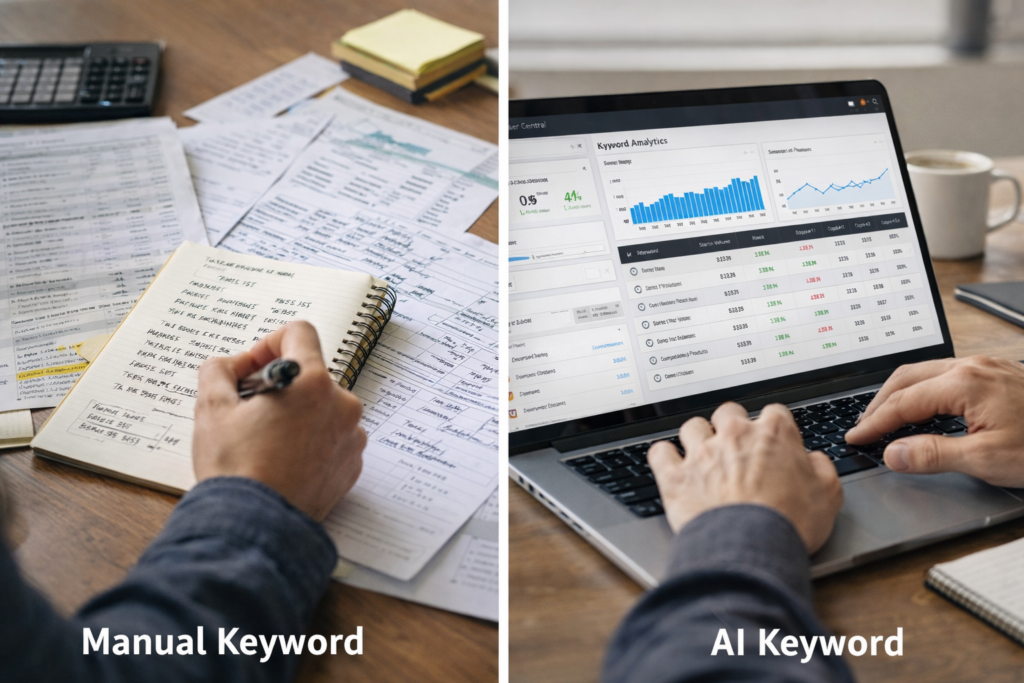
| Manual Keyword Research | AI-Powered Keyword Research | |
| Keywords analyzed | 200–300 | Millions |
| Speed | Hours to days | Minutes |
| Competitor analysis | 1–2 ASINs manually | Up to 10 ASINs simultaneously |
| Buyer intent mapping | Guesswork | Data-driven clustering |
| Seasonal trend detection | Reactive (after the spike) | Predictive (weeks/months ahead) |
| Negative keyword identification | Manual, slow | Automated, continuous |
| Long-tail discovery | Limited | Comprehensive |
| Algorithm alignment | General | A10-optimized |
The fundamental difference is pattern recognition at scale.
When you manually research keywords, you analyze the surface. AI digs into the structure underneath — semantic relationships between search terms, buyer behavior patterns, purchase intent signals, and competitor keyword strategies — all at once.
For example: AI recognizes that “portable bluetooth speaker waterproof” and “shower speaker wireless” represent the same buyer intent. Manual research treats them as separate, unrelated terms. AI clusters them together and tells you to target both — capturing buyers at different points of their search journey.
Reverse ASIN Analysis — The Most Powerful AI Feature One of the most valuable capabilities of AI keyword tools is reverse ASIN analysis. You enter a competitor’s product ASIN, and the tool reveals every single keyword that product ranks for — both organically and through sponsored ads.
This is game-changing for new sellers. Instead of starting from scratch, you can immediately see the exact keyword strategy your top competitors are using, identify where their coverage is weak, and target those gaps directly. Tools like Helium 10 Cerebro, Jungle Scout, and DataDive all offer versions of this feature, and it’s one of the fastest ways to build a high-quality keyword list from day one.
Competitive Advantages of AI Keyword Research for Amazon Sellers
1. Speed — React Before Your Competitors Do
In 2026, Amazon search trends can shift within days. A viral TikTok video, a news story, a supply chain disruption — any of these can change buyer search behavior overnight. AI tools monitor keyword movements continuously and alert you to significant changes. By the time a competitor doing manual monthly reviews notices the shift, you’ve already updated your listing and launched a campaign around the new trend.
2. Scale — Analyze Your Entire Catalog at Once
If you sell multiple products, AI lets you run competitive keyword analysis across your entire catalog simultaneously. You’re not stuck analyzing one product at a time. You get a portfolio-level view of ranking opportunities, keyword gaps, and PPC waste across every single ASIN you manage.
3. Profit Protection — Automatic Negative Keyword Discovery
This one directly saves you money. AI tools continuously monitor which search terms generate impressions and clicks but produce zero conversions. These are your money-draining keywords — the terms that make buyers click your ad but never buy. AI identifies them automatically and flags them for removal. For sellers spending even a few hundred dollars monthly on PPC, systematic negative keyword management can recover 15–20% of wasted ad budget almost immediately.
4. Ranking Acceleration — Find Page-One Opportunities Fast
AI tools calculate what it would realistically take to rank on page one for any keyword — factoring in competition level, average review count, conversion rate benchmarks, and current ranking difficulty. This tells you exactly which keywords are worth going after right now versus which ones are too competitive for your current stage. New sellers especially benefit from this — instead of burning budget fighting for impossible keywords, you start with winnable battles and build momentum.
5. Seasonal Prediction — Plan Campaigns Before Demand Spikes
AI analyzes years of historical search volume data to predict seasonal keyword trends. This means you know months in advance which keywords will spike during Q4, back-to-school season, Valentine’s Day, or any other demand period. You can prepare your listings, build inventory, and launch campaigns before the competition — capturing early traffic while others are still reacting.
6. Multi-Platform Expansion — Amazon to TikTok Shop
AI keyword research doesn’t just help on Amazon. The buyer intent data you uncover on Amazon directly informs your TikTok Shop content strategy — and we’ll cover this in detail shortly.
AI Keyword Research Strategy That Actually Works: Step-by-Step for Amazon Sellers
This is the practical section. Here’s exactly how to implement AI keyword research — even if you’re brand new to Amazon.
Step 1: Run a Reverse ASIN Analysis on Your Top 3–5 Competitors
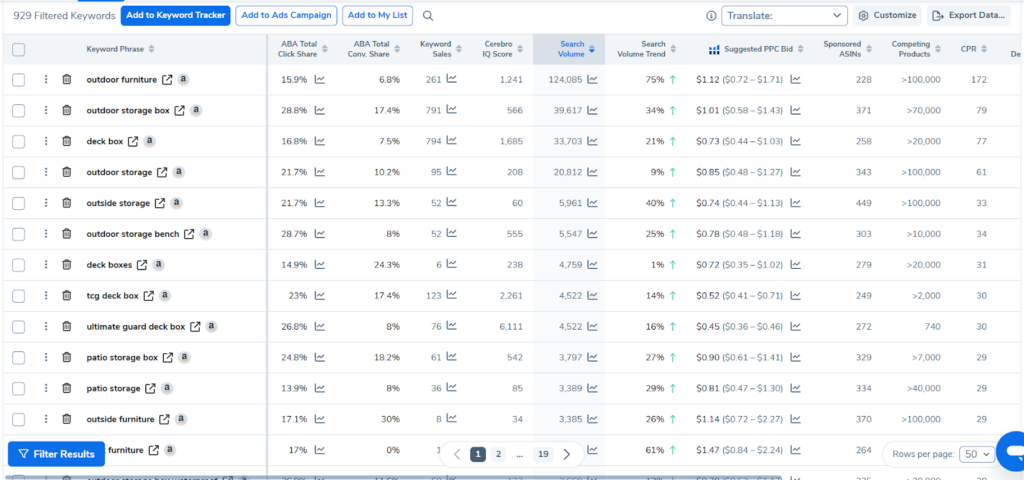
Start by identifying the top 3 to 5 products in your category that are outselling you. Enter their ASINs into a tool like Helium 10 Cerebro or Jungle Scout’s Keyword Scout. The tool will generate a comprehensive list of every keyword those products rank for. This is your starting competitive keyword map.
Step 2: Identify High-Conversion Keywords
From that list, filter for keywords that show strong conversion signals — not just high search volume. High volume with low conversion is a trap. Look for keywords with a healthy balance of monthly searches, manageable competition, and evidence that buyers who use this term actually purchase. Most AI tools show you conversion-related metrics directly.
Step 3: Filter for Low-Competition Opportunities
Especially as a new or growing seller, you want to identify keywords where the competition is beatable. AI tools show you average competitor review counts, ranking difficulty scores, and sponsored competition levels. Prioritize keywords where your listing can realistically compete within your current review and sales history.
Step 4: Integrate Keywords Into Your Listing Strategically
Place your primary high-value keywords in your product title — this is the most important real estate on your listing. Use secondary keywords in bullet points naturally, the way a real customer would speak. Place remaining keywords in your backend search terms field (Amazon gives you 250 bytes — use every single character). Never keyword-stuff your title or bullets in a way that reads unnaturally — Amazon’s A10 algorithm penalizes poor listing quality.
Step 5: Launch PPC With AI-Suggested Keywords
Use your AI keyword research to build three types of PPC campaigns: broad match campaigns to discover new converting terms, phrase match campaigns to capture intent-specific searches, and exact match campaigns to dominate your most valuable proven keywords. Start with AI-identified high-intent terms rather than broad auto-campaigns — this dramatically improves your launch efficiency.
Step 6: Remove Non-Converting Search Terms Weekly
Every week, download your search term report from Amazon Seller Central. Cross-reference with your AI tool’s negative keyword recommendations. Any term spending budget without generating sales for two to three weeks should be added as a negative keyword. This is one of the highest-ROI habits any Amazon seller can build.
Step 7: Track Rankings and Refresh Quarterly
AI keyword research is not a one-time task. Track your keyword rankings weekly using your tool of choice. Every quarter, run a fresh competitive analysis — competitor strategies change, new search trends emerge, and your own product’s authority grows, opening new ranking opportunities. Sellers who treat keyword research as ongoing rather than a one-time launch task consistently outperform those who don’t.
How AI Helps You Adapt to Amazon’s Algorithm Updates in 2026
Amazon’s ranking algorithm — commonly referred to as A10 by sellers — continues to evolve in 2026 with a stronger emphasis on signals that go beyond keyword presence.
Here’s what the A10 algorithm prioritizes in 2026 and how AI keyword research aligns with each factor:
- Conversion Rate: Amazon ranks listings higher when buyers click and purchase. AI helps you target high-intent keywords that actually convert — not just drive traffic.
- Relevance Scoring: Amazon evaluates your full listing for semantic relevance. AI ensures you cover all important keyword variations, not just obvious terms.
- Click-Through Rate (CTR): Higher clicks improve ranking. AI identifies keywords where your listing can realistically compete based on price, reviews, and visuals.
- External Traffic Signals: Amazon rewards listings that bring outside traffic. AI-driven keyword insights help align your TikTok and social campaigns with Amazon ranking signals.
- Amazon Rufus & Conversational Search: Buyers now use natural-language questions. AI helps you optimize for question-based, conversational search queries.
AI Keyword Research for Multi-Platform Sellers: Amazon + TikTok Shop in 2026
If you’re selling — or planning to sell — on both Amazon and TikTok Shop, AI keyword research becomes even more powerful.
These two platforms discover products in fundamentally different ways:
- Amazon is search-driven. Buyers know what they want and search for it directly using specific keywords.
- TikTok Shop is content-driven. Buyers discover products through engaging videos, often without a prior search intent.
Despite these differences, the buyer intent data from Amazon keyword research directly informs how you sell on TikTok — and vice versa.
How Amazon Keyword Data Improves Your TikTok Content Strategy When your AI tool reveals that the top keywords driving conversions for portable Bluetooth speakers are “waterproof,” “portable,” and “long battery life” — that’s not just Amazon data. That’s a window into what buyers care most about. On TikTok, you translate those insights into content themes: a video demonstrating your speaker being used in a shower (waterproof), a video showing it fitting in a backpack (portable), a video running a battery life test at an outdoor event (long battery life). You’re not guessing what content to create — your Amazon keyword data tells you exactly what buyers want to see.
The Language Difference Matters Amazon keywords are transactional and specific: “memory foam pillow queen size cooling gel.” TikTok keywords are conversational and benefit-oriented: “pillow that actually helps with neck pain.” AI research captures both registers and helps you bridge them — using Amazon’s data richness to inform TikTok’s story-driven format.
TikTok Trends Feed Back Into Amazon The reverse also works. Trending topics and product interest that emerge on TikTok often appear in Amazon search volume data weeks later. Sellers who monitor both platforms simultaneously — using AI to track keyword momentum across channels — can spot rising product trends early and position their Amazon listings before the demand spike hits.
What Results Can Amazon Sellers Realistically Expect?
Let’s be honest here — AI keyword research is not a magic button. But when implemented consistently, the results are very real.
- Broader Keyword Coverage From Day One: Most sellers who run their first proper AI keyword analysis discover they’ve been targeting a small fraction of the relevant keywords in their category. It’s common to uncover hundreds of additional relevant terms — including long-tail phrases with high conversion potential — that were completely missing from their listing and campaigns.
- Improved PPC Efficiency Within Weeks: By targeting higher-intent keywords and systematically removing non-converting search terms, sellers typically see meaningful improvement in their advertising cost of sales (ACoS) within the first four to eight weeks of implementing AI-guided PPC management. You’re spending the same budget — or less — but generating better results because every dollar is working harder.
- Organic Ranking Gains Over 60–90 Days: Organic rankings don’t change overnight. But when you consistently optimize your listing with AI-identified high-relevance keywords, Amazon’s algorithm begins recognizing your listing as more relevant to those searches. Most sellers see meaningful organic ranking improvements within 60 to 90 days of systematic keyword optimization — and those organic rankings compound over time, reducing your dependence on paid traffic.
- Faster Product Launches: New product launches are always risky. AI keyword research dramatically reduces that risk by telling you — before you spend a dollar on ads — which keywords are winnable, which competitors are beatable, and which seasonal windows give you the best shot at early traction.
- Stronger Competitive Positioning: When a competitor launches a new product, adjusts their strategy, or starts targeting your keywords aggressively, AI tools alert you within days. This speed of intelligence allows you to respond proactively — adjusting your own campaigns, strengthening your listing, and protecting your market share — rather than noticing the damage after sales have already dropped.
Why Smart Amazon Sellers Use AI Keyword Research in 2026
Here’s the bottom line.
Amazon is more competitive than ever. More sellers are launching every day. Advertising costs are rising. And the algorithm is getting smarter — rewarding sellers who understand buyer intent and penalizing those who guess.
In this environment, manual keyword research is no longer a disadvantage. It’s a dealbreaker.
Your competitors who are growing — the ones consistently ranking on page one, running profitable PPC campaigns, and launching new products with confidence — are not doing it with spreadsheets. They’re using AI to see what you can’t see manually, move faster than you can move manually, and build keyword strategies that compound in value over time.
The good news? AI keyword research is not complicated, expensive, or exclusive to big brands. It’s accessible, practical, and — when implemented with the right strategy — one of the highest-leverage moves any Amazon seller can make in 2026.
Start with reverse ASIN analysis on your top three competitors. Find your keyword gaps. Build your listing around high-intent, high-conversion terms. Clean up your PPC. Track your rankings weekly.
That’s the system. It’s not magic — it’s data, applied consistently.
Frequently Asked Questions (FAQ)
Q. What is AI-powered keyword research for Amazon?
AI-powered keyword research uses artificial intelligence to automatically scan Amazon’s search data, analyze millions of queries, and identify the best keywords for your product listings and PPC campaigns. Instead of manually searching for terms one by one, AI does the heavy lifting — faster, deeper, and with far greater accuracy than any manual method.
Q. Is AI keyword research only for big sellers or high-volume stores?
Not at all. In fact, new and smaller sellers often benefit the most. AI levels the playing field by giving you the same quality of competitive intelligence that large brands use. You don’t need a big catalog or a big budget to start — even a single-product seller can use AI keyword research to find ranking opportunities that their competitors are missing.
Q. How is AI keyword research different from manual research?
Manual research is limited by time, scale, and human pattern recognition. You can realistically analyze a few hundred keywords manually and check one or two competitors. AI analyzes millions of keywords simultaneously, compares up to ten competitors at once, maps buyer intent automatically, and detects trends you would never find manually. It’s not just faster — it’s fundamentally deeper.
Q. Can AI find long-tail keywords for Amazon?
Yes — and this is one of AI’s biggest advantages. Long-tail keywords (3–5 word phrases with specific buyer intent) are often the most valuable for new sellers because they have lower competition and higher conversion rates. AI tools systematically surface thousands of long-tail variations that manual research completely misses.
Q. How often should I do keyword research on Amazon?
At minimum, do a full AI keyword analysis every quarter. But the most successful sellers treat it as an ongoing process — tracking rankings weekly, reviewing PPC search term reports weekly, and refreshing their competitive analysis whenever a new competitor enters or their sales momentum shifts.
Q. Does AI keyword research help reduce Amazon PPC costs?
Directly, yes. AI identifies two things that cut wasted PPC spend: high-intent keywords that actually convert (so your budget goes further), and negative keywords — search terms that generate clicks but zero sales. Systematically removing those negative keywords alone can recover 15–20% of wasted ad spend for many sellers.
Q. What is reverse ASIN keyword research?
Reverse ASIN analysis is a feature in AI keyword tools that lets you enter any competitor’s product ASIN and see every keyword that product ranks for — both organically and through sponsored ads. It’s one of the fastest ways to build a comprehensive keyword strategy because instead of starting from zero, you’re starting from your top competitor’s proven keyword map.
Q. Can beginners use AI keyword tools?
Absolutely. Most modern AI keyword tools — like Helium 10, Jungle Scout, and DataDive — are designed with dashboards that are accessible to sellers at all levels. You don’t need technical expertise. You need to understand your product, follow a clear process (like the step-by-step strategy outlined in this guide), and be consistent about acting on the data.
Q. How does AI help after Amazon algorithm updates?
Amazon’s algorithm changes can shift which keywords suddenly perform better or worse, which listing elements carry more weight, and how conversion signals are interpreted. AI tools adapt to these changes quickly and surface the new patterns in your keyword data. Instead of spending weeks figuring out what changed, you can see the impact in your keyword performance metrics and adjust your strategy accordingly.
Watch how we help sellers to protect their Amazon Business:
Amazon’s Rufus AI Prompts: The Future of Sponsored Products Optimization
Your Amazon Listing Is Losing Money
Amazon Brand Growth Secrets: Use Customer Data To Boost Sales Fast!
Amazon AI Update 2025: Why Sellers Are Losing Ranking Overnight
Amazon Listing Image Masterclass: How Top Sellers Boost CTR & Conversions
How Ecomclips Helps Amazon Sellers Win with AI-Powered Keyword Research in 2026
Amazon sellers today are no longer competing only on basic keyword placement or generic PPC campaigns. With the evolution of the A10 algorithm and the rise of Amazon Rufus AI, ranking now depends on search intent alignment, semantic relevance, and real conversion data.
That means traditional, manual keyword research is no longer enough.
That’s where Ecomclips supports you — helping you turn AI-powered keyword research into a structured ranking and growth strategy.
- Strategic Keyword Audit and Competitive Gap Analysis: We audit your existing listings to identify missing high-value keywords, weak semantic coverage, and ranking gaps. We also analyze your top competitors using reverse ASIN research to uncover untapped opportunities where your product can gain visibility advantage.
- AI-Driven Buyer Intent Research: We use advanced AI keyword research tools to analyze millions of Amazon search queries. This allows us to identify high-intent, conversion-focused keywords, long-tail opportunities, and conversational search phrases aligned with Rufus AI behavior.
- High-Conversion Listing Optimization: We integrate priority keywords strategically into your title, bullet points, description, backend search terms, and A+ content. Every keyword placement is designed to improve relevance scoring, boost click-through rate, and increase conversion rate — without keyword stuffing.
- PPC Keyword Strategy and Negative Keyword Protection: We structure your PPC campaigns around AI-identified high-intent keywords and continuously remove non-converting search terms. This reduces wasted ad spend while improving advertising efficiency and ACoS performance.
- Rufus AI & Conversational Search Optimization: We align your keyword strategy with natural-language, question-based queries that Amazon Rufus prioritizes. This increases your chances of appearing in AI-generated recommendations and conversational search results.
- Ongoing Monitoring and Ranking Optimization: Keyword trends shift. Competitors adjust strategy. Amazon’s algorithm evolves. We continuously track ranking performance, monitor competitor keyword movements, and refresh your keyword strategy to maintain long-term growth.
Contact us today at info@ecomclips.com or book an appointment with our e-commerce experts to start selling smarter on both marketplaces.
Ecomclips: Your Complete eCommerce Solution Under One Umbrella
At Ecomclips, we bring every eCommerce service you need under one roof — strategy, operations, design, marketing, and growth, all seamlessly connected to help your brand thrive across every marketplace.
Since 2012, we’ve been helping businesses of all sizes launch, scale, and dominate online. From Amazon, Walmart, eBay, and Etsy to Shopify and WooCommerce, our team of marketplace experts, designers, developers, and marketers works together to deliver measurable results.
Our services span the full eCommerce lifecycle:
- Account Setup & Product Listing Management: We handle registrations, compliance, and product data optimization across all marketplaces.
- Amazon Optimization Service: From keyword-rich titles and A+ content to PPC campaigns and storefront design, we craft listings that convert.
- Creative Design & Content Production: A+ visuals, infographics, brand stores, and product videos built to boost engagement.
- Advertising & PPC Management: Smart, data-driven ad strategies for Amazon, Walmart, and Google that maximize ROI.
- Web Development & Store Design: Shopify, WooCommerce, and Magento websites built for performance and conversion.
- Data Management & Automation: Streamlined product feeds, catalog syncing, and inventory control for effortless scalability.
- Customer Service & Order Fulfillment: End-to-end support that enhances customer satisfaction and builds long-term loyalty.
- Analytics & Growth Strategy: Real-time insights and ongoing optimization to ensure consistent, profitable growth.
Whether you’re launching a new store or managing multiple global marketplaces, Ecomclips acts as your single strategic partner, simplifying complexity and driving sustainable revenue growth.