
Did you know that getting discovered on Faire is only half the battle? With so many brands competing for retailers’ attention, attractive products alone won’t secure wholesale orders. Buyers want profitable margins, competitive pricing, and products their customers will love.
That’s where Faire Wholesale Marketplace creates opportunities. With the right wholesale strategy, optimized product catalog, smart pricing, and Faire Direct, you can turn first-time buyers into loyal retailers and build consistent wholesale sales.
In this complete guide to selling on Faire in 2026, we’ll explore everything from account setup and catalog optimization to Faire SEO, commission fees, pricing, and sales growth, helping you attract more retailers and grow profitably.
1. What Is Faire Wholesale Marketplace?
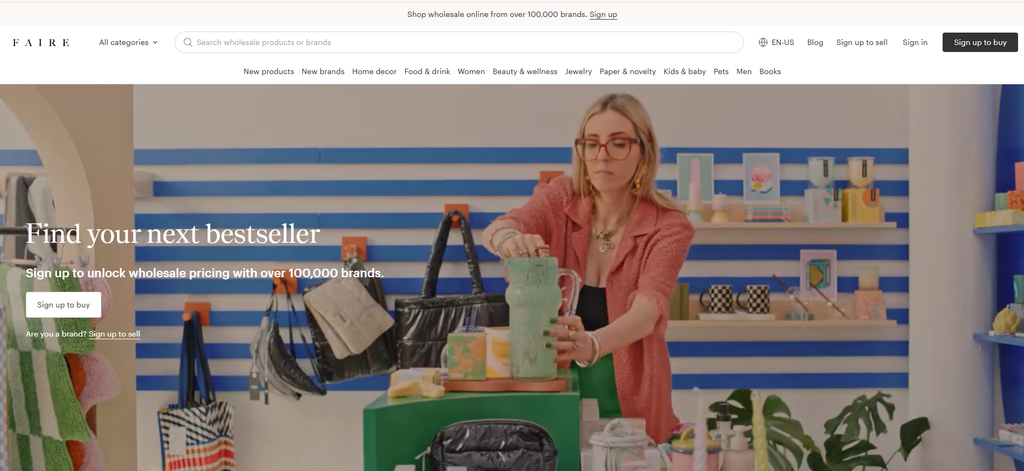
Faire Wholesale Marketplace is a business-to-business (B2B) platform that connects brands with independent retailers looking for unique products to stock in their stores. Unlike traditional ecommerce marketplaces, where customers buy products for personal use, Faire focuses on wholesale buying and selling, allowing retailers to purchase inventory directly from brands for resale.
What makes Faire different is how retailers make purchasing decisions. Instead of buying a single product, they evaluate wholesale pricing, profit margins, minimum order quantities, product demand, and restocking reliability. Brands can reach potential buyers through Faire’s search results, product categories, personalized recommendations, and promotional opportunities. Eligible retailers may also benefit from flexible payment terms and opening-order returns, making it easier to explore new brands.
Why Do Brands Choose Faire?

Faire gives brands an opportunity to reach independent retailers, expand wholesale distribution, and build long-term business relationships without relying entirely on trade shows, distributors, or traditional sales outreach. With built-in ordering tools and retailer discovery features, brands can simplify wholesale selling while focusing on product quality, catalog optimization, competitive pricing, and consistent fulfillment.
The real advantage isn’t just securing the first order. It’s turning that initial purchase into repeat wholesale orders and lasting retail partnerships.
Is Selling on Faire Right for Your Brand?
Faire is most relevant for product-based brands with wholesale-ready assortments in categories such as home goods, gift, beauty, food and beverage, apparel, jewelry, stationery, baby and pet products, subject to eligibility and applicable restrictions. A strong candidate has repeatable production, compliant labeling, clear MSRP and wholesale pricing, and products that can be displayed and explained easily in a retail environment.
Before applying, ask three questions: Can a retailer make an attractive margin? Can you fulfill multiple-unit orders reliably? Is there a recognizable type of independent store that your products fit? If the answer to any is no, refine the proposition before investing heavily in the channel.
How to Start Selling on Faire: Step-by-Step Guide
Getting started on Faire Wholesale Marketplace involves more than creating an account and uploading a few products. You need to prepare your brand, set profitable wholesale terms, and build a storefront that gives retailers confidence to place their first order.
Here’s how to get started on Faire in 2026, from application to your first wholesale sale.
Step 1: Prepare Your Wholesale Business Information
Before applying to Faire, gather the information needed to present your brand professionally. Faire evaluates factors such as product category, brand location, existing business activity, product assortment, and wholesale readiness.
Here’s what you should prepare:
- Business details: Registered business name, brand name, business address, contact information, and website.
- Product information: Main product categories, number of SKUs, product descriptions, and high-quality photographs.
- Wholesale pricing: Wholesale prices, suggested retail prices (MSRP), production costs, and expected profit margins.
- Order requirements: Minimum order quantities (MOQs), case-pack sizes, and preferred opening-order minimums.
- Fulfillment information: Inventory availability, production lead times, shipping location, and packaging requirements.
- Financial documents: Applicable business registration, tax information, and bank details for payment verification.
- Brand credibility: Social media profiles, existing retail partners, customer feedback, awards, or press coverage, if available.
For example, if you sell handmade candles, prepare your wholesale prices, scent variations, case quantities, packaging photographs, and realistic production timelines before applying.
Create a wholesale catalog or line sheet containing product images, SKUs, wholesale prices, MSRP, and ordering information. It will simplify your Faire setup and support future retailer outreach.
Step 2: Apply for a Faire Brand Account
Once your business information is ready, visit Faire’s official brand application page to begin registering.
Unlike some ecommerce marketplaces, Faire reviews brand applications rather than automatically approving every seller.
Follow these steps to apply:
- Visit Faire’s application page and select the option to start selling.
- Enter a valid email address and provide the requested account and contact information.
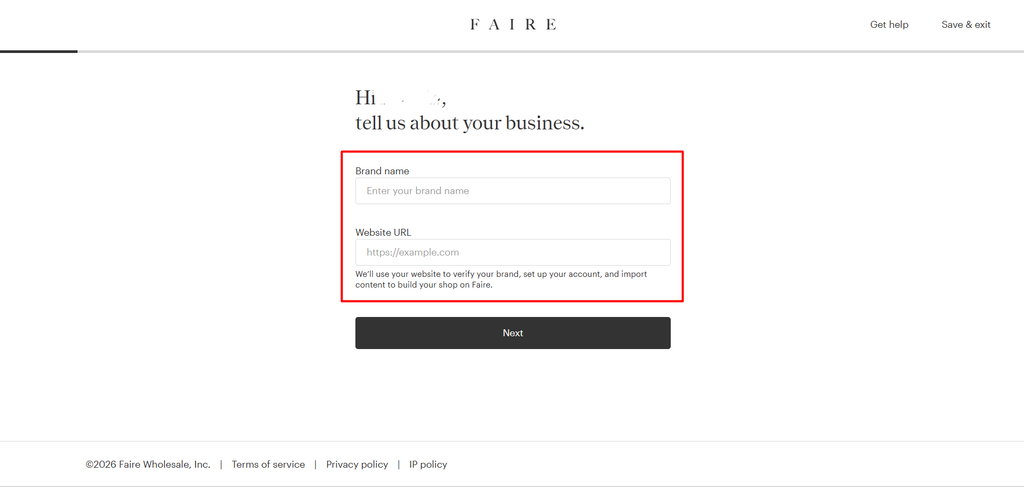
- Add your brand name, business location, website, and relevant social profiles.
- Describe your product categories, assortment, and existing wholesale activities.
- Provide any additional business information requested during the application.
- Review your details and submit the application.
If you already have a Faire retailer account, you’ll need a separate email address for your brand account.
Faire considers factors including product-category demand, location, number of SKUs, and existing wholesale experience when reviewing applications. Approval timelines vary.
Explain what makes your brand distinctive. If you already supply boutiques, gift shops, or other independent retailers, include that experience. Avoid exaggerated product claims or unsupported brand certifications.
Step 3: Create an Attractive Faire Brand Storefront
After approval, you’ll receive instructions to complete onboarding and access your Faire Brand Portal.
Your storefront is your digital wholesale showroom. It’s often the first place retailers evaluate whether your products fit their customers and store identity.
Focus on these essential elements:
- Brand logo: Upload a clear, professional logo that retailers can easily recognize.
- Cover image: Use attractive lifestyle or product photography that represents your collection.
- Featured image: Choose a strong visual that communicates your brand’s product range and aesthetic.
- Brand story: Explain who you are, what you create, and why retailers should carry your products.
- Brand attributes: Add relevant information about manufacturing, sustainability, product origin, and other applicable characteristics.
- Wholesale catalog: Include your available products and, where useful, a downloadable product catalog or lookbook.
For example, instead of writing “We sell premium skincare products,” explain what makes your skincare collection distinctive, who the products serve, and why they belong in an independent beauty store.
Faire also allows brands to showcase information such as their founding story, production practices, images, and videos.
Step 4: Upload and Optimize Your Product Catalog
Your product catalog is one of the most important parts of your Faire shop. Retailers rely on product information, images, prices, and ordering requirements to decide whether to stock your brand.
Faire currently provides several ways to add products:
- Shopify integration: Import products from an existing Shopify catalog.
- Spreadsheet upload: Add multiple products using a structured catalog file.
- Manual product entry: Create and manage listings individually through the Faire Product Editor.
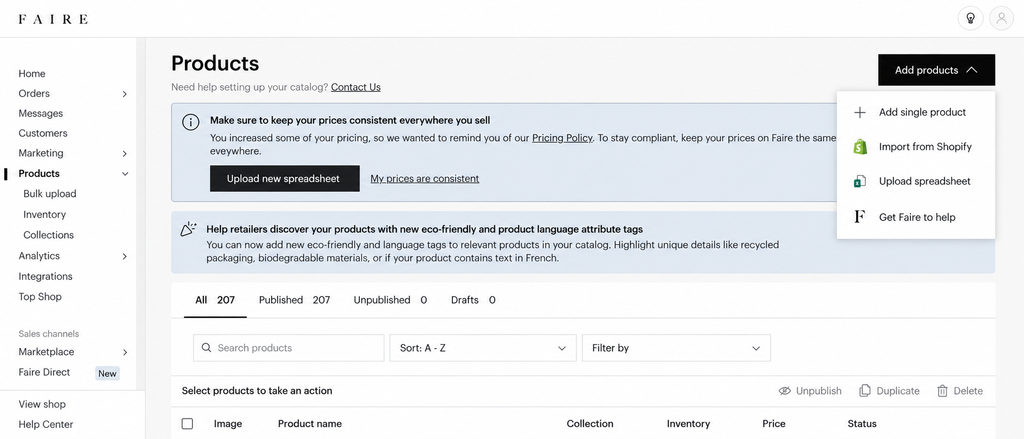
For each product, prepare the following information:
- Product title: Include clear, searchable terms such as product type, material, size, or variation.
- Product description: Explain features, materials, dimensions, ingredients, care requirements, and practical benefits.
- Product images: Include a clean primary image, lifestyle photographs, packaging views, and useful close-ups.
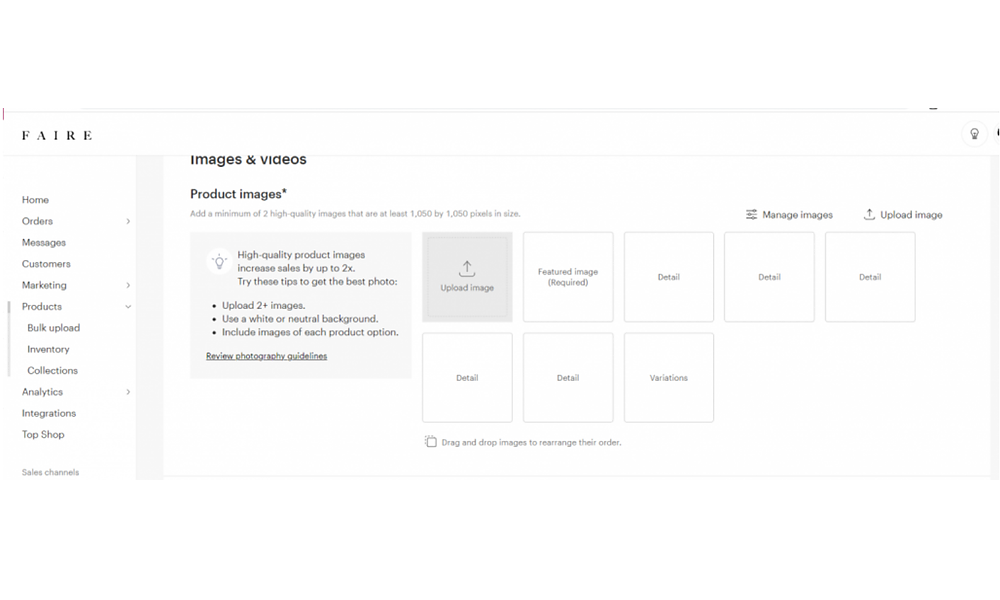
- Wholesale and retail prices: Enter accurate prices that support your business and retailer margins.
- Case size and MOQ: Specify how many units retailers need to purchase.
- Product variations: Add applicable sizes, colors, fragrances, or styles with distinct SKUs.
- Inventory details: Keep available stock accurate and identify preorder products appropriately.
- Product categorization: Select the most relevant product type and category.
For example, instead of using the title “Luxury Candle,” try “Hand-Poured Soy Wax Candle – Lavender & Eucalyptus – 8 oz.” This immediately communicates the product type, material, fragrance, and size.
Faire recommends uploading your full eligible wholesale assortment rather than only a handful of products because a more complete catalog creates additional opportunities for retailers to discover and purchase your products.
Step 5: Set Wholesale Pricing and Ordering Requirements
Now that your products are listed, configure the purchasing terms that make wholesale selling profitable for both your brand and your retailers.
Unlike direct-to-consumer orders, wholesale transactions often involve multiple units, case packs, and larger cart values.
Important settings include:
- Wholesale price: The amount retailers pay per product or case.
- Suggested retail price (MSRP): The recommended price retailers can charge their customers.
- Opening-order minimum: The minimum total order value required from a first-time retailer.
- Reorder minimum: The minimum order value for retailers who have already purchased from your brand.
- Minimum order quantity: The minimum number of units required for a specific product.
- Case pack: The number of units included when a product is sold by the case.
- Shipping and lead times: The estimated fulfillment period and applicable shipping arrangements.
For example, a candle brand might test a $150 opening-order minimum, a $100 reorder minimum, and case packs of six candles. These are illustrative settings, not Faire-recommended benchmarks.
Faire allows brands to configure opening-order and reorder minimums, while individual product MOQs are managed separately.
Don’t automatically choose high minimums to increase average order value. Consider what a new retailer can reasonably invest when testing your products for the first time.
Step 6: Configure Shipping, Inventory, and Payment Settings
A successful wholesale operation depends on what happens after the retailer places an order.
Before launching, make sure your business can process purchases, fulfill inventory, and receive payments without unnecessary delays.
- Shipping and fulfillment: Set realistic processing times based on production capacity, packing requirements, and carrier availability. A product that normally takes five business days to prepare should not advertise next-day fulfillment.
- Inventory management: Confirm available stock for every SKU and variation. If you sell through Shopify or other channels, use supported inventory integrations where appropriate to reduce overselling.
- Shipping configuration: Review available shipping methods, destination restrictions, tracking requirements, and any product-specific handling needs. International orders may involve customs documentation, duties, or additional product compliance requirements.
- Banking and tax verification: Complete the bank-account, business-identity, and tax requirements shown in your Brand Portal. Requirements depend on your business location.
- Payout preferences: Review the available payout schedules and processing costs for your country. Remember that a retailer’s payment terms and your brand’s payout schedule are separate arrangements.
Step 7: Review Your Store and Launch on Faire
Before making your Faire storefront available to retailers, review the entire shopping experience as if you were a boutique owner discovering your brand for the first time.
Use this final launch checklist:
- Complete your brand story, logo, cover image, and storefront information.
- Upload your eligible wholesale catalog with accurate titles, descriptions, and images.
- Verify wholesale prices, MSRP, SKUs, variants, and case quantities.
- Confirm opening-order minimums, reorder minimums, and product-level MOQs.
- Review inventory availability, shipping settings, and fulfillment lead times.
- Complete applicable tax, banking, and payout verification.
- Check product compliance information and selling-market restrictions.
- Prepare your Faire Direct link for eligible existing retailers and self-generated wholesale leads.
- Review your storefront on desktop and mobile for missing information or formatting issues.
Faire also currently offers qualifying new brands opportunities for additional visibility and promotional benefits during their initial launch period. Eligibility requirements and available benefits should be reviewed before activation.
Faire Wholesale Strategy
Wholesale customers shop for inventory, not personal gratification. Their key criteria include potential gross margin, customer demand, differentiation, shelf presentation, delivery reliability and ease of restocking. Your Faire strategy should start with an ideal retailer profile: boutique type, customer demographic, region, price positioning, size of order, merchandising style and likely buying season.
1. Build an assortment, not a pile of SKUs
Organize your line into intuitive groups: everyday bestsellers, seasonal releases, giftable bundles, introductory low-commitment items and premium hero products. Buyers should quickly understand how products merchandise together. A cohesive six-product capsule can outperform a visually chaotic 40-product assortment, even though catalog breadth can improve discovery opportunities.
2. Create an easy first order
An opening minimum should cover your variable fulfillment cost while allowing a store to test products without committing too much cash. Keep case sizes proportional to likely shelf velocity. For example, six candles per fragrance may be easier to trial than 24 of every fragrance. The ideal threshold requires testing against your own costs and target retailers.
3. Manage channel conflict thoughtfully
If you also sell through Shopify, Amazon, Etsy or distributors, align your pricing and brand position across channels. Avoid routinely undercutting retail stockists on your DTC website. If you maintain a minimum advertised price (MAP) policy, obtain appropriate legal advice for applicable competition laws and enforce it consistently; MAP is not a substitute for communicating a workable MSRP. Exclusive bundles or colorways can help differentiate wholesale partners.
4. Focus on retailer lifetime value
The most valuable customer may be the retailer that starts with $180, reorders $350 and eventually carries a full seasonal collection. Track how new buyers progress through the customer relationship, instead of measuring success only by first-order revenue.
Faire Product Catalog Optimization & SEO
Your Faire catalog is more than a collection of product listings, it’s your digital sales representative. Retailers need to find your products easily, understand their value, and get enough information to feel confident placing a wholesale order.
Faire considers multiple factors in marketplace search and ranking, including product information, retailer activity, and brand performance. Since search results can vary by retailer, focus on improving listing quality and conversion rather than relying on a single search position.
1. Optimize Product Titles for Faire Search
A strong product title helps retailers understand what you’re selling before they even open the listing. Use clear, descriptive language that reflects how buyers search for products.
For example, instead of naming a listing “The Emma,” use “Hand-Poured Soy Candle, Lavender & Eucalyptus, 8 oz.” The descriptive title identifies the product, fragrance, material, and size.
Include relevant product terms naturally, lead with the main product type, and avoid unnecessary keywords or vague collection names.
2. Write Product Descriptions That Answer Retailer Questions
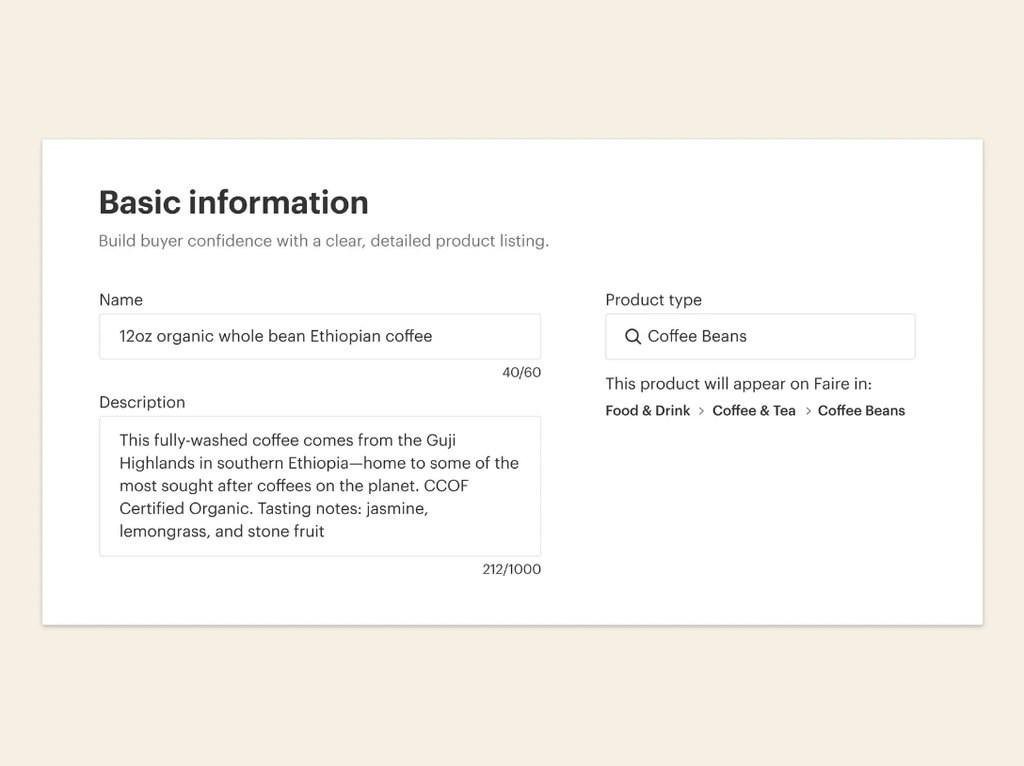
Your product description should do more than promote the product. It should give retailers the information they need to evaluate, display, and resell it.
Use the SPECS → STORY → SELL framework:
- SPECS: Include dimensions, materials, ingredients, weight, care instructions, shelf life, packaging, and relevant compliance details.
- STORY: Explain the product’s design inspiration, craftsmanship, intended use, or genuine point of difference.
- SELL: Highlight practical retail details, such as case quantities, display suggestions, packaging, and suggested retail price where appropriate.
For example, a ceramic mug listing should specify its capacity, material, dimensions, care instructions, packaging, and wholesale ordering requirements—not just describe it as beautiful or handmade.
3. Use High-Quality Product Images
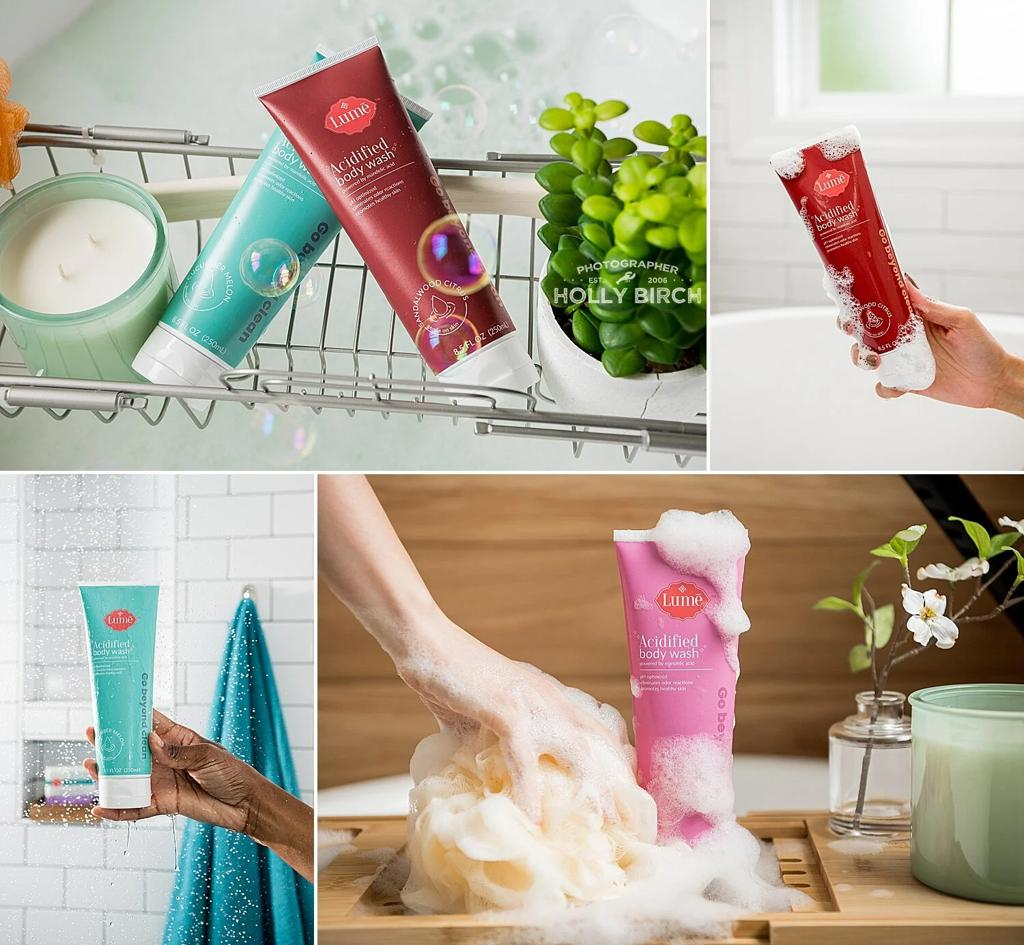
Product photography plays a major role in how retailers evaluate your catalog. Buyers need to understand the product’s appearance, size, quality, packaging, and suitability for their stores.
Build a purposeful image set that includes:
- Main product image: A clean, well-lit image that clearly identifies the product.
- Lifestyle photograph: Shows the product in a realistic setting or use case.
- Scale reference: Communicates dimensions or relative size.
- Packaging photograph: Shows what retailers receive.
- Retail display image: Helps buyers visualize the product on store shelves.
- Detail close-up: Highlights texture, materials, craftsmanship, or distinctive features.
Keep lighting, image quality, and styling consistent across your catalog. Use genuine product photographs and avoid visual edits that misrepresent the product.
4. Choose Accurate Categories and Organize Collections
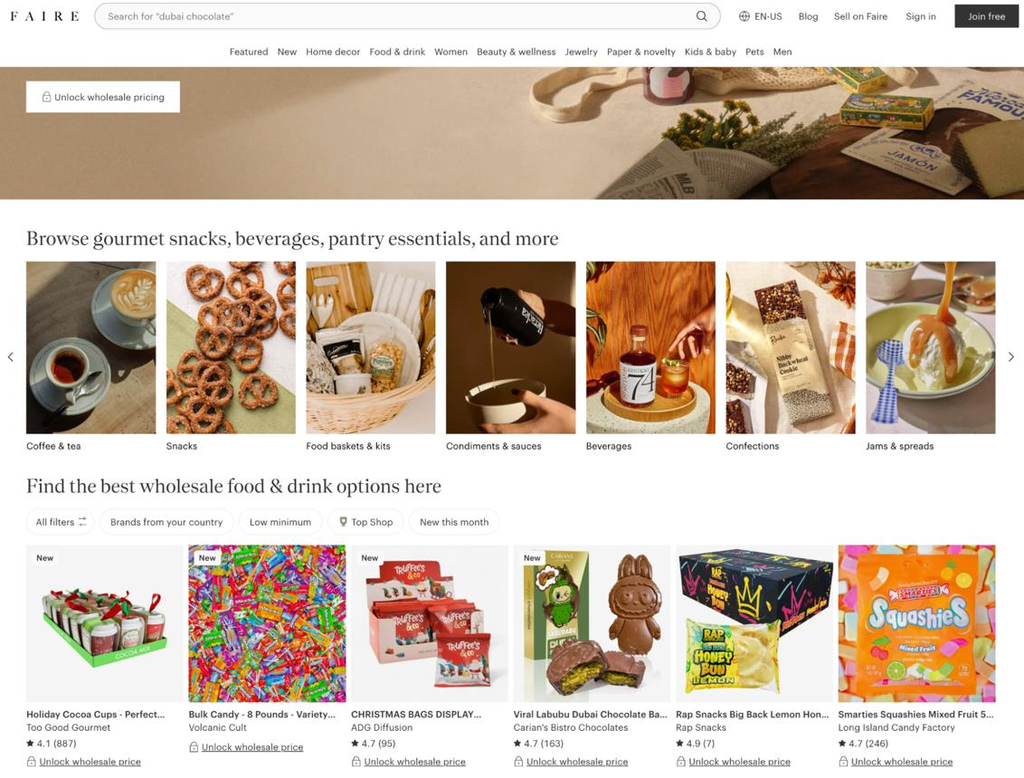
Product categorization helps retailers browse relevant merchandise and helps Faire understand what your products are. Select the closest available category and relevant subcategories rather than choosing broad or loosely related classifications.
Where your shop tools support collections, organize related products around practical buying themes, such as “Bestselling Gifts,” “Spring Tabletop,” or “Gifts Under $20 Wholesale.”
Seasonal collections should reflect retail purchasing cycles. Prepare relevant products early enough for buyers to plan their inventory before major holidays or seasonal selling periods.
5. Keep Product Variations and Inventory Accurate
An optimized catalog must remain accurate after launch. Incorrect stock levels, confusing variations, and discontinued listings can lead to cancellations and weaken retailer confidence.
Group genuine variations—such as sizes, colors, fragrances, or styles—logically. Assign distinct SKUs where needed, maintain accurate inventory, and update product availability and restock information through the tools available in your account.
If you sell across multiple channels, use supported inventory integrations where practical to reduce overselling. Remove or archive discontinued products using the appropriate workflow.
Faire Pricing Strategy for Wholesale: How to Price for Profit
Setting the right wholesale price on Faire isn’t just about covering your product costs. Your prices must leave enough profit for your brand while giving retailers a compelling reason to stock and resell your products.
A common starting point is keystone pricing, where the suggested retail price (MSRP) is twice the wholesale price. However, successful wholesale pricing also accounts for Faire commissions, retailer margins, shipping, packaging, and promotional costs.
1. Understand Your Wholesale Pricing Structure
Before deciding what to charge, understand how your product costs translate into wholesale prices and retailer profits.
Let’s take a handmade candle as an example.
| Pricing Component | Example |
| Product cost per unit | $4.50 |
| Wholesale price | $14.00 |
| Suggested retail price (MSRP) | $28.00 |
| Retailer gross margin | 50% |
| Brand gross margin before Faire fees | 67.9% |
| Brand margin after 15% commission only | 52.9% |
In this example, the retailer has a potential 50% gross margin when selling at MSRP, while the brand retains a 52.9% margin on the wholesale sale after product cost and the assumed 15% commission.
Actual profitability will be lower once applicable processing fees, packaging, shipping, discounts, labor, and other expenses are included.
2. Calculate Profit After Faire Fees and Other Costs
One of the biggest pricing mistakes brands make is calculating profit before marketplace expenses.
Your wholesale price should cover more than manufacturing costs. It must also account for commissions, payment processing, packaging, shipping expenses paid by your brand, and fulfillment labor.
A practical way to calculate order-level profitability is:
Contribution Profit = Wholesale Sales − Discounts − Faire Fees − Product Costs − Packaging − Shipping Costs − Variable Fulfillment Expenses
For example, a $400 order might look profitable initially, but your contribution could change significantly depending on whether it is a marketplace opening order, a reorder, or a qualifying Faire Direct order.
Calculate each order type separately instead of relying on a single margin assumption.
3. Set Retailer-Friendly Order Minimums and Pricing Tiers
Minimum order values and product quantities affect how easily retailers can test your brand.
If your minimum is too high, smaller boutiques may hesitate to purchase. If it is too low, packaging, labor, and shipping expenses may leave little profit.
Consider flexible purchasing structures, such as an accessible opening-order minimum, a practical reorder minimum, and reasonable case-pack quantities.
You can also develop different commercial offers for regular and higher-volume retailers. For example, established stockists might receive early access to collections, exclusive product variations, or curated assortments instead of larger discounts.
4. Use Promotions Without Sacrificing Profit
Promotions can encourage first-time purchases, seasonal orders, and larger wholesale baskets. However, discounts should always be evaluated alongside marketplace fees.
A 10% discount combined with a 15% marketplace commission has different economics from a 10% discount on a qualifying commission-free Faire Direct order.
Before launching a promotion, calculate your expected contribution margin and identify the intended outcome.
Are you trying to attract new stockists, increase average order value, clear seasonal inventory, or encourage reorders?
Faire Commission Fees Explained: What Sellers Actually Pay
Understanding Faire’s commission structure is essential for protecting wholesale profitability.
Not every seller pays the same commission rate. Faire fees depend on your brand’s location, whether the retailer was acquired through Faire Marketplace, and whether the relationship qualifies for Faire Direct.
1. Understand Faire Marketplace Commission Rates
Faire’s published fee structure distinguishes between North American brands and brands outside North America.
| Brand Location and Order Type | Commission Structure |
| US/Canada marketplace opening order | 15% + one-time $10 new-customer fee |
| US/Canada marketplace reorder | 15% |
| Outside North America marketplace opening order | 25% |
| Outside North America marketplace reorder | 15% |
| Qualifying Faire Direct order | 0% commission |
For brands outside North America, the 25% opening-order commission comprises the standard 15% marketplace commission and an additional 10% opening-order referral fee.
These rates are based on Faire’s published guidance and should be verified against the latest fee information applicable to your brand.
2. Account for Payment Processing and Payout Fees
Marketplace commissions are not the only potential selling expenses.
For US and Canadian brands, Faire’s published payment-processing fees depend on payout speed:
- Next-day payout: 3.5% + $0.30
- 30-day payout: 2.4% + $0.30
- 60-day payout: 1.9% + $0.30
For brands outside North America, Faire describes a 3% fee for its optional next-day payout, with an alternative payout schedule under the applicable account terms.
These costs should be included in your financial calculations alongside product, fulfillment, and promotional expenses.
3. See How Faire Fees Affect a $400 Wholesale Order
Let’s compare the fees on an illustrative $400 marketplace opening order.
For a US or Canadian brand:
- Wholesale order subtotal: $400
- Marketplace commission at 15%: $60
- One-time new-customer fee: $10
- Illustrative next-day processing fee: $14.30
- Total illustrated platform charges: $84.30
That leaves $315.70 before product costs, shipping, packaging, and other expenses, assuming the percentage-based processing fee is calculated on the full $400 subtotal.
For a brand outside North America, an equivalent marketplace-acquired opening order at 25% commission would incur $100 in commission, before any other applicable costs. This is why accurately calculating fees is so important when setting wholesale prices.
4. Reduce Commission Costs With Faire Direct
Faire Direct allows brands to invite qualifying retailers through a personalized link or supported Direct workflow.
Under Faire’s published rules, qualifying Direct relationships receive 0% commission, although applicable payment processing or payout costs may remain.
This makes Faire Direct valuable for retailers your business attracts through its own marketing and wholesale sales efforts.
You can incorporate Faire Direct into:
- Wholesale inquiry emails and follow-up conversations.
- Trade-show line sheets, business cards, and QR codes.
- Your website’s wholesale ordering page.
- Outreach to independent boutiques and specialty retailers.
- Existing direct wholesale relationships where eligible.
Remember that Faire Direct qualification depends on Faire’s attribution rules. Sharing a Direct link does not automatically convert an existing marketplace-acquired relationship into a commission-free account.
5. Consider Shipping, Returns, and International Costs
Your actual selling expenses may extend beyond commission and processing fees.
Faire provides returns on qualifying opening orders under its applicable policies, but eligibility and handling differ by situation.
Brands must also understand their responsibilities for shipping, damaged or missing products, delivery issues, and international selling requirements.
For cross-border transactions, consider customs documentation, product origin, duties, VAT/GST, product regulations, and applicable labeling requirements.
Faire Sales Growth Strategy: How to Increase Wholesale Orders
Getting your first wholesale order on Faire is exciting, but consistent growth comes from turning occasional purchases into repeat business. A successful Faire sales growth strategy combines product visibility, retailer acquisition, reliable fulfillment, and long-term relationships.
Here are 4 practical ways to grow your Faire business:
1. Improve Marketplace Visibility and Product Discovery
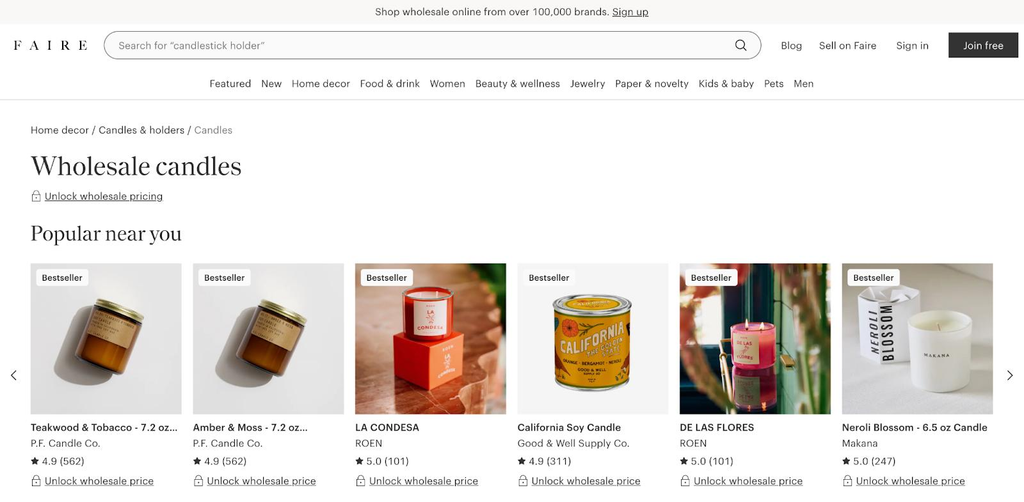
Retailers can’t buy products they can’t find. Start by optimizing your Faire product titles, descriptions, categories, keywords, and images to make your listings relevant to wholesale buyers.
Keep your catalog updated with seasonal collections, new arrivals, and bestselling products. You can also explore Faire’s promotional programs and Promoted Listings, where available, to increase product exposure.
2. Attract New Retailers Through Faire Direct
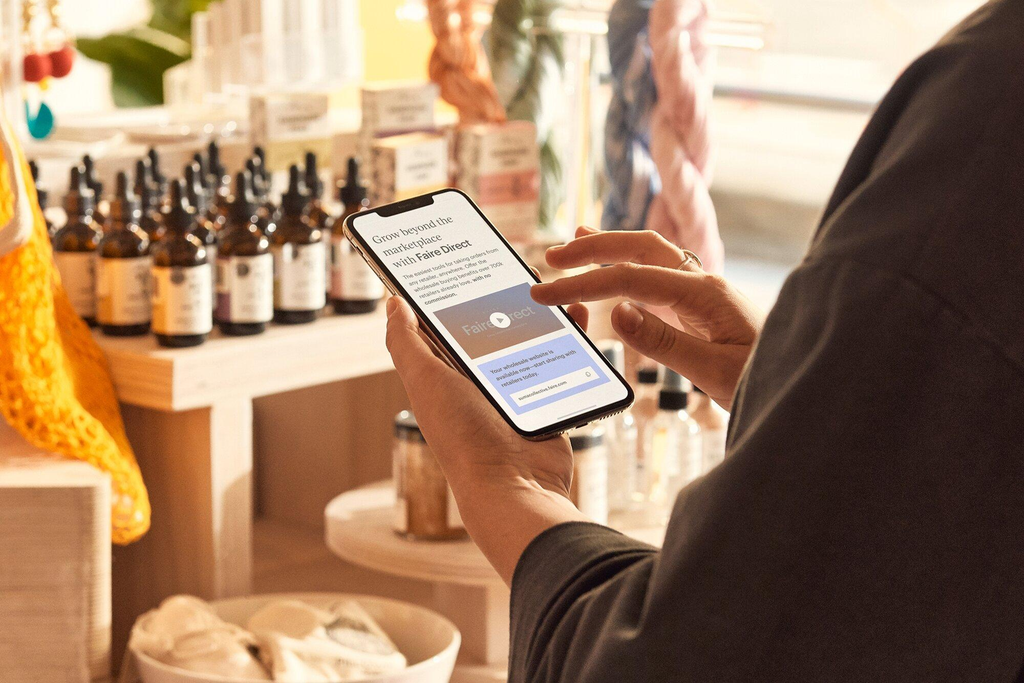
Don’t rely entirely on Faire’s marketplace traffic. Build relationships with independent boutiques, gift shops, and specialty retailers that match your product category and pricing.
Use targeted email outreach, trade shows, social media, and your wholesale website to introduce your brand. Share your Faire Direct link with qualifying retailers to simplify ordering and potentially avoid marketplace commissions.
Focus on retailers most likely to stock and reorder your products rather than contacting every store.
3. Use Promotions and Advertising Strategically
Promotions can encourage first-time orders, increase basket sizes, and support seasonal sales. Consider relevant Faire marketplace events, new-product launches, and carefully planned discounts.
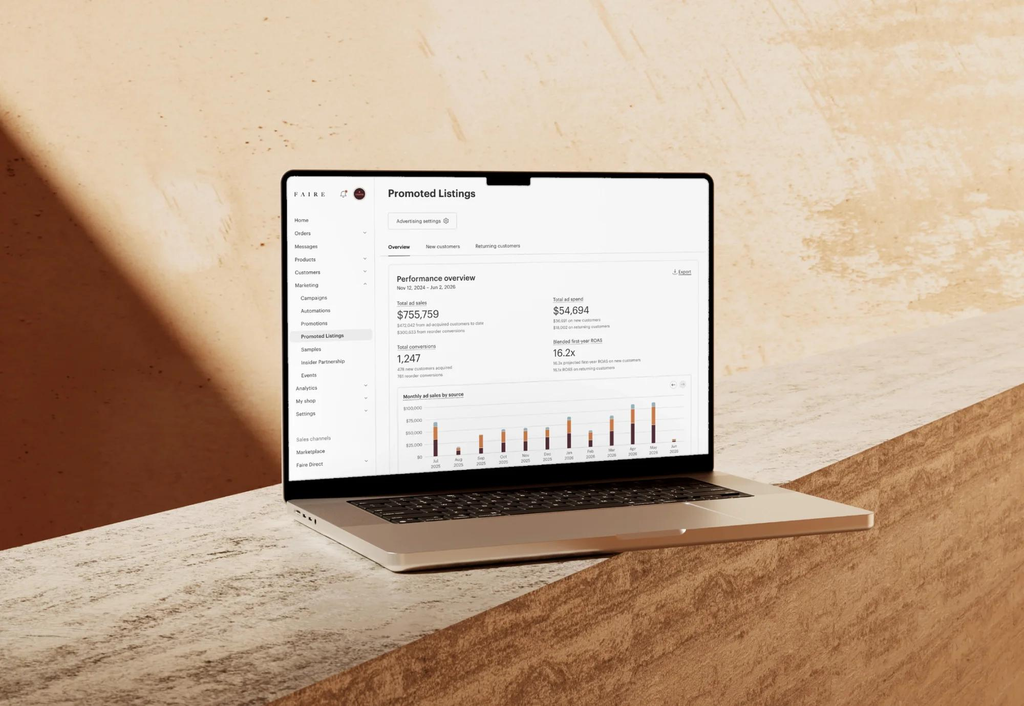
Where available, Faire Promoted Listings can help place products in front of relevant retailers. However, paid visibility works best when your listings already have attractive images, competitive wholesale prices, and reasonable order minimums. Always calculate your margins after discounts, commissions, advertising costs, and other expenses.
4. Turn First-Time Buyers Into Repeat Retailers
Your first order introduces the brand. The reorder shows that the retailer sees value in stocking your products.
After delivery, confirm that the order arrived correctly. Follow up when appropriate with restock updates, seasonal collections, new arrivals, and relevant product recommendations.
Track each retailer’s ordering history, average order value, and typical replenishment cycle. This helps you identify when a buyer may be ready to reorder without sending unnecessary messages.
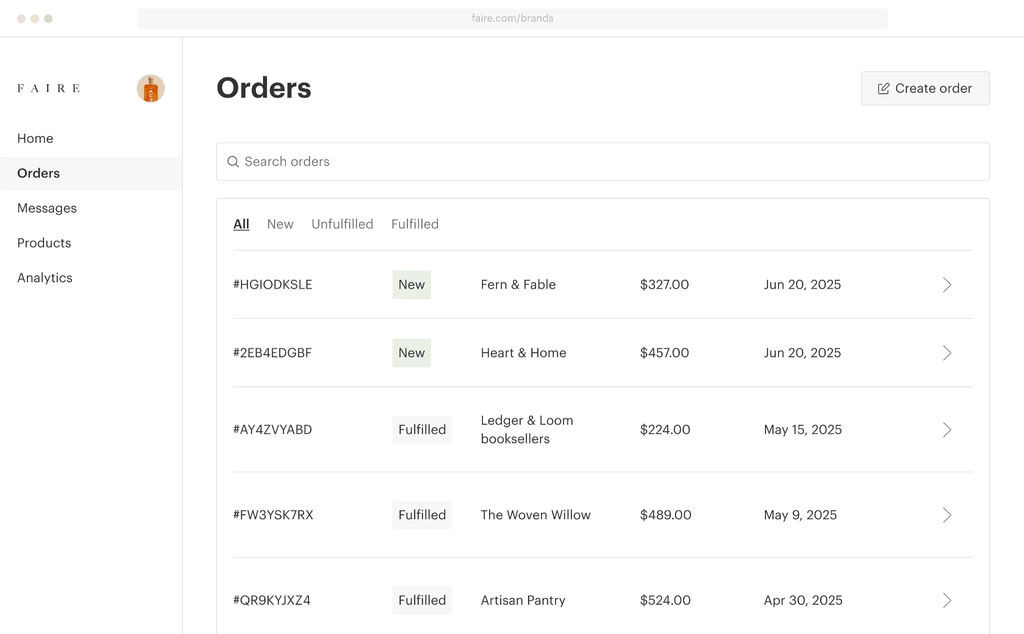
Mistakes That Hold Faire Brands Back
- Ignoring Wholesale Profitability: Launching without calculating wholesale pricing, Faire commission fees, shipping costs, and profit margins can quickly turn sales into losses.
- Poor Product Catalog Optimization: Using generic descriptions, irrelevant keywords, incomplete product details, or inconsistent images makes it harder to attract and convert retailers.
- Unrealistic Order Minimums and Discounts: Setting high minimum order quantities or offering excessive discounts without checking margins can discourage buyers and reduce profitability.
- Weak Inventory and Fulfillment Management: Inaccurate stock levels, delayed shipments, unrealistic lead times, and unreliable order fulfillment can damage retailer trust and repeat sales.
- Neglecting Retailer Relationships and Performance: Focusing only on new orders while ignoring reorders, Faire Direct opportunities, customer feedback, and contribution margins limits long-term growth.
Frequently Asked Questions About Selling on Faire
Q1. Is it free to open a brand shop on Faire?
Faire says it is free to join. Orders can still incur commission, payment processing or payout charges, and potentially other relevant expenses based on your program and location.
Q2. Who can sell on Faire?
Brands with products appropriate for independent retail may apply, subject to Faire review and country- and category-specific eligibility.
Q3. What is the Faire commission rate in 2026?
For US and Canadian brands, marketplace orders carry 15% commission and marketplace-acquired opening orders also have a one-time $10 customer fee. Outside North America, opening marketplace orders generally carry 25% and later marketplace reorders 15%, under current published rules.
Q4. Is Faire Direct really commission-free?
Qualifying Faire Direct orders currently have 0% commission. Payment-processing, payout, shipping and other charges may still apply.
Q5. How does Faire SEO work?
Faire uses a personalized ranking system evaluating product relevance, retailer behavior and brand performance. Strong titles, product information, correct categories, conversion and reliable service all matter.
Q6. What should I include in product photos?
A clear hero image plus relevant lifestyle, scale, packaging, detail and merchandising shots. Image completeness helps shoppers understand the product, but avoid unverified claims about fixed ranking thresholds.
Q7. How should I set the opening-order minimum?
Use your product and fulfillment costs to find a profitable threshold, then assess whether the commitment feels manageable to your ideal retailer. There is no universal best dollar amount.
Q8. Can I connect Shopify to Faire?
Faire provides a Shopify integration for supported catalog, inventory and order workflows. Confirm current functionality and compatibility for your account.
Q9. Does Faire handle retailer returns?
Faire offers eligible opening-order returns under stated conditions. Review applicable policies for damaged products, claims and repeat-order issues.
Q10. Can I sell internationally through Faire?
International selling depends on supported brand and retailer countries plus logistics, payout, tax, customs and product compliance rules. Validate the economics before enabling a new market.
Build a Wholesale Channel, Not Just a Storefront
Faire can bring your brand into a retailer’s consideration set. It cannot make an unprofitable assortment profitable or replace reliable operations. The strongest approach combines retailer-informed pricing, a clear catalog, honest fulfillment promises, channel-specific fee modeling, and consistent account management. Win a first order by reducing risk; earn the next one by helping the retailer sell through.
Grow Your Faire Wholesale Business With Ecomclips
Successful Faire selling requires more than listing products. From Faire wholesale strategy and catalog optimization to pricing, commission management, fulfillment, and retailer retention, every detail matters. Ecomclips helps ecommerce brands improve marketplace visibility, streamline operations, and build sustainable growth strategies focused on profitability.
Watch practical ecommerce tutorials on the Ecomclips YouTube channel, explore expert insights on the Ecomclips Blog, and discover actionable tips to optimize your Faire listings, attract wholesale buyers, and increase repeat orders.
Explore our Ecommerce Growth Resources for more guidance on marketplace SEO, product optimization, pricing, and fulfillment. Follow Ecomclips on Facebook and connect with us on LinkedIn for ecommerce insights and marketplace growth strategies.
Ready to grow your Faire wholesale business? Contact us at info@ecomclips.com or book an appointment with our ecommerce experts to explore your next growth opportunities.