
Imagine this: It’s mid-July 2025, and Amazon Prime Day—the biggest sales event of the year—is in full swing. This time, it’s not just a two-day frenzy; it’s a four-day marathon of deals, discounts, and deal-hungry shoppers. As an Amazon seller, you’ve been counting down the days, buzzing with excitement as millions of customers flood the platform, ready to buy. Your sales dashboard lights up; orders are rolling in, and revenue is climbing fast. But then, a few days later, you crunch the numbers. The excitement fades. Sure, your sales soared, but your profits? They’ve shrunk to less than what you’d make on a quiet Tuesday in March. This is the hidden trap many sellers fall into during Prime Day: more sales, less money in their pockets.
Sound familiar? If it doesn’t yet, it might soon—unless you’re armed with the right knowledge. The good news is that Amazon Prime Day 2025 doesn’t have to be a profit-draining rollercoaster. In this blog, we’re pulling back the curtain on the secrets no one else is telling you. We’ll walk you through real performance data, break down why revenue isn’t the whole story, and give you a step-by-step strategy to maximize both sales and profits during this four-day event. Whether you’re a seasoned seller or prepping for your first Prime Day, stick with us; you’re about to learn how to turn chaos into cash.
Introduction: The Prime Day Promise (and Pitfall)
Amazon Prime Day is the Super Bowl of e-commerce, and in 2025, it’s bigger than ever. Stretching across four days in mid-July, it’s a golden opportunity for sellers to rack up sales and reach millions of eager buyers. But here’s the catch: it’s not enough to just participate. Without a solid plan, you could end up like countless sellers before you—drowning in revenue but starved for profit.
In past years, I’ve tracked Prime Day performance across multiple accounts, and the numbers don’t lie. The potential is massive, but so are the risks. Today, we’re diving into what worked, what didn’t, and how you can set yourself up for success in 2025. We’ll cover everything from last year’s sales and PPC data to profit analysis and a detailed strategy you can start building now. Ready? Let’s get into it.
Performance Overview: What Prime Day Can Do
To understand Prime Day’s power, let’s look at some real numbers from last year. In one of my accounts, sales in May hit $157K. June climbed to $167K. Then came Prime Day in July—sales exploded to $280K. That’s a $100K jump in a single month, driven by the Prime Day surge. On the PPC side, June ad spend was $10K, delivering $80K in sales with a tidy 13% ACoS (Advertising Cost of Sale). During Prime Day, I bumped spending to $13K, and sales hit $119K—up $40K from the prior month—while keeping ACoS steady at 13%.
In another account, the story was even bigger. June sales were $322K, but Prime Day pushed them to $497K—nearly a $200K increase. PPC spend in June was $39K, generating $188K in sales at 21% ACoS. During Prime Day, I spent $64K, pulling in $293K in sales with a 22% ACoS. That’s an extra $100K in ad-driven revenue, all while maintaining control over costs.
These numbers scream opportunity. Prime Day isn’t just a sales event—it’s a revenue rocket. But here’s where the story twists: revenue alone doesn’t pay the bills. Let’s peel back the next layer.
Profit Analysis: The Hidden Truth Behind the Hype
If you’re smiling at those revenue spikes, hold off on the celebration. Revenue is flashy, but profit is what keeps your business alive. Too many sellers—and agencies—focus on the top-line numbers, waving around big sales figures like a victory flag. But dig deeper, and the picture changes.
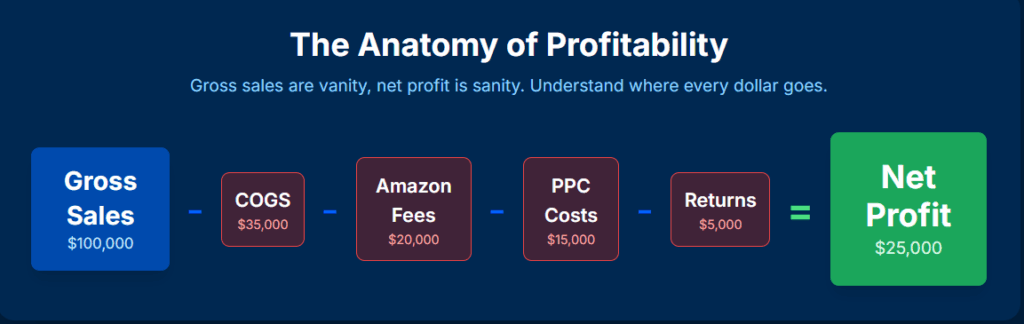
I recently spoke with a seller who swore off Prime Day entirely. Why? Last year, his revenue tripled, but his profits tanked—lower than a regular month. Curious, I took a closer look. Here’s what happens all too often:
Let’s say your product sells for $100 with a 50% profit margin. Your cost is $50, so your break-even point is 50%. On a normal day, you run PPC with a TACoS (Total Advertising Cost of Sales) of 20%, leaving you a comfy 30% profit margin. Sweet, right? Now enter Prime Day. Competitors are slashing prices and cranking up ad bids. To keep up, you offer a 30% discount (price drops to $70) and double your ad budget. Suddenly, your break-even shrinks to 35% because your margin’s tighter. If your TACoS creeps above that—say, to 40%—you’re in the red, even if sales are through the roof.
That’s exactly what happened to this seller. Discounts ate his margins, and sky-high CPCs (Cost Per Click) from fierce competition pushed his TACoS out of control. Revenue looked great, but profit? A ghost. This is the bitter truth: Prime Day can boost sales while silently draining your bottom line. So, how do you avoid this trap? Strategy.
Prime Day Strategy: Your Blueprint for Success
Prime Day’s pros outweigh the cons, but only if you play it smart. The key? A data-driven plan that balances sales growth with profit protection. Here’s how to build it:
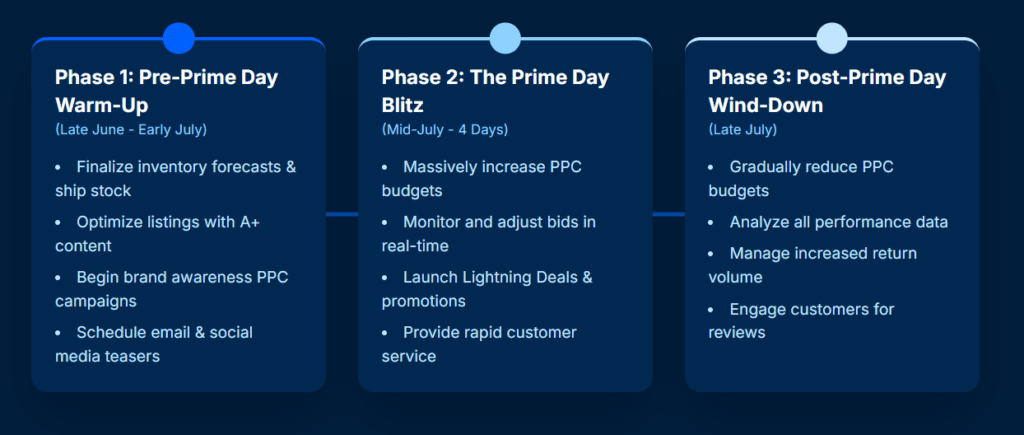
1. Pick Your Players
Don’t throw every product into the Prime Day blender. Focus on high-margin items or proven bestsellers. These are your MVPs—give them the spotlight with targeted discounts and ad spend.
2. Budget Like a Boss
Set separate PPC budgets for your Prime Day stars. This keeps your spending laser-focused and lets you adjust on the fly without disrupting your regular campaigns.
3. Do the Math
Discounts shrink your margins, and extra ad spend ups the stakes. Calculate your new break-even point and show your ideal TACoS target. For example, if a $70 price with a 35% break-even needs a TACoS under 35% to stay profitable, aim for 25%-30% to cushion your profit.
Once you’ve got this foundation, layer on a killer PPC strategy (more on that below). The goal? Boost sales without sacrificing margins during Amazon Prime Day 2025’s four-day madness.
Step-by-Step Amazon PPC Strategies for Keyword Hacks
A killer Amazon PPC Strategy can unlock an extra 35%-45% in sales—if you do it right. Here’s your step-by-step playbook:
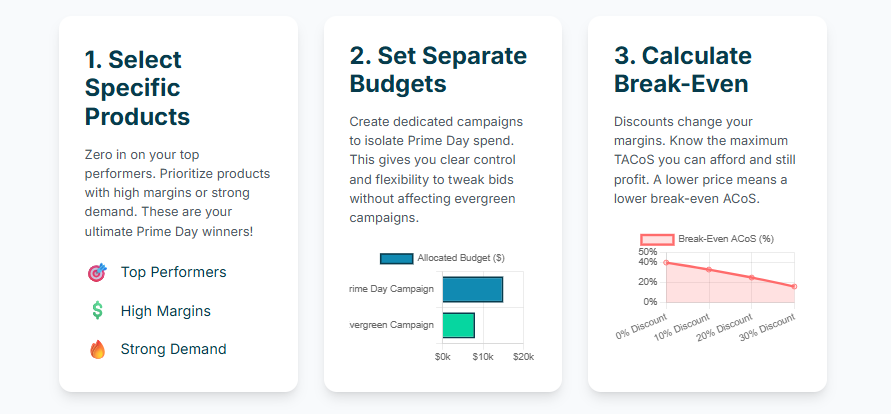
- Select Specific Products
Zero in on your top performers. High margins or strong demand? Those are your Prime Day winners. - Set Separate PPC Budgets
Create dedicated campaigns for your focus products. This isolates your Prime Day spend and gives you flexibility to tweak without chaos. - Calculate Break-Even Points
Discounts change everything. A $100 product at $70 has a lower break-even. Nail down the max TACoS you can afford and still profit. - Optimize Keywords
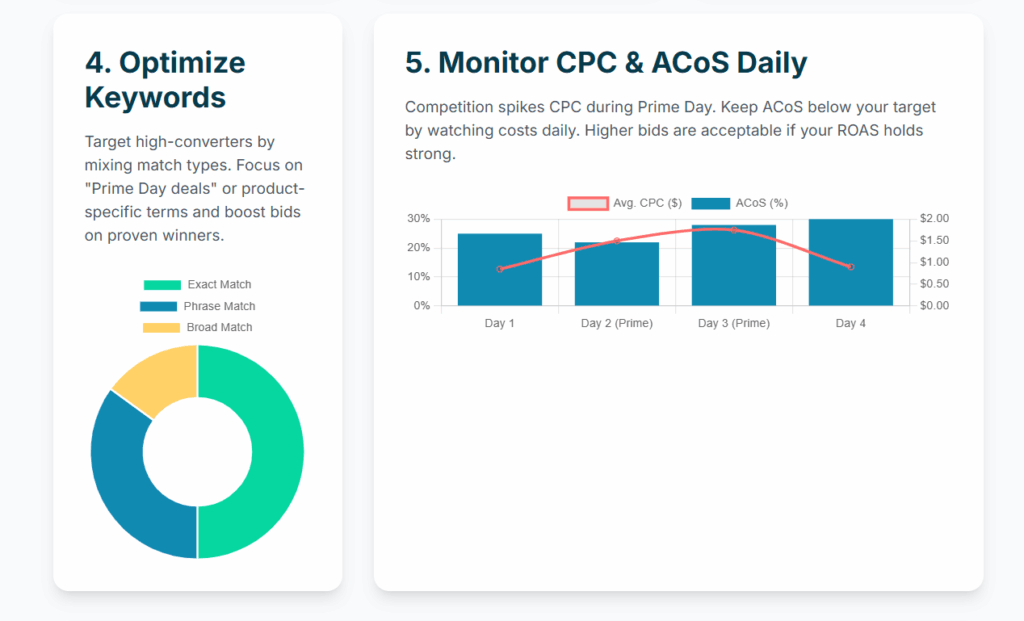
Use an Amazon PPC Keywords Strategy to target high-converters. Mix broad, phrase, and exact matches—think “Prime Day deals” or product-specific terms—and boost bids on winners. - Monitor CPC and ACoS
Competition spikes CPC during Prime Day. Keep ACoS below your target by watching costs daily—higher bids are fine if ROAS holds. - Leverage PPC Hacks
Add negative keywords (e.g., “cheap” for premium products) to cut waste. Adjust placements to favor top-of-search for ready buyers.
Real results back this up. Last Prime Day, one account turned $13K in ad spend into $119K in sales (13% ACoS). Another flipped $64K into $293K (22% ACoS). That’s the power of a focused Amazon PPC Ads Plan.
Overwhelmed? That’s where EcomClips steps in. As an Amazon PPC Agency, we specialize in turning sales events like Prime Day into profit machines. Here’s how we help:
- Custom Amazon PPC Ads Plan
We tailor a plan to your products, budget, and goals—no one-size-fits-all here. - Expert Amazon PPC Keywords Strategy
We mine data for the best keywords, blending analytics with market savvy to drive clicks and conversions. - Pro-Level Amazon PPC Hacks
Bid optimization, campaign structuring, negative keywords—we cut fat and amplify results.
From tracking KPIs like CPC, ACoS, and ROAS to crafting strategies for Amazon advertising, we’ve got the expertise to make Prime Day 2025 your best yet. Want to stop guessing and start winning? Reach out—we’re here to help.
Insights! Key Takeaways for Prime Day 2025
Let’s wrap this up with the big lessons:
- Massive Potential: Sales jumped $100K-$200K in my accounts last Prime Day. PPC revenue soared $40K-$100K.
- Profit Matters: Revenue can triple, but profits can vanish without margin control—ask my client who quit Prime Day after a loss.
- Strategy Is King: Pick products, set budgets, and target TACoS. It’s the line between surviving and thriving.
- PPC Powers Up: A tight Amazon PPC Strategy—keywords, hacks, and monitoring—delivers that 35%-45% sales boost.
Start now. Map your Amazon PPC Ads Plan, pick your products, and optimize. With four days of Prime Day madness ahead, preparation is your edge. Need a hand? EcomClips is just a click away. Let’s make 2025 your most profitable Prime Day yet!
To take your Amazon PPC ads plan to the next level, implement these strategies and monitor your KPIs like CPC bids, ACoS, and ROAS. For personalized support, reach out to EcomClips at info@ecomclips.com. Let’s make 2025 your most profitable year yet on Amazon!