
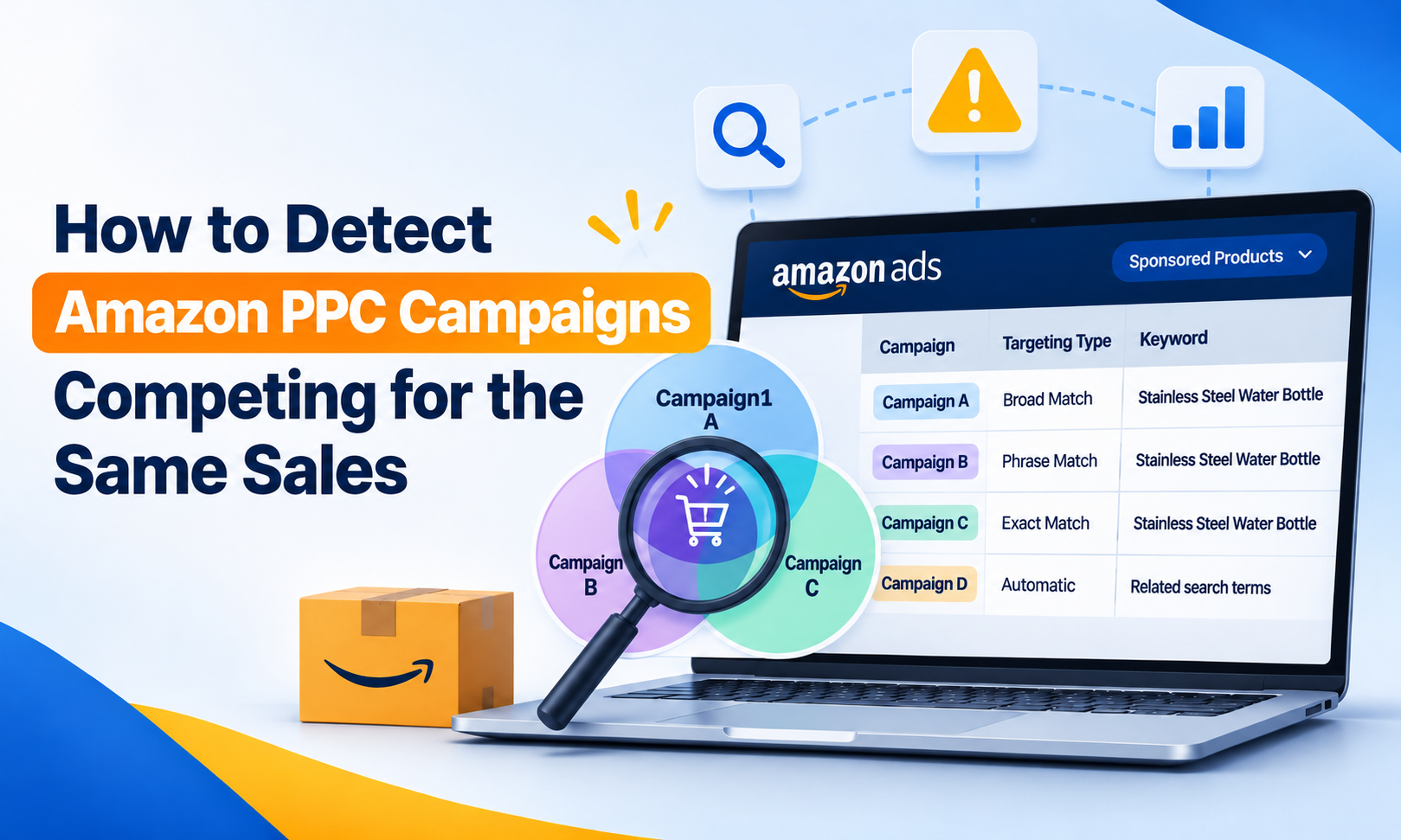
Running multiple Amazon PPC campaigns can help sellers increase product visibility, reach different customer segments, and capture more sales opportunities. However, creating multiple campaigns does not always mean generating additional sales.
Sometimes, different campaigns target the same keywords, search terms, or products. As a result, they may compete for similar advertising opportunities and attract the same potential customers.
This situation is commonly known as Amazon PPC campaign overlap or keyword cannibalization.
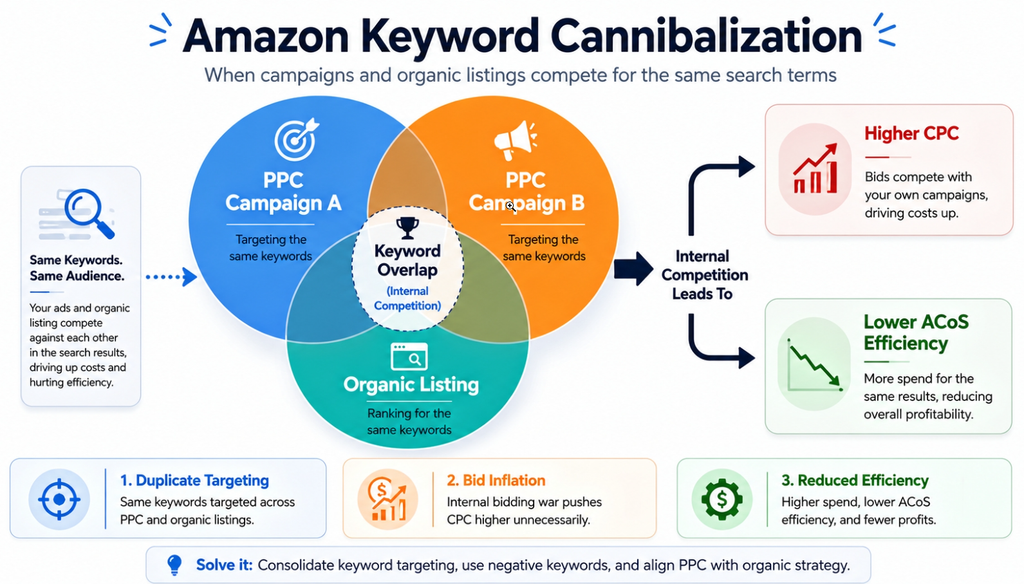
For example, a seller may run several Sponsored Products campaigns targeting the same keyword through Automatic targeting, broad match, phrase match, and exact match campaigns. Instead of reaching additional customers, these campaigns may overlap in their targeting and create unnecessary complexity in budget allocation and performance analysis.
Although Amazon’s advertising auction determines ad eligibility and placement, advertisers should not assume that overlapping campaigns are directly bidding against each other in the same auction. The real concern is that multiple campaigns may target the same demand, create internal competition for budget and visibility, and make it difficult to identify which targeting strategy is generating incremental sales.
In this guide, we will explain how to detect Amazon PPC campaign overlap, identify keyword cannibalization, analyze campaign performance, and build a more efficient campaign structure.
What Is Amazon PPC Campaign Overlap?
Amazon PPC campaign overlap occurs when multiple campaigns, ad groups, or targeting strategies reach the same or very similar customer searches.
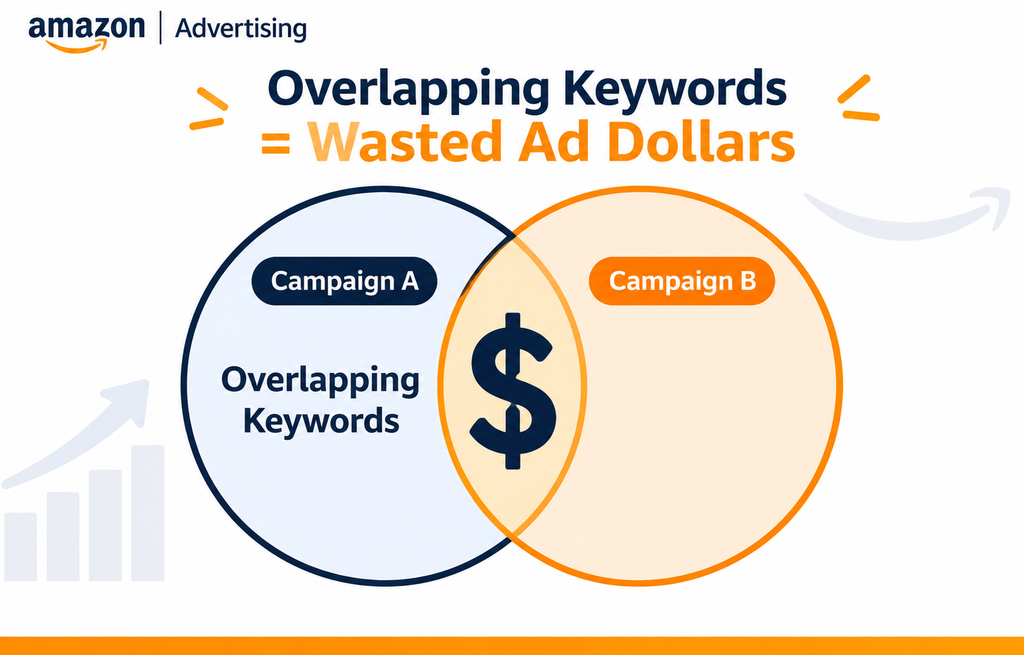
This usually happens when advertisers use identical keywords across different campaigns, duplicate product targets, or overlapping automatic and manual targeting.
For example, consider the following campaign structure:
| Campaign | Targeting Type | Target Keyword |
| Campaign A | Broad Match | Stainless Steel Water Bottle |
| Campaign B | Phrase Match | Stainless Steel Water Bottle |
| Campaign C | Exact Match | Stainless Steel Water Bottle |
| Campaign D | Automatic | Related search terms |
All four campaigns may become eligible for searches related to stainless steel water bottles.
This does not necessarily mean all campaigns will receive impressions for the same search. However, they can overlap in the customer demand they are trying to capture.
Why Is Campaign Overlap a Problem?
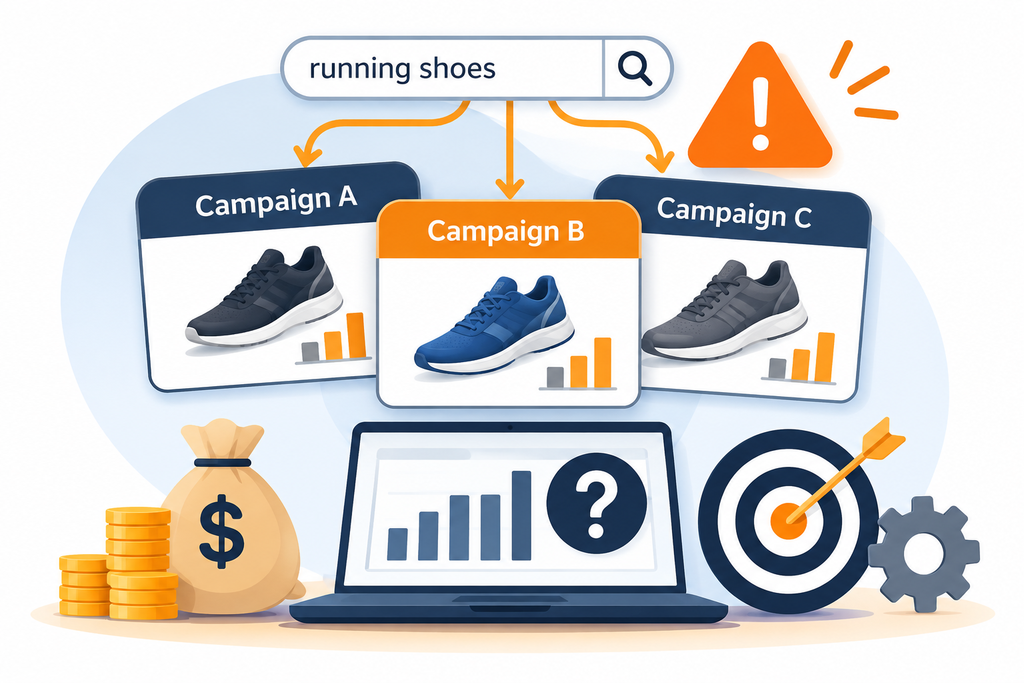
When multiple campaigns target similar search traffic without a clear strategy, sellers may experience:
- Difficulty identifying which campaign generates incremental sales.
- Unnecessary duplication of keyword targeting.
- Inefficient budget distribution.
- Less control over keyword-level performance.
- Difficulty managing bids and campaign profitability.
- Misleading performance analysis when evaluating individual campaigns.
The objective is not to eliminate every instance of targeting overlap. Instead, advertisers should identify unnecessary overlap and establish clear targeting roles for each campaign.
Identify Duplicate Keywords Across Campaigns
One of the easiest ways to detect Amazon PPC campaign overlap is by checking whether the same keywords appear in multiple campaigns.
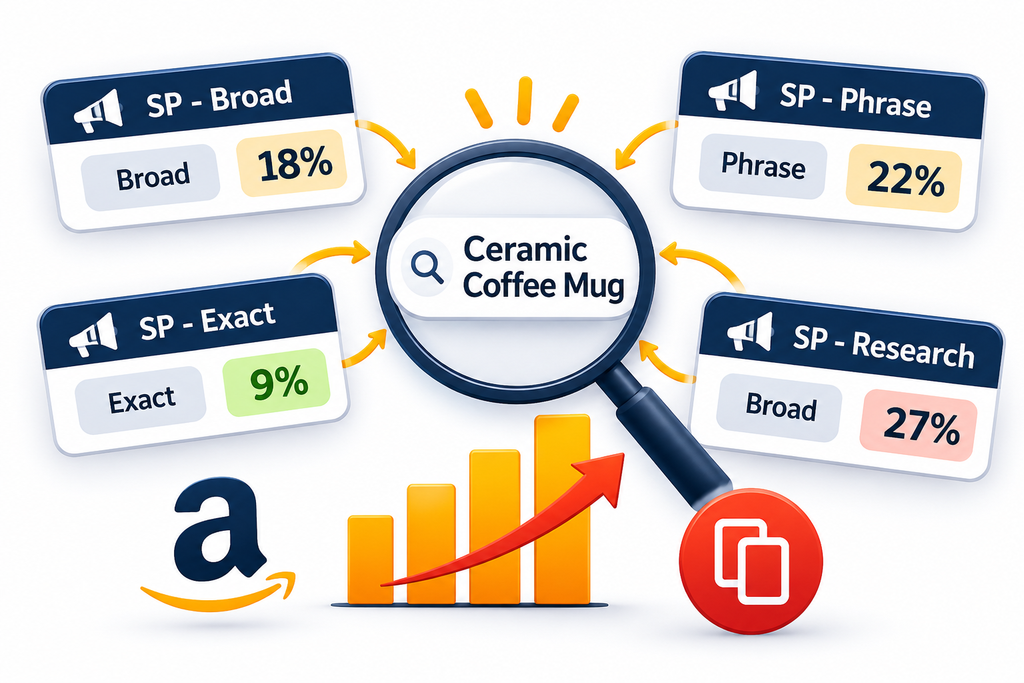
This is particularly important when managing several Sponsored Products manual campaigns.
For example:
| Campaign | Match Type | Keyword | ACoS |
| SP – Broad | Broad | Ceramic Coffee Mug | 18% |
| SP – Phrase | Phrase | Ceramic Coffee Mug | 22% |
| SP – Exact | Exact | Ceramic Coffee Mug | 9% |
| SP – Research | Broad | Ceramic Coffee Mug | 27% |
In this example, the same keyword is targeted across four campaigns.
The exact match campaign delivers the lowest ACoS, while the research campaigns show higher advertising costs.
This indicates an opportunity to review keyword distribution and establish a more controlled structure.
What Should You Check?
- Identify keywords appearing in multiple campaigns.
- Compare their match types.
- Review impressions, clicks, CPC, orders, and attributed sales.
- Identify which campaigns consistently generate profitable conversions.
- Check whether duplicate targets serve different strategic purposes.
Do not automatically pause duplicate keywords. If different match types serve research and performance objectives, overlap may be intentional. Instead, evaluate whether each campaign contributes additional value.
Analyze the Amazon Search Term Report
The Search Term Report is one of the most useful resources for identifying overlapping customer searches.
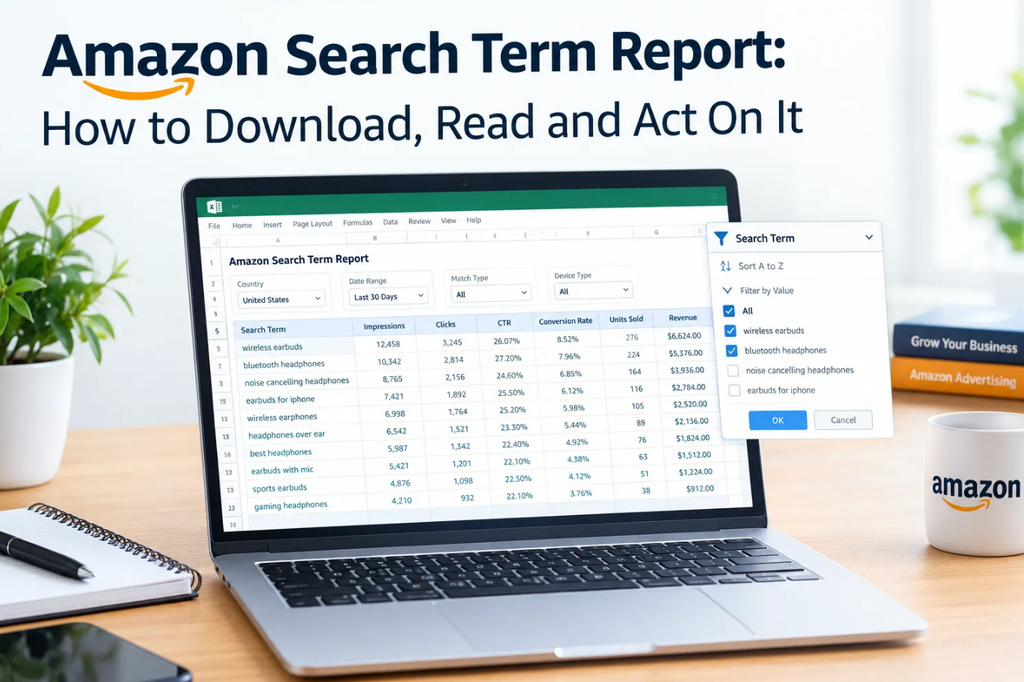
While your campaigns may target different keywords, they can still generate impressions and clicks for the same actual customer search term.
For example:
| Campaign | Targeting | Customer Search Term |
| Auto Campaign | Close Match | Insulated Water Bottle |
| Broad Campaign | Insulated Bottle | Insulated Water Bottle |
| Phrase Campaign | Insulated Water Bottle | Insulated Water Bottle |
| Exact Campaign | Insulated Water Bottle | Insulated Water Bottle |
Here, four different targeting sources are generating traffic for the same customer search term.
This creates an opportunity to review how the search term is distributed across campaigns.
How to Analyze Search Term Overlap
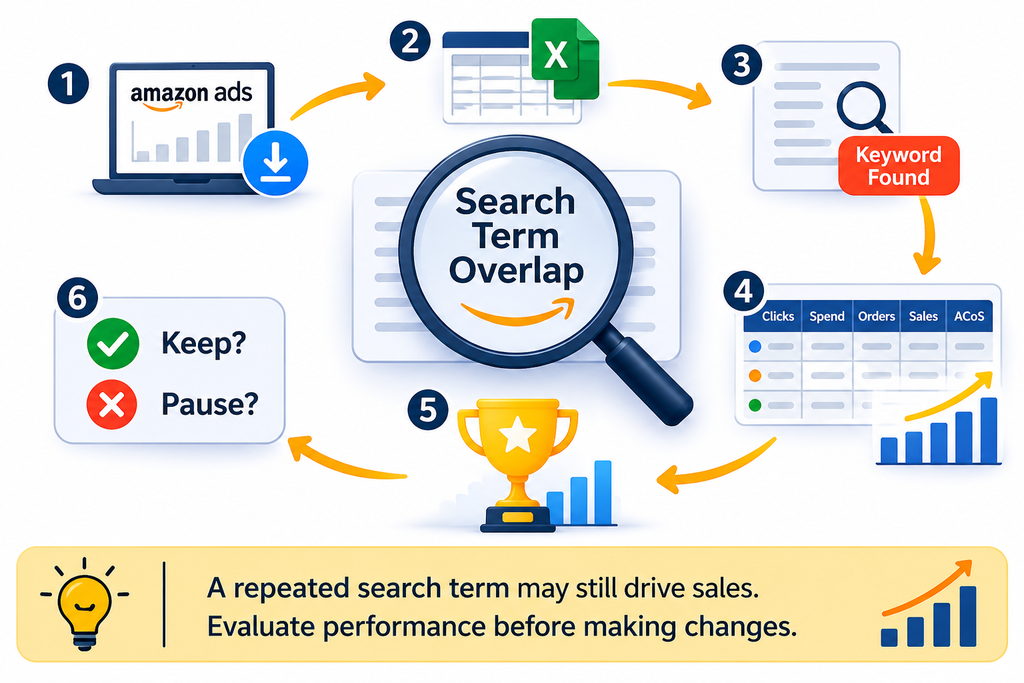
- Download the Sponsored Products Search Term Report.
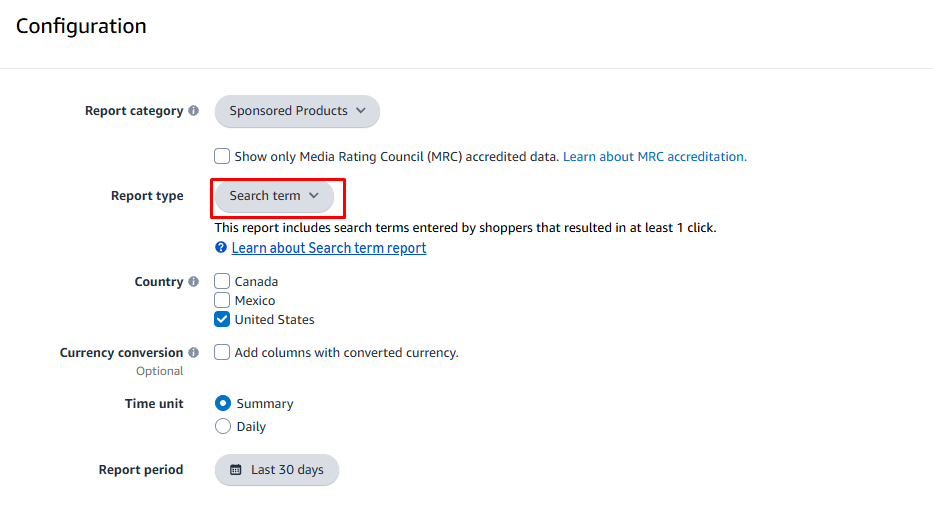
- Export campaign names, ad group names, targeting information, and customer search terms.
- Filter the report to identify repeated customer search terms.
- Compare clicks, spend, orders, sales, and ACoS across campaigns.

- Identify the campaign that delivers the strongest conversion and profitability.
- Decide whether the remaining campaigns should continue targeting that search term.
A repeated search term does not automatically mean wasted spend. Multiple campaigns may contribute to sales over different periods or through different targeting strategies. Evaluate performance over a sufficient date range before making changes.
Monitor Campaign Performance for Signs of Overlap
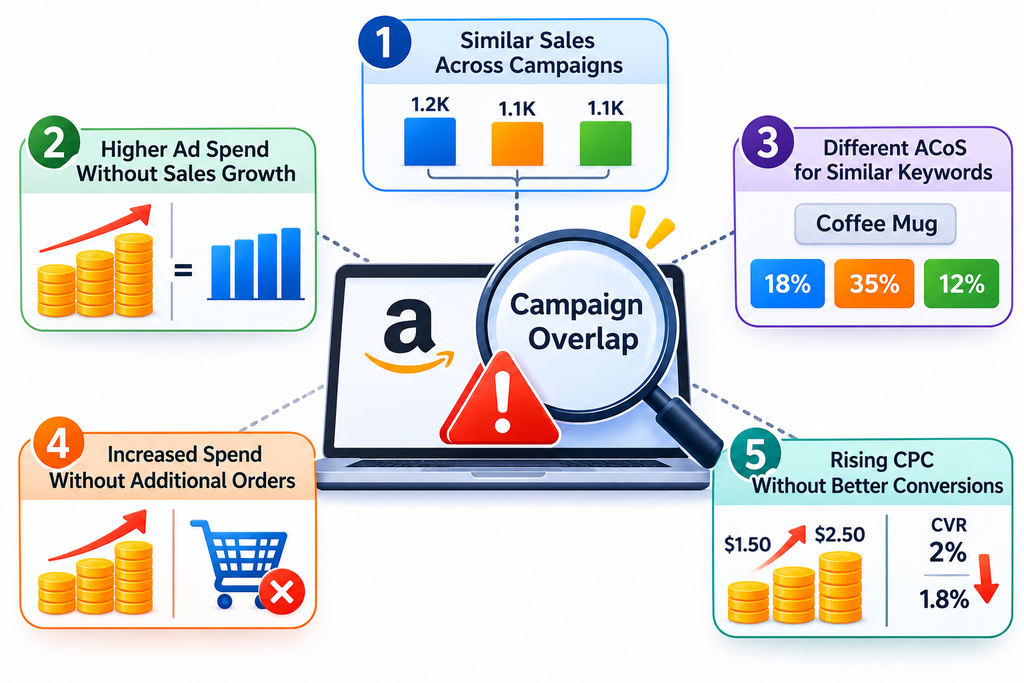
Campaign overlap is not always obvious from keyword lists or search term reports.
Sometimes, performance data shows multiple campaigns targeting similar demand without generating meaningful incremental growth.
Watch for the following warning signs:
A. Multiple Campaigns Generate Similar Sales
If several campaigns generate sales from the same search terms, review whether they reach additional customers or simply capture similar demand.
B. Advertising Spend Increases Without Proportional Sales Growth
If total ad spend increases but overall PPC sales remain relatively unchanged, investigate whether overlapping targeting is contributing to inefficient spending.
C. Similar Keywords Have Different ACoS Across Campaigns
When the same keyword generates different ACoS across campaigns, investigate differences in bids, placements, match types, and conversion rates.
D. Campaigns Consume Budget Without Generating Additional Orders
If multiple campaigns spend heavily on similar search terms, but total account orders do not increase accordingly, review their contribution to overall performance.
E. High CPC Without Improved Conversion Performance
Overlapping targeting can make campaign management more complicated. If CPC increases without a corresponding improvement in conversion rate or sales, review bids and targeting structure.
Never evaluate overlap using ACoS alone. Review total advertising sales, organic sales, conversion rate, and overall account performance to understand whether a campaign is generating incremental value.
Use Negative Keywords to Control Unnecessary Overlap
Negative keywords are one of the most effective ways to control unwanted search term overlap between campaigns.
Once you identify a search term that should be managed by a specific campaign, you can use negative targeting to prevent other campaigns from matching that search term where appropriate.
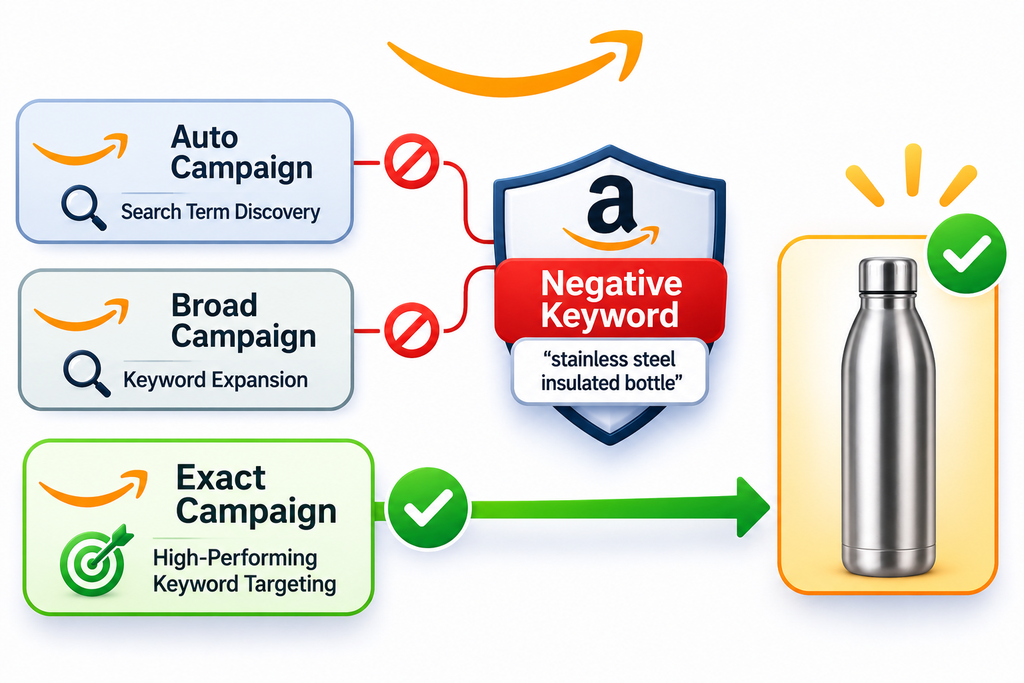
For example:
Suppose you have three campaigns:
- Auto Campaign – Search term discovery.
- Broad Campaign – Keyword expansion.
- Exact Campaign – High-performing keyword targeting.
After analyzing the Search Term Report, you identify that “stainless steel insulated bottle” consistently generates profitable orders.
You may decide to prioritize this search term in the exact match campaign.
To create a more controlled structure, consider adding the relevant negative exact keyword to the discovery campaigns.
Recommended Negative Keyword Strategy
| Campaign Type | Recommended Action |
| Auto Campaign | Add proven search terms as negative exact when routing them to manual campaigns |
| Broad Match | Use negative exact or phrase where appropriate to control unwanted overlap |
| Phrase Match | Exclude search terms that should be managed separately |
| Exact Match | Prioritize high-performing keywords with dedicated bid management |
Important Considerations
- Use negative exact when you want to block a specific customer search term.
- Use negative phrase when you want to block a broader phrase and its matching variations.
- Avoid adding negatives without reviewing their potential impact on relevant traffic.
- Monitor performance after implementing negative keywords.
Negative targeting should help organize traffic, not unnecessarily restrict valuable customer searches.
Evaluate Whether Overlapping Campaigns Generate Incremental Sales

This is one of the most important steps in detecting campaign overlap.
A campaign may generate attributed sales, but that does not necessarily mean those sales are entirely incremental.
For example, imagine two campaigns targeting similar customer searches.
| Metric | Campaign A | Campaign B |
| Ad Spend | $500 | $450 |
| PPC Sales | $2,000 | $1,800 |
| ACoS | 25% | 25% |
| Orders | 40 | 36 |
Both campaigns appear to perform well individually.
However, if they target the same customer demand, you need to investigate whether Campaign B is bringing additional orders or simply capturing sales that might otherwise have been generated through Campaign A.
How to Evaluate Incremental Performance
Compare the following metrics before and after adjusting the campaign structure:
- Total PPC sales.
- Total advertising spend.
- Total account sales.
- Total orders.
- ACoS and TACoS.
- Organic sales contribution.
- Conversion rate.
- Marginal ROAS.
For example, if you reduce spending on overlapping targets and total account sales remain stable while advertising costs decrease, this may indicate that the previous structure contained inefficient spending.
However, if total orders and sales decline significantly, the adjustment may have restricted valuable traffic.
The goal is to reduce duplicated targeting without sacrificing incremental sales opportunities.
Build a Clear Campaign Structure to Prevent Future Overlap
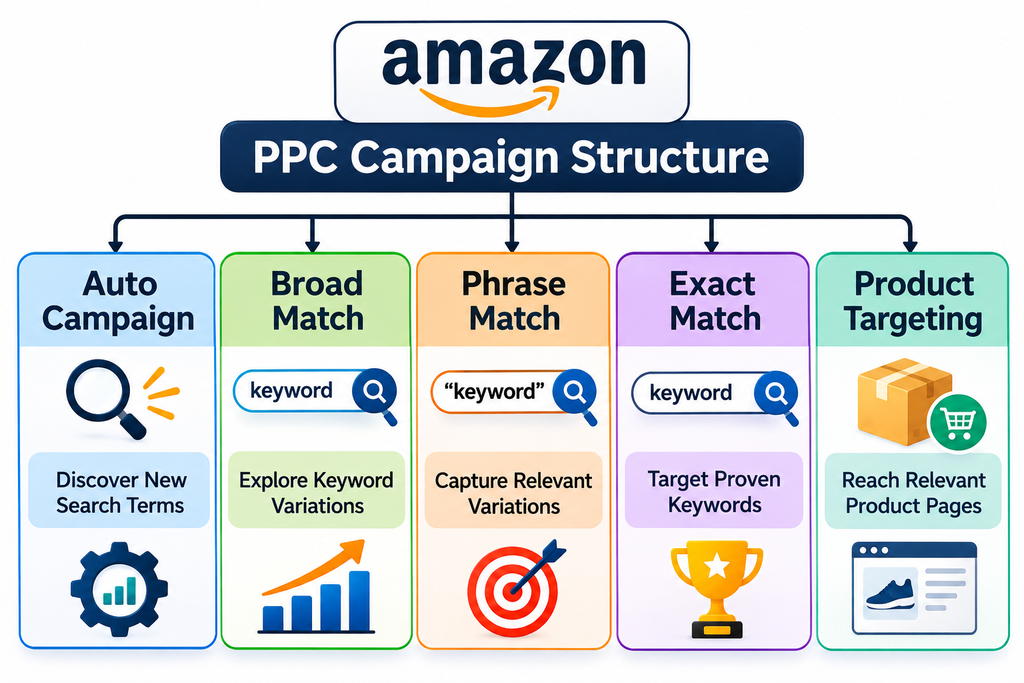
After identifying campaign overlap, the next step is to create a structured campaign organization.
Every campaign should have a specific purpose.
For example:
| Campaign Type | Primary Objective | Management Approach |
| Auto Campaign | Discover new search terms | Monitor search terms and control irrelevant traffic |
| Broad Match | Discover keyword variations | Review search term performance regularly |
| Phrase Match | Capture relevant keyword variations | Refine targeting based on conversion data |
| Exact Match | Capture proven high-performing searches | Prioritize profitable keywords and optimize bids |
| Product Targeting | Reach relevant product detail pages | Evaluate ASIN-level performance |
Best Practices for Campaign Organization
- Assign a clear objective to every campaign.
- Separate keyword discovery from proven keyword targeting.
- Avoid unnecessary duplication of exact match keywords.
- Use negative keywords to control traffic distribution.
- Keep high-performing keywords in dedicated campaigns when this improves management.
- Review campaign performance regularly.
A well-organized structure makes it easier to identify profitable targeting opportunities and control advertising costs.
Common Mistakes to Avoid When Managing Campaign Overlap
Even experienced Amazon PPC advertisers can make mistakes when managing multiple campaigns.
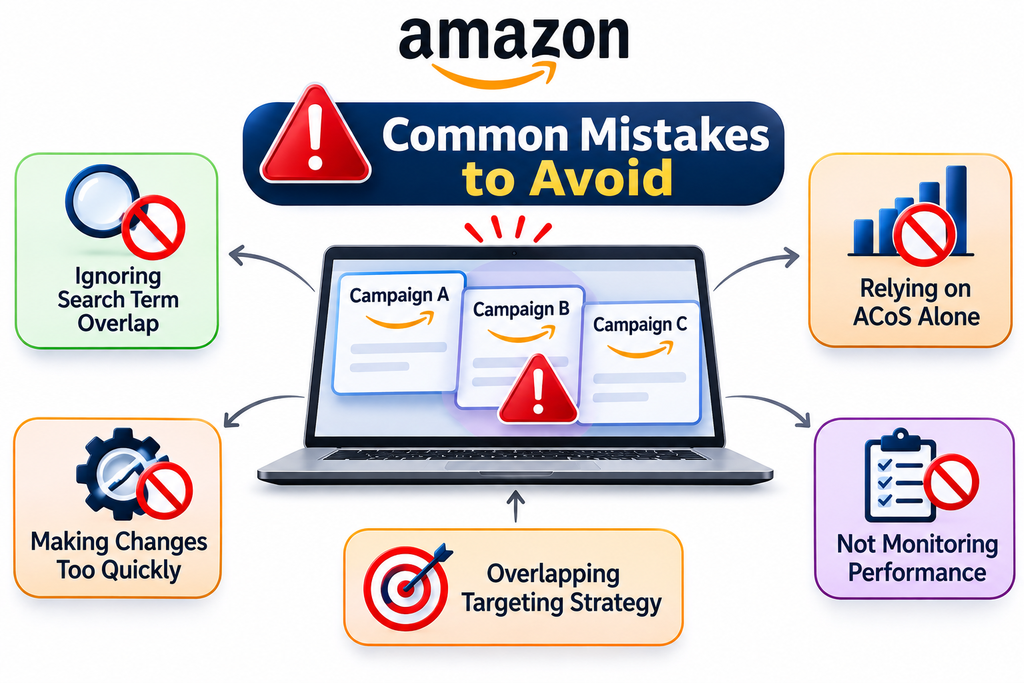
Here are some common issues to avoid:
1. Pausing Every Duplicate Keyword
Duplicate keywords are not always harmful. Some overlap is intentional and can serve different campaign objectives.
2. Adding Negative Keywords Too Quickly
Blocking a search term without reviewing its performance can reduce valuable traffic and sales opportunities.
3. Evaluating Campaigns Individually Only
A campaign may look inefficient on its own but contribute valuable sales to the overall account. Always consider account-level performance.
4. Ignoring Match Type Differences
Broad, phrase, and exact match keywords serve different targeting purposes. Their performance should be evaluated accordingly.
5. Making Changes Based on Limited Data
A few clicks or one order are not enough to determine whether a keyword is profitable or whether campaign overlap is harmful.
6. Ignoring Organic Sales
PPC performance should be evaluated alongside total sales and organic sales trends to understand the broader business impact.
Amazon PPC Campaign Overlap Audit Checklist
A regular campaign audit helps identify unnecessary targeting duplication before it becomes a major budget management issue.
Use the following checklist during your PPC optimization process.
- Identify duplicate keywords across campaigns.
- Review repeated customer search terms.
- Compare campaign-level ACoS, ROAS, CPC, and conversion rates.
- Identify campaigns targeting similar customer demand.
- Check whether overlapping campaigns generate incremental orders.
- Review high-spend search terms with low or no conversions.
- Add negative keywords where appropriate.
- Separate keyword discovery from proven keyword targeting.
- Review budget allocation across campaigns.
- Monitor total sales and TACoS after making changes.
A consistent audit process helps maintain better campaign control and reduces unnecessary advertising expenses.
Conclusion
Amazon PPC campaign overlap is not necessarily a problem in every account. In fact, some targeting overlap is natural when managing automatic, broad, phrase, exact, and product targeting campaigns.
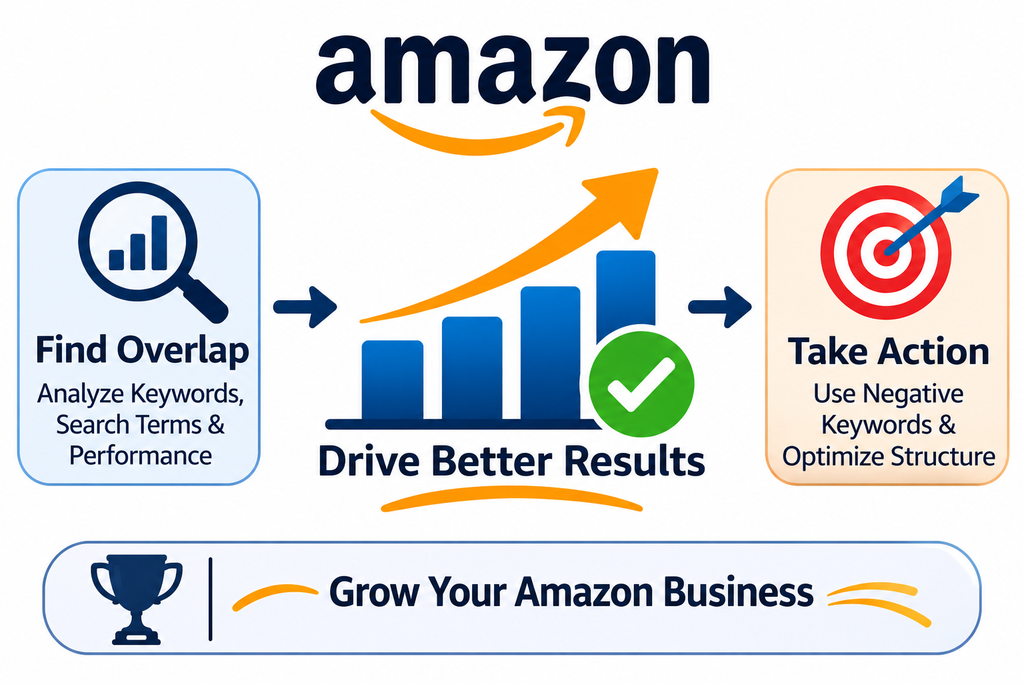
The real challenge is identifying when multiple campaigns are targeting the same customer demand without generating additional sales or meaningful business value.
By analyzing duplicate keywords, reviewing Search Term Reports, monitoring campaign performance, using negative keywords strategically, and evaluating incremental sales, advertisers can build a more efficient PPC structure.
Remember, the objective is not simply to reduce the number of campaigns or eliminate duplicate keywords. It is to make sure every campaign has a clear purpose and contributes to overall business growth.
A well-structured Amazon PPC account should prioritize relevant traffic, profitable conversions, controlled spending, and sustainable sales growth.
For more Amazon PPC, SEO, and AI shopping content, visit the Ecomclips blog or follow the Ecomclips YouTube channel, Ecomclips Facebook page, and connect with Ecomclips on LinkedIn.
Questions about an account review or a free audit can be sent to info@ecomclips.com.
At Ecomclips, we have successfully managed 1,000+ accounts across various e-commerce marketplaces, with a combined monthly advertising spend of over $500,000. Our experienced team specializes in Amazon PPC management, helping businesses increase sales, improve advertising efficiency, reduce wasted spend, and maximize profitability.
Our services include Amazon PPC audits, keyword research, campaign setup and optimization, bid and budget management, search term analysis, negative keyword optimization, competitor targeting, and ongoing performance monitoring. We develop tailored strategies based on each account’s goals, product performance, and profit margins.
If you have an Amazon Seller Central account, we’d be happy to offer you a free Amazon PPC account audit to identify growth opportunities and provide actionable recommendations to improve your advertising performance.