
Managing Amazon PPC campaigns is not simply about increasing advertising budgets or generating more sales. The real challenge is knowing which products deserve more investment and which products are consuming advertising budgets without delivering enough profit.
Many sellers make the mistake of allocating more budget to their best-selling ASINs. Although high sales volume can indicate strong demand, it doesn’t necessarily mean a product is the most profitable advertising opportunity.
One ASIN may generate $10,000 in attributed sales but have a high ACoS and low profit margin. Another may generate only $4,000 in sales while delivering a much stronger return after advertising costs.
So, which product deserves more advertising investment?

The answer is the ASIN that can generate the strongest incremental profit while maintaining sustainable growth.
In this guide, we will explore how to evaluate ASIN-level performance, identify profitable advertising opportunities, calculate break-even ACoS, and allocate Amazon PPC budgets using a profit-first approach.
Why ASIN-Level Budget Allocation Matters
Not every product performs equally well under advertising.
Some ASINs have strong conversion rates, healthy profit margins, and consistent customer demand. Others may generate clicks but struggle to convert those clicks into orders.
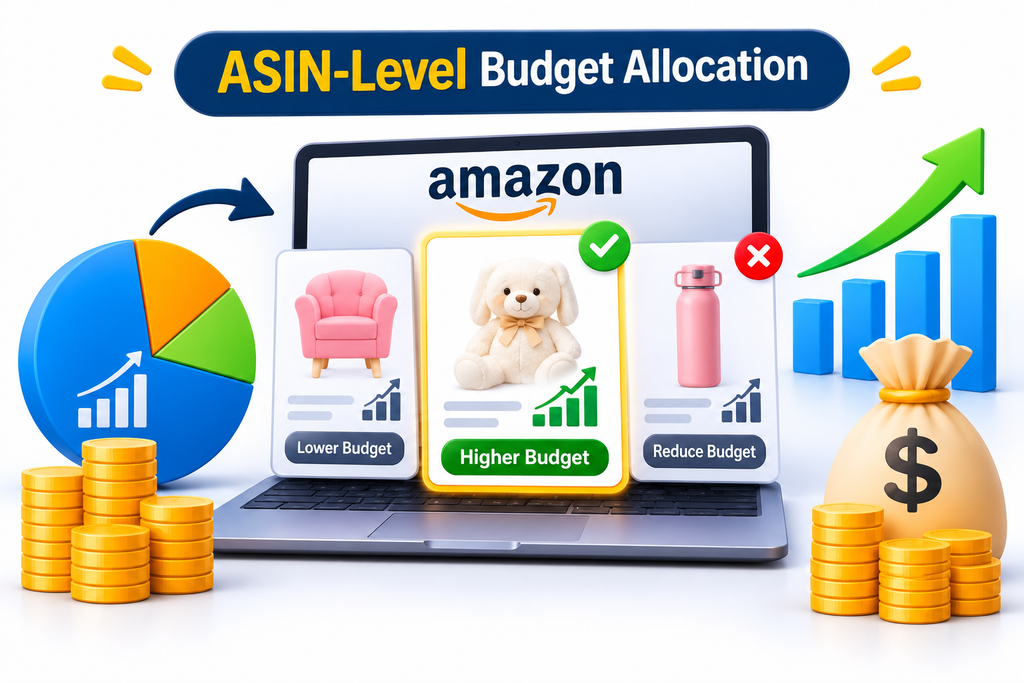
Allocating the same advertising budget across every product can result in wasted spending and missed growth opportunities.
ASIN-level budget allocation helps sellers:
- Identify products generating profitable advertising sales.
- Reduce unnecessary spending on underperforming products.
- Prioritize ASINs with stronger conversion potential.
- Improve overall advertising efficiency.
- Maintain a better balance between sales growth and profitability.
- Make informed decisions about increasing, reducing, or reallocating budgets.
Instead of asking, “Which ASIN generates the most sales?” sellers should ask, “Which ASIN generates the most profitable incremental sales?”
Evaluate Profit Margin Before Increasing Ad Spend
Profit margin should be one of the first factors considered when deciding whether an ASIN deserves more advertising investment.
A product with a high selling price does not automatically generate high profit. Product cost, Amazon referral fees, fulfillment fees, shipping, promotions, and other operating expenses all affect profitability.
Before increasing advertising spend, calculate the contribution margin available to cover advertising costs.
Contribution margin is the amount of money left over from a product’s sales revenue after subtracting all associated variable costs.
Example:
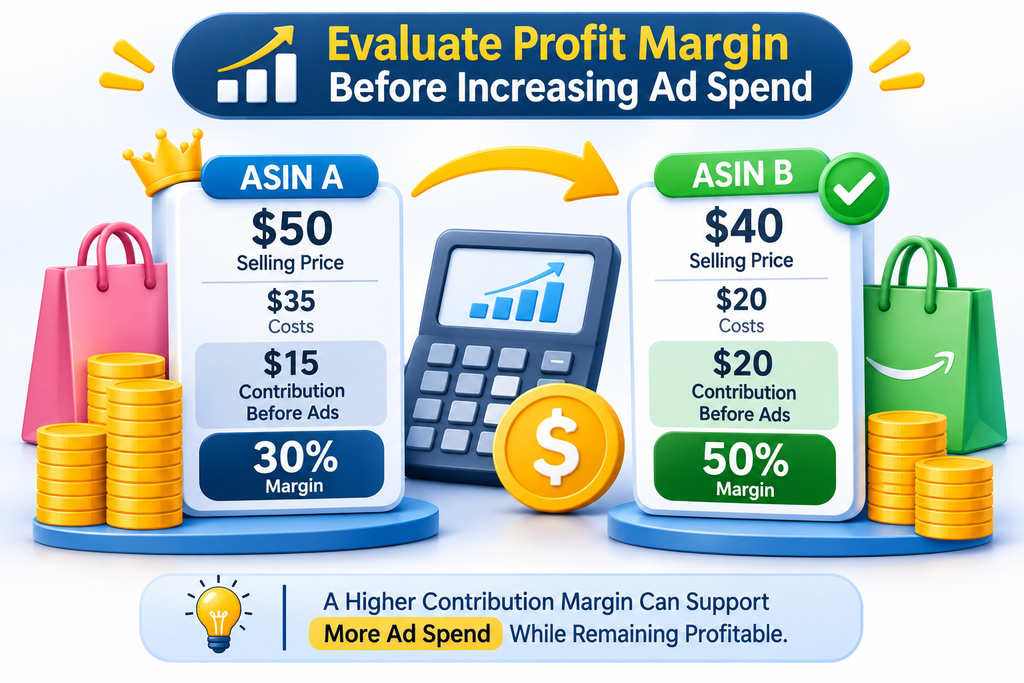
Consider two ASINs:
| Cost and Revenue | ASIN A | ASIN B |
| Selling Price | $50 | $40 |
| Product and Other Costs* | $35 | $20 |
| Contribution Before Ads | $15 | $20 |
| Contribution Margin | 30% | 50% |
Although ASIN A has a higher selling price, ASIN B has a stronger contribution margin.
This means ASIN B can potentially support a higher advertising cost relative to its sales while maintaining profitability.
PPC takeaway: Do not allocate advertising budgets based on selling price or sales volume alone. Evaluate how much profit each ASIN can generate after its non-advertising costs.
Calculate Break-Even ACoS for Each ASIN
One of the most important steps in profit-first Amazon PPC optimization is calculating the break-even ACoS for individual products.
Break-even ACoS represents the advertising cost percentage at which an ASIN covers its advertising expenses without generating a contribution profit or loss from the advertised sale.
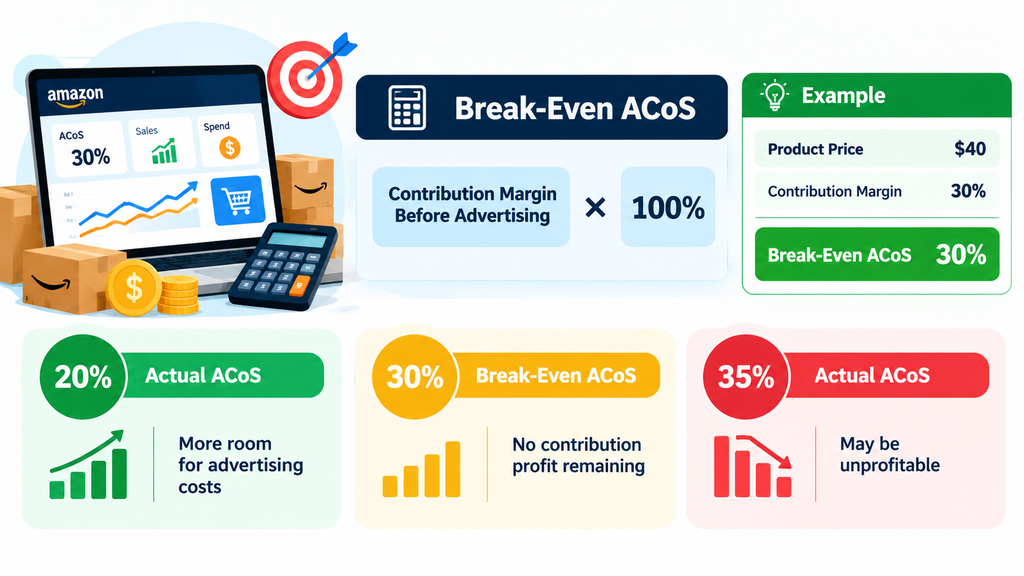
Formula:
Break-Even ACoS = Contribution Margin Before Advertising × 100
Using the previous example:
| Metric | ASIN A | ASIN B |
| Contribution Margin | 30% | 50% |
| Break-Even ACoS | 30% | 50% |
| Target ACoS (Illustrative) | 20% | 30% |
ASIN B can tolerate a higher ACoS because it has a stronger contribution margin.
However, break-even ACoS should not be the actual performance target. Sellers should establish a target ACoS below break-even to protect their desired profit.
Why this matters:
An ACoS of 25% may be profitable for one ASIN but unprofitable for another. Therefore, applying the same ACoS target across every product can lead to poor budget decisions.
Analyze ASIN-Level ACoS and ROAS Together
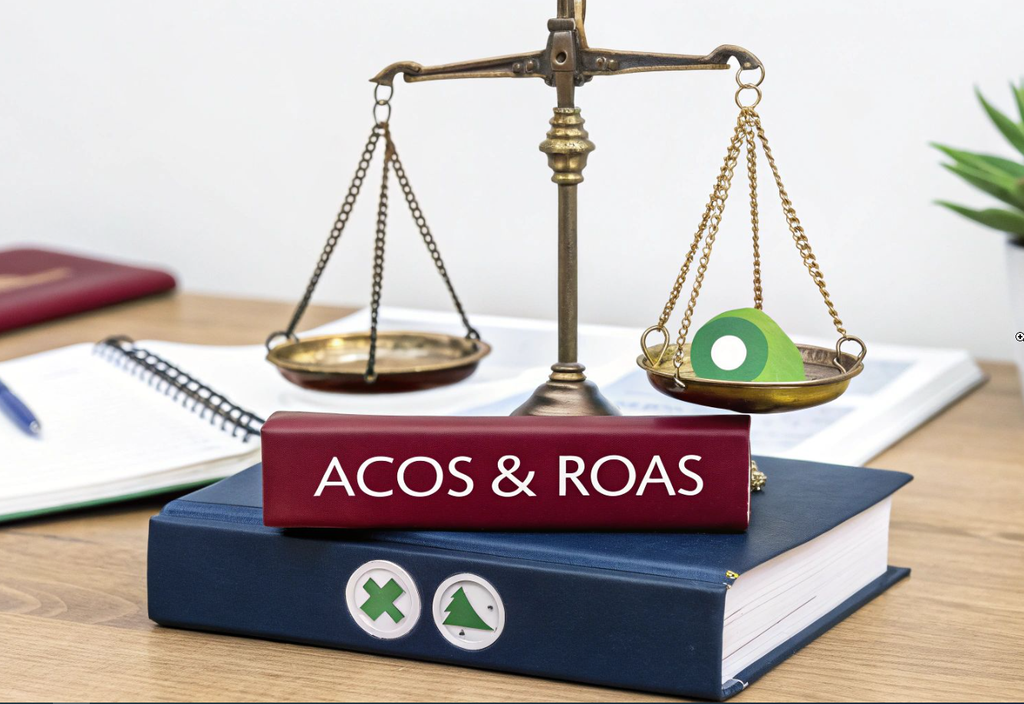
ACoS and ROAS are important indicators of advertising efficiency, but neither should be evaluated in isolation.
- ACoS (Advertising Cost of Sales): Measures advertising spend as a percentage of attributed sales.
- ROAS (Return on Ad Spend): Measures attributed sales generated for every dollar spent on advertising.
Formulas:
ACoS = (Ad Spend ÷ Attributed Sales) × 100
ROAS = Attributed Sales ÷ Ad Spend
Consider the following example:
| Performance Metric | ASIN A | ASIN B |
| Ad Spend | $1,000 | $600 |
| PPC Sales | $4,000 | $3,000 |
| ACoS | 25% | 20% |
| ROAS | 4.0x | 5.0x |
ASIN A generates more PPC sales, but ASIN B delivers better advertising efficiency.
If both products have sufficient inventory and comparable growth opportunities, ASIN B may deserve additional budget.
However, the final decision should also consider contribution margins, organic sales impact, and incremental performance.
PPC takeaway: High PPC sales do not automatically justify higher budgets. Compare ACoS and ROAS against each ASIN’s profitability targets.
Evaluate Conversion Rate Before Scaling
A product may receive thousands of impressions and clicks but generate very few orders.
This indicates that advertising traffic is not converting efficiently.
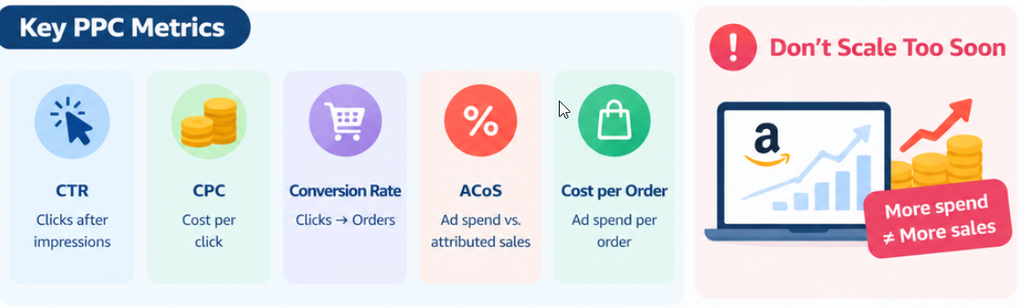
Before increasing the budget, evaluate:
- Click-through rate (CTR).
- Conversion rate (CVR).
- Average cost-per-click (CPC).
- Total orders.
- Product detail page quality.
- Customer reviews and ratings.
- Pricing and promotional competitiveness.
For example:
| Metric | ASIN A | ASIN B |
| Clicks | 2,000 | 1,500 |
| Orders | 80 | 120 |
| Conversion Rate | 4% | 8% |
| Average CPC | $0.80 | $0.50 |
| Ad Spend | $1,600 | $750 |
ASIN B generates more orders despite receiving fewer clicks. It also has a lower average CPC and stronger conversion performance.
This suggests that ASIN B is attracting more qualified traffic and converting that traffic more efficiently.
Before scaling an ASIN with weak conversion performance, investigate whether the problem is related to irrelevant search terms, pricing, product images, listing content, reviews, or competition.
PPC takeaway: Prioritize ASINs that convert relevant traffic efficiently. Improve the listing before investing more money in products with weak conversion rates.
Check Inventory Availability Before Increasing Budgets
Inventory availability is another important factor in ASIN-level advertising decisions.
A profitable product may not deserve additional advertising spend if its available inventory is too low to support increased demand.

Before scaling an ASIN, review:
- Available FBA inventory.
- Reserved inventory.
- Inbound inventory.
- Recent sales velocity.
- Estimated days of inventory remaining.
- Replenishment lead time.
For example:
| Inventory Metric | ASIN A | ASIN B |
| FBA On-Hand | 500 | 120 |
| Available Units | 450 | 35 |
| Average Daily Sales | 15 | 10 |
| Estimated Available Stock Coverage | 30 Days | 3.5 Days |
Although ASIN B may be performing well, its available stock is limited. Increasing its advertising budget could accelerate stock depletion and create an out-of-stock situation.
ASIN A has more inventory coverage and may be a better candidate for controlled scaling.
PPC takeaway: Advertising investment should match inventory capacity. Avoid aggressively scaling products that cannot sustain additional demand.
Use the Advertised Product Report to Identify Winning ASINs
Amazon Ads provides product-level reporting that helps advertisers evaluate how individual advertised products perform across campaigns.
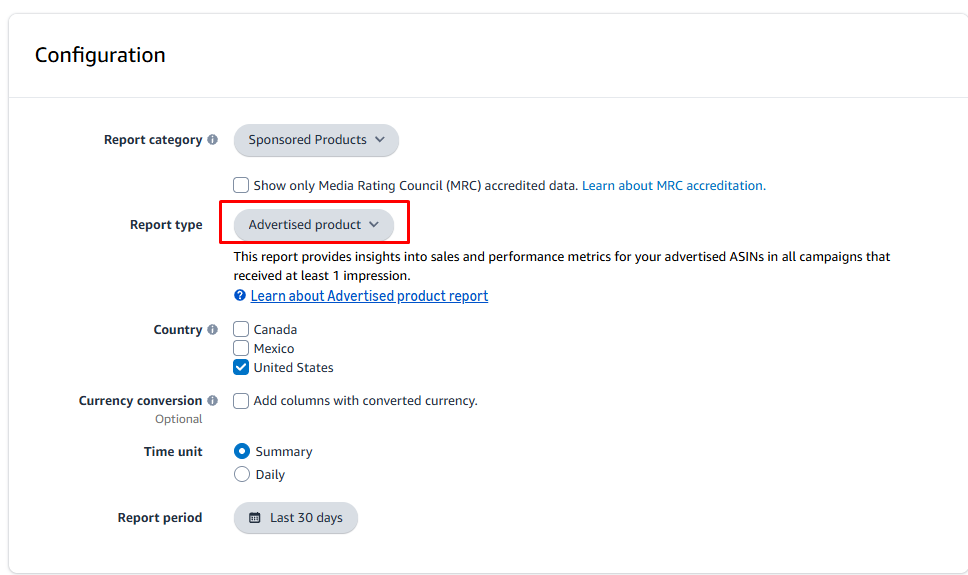
The Sponsored Products Advertised Product Report can help identify:
- ASINs generating attributed sales.
- Advertising spend by advertised product.
- Product-level ACoS and ROAS.
- Performance trends over time.
- Products that may need bid or campaign adjustments.
Review the report regularly rather than relying only on campaign-level performance.
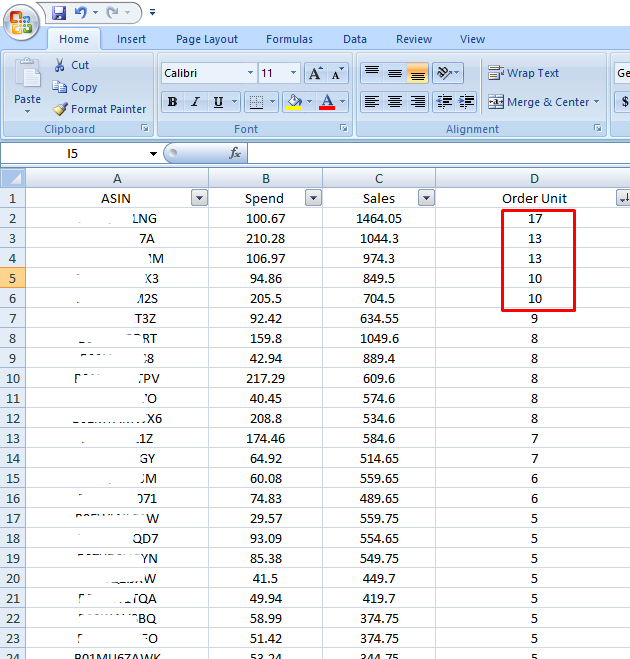
An individual campaign may contain multiple advertised ASINs, and those products may have very different profitability levels.
For example, one ASIN may generate most of the campaign’s attributed sales while another consumes a significant share of its advertising budget without producing enough orders.
Separating and evaluating ASIN-level performance makes it easier to identify where the budget should go.
PPC takeaway: Use product-level reporting to make decisions at the ASIN level instead of assuming that every product within a successful campaign performs equally well.
Measure Incremental Profit Before Scaling Budgets
One of the biggest mistakes in Amazon PPC is increasing budgets based only on historical ROAS.
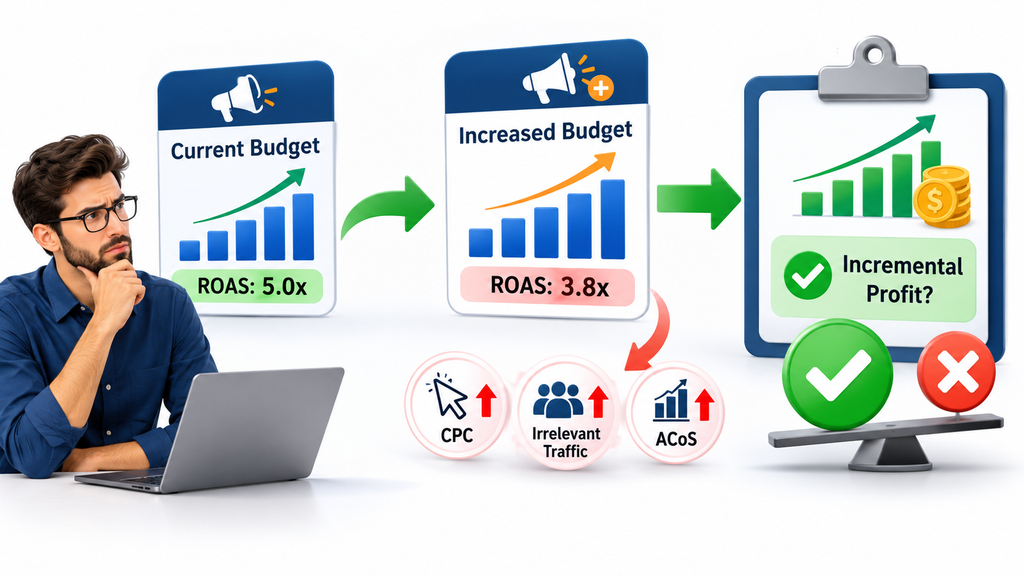
A product may perform well at its current budget, but additional spending does not always produce sales at the same efficiency.
As advertising investment increases, CPC may rise, less relevant traffic may enter the campaign, and ACoS may increase.
This is why sellers should evaluate marginal performance.
Formula:
Marginal ROAS = Additional Attributed Sales ÷ Additional Ad Spend
Consider this example:
| Metric | Before Scaling | After Scaling |
| Ad Spend | $500 | $700 |
| PPC Sales | $2,500 | $3,300 |
| Additional Ad Spend | — | $200 |
| Additional PPC Sales | — | $800 |
| ROAS | 5.0x | 4.71x |
| Marginal ROAS | — | 4.0x |
The additional $200 in advertising spend generated $800 in additional attributed sales.
Although overall ROAS declined from 5.0x to approximately 4.71x, the additional investment still generated 4.0x marginal ROAS.
Whether this additional spending is worthwhile depends on the ASIN’s contribution margin and profitability target.
PPC takeaway: Evaluate the profit generated by additional advertising spend, not just the overall ROAS of the campaign.
Segment ASINs into Three Budget Categories
Once you have evaluated profit margins, ACoS, ROAS, conversion rates, inventory, and incremental performance, divide your ASINs into three categories.
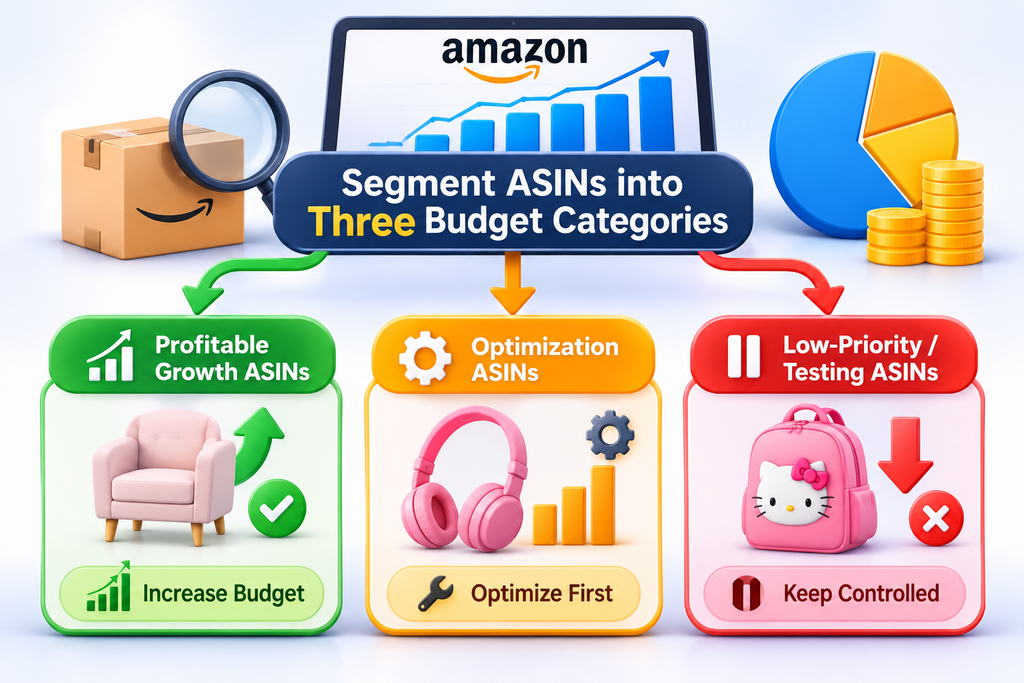
Category 1: Profitable Growth ASINs
These products consistently generate profitable sales and have sufficient inventory to support additional demand.
Common characteristics:
- ACoS is below the target.
- ROAS is strong.
- Conversion rate is healthy.
- Contribution margin is attractive.
- Inventory is sufficient.
- Campaigns show opportunities for additional profitable traffic.
Action: Gradually increase budgets and bids where performance supports additional investment.
Category 2: Optimization ASINs
These products show potential but are not currently delivering the desired advertising efficiency.
Common characteristics:
- ACoS is above target.
- CPC is increasing.
- Conversion rate is below expectations.
- Some keywords or targets generate clicks without orders.
- Listing content or pricing may need improvement.
Action: Optimize bids, targeting, search terms, and product listings before increasing budgets.
Category 3: Low-Priority or Testing ASINs
These products have limited sales history, weak conversion performance, low demand, or uncertain profitability.
Common characteristics:
- High spend with few or no orders.
- Weak conversion rates.
- Limited search demand.
- Insufficient performance data.
- Low inventory availability.
Action: Keep budgets controlled, test relevant targeting opportunities, and reduce or pause inefficient spending when justified by sufficient data.
Avoid making decisions based on only a few clicks or a very short reporting period.
Build a Profit-First ASIN Budget Allocation Framework
After segmenting your products, establish a structured budget allocation model.
An illustrative starting framework could be:
| ASIN Category | Budget Allocation | Main Objective |
| Profitable Growth ASINs | 60% | Scale profitable sales |
| Optimization ASINs | 25% | Improve efficiency |
| Testing and New ASINs | 15% | Discover new opportunities |
This allocation is not a fixed rule. Adjust it based on actual profitability, inventory, sales demand, and business objectives.
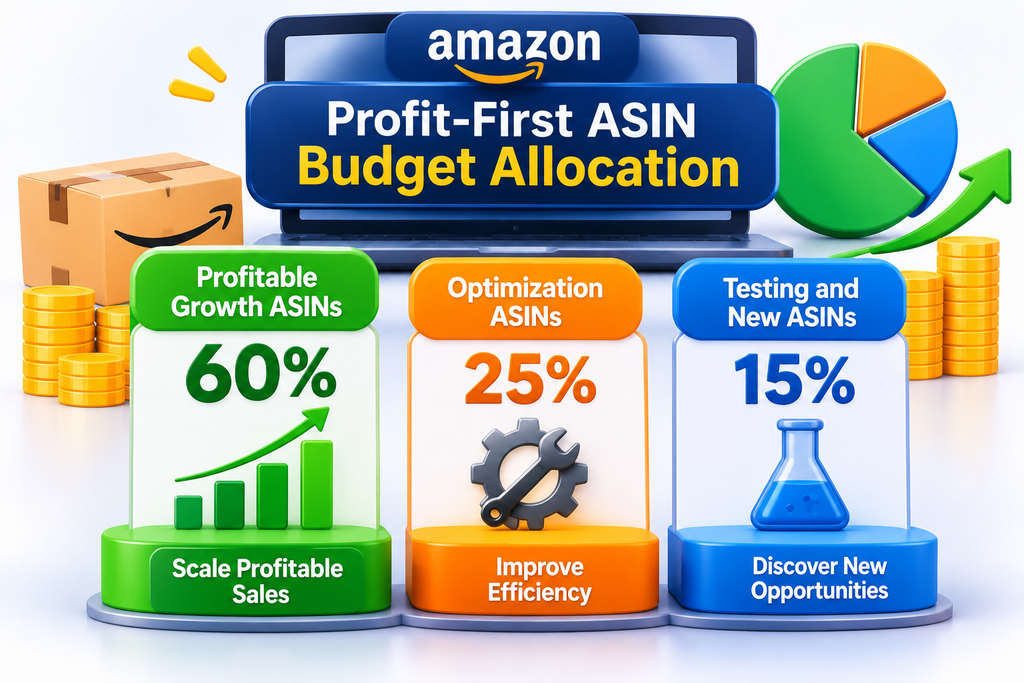
For example, if the testing category does not show promising results, move more budget toward profitable growth ASINs.
Likewise, if a product is generating strong incremental profit but frequently runs out of budget, consider increasing its allocation.
The objective is to ensure that advertising budgets support the products with the strongest business potential.
Common ASIN-Level Budget Allocation Mistakes to Avoid
Even experienced Amazon advertisers can make poor budget decisions when they focus on sales volume instead of profitability.
Here are some common mistakes:
1. Giving More Budget to the Highest-Selling ASIN
High sales do not necessarily mean high profit. Always evaluate contribution margin and advertising costs.
2. Applying the Same ACoS Target to Every Product
Different ASINs have different costs, margins, and profitability requirements. Establish product-specific targets.
3. Scaling Campaigns Without Checking Inventory
Additional advertising demand can accelerate stock depletion. Check available inventory and replenishment timelines first.
4. Ignoring Conversion Rate
More clicks do not guarantee more orders. Investigate listing performance and traffic relevance before increasing bids.
5. Evaluating Only Overall ROAS
A strong historical ROAS does not guarantee that additional budget will generate equally profitable sales. Measure marginal performance.
6. Making Decisions With Insufficient Data
Avoid pausing or scaling ASINs based on very small samples. Use an appropriate evaluation period and consider sales volume, clicks, and conversion trends.
7. Ignoring Organic Sales and Total Business Performance
Advertising-attributed sales are only part of the picture. Monitor total sales, organic performance, and TACoS alongside ACoS and ROAS.
A Practical ASIN-Level PPC Optimization Checklist
Before increasing advertising budgets for any ASIN, review the following:
- Is the product contribution margin healthy?
- Is its break-even ACoS clearly established?
- Is current ACoS within the target range?
- Is ROAS meeting the business objective?
- Is the conversion rate competitive?
- Are search terms relevant and generating orders?
- Is CPC sustainable?
- Does the listing have strong images, content, pricing, and reviews?
- Is sufficient FBA inventory available?
- Can the product generate additional profitable sales with more spend?
- Has marginal ROAS or incremental profit been evaluated?
If an ASIN meets most of these criteria, it may be a strong candidate for additional advertising investment.
Invest in ASINs That Generate Profitable Growth
The ASIN that deserves more advertising spend is not necessarily the one with the highest sales, most impressions, or largest campaign budget.

It is the product that can generate the strongest incremental profit while maintaining sustainable advertising efficiency.
A successful Amazon PPC strategy requires sellers to look beyond surface-level metrics and evaluate contribution margins, break-even ACoS, ROAS, conversion rates, inventory availability, and marginal performance.
By segmenting ASINs into profitable growth, optimization, and testing categories, advertisers can allocate budgets more effectively, reduce wasted spend, and identify better opportunities for business growth.
The goal of Amazon PPC is not simply to sell more. It is to generate more profitable sales from every advertising dollar invested.
For more Amazon PPC, SEO, and AI shopping content, visit the Ecomclips blog or follow the Ecomclips YouTube channel, Ecomclips Facebook page, and connect with Ecomclips on LinkedIn.
Questions about an account review or a free audit can be sent to info@ecomclips.com.
At Ecomclips, we have successfully managed 1,000+ accounts across various e-commerce marketplaces, with a combined monthly advertising spend of over $500,000. Our experienced team specializes in Amazon PPC management, helping businesses increase sales, improve advertising efficiency, reduce wasted spend, and maximize profitability.
Our services include Amazon PPC audits, keyword research, campaign setup and optimization, bid and budget management, search term analysis, negative keyword optimization, competitor targeting, and ongoing performance monitoring. We develop tailored strategies based on each account’s goals, product performance, and profit margins.
If you have an Amazon Seller Central account, we’d be happy to offer you a free Amazon PPC account audit to identify growth opportunities and provide actionable recommendations to improve your advertising performance.