
Over the last few years working with Amazon SEO, listings, PPC, and marketplace growth, I’ve learned a simple truth: page-one rankings aren’t given, they’re earned. Not by stuffing keywords, but by building stronger relevance, conversion, and sales performance.
Most sellers still think better rankings come from finding more keywords. In reality, Amazon also looks at shopper behavior, offer strength, conversion, availability, and customer experience.
That is why a fully optimised product can still sit behind a simpler competitor. And in 2026, semantic search, COSMO, personalisation, and Alexa for Shopping are making product discovery even more advanced.
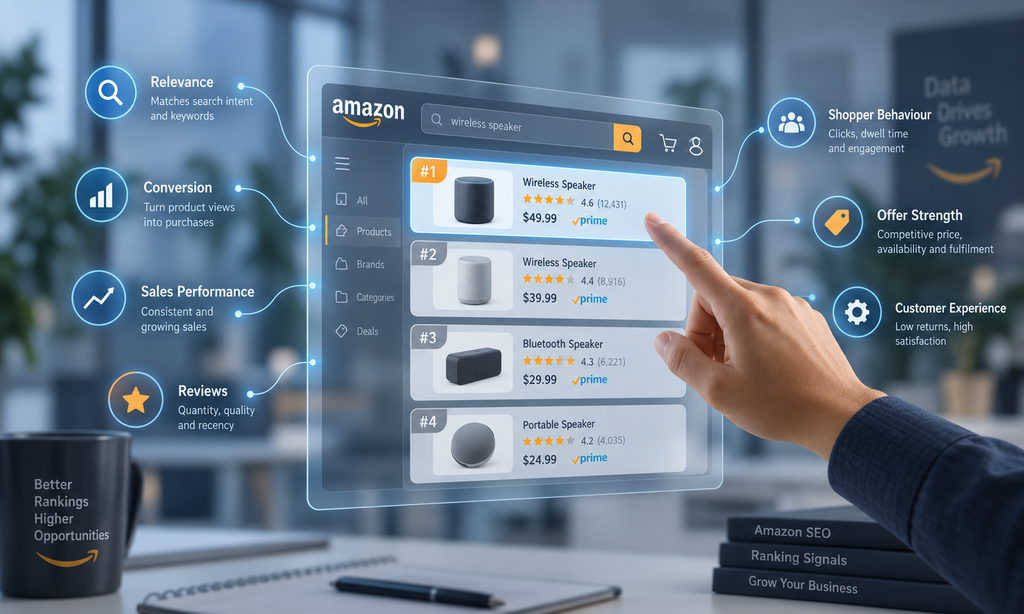
So, let’s break down how Amazon ranking really works in 2026, which signals matter most, and what sellers should focus on to improve organic visibility.
What Is the Amazon Ranking Algorithm?
The Amazon ranking algorithm is the set of systems Amazon uses to decide which products appear for each search. It looks beyond simple keyword matching and considers relevance, product data, offer quality, availability, shopper behaviour, and personalisation.
For example, someone searching for ‘office chair’ may see very different results from someone searching for ‘ergonomic office chair with lumbar support for tall users.’
Amazon is trying to understand the shopper’s intent and surface products that are both relevant and likely to satisfy that search.
Why Sellers Need to Understand Amazon Ranking
Understanding how Amazon ranks products helps sellers make better decisions across SEO, PPC, pricing, content, and inventory.
It helps you understand why a product may get impressions but few clicks, why another converts well but struggles to gain visibility, and why changing only keywords often does not fix a ranking problem.
The better you understand the signals Amazon is evaluating, the easier it becomes to identify what is actually holding an ASIN back and what needs to improve.
Amazon A9 vs A10: What Actually Changed?
Amazon sellers often talk about A9 and A10 as separate ranking algorithms, but the distinction is more nuanced.
A9 is the name historically associated with Amazon product search. A10, on the other hand, is mainly an industry term used by sellers, agencies, and software companies to describe how Amazon search has evolved beyond the older keyword-heavy model.
What Was Amazon A9?
A9 became closely associated with the traditional approach to Amazon SEO, where sellers focused heavily on:
- keyword relevance,
- product indexing,
- sales history,
- conversion,
- and listing performance.
The basic strategy was straightforward: target relevant keywords, optimize the listing, generate sales, and improve visibility.
What Is Amazon A10?
‘A10’ is commonly used to describe the broader evolution of Amazon search.
It is not a publicly documented Amazon algorithm with a confirmed formula. Instead, it reflects a move towards a more complete ranking system that considers search intent, shopper behaviour, conversion, offer quality, product relevance, and customer experience alongside keywords.
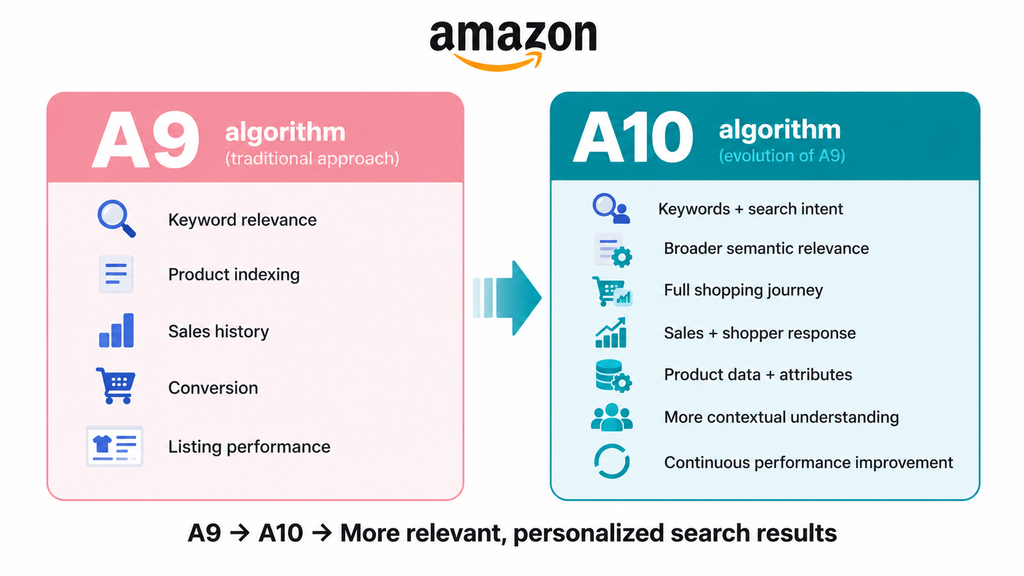
What Changed From A9 to A10?
| Traditional A9 Thinking | Modern A10 Thinking |
| Heavy keyword focus | Keywords + search intent |
| Exact keyword matching | Broader semantic relevance |
| Listing-focused optimisation | Full shopping journey |
| Sales volume | Sales + shopper response |
| Keyword placement | Product data + attributes |
| Less context | More contextual understanding |
| One-time optimisation | Continuous performance improvement |
Amazon search has moved beyond a mainly keyword-first model towards a broader system built around relevance, intent, shopper behaviour, and overall performance.
What Is COSMO?

COSMO is a large-scale ecommerce commonsense knowledge system developed by Amazon researchers to help Amazon better understand what shoppers actually mean, not just the exact words they type.
Traditional search can easily understand a query such as: ‘slip-resistant shoes’ because the requested feature may appear directly in the listing. But shopper intent is often more complex.
For example: ‘shoes for pregnant women’. The best product may never mention ‘pregnant women’ in the listing. However, Amazon can understand that features such as slip resistance or comfort may be relevant to that shopper.
COSMO helps build relationships between:
- products,
- intended audiences,
- use cases,
- functions,
- situations,
- events,
- and related customer needs.
COSMO Is Not “A11”
COSMO should not be treated as a new A11 algorithm or a direct replacement for A9 or A10. It is better understood as part of Amazon’s wider search and recommendation technology.
For sellers, the important change is that Amazon is becoming better at connecting shopper intent with product meaning, even when the exact search phrase does not appear in the listing.
That makes accurate attributes, materials, compatibility, specifications, use cases, audience information, and product details increasingly important for discoverability.
Amazon Search Is Becoming Semantic
Older Amazon SEO strategies often followed a simple formula: Find keyword → insert keyword → become relevant
That model is incomplete today.
Amazon has researched semantic product search for years. Pure lexical matching can struggle with synonyms, spelling variations, related meanings, and broader search intent. Semantic retrieval helps Amazon identify products that are conceptually relevant to a shopper’s query, even when the exact same words are not used.
This does not mean keywords are dead. Accurate, relevant terminology still helps Amazon understand what a product is.
Sellers now need to optimise for two types of relevance:
1. Lexical relevance: Does the listing contain the accurate words and phrases customers use?
2. Semantic relevance: Does the complete product information clearly explain the product’s audience, purpose, features, compatibility, use cases, and problems it solves?
For Amazon SEO in 2026, strong listings need to support both keyword relevance and contextual understanding.
Alexa for Shopping Changes Product Discovery
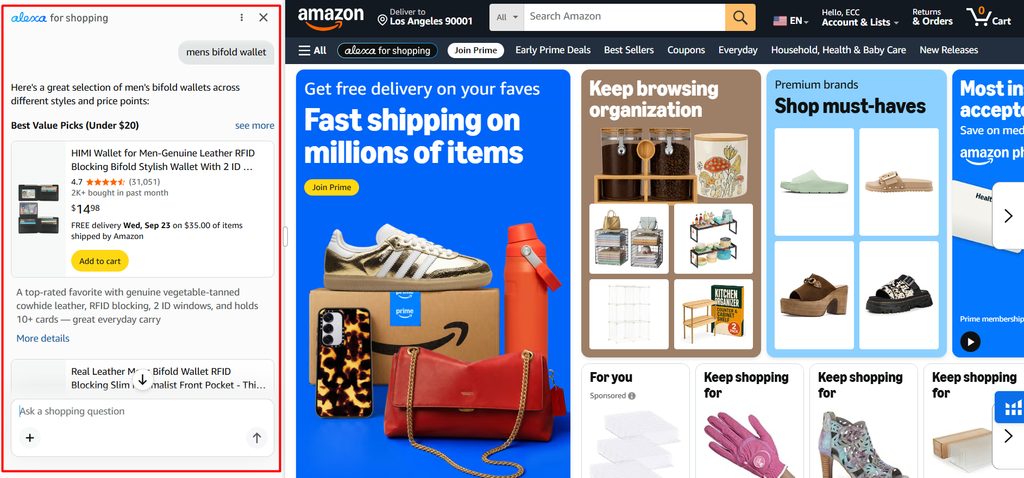
Amazon’s generative AI shopping assistant was originally known as Rufus and was renamed Alexa for Shopping on May 13, 2026. This expands product discovery beyond the traditional journey: Keyword → search results → product page
Customers can increasingly ask conversational questions such as:
- What water bottle is suitable for hiking?
- Does this blender crush ice?
- Which coffee machine is easier to clean?
- Find a birthday gift for someone who loves gardening.
- Find formal dresses under $100.
- Compare this product with the item in my cart.
Alexa for Shopping can use information from Amazon’s product catalogue, reviews, community Q&A, shopping activity, and conversational context to answer questions and recommend products.
How Amazon Ranking Works: The 7 Stages From Product Data to Purchase
Amazon ranking is easier to understand when you stop thinking of it as one formula and look at it as seven connected stages. At each stage, Amazon is trying to answer a different question about the product, the search, the offer, and the shopper.
Stage 1: Amazon Understands and Indexes the Product
Before a product can rank, Amazon needs to understand what it is and where it belongs.
Amazon can use information such as:
- Item name
- Item highlights
- Bullet points
- Backend search terms
- Brand
- Product type
- Category
- Material
- Size
- Colour
- Compatibility
- Intended use
- Technical specifications
- Variation data
Example: A seller lists a 1,500W countertop blender with a 64 oz jar and ice-crushing function.
If the listing clearly provides those details, Amazon has a stronger foundation for understanding that the product belongs in searches related to:
- countertop blenders,
- smoothie makers,
- high-power blenders,
- ice-crushing blenders.
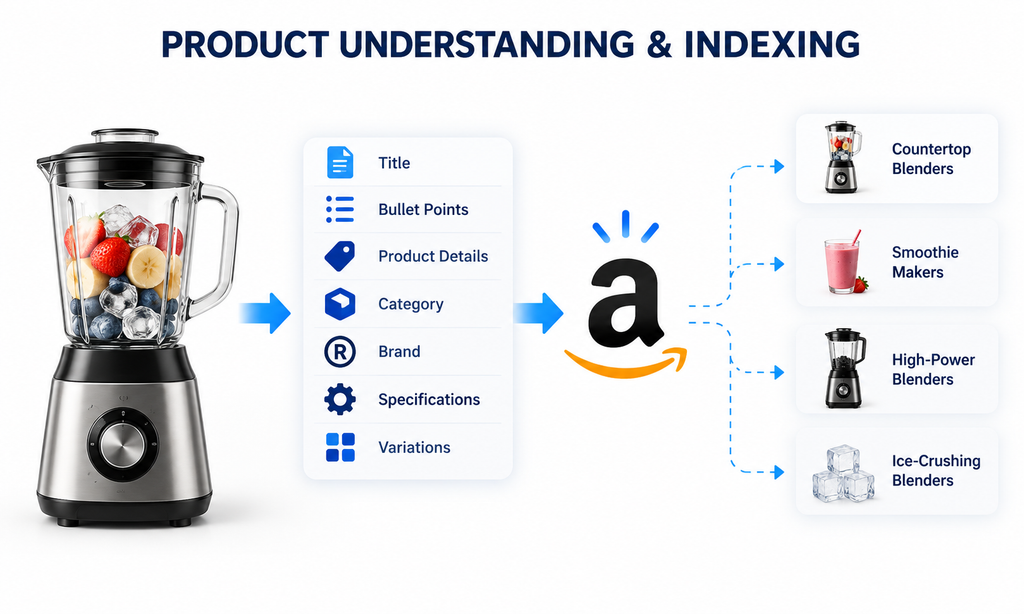
If the product data is incomplete, inaccurate, or placed in the wrong category, its ranking potential starts from a weaker position.
Stage 2: Amazon Interprets Search Intent
Next, Amazon has to determine what the shopper is actually looking for. A broad search and a specific search can represent very different buying intentions.
Example: ‘office chair’ is much broader than: ‘ergonomic office chair with lumbar support for tall people’
The second query gives Amazon more context about:
- product type,
- ergonomic function,
- required feature,
- and intended user.
Amazon therefore needs to interpret more than individual keywords. It needs to understand the meaning behind the search.
Stage 3: Amazon Selects Relevant Product Candidates
Once Amazon understands the query, it retrieves products that could reasonably satisfy it. Not every indexed product enters the final ranking competition.
Example: If you search for orthopaedic dog bed for large dogs
Amazon might consider:
- a large memory-foam dog bed,
- an orthopaedic bed with raised sides,
- an extra-large washable pet bed,
- a standard cushion bed with no orthopaedic support.
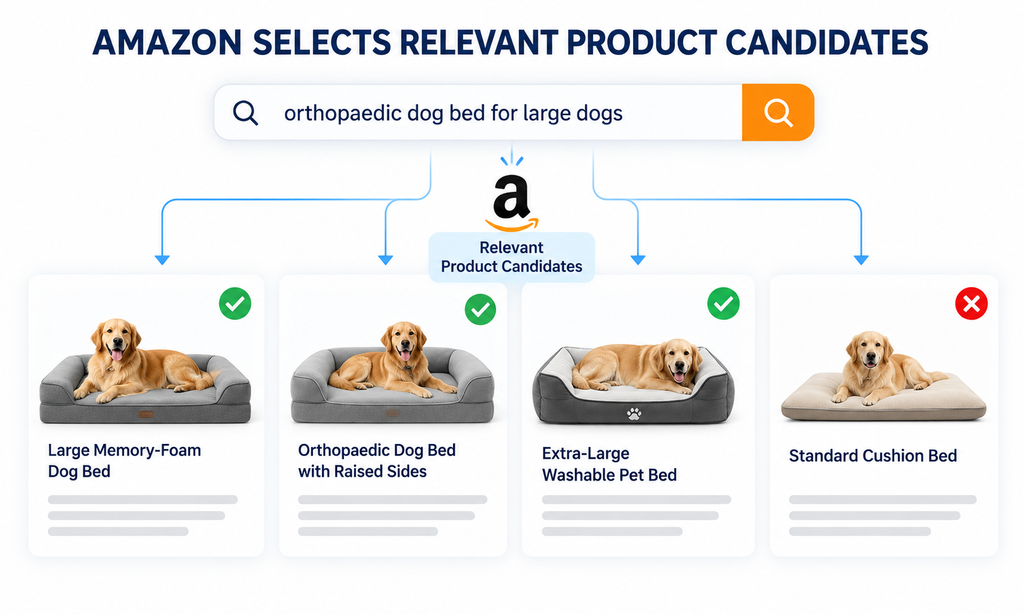
The first products may be stronger matches because they meet more of the shopper’s requested attributes.
Stage 4: Amazon Evaluates the Strength of Each Offer
Being relevant is not enough. Amazon also needs to consider whether the offer itself is attractive to shoppers.
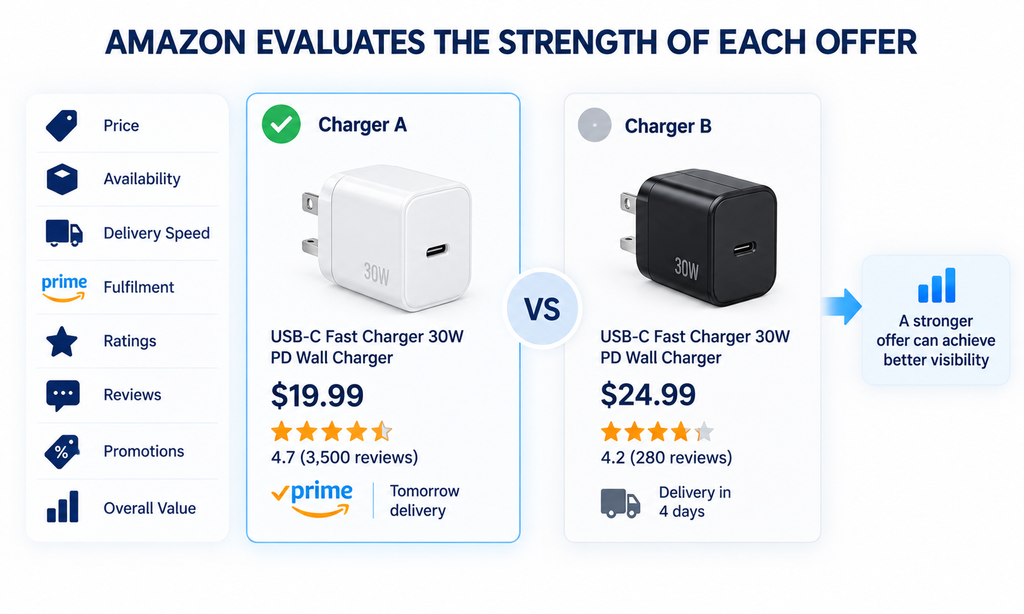
Signals around the offer can include:
- price,
- stock availability,
- delivery speed,
- fulfilment,
- ratings,
- reviews,
- promotions,
- and overall value.
Example: Two USB-C chargers are equally relevant.
Charger A
- $19.99
- 4.7 stars
- 3,500 reviews
- Prime delivery tomorrow
Charger B
- $24.99
- 4.2 stars
- 280 reviews
- delivery in four days
Both may qualify for the search, but they do not present the same level of shopper appeal. This is why Amazon ranking is not only an SEO competition. It is also an offer competition.
Stage 5: Amazon Determines Ranking and Search Placement
Amazon then compares the eligible products and decides which should appear higher and which should appear lower.
This is where several signals may work together, including:
- relevance,
- shopper response,
- conversion,
- sales performance,
- price,
- availability,
- delivery,
- ratings,
- and customer experience.
For: single serve coffee maker for small kitchen, three products may all be relevant.
One may rank higher because it:
- closely matches the compact-use intent,
- converts strongly,
- has competitive pricing,
- maintains stock,
- and receives positive shopper response.
Another may match the keywords but perform poorly after shoppers click. That helps explain why two well-optimised listings can still appear in very different positions.
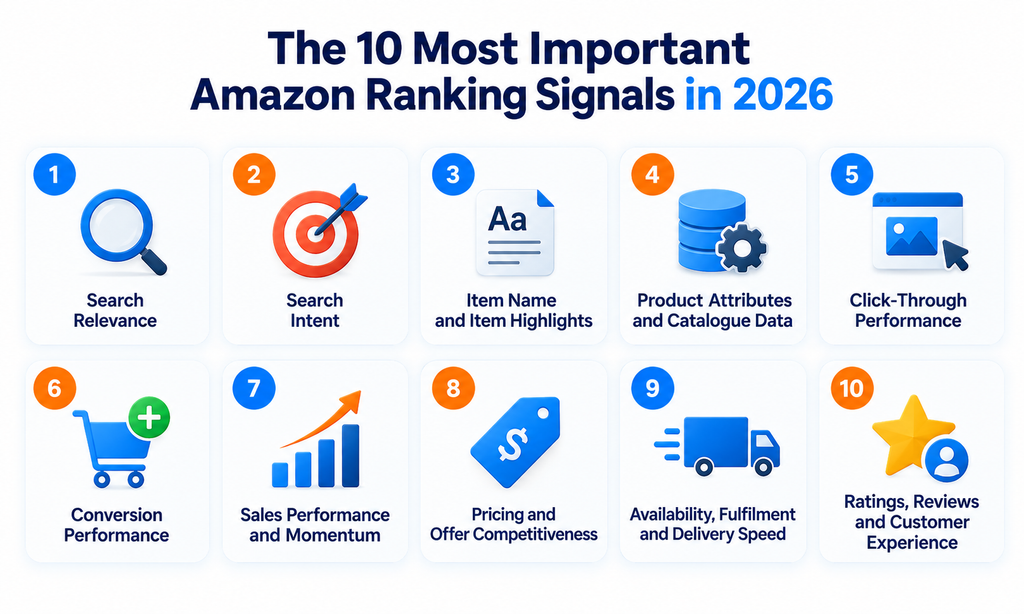
The 10 Most Important Amazon Ranking Signals in 2026
Amazon does not publish a fixed ranking formula, but these are the areas sellers should focus on when trying to improve organic visibility.
1. Search Relevance
Amazon first needs to understand why your product belongs in a particular search.
Relevance comes from areas such as:
- Item name
- Item highlights
- Bullet points
- Backend search terms
- Product description
- Category
- Product attributes
2. Search Intent
Search volume alone does not determine keyword value.
Compare: coffee maker with: single serve coffee maker for small apartment. The second query reveals much more about what the shopper actually wants.
Strong Amazon SEO therefore targets buyer intent, not just high-volume keywords.
3. Item Name and Item Highlights
In 2026, Amazon introduced a 75-character Item name and an additional 125-character Item highlights field for most non-media categories. Both can contribute to search discoverability.
A better structure is:
Item Name: Brand + Product Type + Main Differentiator
Item Highlights: Material + Use Case + Compatibility + Key Features
The objective is clarity, not keyword stuffing.
4. Product Attributes and Catalogue Data
Amazon also learns from structured product information.
Important attributes can include:
- material,
- size,
- colour,
- compatibility,
- style,
- function,
- dimensions,
- intended use,
- technical specifications.
Detailed product data helps Amazon understand what the product is and when it should appear.
5. Click-Through Performance
Ranking means little if shoppers do not click.
CTR can be influenced by:
- main image,
- Item name,
- price,
- coupon,
- rating,
- review count,
- badges,
- delivery promise.
If impressions are strong but clicks are weak, the problem may be your search-result presentation, not indexing.
6. Conversion Performance
Clicks need to become purchases.
Conversion can depend on:
- secondary images,
- videos,
- product benefits,
- A+ Content,
- reviews,
- price,
- delivery,
- variations,
- specifications,
- customer trust.
This is why Amazon SEO and listing optimization cannot be separated.
7. Sales Performance and Momentum
Sales performance remains an important part of Amazon marketplace visibility.
However, sellers should distinguish between:
Best Sellers Rank: category-level sales performance and
Organic Search Rank: position for a specific query.
A product can perform strongly in its category while ranking very differently across individual keywords.
8. Pricing and Offer Competitiveness
Price affects more than profit margin.
It can influence:
- CTR,
- conversion,
- Featured Offer performance,
- promotional appeal,
- shopper trust.
You do not always need to be the cheapest. But shoppers need to understand why your offer is worth the price.
9. Availability, Fulfilment and Delivery Speed
A product cannot maintain sales momentum while unavailable.
Stockouts can interrupt:
- sales,
- advertising,
- conversion,
- keyword momentum,
- organic visibility.
Delivery speed and fulfilment also influence how attractive the offer looks in search.
Maintaining stock and a competitive delivery promise therefore supports both conversion and ranking performance.
10. Ratings, Reviews and Customer Experience
Reviews do not automatically guarantee higher organic rankings, but they can strongly influence shopper behaviour.
Ratings and reviews affect:
- trust,
- CTR,
- conversion,
- purchase confidence,
- product expectations.
Customer experience also continues after the purchase. Poor product quality, excessive returns, misleading information, or repeated complaints can weaken the overall performance of the ASIN.
How to Rank Higher on Amazon in 2026: The Ecomclips 7-Step System
Instead of chasing algorithm rumours, use a process you can measure and improve.
Step 1: Map Your Search Market
Start by grouping keywords around shopper intent, rather than putting every term into one spreadsheet.
A simple keyword map could include:
- Core: insulated water bottle
- Material: stainless steel water bottle
- Feature: leakproof straw bottle
- Use case: hiking water bottle
- Size: 32 oz water bottle
Also connect keywords with the product’s audience, function, problem solved, and use case. This creates stronger relevance without keyword stuffing.
Step 2: Confirm Indexing Before Chasing Position
Before trying to move from position #20 to #5, make sure Amazon properly understands the product.
Check your primary keywords, backend search terms, category, product type, attributes, compatibility, and specifications.
If coverage is weak, fix indexing and catalogue data first. Ranking comes next.
Step 3: Optimize the Search Result Before the Product Page
A shopper cannot convert without first clicking.
Compare your ASIN against nearby competitors and review:
- Main image
- Item name
- Price
- Rating and reviews
- Coupon or promotion
- Delivery promise
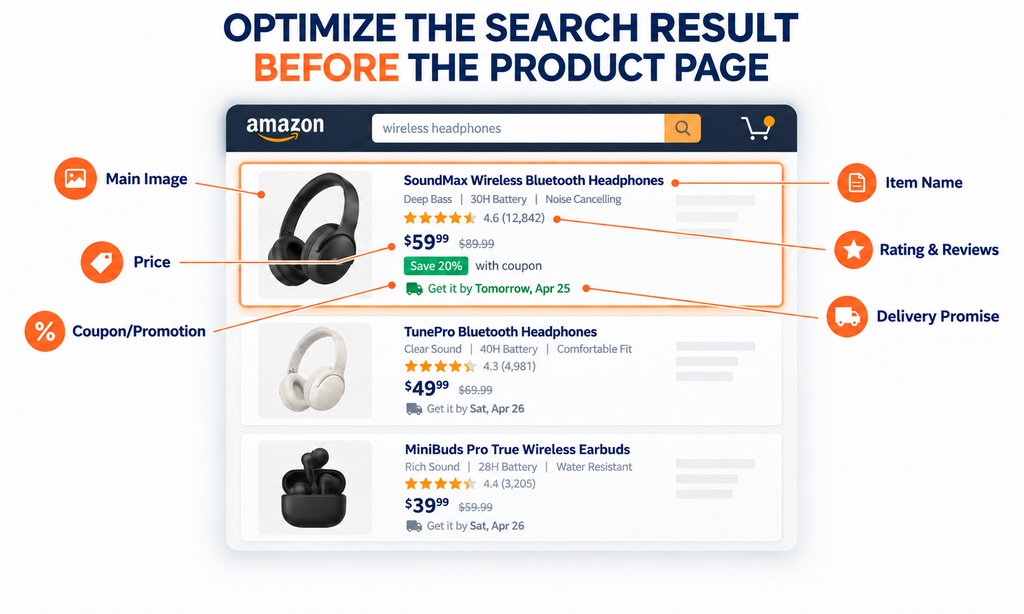
Ask: Why should a shopper click my product instead of the listings around it? If the answer is unclear, CTR may be holding the ranking back.
Step 4: Improve Query-Level Conversion
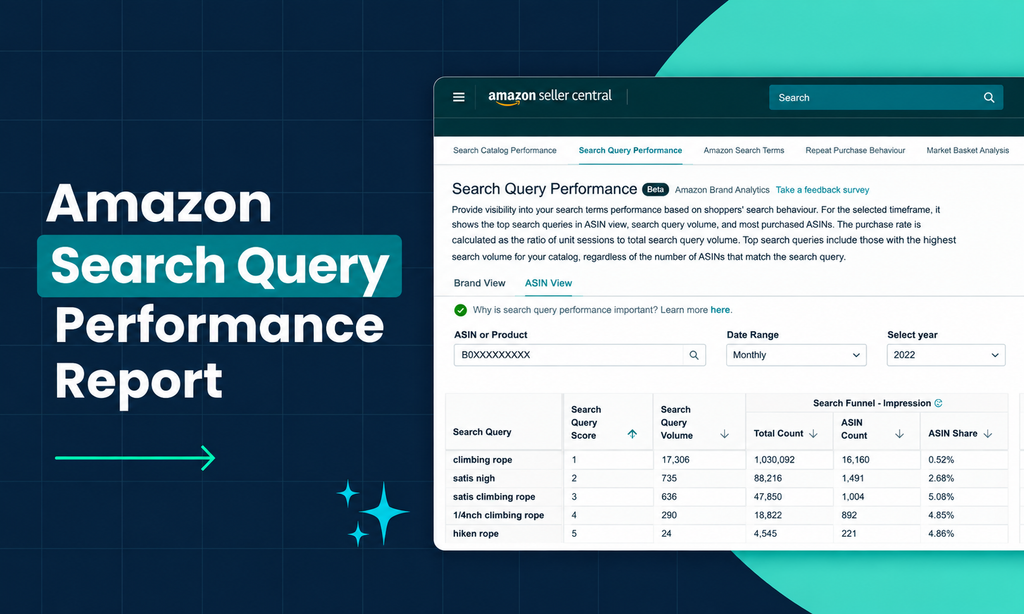
Do not rely only on overall listing conversion. A product might convert strongly for ‘32 oz hiking water bottle’ but poorly for ‘gym bottle.’
Use Search Query Performance and PPC data to identify search terms where:
- relevance is strong,
- shoppers click,
- conversion is competitive,
- and demand is meaningful.
Focus organic and advertising effort on the queries showing the strongest buyer fit.
Step 5: Strengthen the Product Detail Page
Once shoppers click, remove as much purchase uncertainty as possible.
The page should clearly explain what the product is, who it is for, its main benefits, specifications, compatibility, what is included, and why it is different.
Use images, video, bullets, A+ Content, and accurate product information together to improve conversion.
Step 6: Protect Ranking Momentum Operationally
SEO alone cannot protect a strong organic position.
Monitor:
- Inventory
- Pricing
- Delivery performance
- Featured Offer status
- Listing suppression
- Variations
- Catalogue issues
- Compliance
A stockout, weaker offer, or catalogue problem can quickly interrupt the momentum you have built.
Ranking should be managed across: SEO + PPC + Content + Pricing + Inventory + Customer Experience
Step 7: Measure Ranking as a Funnel, Not a Position
Keyword position tells you where you rank, but not why performance is changing.
Track the full journey: Impressions → Clicks → Cart Adds → Purchases
If impressions are low, investigate relevance and indexing. If clicks are weak, review the search result. If purchases are low, investigate the offer and product page.
Use controlled experiments on images, titles, bullets, and A+ Content where available.
5 Amazon Algorithm Myths Sellers Should Stop Believing
Myth 1: Amazon Uses One Fixed Algorithm
Amazon search is not one static formula. It combines relevance, ranking, behavioural data, catalogue systems, personalisation, recommendations, and AI.
Myth 2: A10 Officially Replaced A9
“A10” is mainly an industry term used to describe how Amazon search has evolved. Amazon has not published an official A10 formula or fixed ranking specification.
Myth 3: COSMO Replaced A10
COSMO is real Amazon technology, but it is a commonsense knowledge system, not a publicly announced replacement called A10 or A11.
Myth 4: More Reviews Automatically Mean Higher Rank
Reviews can improve trust, CTR, and conversion, but more reviews do not automatically guarantee a higher organic position.
Myth 5: PPC Spend Directly Buys Organic Ranking
Advertising can generate traffic, sales, and useful performance data, but PPC spend itself does not guarantee better organic ranking.
What Changed About Amazon Ranking in 2026?
Several developments make 2026 meaningfully different.
1. Titles Became Shorter
Amazon introduced a 75-character Item name limit for most non-media categories, making titles shorter and more focused.
2. Item Highlights Became a Search Input
Sellers now have an additional 125-character Item highlights field.
Amazon says both Item name and Item highlights are search inputs, with neither prioritised for discoverability.
3. Conversational Shopping Became More Important
Rufus became Alexa for Shopping, making conversational product discovery more important.
Shoppers can now search by:
- purpose,
- activity,
- preferences,
- comparisons,
- product questions.
4. Personalization Is Expanding
Amazon can use shopping history, preferences, and context to personalize recommendations and product discovery.
5. Product Data Matters Beyond Keyword Matching
Amazon is moving beyond exact-match keywords.
Semantic search and systems such as COSMO help Amazon understand relationships between products, attributes, audiences, use cases, and shopper intent.
Amazon ranking in 2026 depends more on relevance, product understanding, shopper intent, and performance, not keyword stuffing alone.
How to Improve Amazon Rankings in 2026
Strong Amazon rankings come from more than keywords. Sellers need listings and offers that are relevant, competitive, easy to understand, and capable of converting shoppers.
In 2026, accurate product data, search intent, conversion, pricing, availability, and customer experience all contribute to sustainable visibility.
The most effective approach is to help Amazon understand the product clearly while giving shoppers enough confidence to choose it.
Frequently Asked Questions About the Amazon Algorithm
Q1. What is the Amazon algorithm in 2026?
The Amazon algorithm refers to the search, retrieval, relevance, ranking, personalisation, and machine-learning systems Amazon uses to match shoppers with products. Sellers often call the system A9 or A10, but Amazon does not publish one universal seller-facing ranking formula.
Q2. Does Amazon still use A9?
A9 remains a common industry term associated with Amazon search, but modern Amazon search has evolved far beyond the simple A9 explanations commonly found in older SEO guides. Amazon now uses semantic search, machine learning, personalisation, and AI across product discovery.
Q3. Is Amazon A10 official?
A10 is widely used by sellers and agencies as shorthand for modern Amazon ranking behaviour, but it should not be treated as a published Amazon algorithm with confirmed ranking percentages.
Q4. Is COSMO Amazon’s new algorithm?
Not exactly. COSMO is a large-scale commonsense knowledge system developed by Amazon to help understand relationships between products, functions, audiences, use cases, and shopper needs. Amazon does not describe it as a universal replacement for A9 or A10.
Q5. What happened to Amazon Rufus?
Amazon renamed Rufus Alexa for Shopping on May 13, 2026. It supports conversational product research, comparisons, recommendations, price discovery, and personalised shopping.
Q6. What are the most important Amazon ranking factors?
Sellers should focus on search relevance, product data, shopper engagement, conversion, sales performance, pricing, availability, fulfilment, reviews, and customer experience.
Q7. Does conversion rate affect Amazon ranking?
Amazon measures conversion-related behaviour through tools such as Search Query Performance, including impressions, clicks, cart adds, and purchases. However, Amazon does not publish a fixed percentage showing exactly how much conversion contributes to ranking.
Q8. Do reviews improve Amazon ranking?
Reviews can influence trust, CTR, and conversion, but more reviews do not automatically guarantee a higher organic position.
Q9. Does PPC improve organic Amazon ranking?
PPC can generate qualified traffic, conversions, sales, and keyword data, but advertising spend itself does not guarantee a higher organic ranking.
Q10. Does external traffic improve Amazon ranking?
External traffic can bring additional customers and sales, but Amazon does not publish a fixed ranking boost for traffic from Google, TikTok, Meta, influencers, or other external sources.
Build Stronger Amazon Rankings With Ecomclips
Ranking products on Amazon requires more than adding keywords to a listing. Search relevance, catalogue structure, listing content, conversion, advertising, pricing, inventory, customer experience, and performance data all work together.
At Ecomclips, we help Amazon sellers and brands build connected marketplace strategies designed around sustainable visibility and profitable growth.
Our Amazon support includes:
- Amazon SEO & Keyword Strategy: Identify relevant search opportunities, map buyer intent, improve keyword coverage, and strengthen organic visibility.
- Listing Optimisation: Improve Item names, Item highlights, bullet points, product attributes, images, A+ Content, backend search terms, and conversion elements.
- Amazon PPC Management: Build advertising campaigns around relevant search demand and connect paid performance with organic growth.
- Search & Performance Analysis: Diagnose impressions, clicks, conversion, rankings, keyword performance, and competitive movement.
- Catalogue & Compliance Support: Maintain accurate product data, variations, attributes, and marketplace compliance.
- Inventory & Growth Strategy: Connect stock planning, pricing, advertising, and organic growth so successful ASINs can maintain momentum.
Grow Your Amazon Business With Ecomclips
Strong Amazon rankings require more than keywords. Sellers need the right mix of SEO, listing optimization, PPC, pricing, conversion, inventory, and customer experience. Ecomclips helps brands improve visibility, performance, and long-term marketplace growth.
Watch Amazon tutorials and strategy updates on the Ecomclips YouTube channel, explore practical seller resources on the Ecomclips Blog, and read our Amazon SEO 2026: The Complete Guide to Ranking Products on Amazon for the wider SEO framework.
Follow the Ecomclips Facebook page and connect with Ecomclips on LinkedIn for more ecommerce insights and updates.
Need help with Amazon SEO, rankings, PPC, or listing performance? Email info@ecomclips.com or book a consultation with our ecommerce experts.