
Five years ago, the answer seemed obvious. If you wanted to build an ecommerce business, Amazon was the place to be.
But in 2026, that answer is no longer so simple.
Walmart Marketplace has grown into a serious ecommerce opportunity, backed by expanding fulfilment, advertising, seller tools, and omnichannel capabilities.
So the question has changed from ‘Should I sell on Amazon?’ to Amazon, Walmart, or both?
In this guide, we’ll compare Walmart vs Amazon selling in 2026 across competition, fees, fulfilment, advertising, SEO, and growth potential to help you decide which marketplace is the better fit for your business.
Amazon vs Walmart: The Biggest Difference Sellers Need to Understand
The biggest difference is simple: Amazon is a digital-first marketplace. Walmart is a retail-first business that expanded into ecommerce.
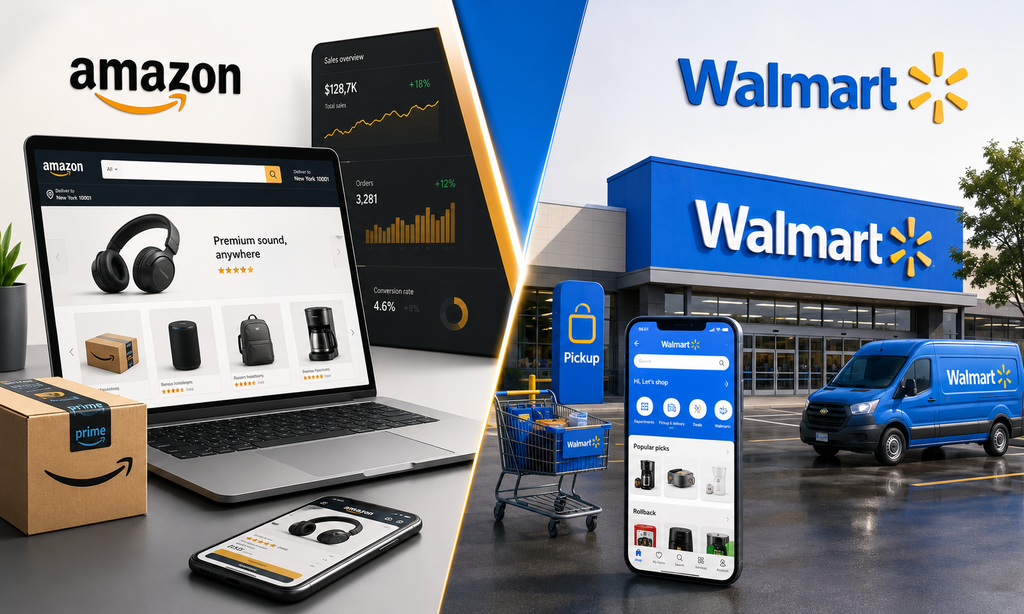
That difference shapes how each platform attracts customers, ranks products, handles fulfilment, and rewards sellers.
From the outside, both marketplaces look similar. Sellers can:
- Upload products
- Manage inventory
- Receive customer orders
- Run marketplace advertising
- Outsource fulfilment
But underneath, they operate from very different foundations.
Amazon was built around online product discovery and digital convenience. Walmart was built around retail value, physical stores, and omnichannel shopping. That is why the same product can perform very differently on Amazon and Walmart.
Amazon & Walmart: Two Different Ecommerce Growth Models
Amazon and Walmart both give sellers access to millions of customers, but they create opportunity in very different ways.
Amazon is search-driven. Walmart is retail-driven.
Amazon customers usually arrive with strong purchase intent. They search for products such as wireless earbuds, office chairs, portable blenders, or supplements and compare options based on:
- Reviews
- Keywords
- Product positioning
- Price
- Images
- Conversion signals
This creates a huge opportunity for sellers, but also intense competition from established brands, private-label sellers, international manufacturers, and advertisers with large PPC budgets.
Walmart takes a different approach. Its strength comes from decades of retail trust and its growing omnichannel ecosystem. Customers already associate Walmart with:
- Value
- Convenience
- Reliability
- Everyday shopping
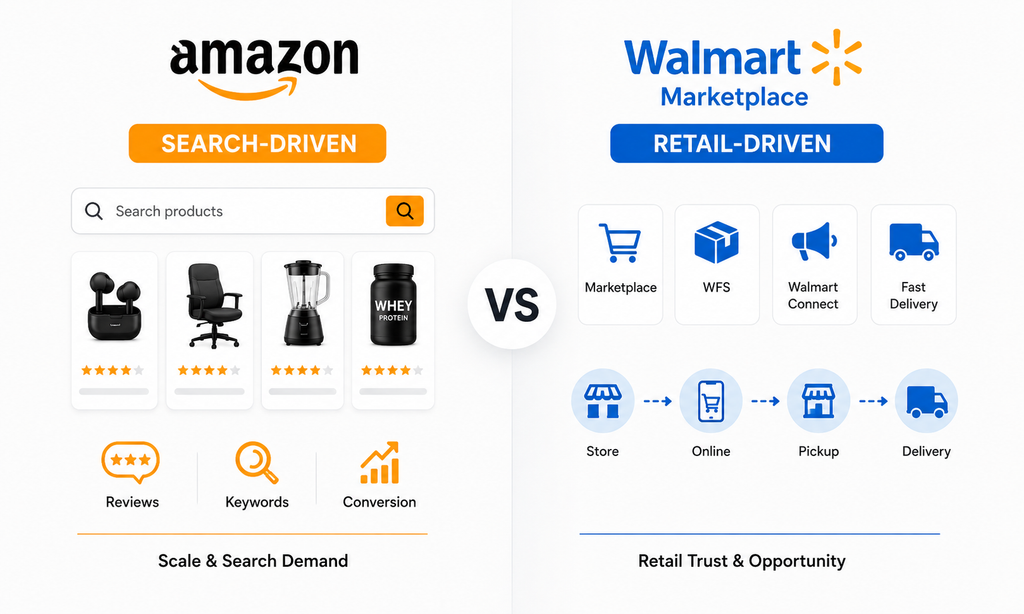
Walmart is now combining that retail strength with Walmart Marketplace, WFS, Walmart Connect, store pickup, and fast delivery.
So while Amazon gives sellers access to a mature, high-intent digital marketplace, Walmart offers access to a growing ecommerce ecosystem backed by one of the world’s strongest retail brands.
Amazon offers scale and search demand. Walmart offers retail trust and expanding ecommerce opportunities.
Walmart vs Amazon: Which Marketplace Has the Bigger Opportunity?
The first thing most sellers compare is marketplace size. And there is no question: Amazon is significantly larger.
Amazon offers:
- A massive global customer base
- Millions of active sellers
- A mature fulfillment ecosystem
- Advanced advertising tools
But a bigger marketplace does not automatically mean a better opportunity.
More traffic also brings:
- More sellers
- More competition
- Higher advertising costs
- Harder organic visibility
Why Bigger Doesn’t Always Mean Better
Think about it this way.
Mall A
- 10 million visitors per month
- 50,000 stores
Mall B
- 3 million visitors per month
- 5,000 stores
Mall A has far more traffic, but each store is competing against thousands of others. Mall B has fewer visitors, but sellers may have a better chance to stand out because there is less competition.
The same concept applies to ecommerce marketplaces.
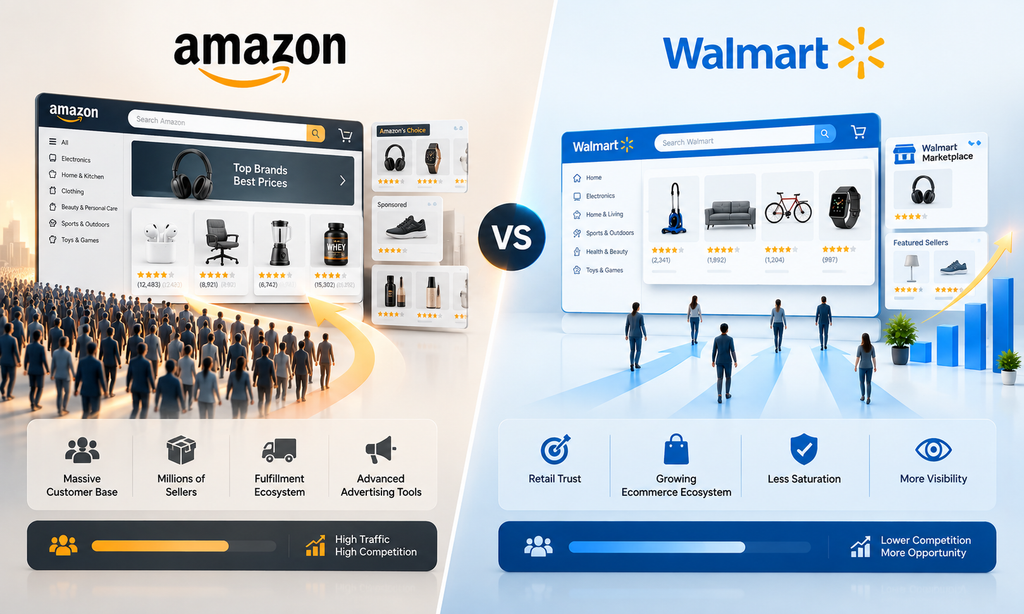
Amazon gives sellers access to unmatched traffic and demand, but visibility can be harder to win. Walmart has a smaller audience, but in some categories, lower seller saturation can create stronger opportunities for visibility and growth.
So the real question is not simply: Which marketplace is bigger? It is: Which marketplace gives my product the better chance to be seen, chosen, and sold profitably?
Amazon vs Walmart: Where Is the Bigger Growth Opportunity?
Amazon and Walmart both offer strong opportunities for ecommerce sellers, but their advantages come from different places.
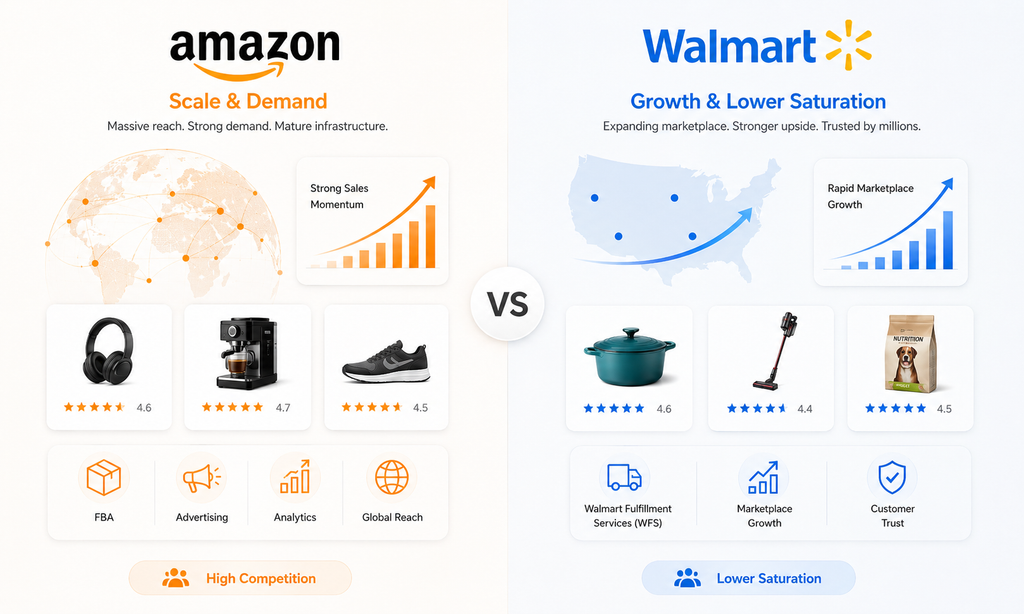
Amazon offers scale and demand. Walmart offers growth and lower saturation.
Amazon: Scale, Demand and Mature Infrastructure
Amazon gives sellers access to:
- Massive customer reach
- Strong purchase intent
- FBA and Brand Registry
- A+ Content
- Advanced advertising tools
- Analytics
- Global marketplace access
This mature ecosystem creates enormous sales potential. But it also brings intense competition, especially in categories such as beauty, electronics, supplements, home products, and pet products.
New sellers often compete against established listings with thousands of reviews, strong rankings, and large advertising budgets.
Walmart: Growth, Visibility and Lower Saturation
Walmart’s opportunity comes from being a marketplace that is still expanding.
In many categories, sellers may benefit from:
- Lower seller competition
- More manageable advertising costs
- Greater visibility for newer brands
- Early-mover opportunities
However, Walmart is not automatically easier. Sellers still need competitive pricing, strong listings, reliable fulfillment, and a good customer experience.
Amazon gives sellers access to a larger, mature marketplace. Walmart may give sellers more room to grow in a less saturated environment.
The Real Winner Depends on Your Business Stage
There is no universal winner. The better marketplace depends on your current business stage.
1. Need Maximum Customer Reach
Amazon has the advantage. Its massive audience and strong purchase intent make it the better choice for sellers focused on scale.
2. Want a New Growth Channel
Walmart becomes attractive. Lower saturation in some categories can create more room for visibility and expansion.
3. Already Successful on Amazon
Walmart can be the next logical step. Established Amazon sellers can use their existing products, systems, and marketplace experience to expand into Walmart.
4. Build a Multichannel Business
The smartest strategy is not always choosing one marketplace forever.
Successful ecommerce brands increasingly use Amazon + Walmart together to reduce marketplace dependency and create multiple growth opportunities.
Customer Behavior: Amazon Shoppers vs Walmart Shoppers
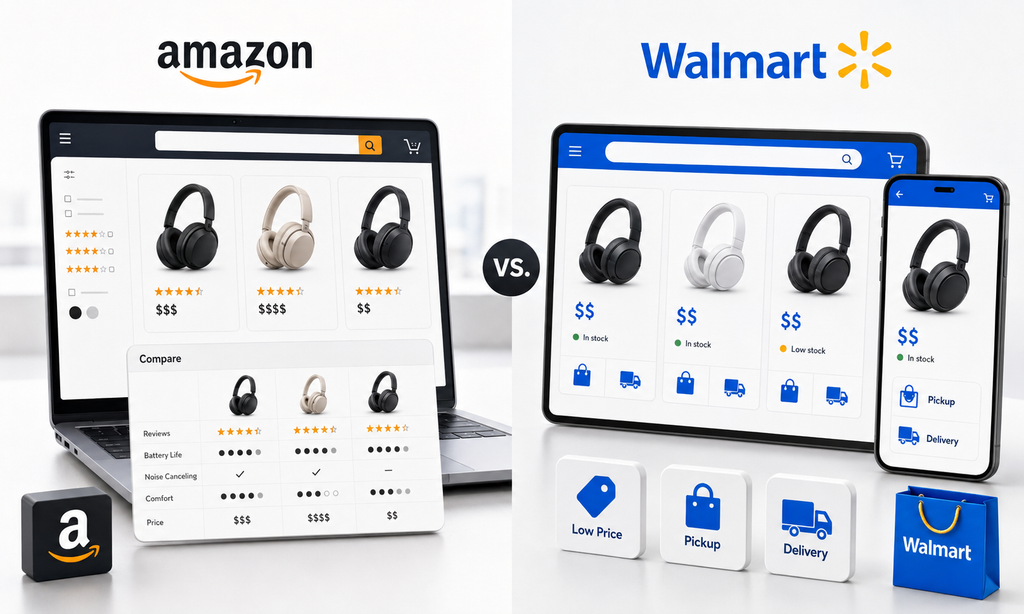
Amazon and Walmart customers shop differently, and that difference directly affects product selection, pricing, listings, and advertising.
How Amazon Shoppers Make Decisions
Amazon shoppers are more research-driven. They often compare reviews, ratings, features, images, product details, and brand reputation before buying. Their main question is: Which product gives me the best solution?
That is why Amazon sellers need strong keywords, persuasive listing content, high-quality images, social proof, and competitive pricing.
How Walmart Shoppers Make Decisions
Walmart shoppers are more value-driven. They tend to focus on price, convenience, availability, delivery speed, and overall trust. Their main question is: Which product gives me the best overall value?
This means the same product can perform differently on each marketplace. A premium, search-driven product may perform better on Amazon, while a competitively priced everyday product may find a stronger fit on Walmart.
The real deciding factor is: Product + Customer + Strategy
Walmart vs Amazon Seller Requirements: Which Marketplace Is Easier to Join?
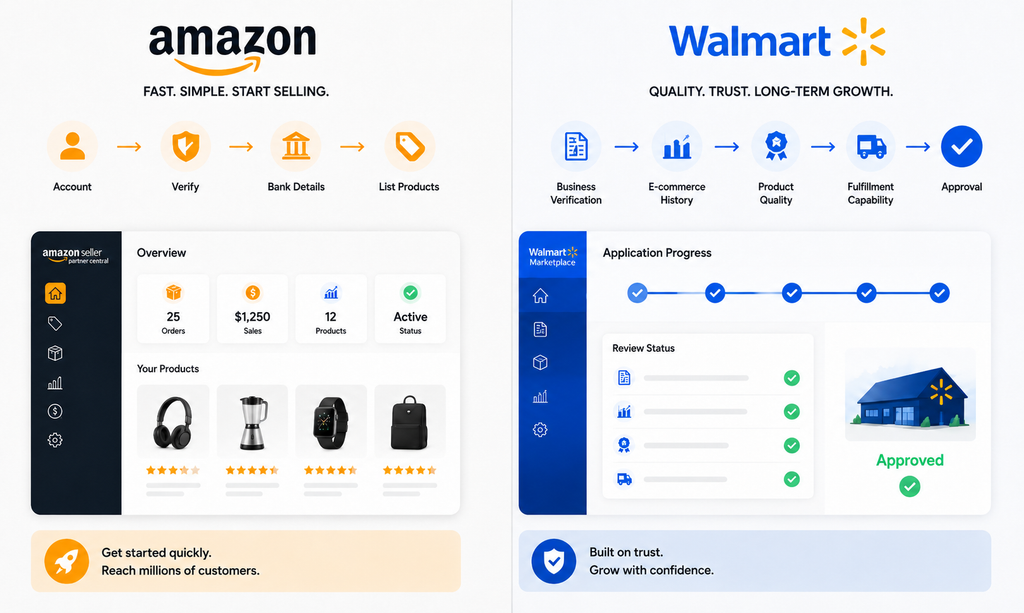
Amazon and Walmart have different approaches to seller approval. Amazon prioritizes accessibility, while Walmart focuses on maintaining a more controlled marketplace.
Amazon: Easier Entry, Higher Competition
Amazon allows eligible sellers to quickly create an account by providing:
- Business information
- Identity verification
- Banking and tax details
- Product listings
With Individual and Professional selling plans, sellers can choose the option that fits their business size. The advantage is easy access, but lower entry barriers also create higher competition.
Walmart: Selective Entry, Controlled Competition
Walmart follows a stricter approval process and evaluates:
- Business experience
- Product quality
- Pricing
- Fulfillment capability
- Customer service
This higher entry barrier helps maintain marketplace quality and reduces seller saturation.
In short: Amazon is easier to join, but Walmart offers a more selective seller environment.
Amazon vs Walmart Seller Requirements Comparison
| Requirement | Amazon | Walmart Marketplace |
| Account approval | Generally easier | More selective |
| Business verification | Required | Required |
| Ecommerce experience | Helpful but not always required | Strongly considered |
| Product catalog quality | Important | Very important |
| Fulfillment readiness | Important | Important |
| Competition after approval | Very high | Growing |
Amazon Competition: The Most Competitive Marketplace Environment
Amazon’s biggest advantage—massive customer demand—has also created intense competition.
The platform attracts:
- New sellers
- Private-label brands
- Established companies
- Global manufacturers
- Resellers
In competitive categories, new sellers often compete against listings with:
- Thousands of reviews
- Strong rankings
- Large PPC budgets
- Established brand presence
A new seller is not just competing against a product; they are competing against the years of sales history and customer trust behind it.
Why Amazon Competition Has Increased
1. More Sellers Entering the Marketplace
Amazon’s growth has attracted sellers worldwide, creating more competition for visibility, pricing, and customers.
2. Increased Private-Label Competition
More brands are launching their own products, making it harder for new sellers to enter established categories.
3. Rising Advertising Dependence
Many categories now require PPC investment because organic ranking alone is often not enough to generate consistent sales.
4. Higher Customer Expectations
Buyers now expect better images, detailed listings, competitive pricing, fast delivery, and strong product value.
5. Review Advantage
Established products with thousands of reviews and strong ratings have a major trust advantage over new sellers starting from zero.
Walmart Competition: Lower Saturation, Different Challenges
Walmart Marketplace generally has fewer sellers compared with Amazon, creating opportunities for brands looking for additional growth channels.
However, Walmart competition is based less on reviews and more on the overall shopping experience.
1. Lower Seller Saturation
Fewer sellers in many categories can create more opportunities for visibility and growth.
2. Price Competitiveness
Walmart shoppers are highly value-focused, making competitive pricing an important ranking factor.
3. Product Availability
Consistent inventory is essential because out-of-stock products can lose visibility and sales opportunities.
4. Shipping Performance
Fast and reliable delivery plays a major role in customer satisfaction and marketplace success.
5. Seller Reliability
Walmart emphasizes strong customer experience through accurate listings, dependable fulfillment, and quality service.
A successful Amazon strategy cannot simply be copied to Walmart. Products that perform well on Amazon may struggle on Walmart if pricing, delivery, or availability do not meet customer expectations.
Why Amazon and Walmart Reward Different Sellers
A simple way to think about it:
Amazon: Winning Through Product Authority
Who has the strongest product authority?
Amazon competition is mainly driven by:
- Reviews
- Sales history
- Brand strength
- PPC performance
Walmart: Winning Through Customer Experience
Who provides the best overall buying experience?”=
Walmart competition is mainly driven by:
- Price
- Delivery
- Availability
- Seller performance
This difference explains why the same product can succeed on one marketplace and struggle on the other.
Amazon vs Walmart Fees: Which Marketplace Costs Less?
Many sellers compare marketplaces based only on fees, but lower fees do not always mean higher profits.
The real question is: How much profit remains after all selling costs are deducted?
Your actual profitability depends on:
- Marketplace fees
- Fulfillment costs
- Advertising expenses
- Storage costs
- Returns
- Inventory investment
Both Amazon and Walmart have similar cost categories, but their fee structures and operating models are different.
Amazon Seller Fees Explained
Amazon sellers typically manage several types of costs:
1. Selling Plan Fees
Amazon offers different selling plans based on seller needs.
Individual Plan: Suitable for small sellers testing products or selling lower volumes.
Professional Plan: Designed for businesses selling at scale and provides access to:
- Advertising tools
- Advanced reports
- Bulk listing features
- Professional selling capabilities
2. Referral Fees
Amazon charges a percentage of each sale as a referral fee.
The rate depends on the product category, meaning categories like:
- Electronics
- Beauty
- Clothing
- Home products
may have different fee percentages.
3. Fulfillment Fees (FBA)
Sellers using Fulfillment by Amazon (FBA) pay Amazon to handle:
- Inventory storage
- Picking and packing
- Shipping
- Customer service
- Returns
FBA simplifies operations but can significantly impact profit margins.
4. Storage Fees
Amazon charges storage fees based on:
- Inventory volume
- Storage duration
- Seasonal demand periods
Slow-moving inventory can increase costs and reduce profitability.
5. Advertising Costs
Amazon PPC has become essential in many competitive categories.
Popular keywords often require higher advertising budgets, and poor campaign management can reduce profit even when sales increase.
Walmart Marketplace Fees Explained
Walmart follows a simpler marketplace fee structure compared with Amazon.
1. Referral Fees
Walmart charges a category-based referral fee on each sale. The percentage varies depending on the product category.
2. Fulfillment Costs (WFS)
Sellers using Walmart Fulfillment Services (WFS) pay for:
- Storage
- Picking and packing
- Shipping
- Customer support
Similar to Amazon FBA, WFS helps sellers scale without managing their own warehouse operations.
3. Advertising Costs (Walmart Connect)
Sellers can use Walmart Connect to increase product visibility through paid advertising.
Advertising costs depend on:
- Campaign type
- Targeting
- Competition
- Product category
Amazon vs Walmart Fees: The Real Difference
Amazon and Walmart both charge sellers for marketplace access, fulfillment, and advertising.
The key difference is not simply who has lower fees.
Amazon offers a more mature ecosystem with higher competition and advertising pressure, while Walmart provides a growing marketplace with a simpler cost structure but different customer expectations.
The most profitable marketplace is the one where your product achieves the best balance between:
Sales Volume + Costs + Conversion + Profit Margin.
Walmart vs Amazon Fee Comparison
| Cost Area | Amazon | Walmart |
| Monthly subscription | Professional selling plan | Generally no monthly marketplace fee |
| Referral fees | Category-based | Category-based |
| Fulfillment | FBA | WFS |
| Storage fees | Yes | Yes with WFS |
| Advertising | Amazon Ads | Walmart Connect |
| Main cost challenge | PPC + fulfillment | Fulfillment + competitive pricing |
Which Marketplace Is More Profitable?
Profitability is where many Amazon vs Walmart comparisons become misleading.
Some sellers assume ‘Walmart has lower fees, so it must be more profitable.’ Others believe ‘Amazon has more customers, so it will always make more money.’
Both assumptions are incomplete.
The most profitable marketplace depends on your specific product, operating costs, advertising performance, and customer conversion.
How Profit Margins Differ Across Marketplaces
Imagine selling a product for $40 with a product cost of $10.
On Amazon, your revenue starts at $40, but your final profit is affected by costs such as referral fees, FBA fulfillment fees, advertising expenses, and storage costs.
On Walmart, the same product may also sell for $40, but profitability will depend on referral fees, Walmart Fulfillment Services (WFS) costs, advertising expenses, and inventory-related costs.
The marketplace that generates the highest sales volume is not always the one that creates the highest profit.
The winning marketplace is the one where:
- Your product converts better
- Your advertising generates profitable sales
- Your operating costs remain controlled
- Your customers have a strong buying experience
Ultimately, profitability comes from finding the right balance between revenue, costs, and marketplace fit.
Amazon FBA vs Walmart Fulfillment Services (WFS)
Fulfillment has become one of the most important factors in marketplace success.
Today’s customers expect:
- Fast delivery
- Reliable shipping
- Easy returns
Because fulfillment directly impacts:
- Conversion rates
- Customer satisfaction
- Marketplace visibility
Both Amazon and Walmart offer fulfillment solutions that help sellers scale without managing their own warehouses.
Amazon FBA: The More Established Fulfillment Network
Fulfillment by Amazon (FBA) is one of the most mature fulfillment systems in ecommerce.
With FBA, Amazon manages:
- Inventory storage
- Order processing
- Packing
- Shipping
- Customer service
- Returns
The biggest advantage is Prime eligibility. Many customers prefer products with fast Amazon delivery, which can improve trust and increase conversion rates.
Key Advantages of Amazon FBA
1. Strong Customer Trust: Customers are highly familiar with Amazon’s delivery experience, making them more confident purchasing FBA products.
2. Easy Business Scaling: Sellers can grow without building their own warehouse and fulfillment operation.
3. Higher Conversion Potential: Fast delivery and Prime eligibility can positively influence buying decisions.
Challenges of Amazon FBA
Despite its advantages, sellers need to manage:
- Increasing fulfillment fees
- Storage costs
- Inventory planning
- Long-term storage risks
Poor inventory management can reduce profit margins.
Walmart Fulfillment Services (WFS): A Growing Alternative
Walmart Fulfillment Services (WFS) provides a similar fulfillment model for Walmart Marketplace sellers.
Sellers send inventory to Walmart fulfillment centers, and Walmart manages:
- Storage
- Picking and packing
- Shipping
- Customer service
- Returns
WFS allows sellers to offer a faster, more reliable delivery experience while focusing on product growth.
Key Advantages of WFS
1. Easier Scaling: Sellers can expand without investing in their own fulfillment infrastructure.
2. Better Customer Experience: Faster delivery helps sellers meet Walmart customers’ expectations.
3. Marketplace Advantage: Using WFS can improve competitiveness by providing reliable fulfillment and delivery performance.
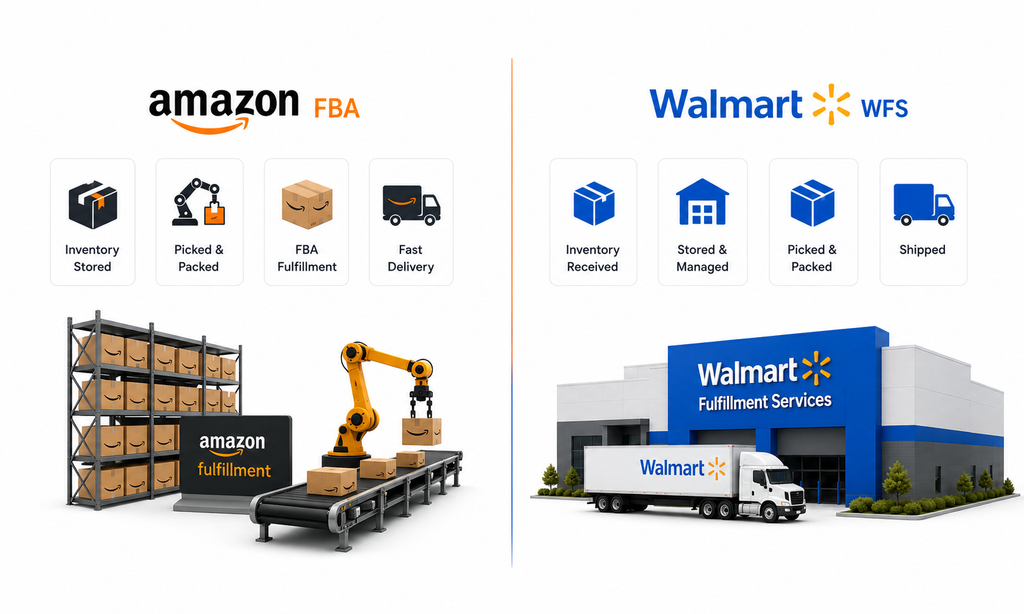
Amazon FBA vs Walmart WFS: The Key Difference
Amazon FBA has the advantage of being a more established system with strong customer recognition and a mature ecosystem.
WFS provides a growing fulfillment opportunity for sellers entering Walmart’s expanding marketplace.
The best choice depends on:
- Product category
- Fulfillment costs
- Sales volume
- Profit margins
- Customer expectations
Successful sellers focus not only on where they sell, but also on how efficiently they deliver.
Amazon SEO vs Walmart SEO: How Ranking Works Differently
One of the biggest mistakes Amazon sellers make when expanding to Walmart is assuming they can simply copy their Amazon strategy.
Both platforms use search algorithms, but they prioritize different signals because their customers shop differently.
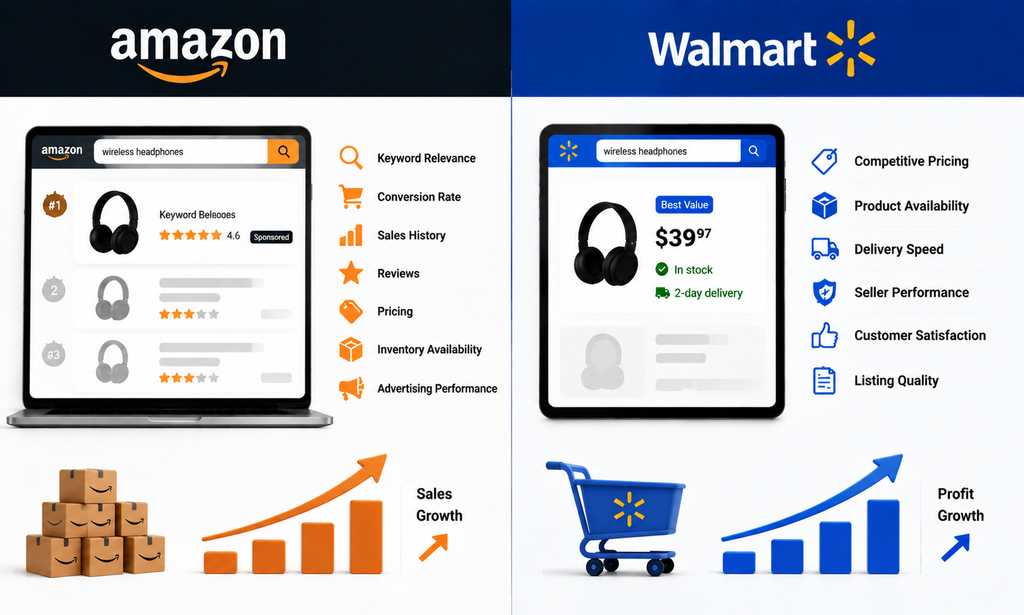
Amazon focuses on search relevance and conversion. Walmart focuses on relevance, value, availability, and customer experience.
Understanding these differences helps sellers improve visibility on both marketplaces.
How Amazon Ranking Works
Amazon’s goal is to show products most likely to convert.
Key ranking factors include:
- Keyword relevance
- Conversion rate
- Sales history
- Reviews
- Pricing
- Inventory availability
- Advertising performance
Key Amazon SEO Factors
1. Keyword Relevance: Keywords help Amazon understand what a product is and match it with customer searches.
2. Conversion Rate: Products with strong clicks and purchases receive better ranking signals.
3. Sales Velocity: Consistent sales help products gain ranking momentum.
How Walmart Ranking Works
Walmart focuses more on the overall shopping experience.
Important ranking factors include:
- Product relevance
- Competitive pricing
- Shipping speed
- Inventory availability
- Seller performance
- Listing quality
Key Walmart SEO Factors
1. Competitive Pricing: Walmart shoppers value affordability, making price an important ranking factor.
2. Product Availability: Consistent inventory helps maintain visibility and customer trust.
3. Delivery Performance: Fast and reliable shipping improves customer experience and competitiveness.
Amazon vs Walmart Listing Strategy
A common mistake is using the same listing everywhere.
Amazon Listing Focus
Amazon listings should focus on search intent:
- Keyword-rich titles
- Benefit-driven bullet points
- High-quality images
- Reviews and social proof
- A+ Content
Walmart Listing Focus
Walmart listings should focus on value communication:
- Clear product information
- Competitive pricing
- Strong images
- Accurate attributes
- Delivery details
The same product may need different positioning on each platform.
Amazon asks: Why is this the best solution? Walmart asks: Why is this the best value?
Amazon Advertising vs Walmart Advertising: Which Platform Gives Sellers More Opportunity?
Advertising has become essential for marketplace success. Even a strong product can struggle if customers cannot discover it.
Both Amazon and Walmart offer advertising solutions, but they are at different stages of development.
Amazon Ads: Advanced but Highly Competitive
Amazon Ads is one of the most mature ecommerce advertising platforms.
Sellers can use:
- Sponsored Products
- Sponsored Brands
- Sponsored Display
- Brand campaigns
- Audience targeting
Amazon’s biggest advantage is its massive customer data. The platform understands:
- What customers search for
- What they purchase
- Which products they consider
However, this maturity creates higher competition.
Key Challenge: Rising PPC Costs
As more sellers compete for visibility:
- Keyword costs increase
- Ad budgets become larger
- Competition becomes harder
In many categories, PPC is no longer optional—it has become a necessary part of selling on Amazon.
Walmart Connect: A Growing Advertising Opportunity
Walmart Connect is Walmart’s advertising platform and is still developing compared with Amazon Ads.
It allows sellers to promote products through:
- Sponsored products
- Search placements
- Display advertising
- Customer targeting
The biggest opportunity is lower advertising saturation in many categories.
While Amazon sellers often compete with thousands of advertisers, Walmart sellers may find more room to test campaigns and gain visibility.
However, success still depends on:
- Strong products
- Optimized listings
- Competitive pricing
- Effective targeting
In simple terms: Amazon Ads provides advanced tools and massive reach, while Walmart Connect offers growing opportunities in a less crowded advertising environment.
Product Selection: What Sells Better on Amazon vs Walmart?
Choosing the right product is one of the biggest factors in marketplace success.
A product that performs well on Amazon may not achieve the same results on Walmart because customer expectations and shopping behaviour are different.
Products That Perform Well on Amazon
Amazon is strongest for search-driven and problem-solving products.
1. Search-Based Products
Products customers actively search for, such as:
- Electronics accessories
- Specialized tools
- Hobby products
- Beauty solutions
- Fitness products
These products perform well because customers already have a clear buying intention.
2. Problem-Solving Products
Amazon shoppers often search for solutions to specific problems.
Examples:
- A better laptop stand
- A solution for pet hair
- Improved home storage
Products that clearly solve customer needs often have strong potential.
3. Premium Products
Amazon customers are often willing to pay more when products offer:
- Better quality
- Strong reviews
- Advanced features
- Trusted branding
Products That Perform Well on Walmart
Walmart performs strongly in everyday consumer categories where customers prioritize value and convenience.
Common opportunities include:
- Household products
- Kitchen items
- Storage solutions
- Personal care products
- Everyday essentials
Walmart customers already associate the brand with affordable and reliable shopping.
Key Walmart Product Success Factors
1. Competitive Pricing: Customers expect strong value, making pricing an important factor.
2. Broad Customer Appeal: Products solving common everyday needs often have wider potential.
3. Reliable Availability: Consistent inventory and dependable fulfillment help maintain customer trust.
Should You Sell the Same Product on Both Marketplaces?
Yes, but avoid simply copying the same strategy.
A successful multichannel approach requires adapting:
- Pricing strategy
- Listing content
- Advertising approach
- Inventory planning
- Product positioning
For example, a kitchen product successful on Amazon may need different messaging on Walmart.
The smart approach is:
- Analyze Amazon performance data, including sales, reviews, conversion rate, and customer feedback.
- Adjust the product strategy for Walmart by optimizing pricing, listing content, and positioning.
- Use Walmart advertising to build visibility.
- Measure success through profitability, not just revenue.
The best marketplace is not determined only by the product—it depends on the match between product, customer, and marketplace strategy.
Amazon vs Walmart: Which Marketplace Is Better for Different Types of Sellers?
There is no universal winner between Amazon and Walmart.
The right choice depends on:
- Product category
- Business stage
- Budget
- Operational capability
- Growth goals
Instead of asking Is Amazon better than Walmart?, sellers should ask: Which marketplace gives my business the best chance to succeed?
For New Sellers
1. Amazon Advantage: Amazon offers easier access to customers, established fulfillment options, advanced tools, and strong customer demand.
2. Amazon Challenge: The marketplace is highly competitive, requiring strong skills in SEO, PPC, listings, reviews, and inventory management.
3. Walmart Opportunity: Walmart’s growing marketplace can provide opportunities in categories with lower seller saturation.
4. Walmart Challenge: The approval process is more selective, and sellers need strong operations and customer service.
Best Fit: New sellers may find Amazon easier to start, while experienced sellers may find Walmart attractive for growth.
For Private Label Brands
Amazon remains a strong platform for building brands through:
- Keyword ranking
- Reviews
- Brand Registry
- A+ Content
- Advertising
However, rising PPC costs and competition are making growth more challenging.
Successful Amazon brands can use their existing products, reviews, and experience to expand into Walmart.
For Established Amazon Sellers
Walmart is a natural expansion opportunity for successful Amazon sellers.
They already have:
- Proven products
- Supplier relationships
- Inventory systems
- Marketplace experience
Adding Walmart helps reduce dependency on a single platform and creates additional growth opportunities.
The smartest strategy is not choosing Amazon or Walmart—it is using both based on your business goals.
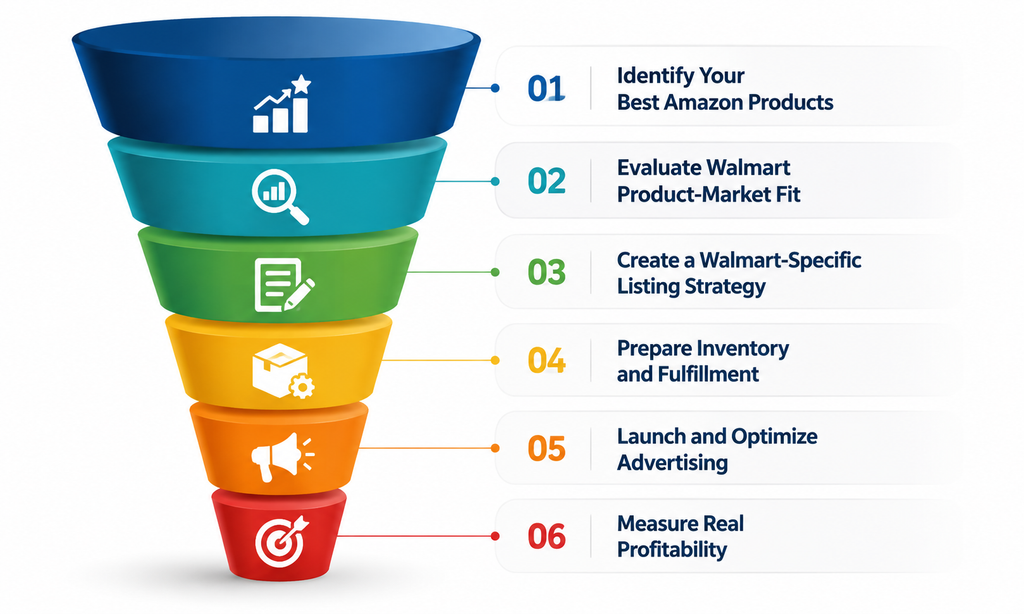
Step-by-Step Amazon to Walmart Expansion Strategy
Expanding from Amazon to Walmart can be a smart growth opportunity, but success requires more than simply copying your Amazon business.
A strong expansion strategy focuses on selecting the right products, adapting listings, preparing operations, and measuring profitability.
Step 1: Identify Your Best Amazon Products
Do not move your entire catalog to Walmart immediately.
Start with products that already have:
- Strong sales history
- Positive reviews
- Healthy profit margins
- Stable inventory
Your proven Amazon winners give you the highest chance of success on Walmart.
Step 2: Evaluate Walmart Product-Market Fit
A product that succeeds on Amazon may not perform the same way on Walmart.
Before launching, analyze:
- Customer demand
- Price competitiveness
- Category competition
- Existing Walmart alternatives
Ask: Would a Walmart customer choose this product?
Step 3: Create a Walmart-Specific Listing Strategy
Avoid copying your Amazon listing directly.
Optimize your Walmart listing by adjusting:
- Title structure
- Product description
- Images
- Pricing
- Product attributes
Amazon shoppers often focus on features and reviews, while Walmart shoppers place more emphasis on value and convenience.
Step 4: Prepare Inventory and Fulfillment
Before launching, ensure your operations are ready.
Focus on:
- Inventory availability
- Shipping capability
- Return handling
- Customer support
Using Walmart Fulfillment Services (WFS) can help improve delivery speed and customer experience.
Step 5: Launch and Optimize Advertising
Do not expect immediate organic sales after launch.
Use Walmart Connect to:
- Generate initial visibility
- Test customer demand
- Collect performance data
- Improve product ranking
Monitor campaigns and optimize based on results.
Step 6: Measure Real Profitability
Revenue alone does not define success.
Track important metrics such as:
- Advertising costs
- Conversion rate
- Profit margins
- Return rate
- Fulfillment expenses
A successful expansion is not about generating more sales—it is about building a profitable and sustainable Walmart channel.
Walmart vs Amazon — Which One Should Sellers Choose?
There is no single winner between Amazon and Walmart. The right choice depends on your product, business goals, and growth strategy.
Amazon remains the ecommerce powerhouse with massive customer demand, strong purchase intent, advanced seller tools, and global reach.
Walmart has become a powerful growth opportunity with a growing marketplace, lower saturation in some categories, strong retail trust, and expanding ecommerce infrastructure.
The biggest mistake sellers make is thinking they must choose Amazon or Walmart. The smarter approach is to use both platforms strategically.
Amazon provides scale. Walmart provides opportunity. Together, they create a stronger foundation for long-term ecommerce growth.
Frequently Asked Questions (FAQs)
Q1. Is Walmart better than Amazon for sellers in 2026?
It depends on your business. Amazon offers scale and demand, while Walmart provides growing opportunities with potentially lower competition.
Q2. Is Walmart cheaper than Amazon to sell on?
Walmart may have a simpler fee structure, but profitability depends on fulfillment, advertising costs, fees, and product margins.
Q3. Can Amazon sellers sell on Walmart Marketplace?
Yes. Many Amazon sellers expand to Walmart, but they need a separate strategy for listings, pricing, and advertising.
Q4. Is Walmart Marketplace less competitive than Amazon?
In many categories, Walmart has lower seller saturation, but success still requires strong pricing, listings, fulfillment, and customer service.
Q5. Should I use Amazon FBA or Walmart WFS?
FBA has a more mature ecosystem, while WFS offers a growing opportunity. The best choice depends on your products and business model.
Q6. Which marketplace has better advertising?
Amazon Ads offers more advanced tools, while Walmart Connect provides growing opportunities with less advertising saturation.
Q7. Should I sell the same products on Amazon and Walmart?
Yes, but optimize each marketplace separately with different pricing, content, advertising, and inventory strategies.
Q8. Is Walmart the biggest competitor to Amazon?
Walmart is a major ecommerce competitor, combining retail strength with online growth, while Amazon dominates digital marketplace shopping.
Grow Your Walmart and Amazon Business With Ecomclips
Building a successful business on Walmart Marketplace or Amazon requires continuous learning, adapting to marketplace changes, and applying the right strategy for each platform. Ecomclips provides practical ecommerce resources, marketplace insights, and seller strategies to help businesses improve performance, protect profitability, and scale across multiple sales channels.
Watch Amazon and Walmart tutorials, marketplace growth strategies, advertising insights, and ecommerce updates on the Ecomclips YouTube channel. Explore detailed seller guides, marketplace comparisons, optimization strategies, and ecommerce growth resources on the Ecomclips Blog.
Stay connected with the latest ecommerce trends and company updates by following the Ecomclips Facebook page, and connect with Ecomclips on LinkedIn for professional marketplace insights and ecommerce discussions.
Have questions about expanding from Amazon to Walmart, optimizing product listings, improving search visibility, managing marketplace advertising, choosing the right fulfillment strategy, or building a profitable multichannel ecommerce business?
Contact the Ecomclips team at info@ecomclips.com or book a consultation with our ecommerce experts to discuss your goals and explore how we can help you grow successfully on Walmart, Amazon, and beyond.