
After years of working with Amazon SEO, one lesson stands out: Basic SEO gets you indexed. Advanced SEO gets you ahead.
The listings that win are not simply using more keywords. They are better at matching shopper intent, earning clicks, converting demand, communicating value, and learning from what customers do next.
In 2026, advanced Amazon SEO stretches far beyond titles and backend terms. It connects search-query data, keyword architecture, shopper behavior, semantic relevance, AI discovery, catalog structure, pricing, reviews, mobile experience, PPC, and testing.
So, let’s break down the 7 advanced Amazon SEO strategies we use to understand why an ASIN is winning, where it is losing shoppers, and what should be improved next.
What Is Advanced Amazon SEO?
Basic Amazon SEO helps Amazon understand what your product is. Advanced Amazon SEO focuses on why Amazon should keep showing it and why shoppers should choose it.
Basic optimization normally covers keyword research, titles, bullet points, backend search terms, images, A+ Content, and ranking tracking.
Advanced SEO goes further into:
- Search-query performance
- Shopper intent
- Semantic relevance
- Click and conversion behaviour
- Competitive positioning
- Product data
- AI shopping visibility
- PPC insights
- Testing
- External demand
- Customer experience
- Ranking defence
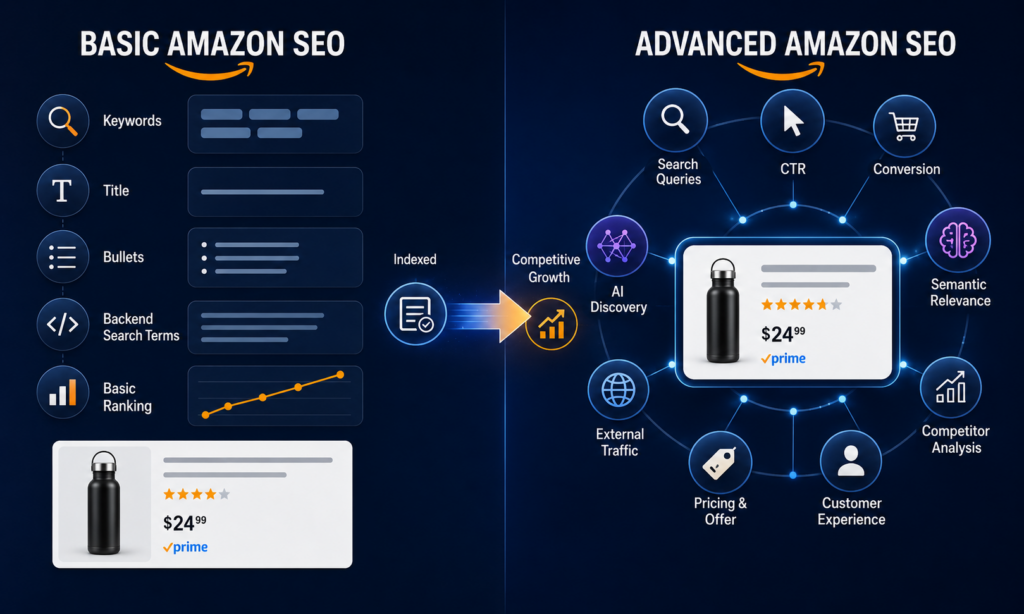
Advanced SEO works across two layers:
- Relevance: Should your ASIN appear for the query?
- Performance: When it appears, does it earn the click and purchase?
The first gets you into the search. The second determines whether you can actually win it.
Why Do Sellers Need Advanced SEO?
Imagine two sellers competing for ‘face moisturizer for dry skin’
Both listings contain the right keywords. Both are indexed. Both appear in Amazon search. But Seller A receives plenty of impressions without enough clicks, while Seller B continues gaining clicks, purchases, and visibility.
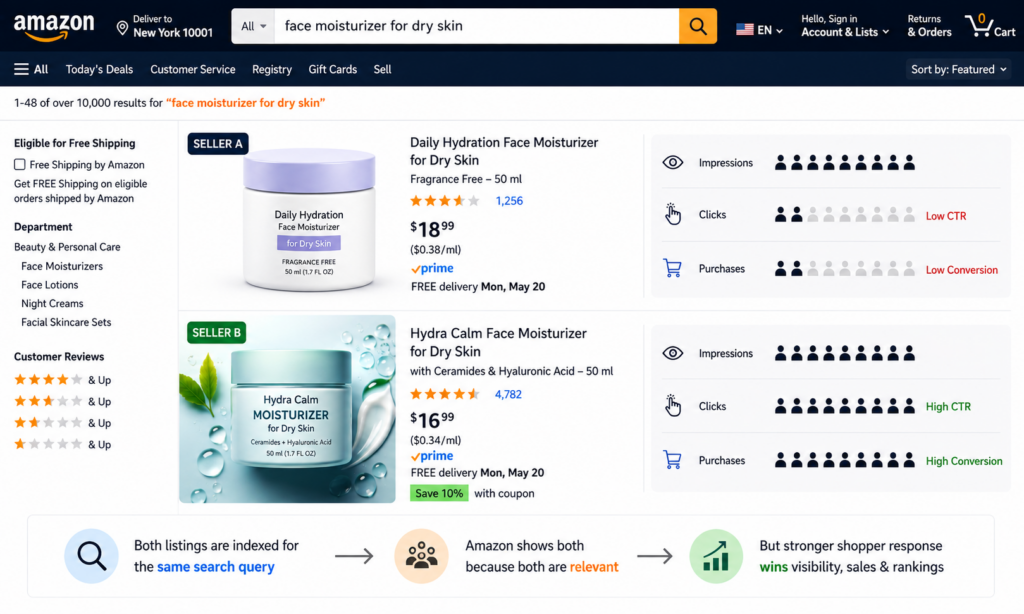
At that point, Seller A does not necessarily have a keyword problem. The difference could be the main image, price, rating, reviews, ingredient positioning, delivery, trust signals, or overall offer.
Amazon already understands both products. The real question is: Which moisturizer do shoppers choose when Amazon shows them?
That is where advanced SEO begins. Basic SEO gets you into the competition. Advanced SEO helps you win it.
Advanced Amazon SEO in 30 Seconds
Here is the diagnostic mindset behind the entire guide:
- Low visibility: Fix relevance, product data, category alignment, or targeting.
- Visibility without clicks: Fix the search result.
- Clicks without cart adds: Fix consideration.
- Cart adds without purchases: Fix purchase friction.
- Strong conversion but weak visibility: Scale qualified exposure.
- PPC query converts: Treat it as an SEO opportunity.
- Reviews repeat the same complaint: Fix the information gap.
- Mobile hides your differentiator: Rebuild for compressed viewing.
- Several ASINs target identical intent: Fix the catalog architecture.
Advanced SEO is not about changing more. It is about knowing what deserves to change first.
1. Build a Search-Query Strategy, Not a Keyword Dump
Keyword research still matters.
What has changed is how advanced sellers use the keywords they find. The old process looked like: Find high-volume keywords → Place them everywhere → Track rank
A better process is: Find demand → Validate relevance → Measure shopper response → Prioritize opportunity
Amazon’s Search Query Performance data helps eligible brands examine stages such as impressions, clicks, cart adds, and purchases instead of looking only at where an ASIN ranks.
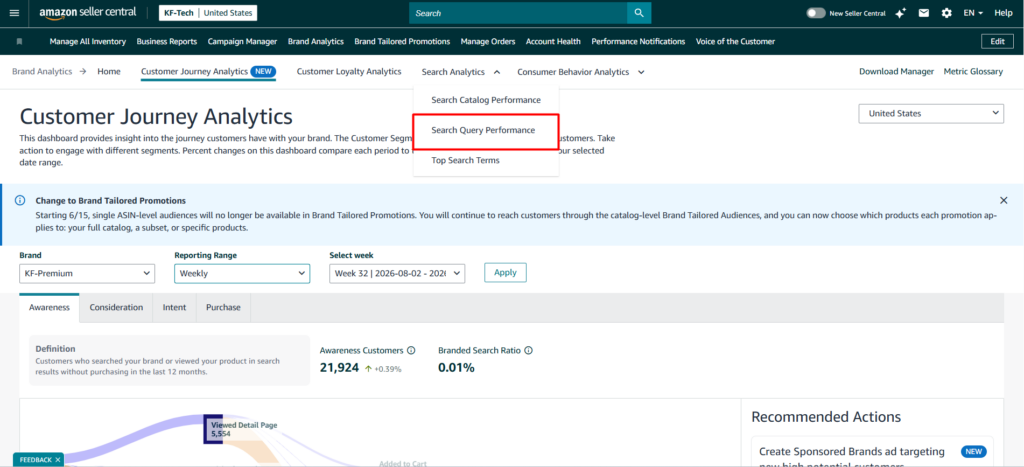
A keyword tells you what was typed. A query funnel tells you whether you actually won anything from it.
Product That Ranks But Does Not Win
Imagine your magnesium supplement appears frequently for ‘best magnesium supplement for sleep’. Your organic position looks healthy.
Search Query Performance, however, shows:
- Strong impression share
- Weak click share
- Weak purchase share
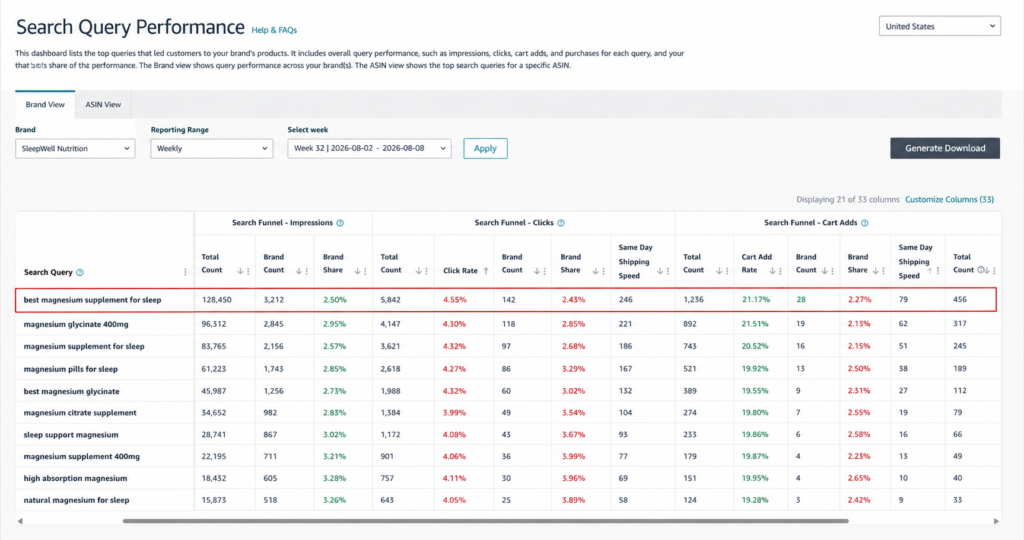
That changes the diagnosis immediately.
Visibility is not the main problem. Amazon is already giving the product opportunities to compete.
Now ask: Why are shoppers choosing another supplement?
Possible issues include:
- Main image
- Reviews
- Rating
- Price
- Ingredient clarity
- Serving information
- Product positioning
- Brand trust
- Offer strength
This is why advanced Amazon SEO does not stop at: Where do I rank? It asks: When Amazon gives me visibility, how much of that demand do I actually win?
That is query-level SEO.
Give Every Keyword a Clear Job
Not every relevant keyword belongs in the same place.
Instead of forcing as many phrases as possible into the visible listing, separate keywords by purpose.
- Primary Keywords: Core searches that clearly define what the product is.
- Secondary Keywords: Relevant features, benefits, use cases, and product variations.
- Long-Tail Keywords: More specific searches that often reveal stronger shopper intent.
- Backend Terms: Relevant language that can support indexing but does not fit naturally into customer-facing copy.
This creates cleaner keyword architecture and prevents the listing from sounding like it was written for a search engine instead of a shopper.
Use Visible Keywords and Backend Terms Differently

Customer-facing content should stay clear, persuasive, and useful. Backend terms can extend relevant search coverage without making the listing feel stuffed.
Good backend candidates include:
- Synonyms
- Abbreviations
- Alternate product names
- Legitimate spelling variations
- Relevant long-tail terms
Avoid unnecessary repetition and stay within the applicable marketplace byte limit.
Visible keywords explain the product. Backend terms extend relevant coverage.
2. Diagnose the Search Funnel Before Changing the Listing
One of the easiest ways to destroy useful SEO data is to change everything at once.
If you rewrite the title, replace the main image, adjust the price, edit A+ Content, and change PPC in the same week, performance may improve, but you will not know which change actually moved the needle.
A better approach is to diagnose the shopper journey first.
Think of Amazon search as a funnel: Impressions → Clicks → Cart Adds → Purchases
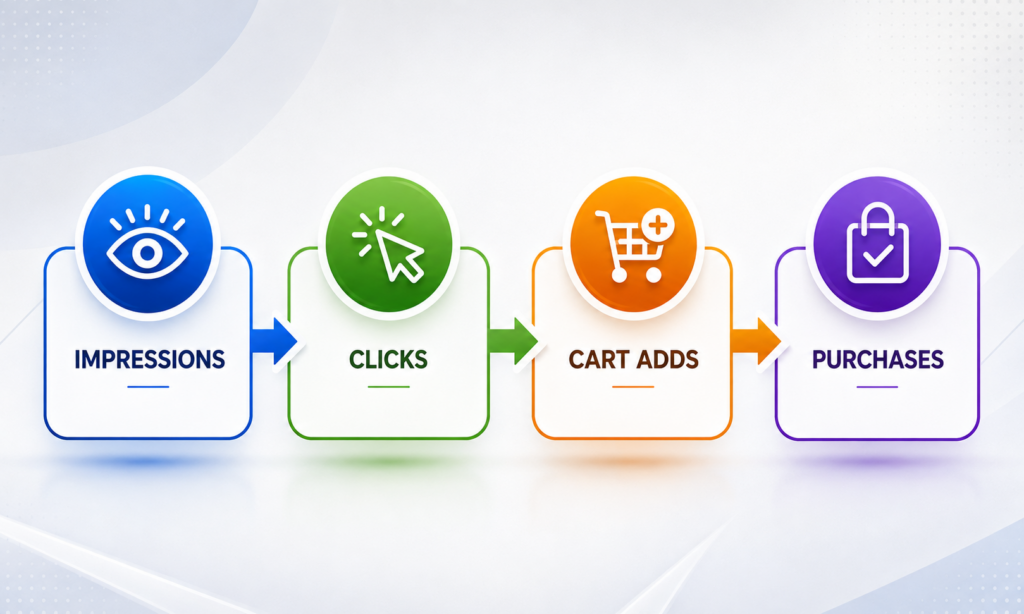
High Impressions + Low Clicks
Amazon is already giving your ASIN visibility. The problem is that shoppers are seeing the product and choosing something else.
That usually points to the search result itself.
Review the main image, title, price, rating, review count, coupon, delivery promise, and how clearly the product stands out beside competing listings.
Your priority is CTR.
High Clicks + Low Cart Adds
Now the search result is doing its job.
Shoppers are interested enough to open the listing, but something on the product page is making them hesitate.
Look at secondary images, product benefits, dimensions, compatibility, A+ Content, specifications, variations, and whether the listing answers the questions shoppers need before committing.
Your priority is consideration.
High Cart Adds + Low Purchases
This is a later-stage problem.
The shopper has already clicked and shown purchase intent by adding the product to cart, but something stops the final order.
That could be the final price, delivery timing, availability, promotion strength, competitor offers, variation availability, or trust.
Your priority is purchase friction.
Strong Clicks + Strong Purchases + Weak Visibility
This is not really a conversion problem. The product already performs well when shoppers find it.
In this case, the opportunity is to increase qualified visibility through relevant organic keywords, exact-match PPC, long-tail queries, product targeting, seasonal demand, or external traffic.
Do not fix what is already working. Scale it.
Find the Leak Before You Optimize
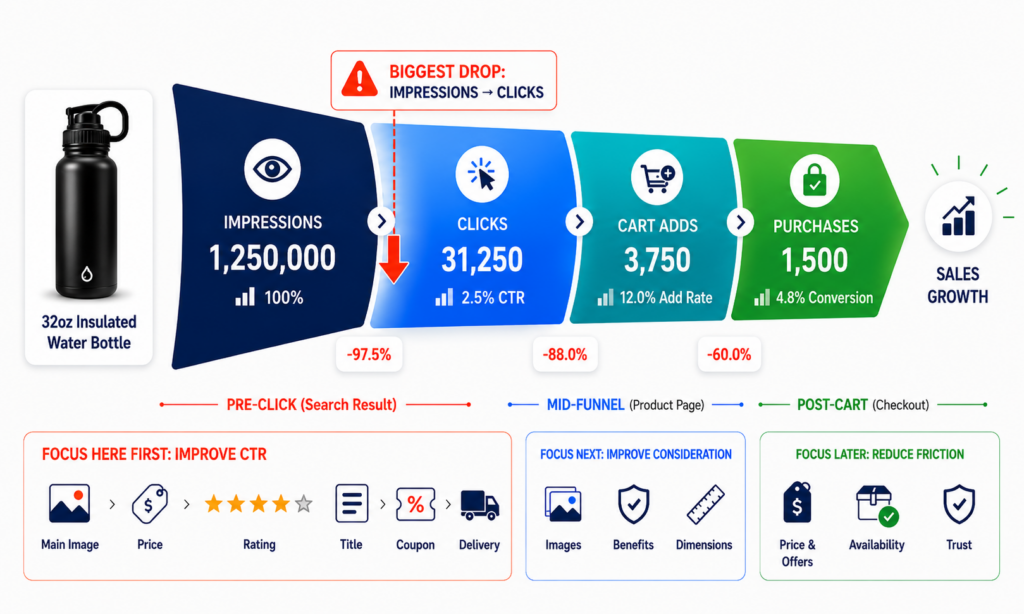
Imagine an insulated water bottle receives: 1,250,000 Impressions → 31,250 Clicks → 3,750 Cart Adds → 1,500 Purchases
The image makes the biggest problem easy to spot: the sharpest drop happens between Impressions and Clicks.
That means Amazon is already giving the product visibility, but too few shoppers are choosing it from the search results.
So the first priority should be the pre-click experience: Main Image → Price → Rating → Title → Coupon → Delivery
At this stage, rewriting A+ Content is unlikely to be the best first move.
If CTR improves but cart adds remain weak, then move deeper into the product page and review images, benefits, dimensions, and other consideration factors. If cart adds are strong but purchases lag, focus on price, availability, and trust.
That is the real value of funnel diagnosis: find the biggest leak first, fix that stage, then move to the next one.
3. Move From Keyword Matching to Shopper Intent
Keywords tell you what shoppers type. Intent explains why they are searching for it.
That difference matters more as Amazon search becomes better at connecting products with customer needs, situations, audiences, and outcomes. Amazon’s COSMO research is useful here because it explores behavioural relationships such as searches, purchases, and co-purchases to understand how products relate to real-world shopper needs.
For sellers, advanced SEO should not stop at matching exact phrases. Your listing should also communicate who the product is for, when it is useful, what problem it solves, and which outcome it delivers.
Look Beyond the Keyword
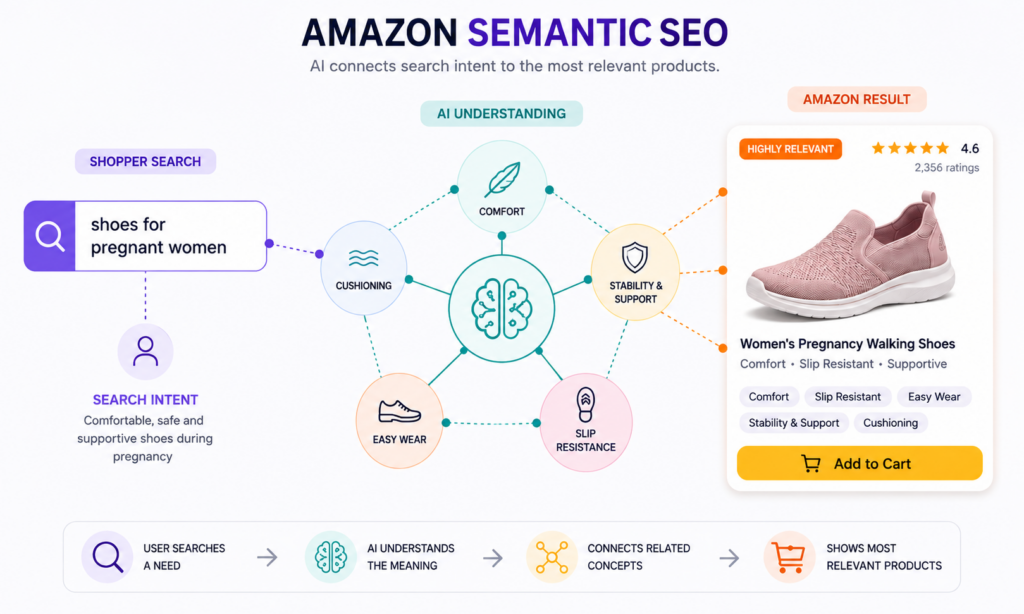
Consider the query ‘shoes for pregnant women’
A traditional keyword strategy may simply try to place that phrase inside the listing. But an intent-based strategy asks a more useful question: What is this shopper actually looking for?
The answer may involve comfort, stability, slip resistance, support, and easy wear. The keyword tells Amazon what the shopper typed, but these surrounding needs explain the intent behind the search.
Build an Intent Map Around the Product
A keyword map focuses on what words describe your product. An intent map goes deeper by asking: Why would someone choose this product?
For shoes designed for pregnant women, that could look like:
- Product Identity: women’s walking shoes, slip-on shoes
- Feature Intent: cushioned sole, non-slip outsole, lightweight design
- Outcome Intent: better comfort, easier movement, improved stability
- Audience Intent: pregnant women, expectant mothers
- Situation Intent: walking, daily errands, work, travel
- Problem Intent: foot discomfort, swelling, difficulty bending, reduced stability
This creates a richer SEO strategy than simply repeating ‘shoes for pregnant women’ throughout the listing.
You are helping communicate what the shoes are, who they are for, when they are useful, and which needs they are designed to address.
4. Optimize for Alexa for Shopping and AI Discovery
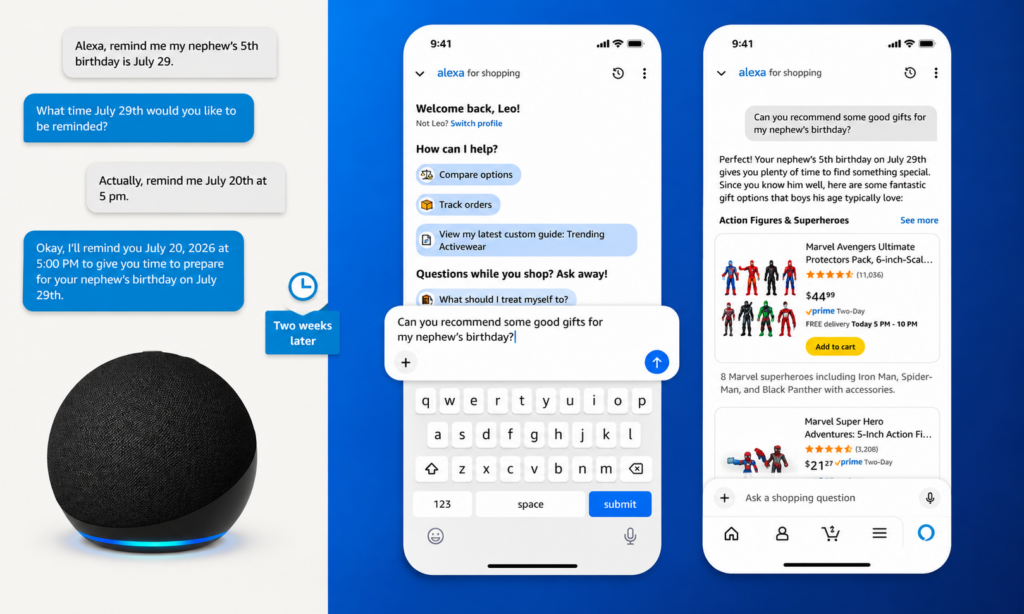
Amazon shopping is becoming more conversational.
With Alexa for Shopping, shoppers can move beyond short keyword searches and ask detailed product questions based on their needs, preferences, and constraints. That changes how sellers should think about SEO.
A traditional Amazon search might be: ‘portable espresso maker’
But a conversational shopping query could be: ‘Which portable espresso maker is small enough for carry-on luggage and works without electricity?’

That single question contains much more context: Product + Use Case + Constraint + Desired Outcome
A listing built only around short keywords may be relevant, but still fail to provide enough information for Amazon or the shopper to confidently compare the product.
Make the Product Easier to Understand
Imagine two competing portable espresso maker listings.
Listing A says: ‘Premium Portable Espresso Maker for Travel.’ It sounds good, but important information is buried deeper in the page.
Listing B clearly explains that the product is manually operated, compact enough for travel, compatible with ground coffee or capsules, easy to clean, and does not require electricity.
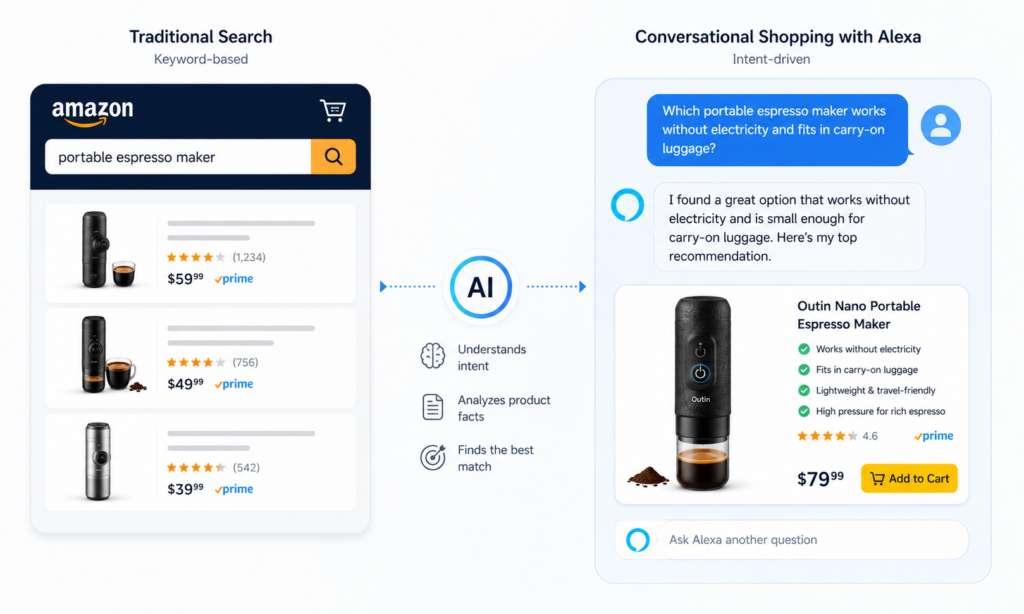
Both listings may target similar keywords.
But Listing B gives Amazon and the shopper a much clearer picture of what the product does, where it can be used, and whether it fits the shopper’s exact need. That is why advanced SEO increasingly depends on answer completeness, not just keyword coverage.
Use Question-Based SEO
Think about the questions a serious shopper may ask before buying.
For a portable espresso maker, they might ask:
- Does it need electricity?
- Can I use ground coffee?
- Does it accept capsules?
- How much does it weigh?
- Can I take it camping?
- How difficult is it to clean?
Your listing should answer those questions naturally through bullets, product attributes, images, A+ Content, videos, and comparison charts.
5. Treat Catalog Structure, Taxonomy, and Variations as SEO Infrastructure
Amazon SEO does not exist only in the title, bullets, and backend search terms. Amazon also uses structured catalogue data to understand what the ASIN is, who it is for, how it differs from similar products, and where it belongs in the catalogue.
That makes catalogue quality part of your SEO foundation.
Depending on the category, important structured attributes may include:
- Product type
- Category and browse placement
- Product attributes
- Variations
- Compatibility
- Size
- Colour
- Material
- Capacity
Think of taxonomy as the digital aisle where Amazon places your product. Even a well-optimised listing can struggle if the product sits within the wrong category structure or important attributes are missing.
When Catalogue Data Makes or Breaks Relevance
Imagine you sell Wind Deflectors for Peugeot Partner 2008–2018.
The title may correctly explain what the product is and which vehicle it fits. But suppose the underlying catalogue data is missing important information such as:
- Peugeot Partner compatibility
- 2008–2018 model years
- Van body type
- Gloss black colour
- Acrylic material
- Exterior tape installation
- 2-piece quantity
In that situation, Amazon has to rely too heavily on the visible copy to understand the product.
Now compare this with an ASIN where the same information is consistently reinforced across: Item Name + Item Highlights + Product Attributes + Images + Variation Data
This creates a much clearer product identity.
Structured data can therefore support more than catalogue cleanliness. It can strengthen search relevance, filtering, shopper confidence, conversion quality, and expectation-setting.
This is especially important for products where compatibility, size, fitment, material, or variation selection directly affects whether the product is right for the shopper.
Use Item Name and Item Highlights Strategically
Do not try to force every important feature into the Item Name. The better approach is to use Item Name and Item Highlights together as one search-result package.
Think of it as: 75 characters for the Item Name + 125 characters for Item Highlights = 200 characters of coordinated product information
For Example,
Item Name: Insulated Water Bottle 750ml, Stainless Steel, Double Wall, Leakproof, Black
Item Highlights: Keeps Drinks Cold for 24 Hours & Hot for 12 Hours, Sweat-Free Exterior, Ideal for Gym, Travel & Outdoor Use
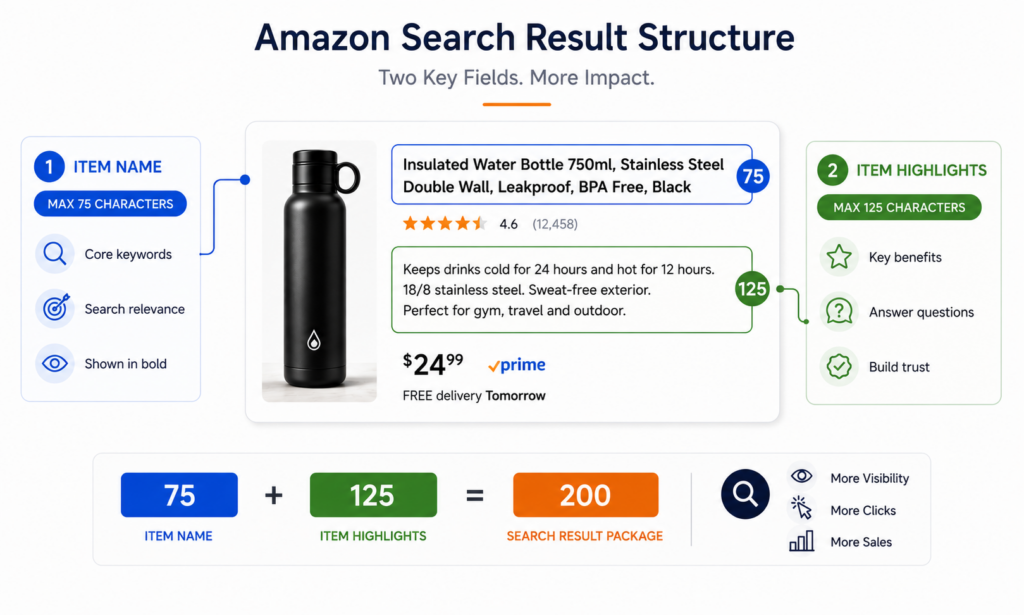
The Item Name should establish the core product identity, primary keyword, size, material, and most important differentiators. The Item Highlights should extend that information with benefits, use cases, and details that help shoppers quickly understand why the product fits their needs.
So the structure becomes:
Item Name = What the product is
Item Highlights = What it does and why it matters
Build Variations Around Shopper Choice
A variation should answer: ‘Which version is right for me?’ Not: ‘Why are these unrelated products grouped together?’
Good variation structures may organize legitimate choices such as:
- Size
- Color
- Pack quantity
- Style
- Configuration
Amazon’s current seller guidance confirms that sellers can use one listing for valid product variations such as size or color.
6. Treat CTR, Pricing, Reviews, and Mobile Experience as One Conversion System
Getting indexed is only the beginning.
A keyword can help Amazon understand that your product is relevant, but relevance does not guarantee a click. And a click has little value if the shopper reaches the product page and decides not to buy.
That is why advanced Amazon SEO should connect: Visibility → Clickability → Conversion
Once Amazon starts showing your ASIN, performance depends on how the complete offer compares with the alternatives around it. Main image, price, rating, reviews, coupon, delivery, product differentiation, and trust all influence whether visibility becomes revenue.
When Ranking Is Not the Real Problem
Imagine three products appear for: ’32 oz insulated water bottle’
Product A: $24.99, 4.7 stars, 12,000 reviews
Product B: $22.99, 4.6 stars, coupon available
Your Product: $29.99, 4.4 stars, 620 reviews
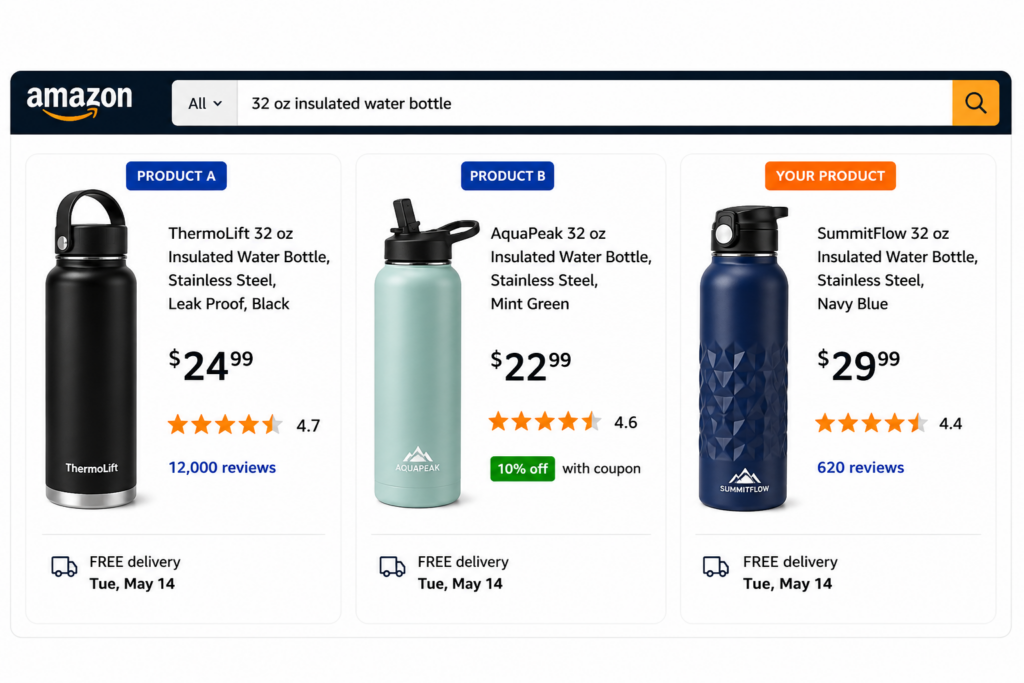
All three may be relevant for the same query. But at this stage, shoppers are not comparing keyword optimization. They are comparing value.
If your bottle costs $5–$7 more, the reason for that premium needs to be obvious. Maybe it offers better insulation, stronger materials, additional lids, a larger accessory bundle, or a feature competitors do not have.
If those advantages are buried halfway down the product page, shoppers may never discover them.
Your SEO problem is no longer a keyword problem. It is a value communication problem.
Win the Click Before You Optimize the Product Page
Before shoppers ever reach your A+ Content, they may already be comparing: Main Image → Price → Rating → Review Count → Coupon → Delivery → Product Positioning
That means CTR optimization begins directly in the search results.
- A better main image may improve attention.
- A coupon may make the offer more attractive.
- A clearer title may communicate differentiation faster.
- A stronger rating may reduce perceived risk.
These are not traditional ‘keyword SEO’ activities, but they can determine whether the visibility you earned turns into meaningful traffic.
Use Reviews to Find Conversion Gaps
Conversion analysis should also continue after the click. Reviews, questions, and returns can reveal what your listing fails to communicate.
Imagine customers repeatedly say: ‘Great backpack, but much smaller than expected.’
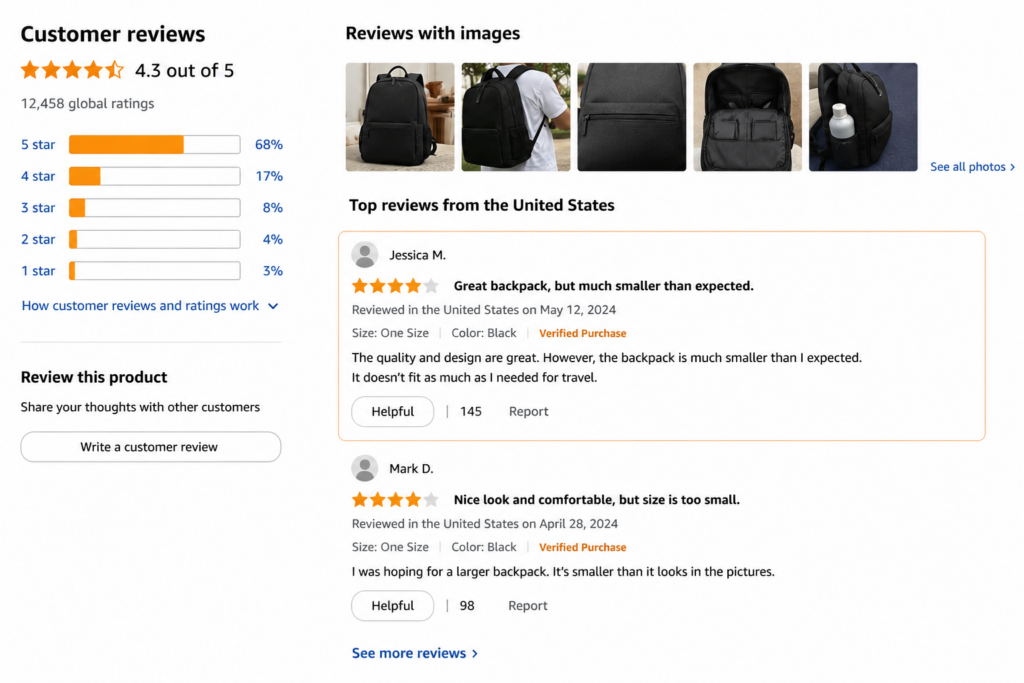
The problem may not be the backpack itself. The product page may simply be setting the wrong expectation.
Adding more keywords will not fix that. Improve the information shoppers need before buying:
- Show exact dimensions
- Add capacity graphics
- Show the backpack beside a person
- Clarify laptop compatibility
- Include packed examples
- Compare sizes visually
Now the listing does a better job of attracting the right shopper, not just more shoppers.
Optimize the Listing for Mobile Shoppers
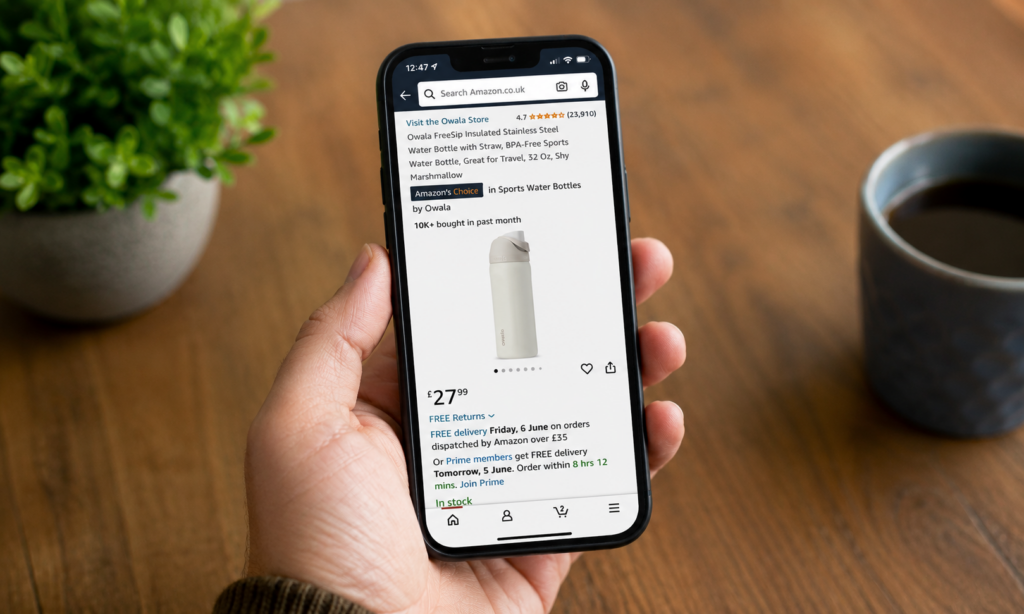
A listing can look excellent on desktop and still lose the sale on mobile.
On a smaller screen, shoppers see less information at once, so the most important details need to work harder. Open your listing on a real phone and ask: What does the shopper understand before they start scrolling?
Make sure the mobile experience quickly communicates:
- Product identity
- Main differentiator
- Price and promotion
- Rating and reviews
- Critical size or compatibility
- Delivery information
- Main image clarity
Keep images easy to read without zooming, make important benefits visible early, and avoid burying essential information deep inside A+ Content.
Mobile optimization is not about shrinking the desktop listing. It is about making the buying decision easier on a smaller screen.
Advanced Amazon SEO is not only about earning visibility. It is about turning the right visibility into qualified clicks, confident purchases, and better customer expectations across both desktop and mobile.
7. Use PPC and A/B Testing as an SEO Strategy
SEO tells you where you want to grow. PPC can help tell you which searches are actually worth growing into.
Organic ranking data can take time to become clear, especially when a listing is still building history. Sponsored Products can give you faster evidence about which search terms attract clicks, convert into sales, and match the product’s real customer intent.
That makes PPC more than an advertising channel.
Finding an Organic Opportunity Through PPC
Imagine a portable coffee maker consistently receives Sponsored Products traffic for: ‘travel coffee maker for camping’
Over time, that query produces:
- Strong CTR
- Strong conversion
- Profitable sales
That is useful evidence. It suggests that shoppers using that search are not only interested in the product—they are willing to buy it.
Now compare that with another keyword that generates plenty of clicks but very few purchases. The second term may have more search volume, but the first one has stronger conversion proof.
That is where PPC can guide SEO.
You can reinforce the proven intent across: Listing Copy → Item Highlights → Images → Attributes → A+ Content
For example, if shoppers searching for a ‘travel coffee maker for camping’ convert well, your listing should clearly communicate the product’s portability, camping suitability, compact dimensions, manual operation, and other genuinely relevant features.
PPC does not guarantee that Amazon will move the ASIN higher organically. But it gives you something much more useful than a guess: evidence that the query matches the product and produces buyers.
Turn PPC Data Into an SEO Feedback Loop
The strongest approach is not: PPC over here. SEO over there. The two should continuously share information.
A simple workflow looks like: PPC Search Term → Conversion Proof → Listing Integration → Organic Opportunity
PPC discovers and validates demand. SEO then uses that insight to strengthen relevance and product positioning.
Organic performance can then show whether the strategy deserves further investment.
That creates a much smarter growth loop than simply adding high-volume keywords to the listing because a research tool suggested them.
A/B Test Content Instead of Debating It
Search-term data can tell you what intent matters. A/B testing can help tell you how to communicate that intent better.
Imagine your team disagrees about the second product image.
Version A – Shows only the portable coffee maker
Version B – Shows the coffee maker with its complete travel accessory bundle.
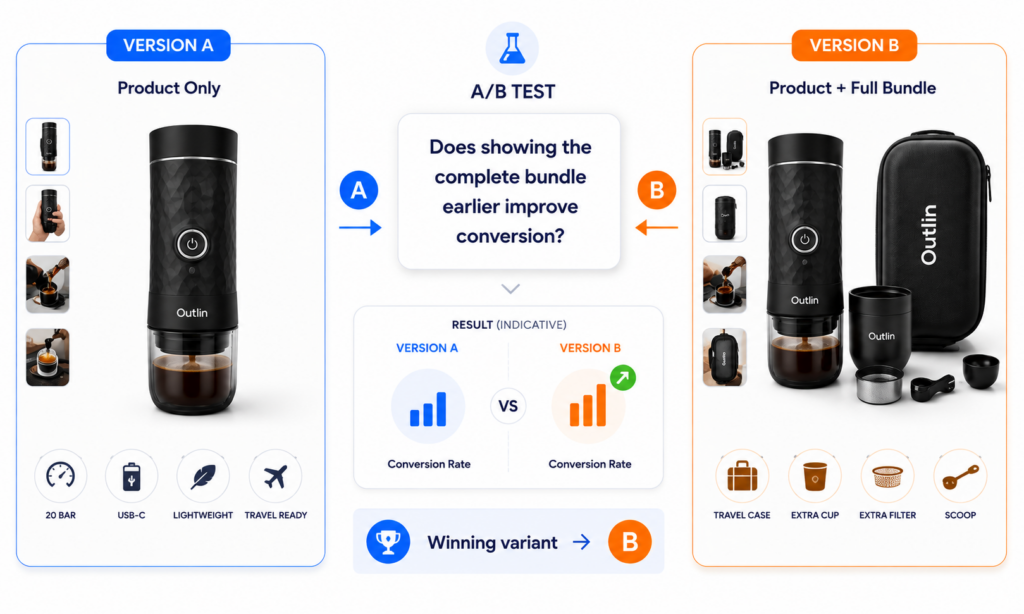
Both ideas sound reasonable.
Instead of deciding based on opinion, test the hypothesis: ‘Does showing the complete accessory bundle earlier increase conversion?’
Amazon’s Manage Your Experiments can help eligible sellers compare different versions of listing content and evaluate which version produces stronger shopper response.
This matters because advanced SEO should not rely on: ‘I think this looks better.’ It should increasingly rely on: ‘The data shows shoppers respond better to this version.’
Advanced Amazon SEO Mistakes That Can Undermine All 7 Strategies
Advanced SEO is not about making the process more complicated. It is about making better decisions with better data.
Avoid these 10 common mistakes:
- Chasing Search Volume Instead of Buyers: A smaller, highly relevant query can be more valuable than a huge generic keyword that attracts the wrong traffic.
- Treating Rank as the Only KPI: Ranking means little if impressions do not turn into clicks, cart adds, and purchases.
- Optimizing Every ASIN for the Same Intent: Give each product a clear role so your own listings do not compete for the same shopper need.
- Copying Competitors Blindly: A competitor may win because of price, reviews, brand strength, or offer quality, not simply because of its keywords or creative.
- Ignoring Structured Product Data: Titles and bullets are only part of SEO. Attributes, compatibility, dimensions, variations, and other catalogue fields also matter.
- Sending Unqualified External Traffic: More visitors do not automatically mean better SEO. Focus on traffic that closely matches the product and is likely to convert.
- Ignoring Reviews and Returns: Customer feedback often exposes unclear sizing, compatibility, benefits, expectations, or missing product information.
- Using AI Without Verification: AI can accelerate research and content development, but specifications, claims, compatibility, certifications, and compliance details still need human validation.
Build an Amazon SEO System That Gets Smarter With Every Sale
Amazon SEO should not stop when you reach page one. That is where the real work begins. The strongest brands keep learning from search data, shopper behaviour, conversion, PPC, competitors, and customer feedback.
At Ecomclips, we connect SEO, PPC, analytics, catalogue management, creative content, and marketplace operations into one growth system. Instead of rewriting a listing every time performance drops, we first find where the funnel is breaking, which queries are losing ground, and what should be tested next.
That is how SEO becomes more than a checklist. It becomes a system that gets smarter with every click, purchase, review, and experiment. The goal is not just to rank higher. It is to give Amazon more reasons to keep showing your product—and shoppers more reasons to keep choosing it.
How Ecomclips Helps Brands Build Stronger Amazon SEO
At Ecomclips, we approach Amazon SEO as a complete growth system—not simply a matter of adding keywords to listings.
Our team combines keyword research, listing optimisation, catalogue management, creative content, PPC insights, and performance analysis to help sellers improve relevance, visibility, shopper engagement, and conversion.
- Advanced Keyword & Search-Query Research: We identify primary, secondary, long-tail, and high-intent search terms while analysing shopper behaviour and query-level performance to find the opportunities that matter most.
- SEO-Optimised Amazon Listings: We optimise Item Names, Item Highlights, bullet points, product descriptions, backend search terms, and other listing fields to strengthen relevance without sacrificing readability or shopper experience.
- Catalogue & Product Data Optimization: We review product types, browse placement, attributes, variations, compatibility, dimensions, materials, and other structured data so Amazon can understand and classify each ASIN more accurately.
- Images & A+ Content Optimisation: We create and improve product images, infographics, lifestyle visuals, comparison content, and A+ Content to communicate important benefits, answer shopper questions, and support conversion.
- SEO + PPC Integration: We use PPC search-term and conversion data to identify proven shopper intent and uncover keywords that can be reinforced through organic listing optimisation.
- Conversion & Funnel Analysis: We analyse impressions, CTR, cart adds, purchases, pricing, reviews, mobile presentation, and other performance signals to identify where shoppers are dropping out and what should be improved first.
- Ongoing SEO Audits & Optimisation: Amazon search behaviour, competition, catalogue data, and customer expectations continue to change. We regularly review listings and performance data to identify new optimisation opportunities and areas that need attention.
Need Help With Your Amazon SEO Strategy?
Whether you need help with keyword research, listing optimisation, catalogue structure, A+ Content, PPC integration, or a complete Amazon SEO audit, the Ecomclips team can help you identify performance gaps and build a strategy around your products, customers, and marketplace goals.
For more practical Amazon and ecommerce guidance, explore the Ecomclips Blog, visit the Ecomclips YouTube channel, or browse additional ecommerce resources on the Boostontime Blog.
Need direct support? Email us at info@ecomclips.com or book an appointment with our ecommerce experts to discuss your Amazon SEO strategy and discover where your listings have the greatest opportunity to improve.