
Amazon or Walmart? Many sellers jump in without understanding which marketplace best suits their product or strategy.
Both platforms offer massive opportunities, but they differ in fees, traffic, competition, fulfillment options, and buyer behavior. Picking the wrong marketplace can cost time, money, and growth potential, even if you have a great product.
To help you make an informed decision, we’ll break down each platform, compare key metrics, and highlight which types of sellers succeed where. By the end, you’ll know whether Amazon, Walmart, or both is the right move for your business.
Table of Contents:
- Marketplace Overview – Amazon vs Walmart
- Fees, Commissions & Profit Margins on Amazon and Walmart
- Traffic, Customer Behavior & Conversion
- Product Listing Optimization & SEO
- Fulfillment & Logistics Comparison
- Advertising & Promotions
- Marketplace Pros & Cons — Which One Wins?
- How to Choose the Right Marketplace: Amazon vs. Walmart
- FAQs — Choosing Between Amazon and Walmart
Marketplace Overview – Amazon vs Walmart
When deciding where to sell, understanding each marketplace’s reach, audience, and logistics is essential.
Amazon is the global eCommerce giant with massive traffic, a diverse customer base, and a robust fulfillment network through FBA (Fulfillment by Amazon). Sellers gain access to millions of buyers, but competition is fierce, and standing out requires optimized listings, reviews, and marketing.
Walmart, while smaller online, is rapidly growing and offers less competition. Walmart Fulfillment Services (WFS) makes shipping and inventory management straightforward, and sellers often benefit from higher visibility for new products. Walmart’s audience is loyal and expects fast, reliable service, but the traffic volume is lower compared to Amazon.
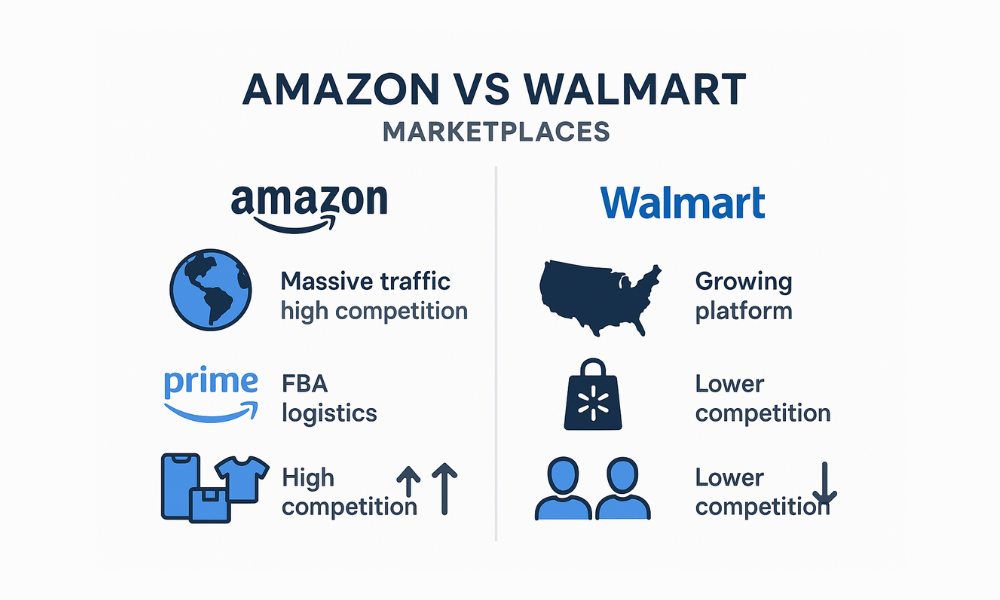
Your choice should consider not just audience size but also competition, fulfillment options, and potential for long-term growth.
| Feature | Walmart | Amazon |
| Fees & Costs | Referral fees per category, generally 6%–20% | Referral fees (6%–45%, most categories 15%)+ FBA/fulfillment fees |
| Entry Requirements | Manual Approval, Documentation Requirements | Requires Application Approval, Easy and Fast |
| Fulfillment Options | Seller-managed or Walmart Fulfillment Services (WFS) | Fulfillment by Amazon (FBA) or seller-fulfilled (FBM) |
| Seller Growth | Less competition, trusted brand, growing audience, lower fees | Massive traffic, higher fees |
| Advertising & Marketing Options | Display Ads, Sponsored ads | Sponsored Products, Sponsored Brands, Coupons, Display Ads |
| Competition & Niche Opportunities | Smaller audience, easier visibility in some niches | Bigger audience, but tougher visibility in some niches |
| Traffic & Market Reach | Growing online platform, lower than Amazon | Largest e-commerce platform with massive traffic |
| Seller Base | Smaller, mostly U.S.-based | Smaller, global-based |
| Global Expansion | Primarily U.S., with limited international reach | Worldwide marketplaces with global selling options |
| Customer Trust | High due to Walmart’s brand reputation | Very high; Amazon Prime membership boosts trust and sales |
Fees, Commissions & Profit Margins on Amazon and Walmart
Understanding costs is crucial before committing to a marketplace, as fees directly impact your profit margins.
Amazon Fees:
- Referral Fees: A percentage of each sale, typically 8–15% depending on the category.
- Subscription Fees: $39.99/month for Professional sellers; Individual sellers pay $0.99 per item sold.
- Fulfillment Fees (FBA): Covers storage, picking, packing, and shipping; varies by size and weight of the product.
- Additional Fees: Long-term storage, removal, and returns processing fees for FBA.
Walmart Fees:
- Referral Fees: Usually 6–15%, depending on category.
- No Monthly Subscription Fee for marketplace sellers.
- Walmart Fulfillment Services (WFS): Fees include storage, fulfillment, and shipping; generally lower than Amazon FBA.
Thinking About Hiring an Expert?
Ecomclips’ Partners Achieve an Average 85% Profit Increase!
Traffic, Customer Behavior & Conversion
Traffic and customer behavior differ greatly between Amazon and Walmart, influencing how quickly your products sell.
Amazon attracts high volumes of shoppers, including Prime members with strong buying intent. This means competition is fierce, and conversions often rely on optimized listings, strong reviews, and competitive pricing. Tracking metrics like impressions, click-through rate (CTR), and conversion rate is essential to understanding performance.
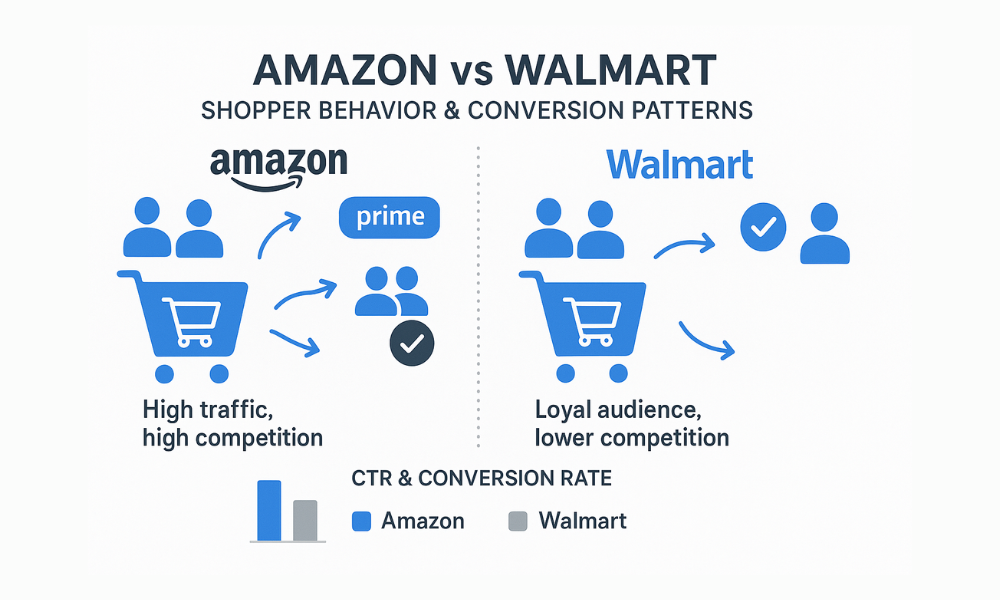
Walmart sees lower traffic, but shoppers are often loyal and less price-sensitive. With fewer competitors, new products may gain visibility faster, though overall sales volume might be smaller than Amazon’s. Conversion still depends on clear product listings, images, and fast shipping through WFS.
Analytics Tip: Monitor CTR, conversion rate, and sales velocity separately for each platform to identify where your efforts yield the highest ROI.
Product Listing Optimization & SEO
Optimizing your product listing is key to visibility and conversions on both marketplaces.
Amazon SEO focuses on placing relevant keywords in your title, bullets, backend search terms, and A+ Content. A strong listing combines keyword optimization with persuasive copy, high-quality images, and a clear value proposition to increase CTR and conversions.
Walmart SEO relies on product title, description, item specifics, and taxonomy. While the principles are similar, Walmart’s algorithm prioritizes relevance and completeness of product data more than keywords alone. Properly structured listings can improve search ranking and visibility faster than Amazon in some categories.
Best SEO practices for both marketplaces:
- Include target keywords naturally.
- Use clear, benefit-driven titles and bullets.
- Add high-quality images and lifestyle visuals.
- Complete all item specifics and taxonomy fields.
Fulfillment & Logistics Comparison
Reliable fulfillment is critical for maintaining customer satisfaction and eligibility for top placement like Amazon’s Buy Box.
Amazon: Sellers can choose FBA (Fulfillment by Amazon) or FBM (Fulfilled by Merchant). FBA handles storage, picking, packing, shipping, and customer service, providing faster delivery and access to Prime shoppers. FBM offers more control but requires efficient logistics to meet Amazon’s shipping standards. Fast and accurate fulfillment directly impacts conversions and search engine rankings.
Walmart: Walmart Fulfillment Services (WFS) offers similar support, including storage, packing, and 2-day shipping expectations. WFS simplifies logistics and ensures consistent delivery times, which is essential for maintaining Walmart’s trust and customer satisfaction.
Quick Insight: Selecting a reliable fulfillment method can significantly impact sales. Slow or inconsistent shipping hurts both conversions and your marketplace reputation.
Advertising & Promotions
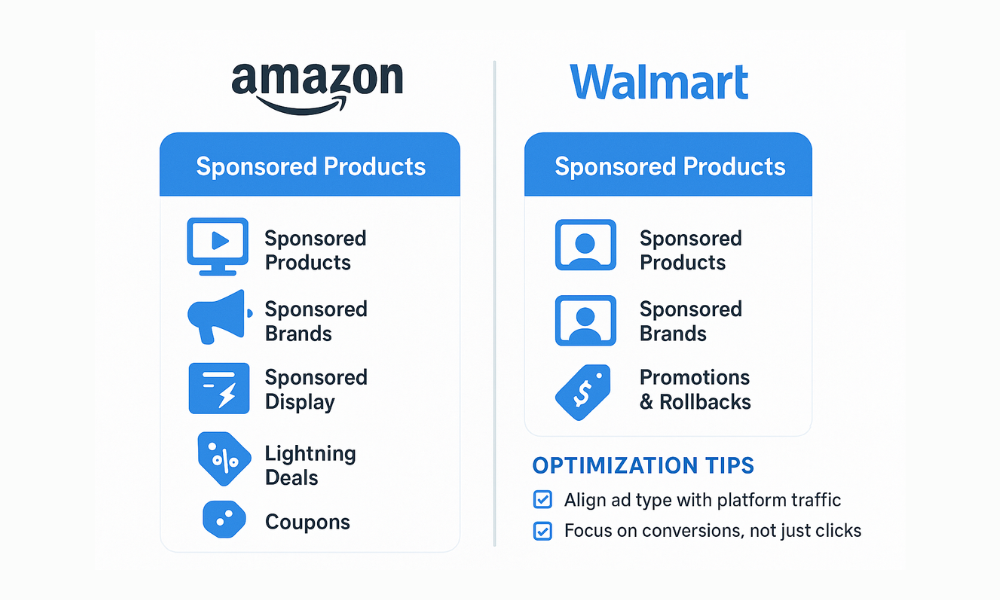
Advertising is essential to boost visibility and drive sales, but each marketplace has its own options and best practices.
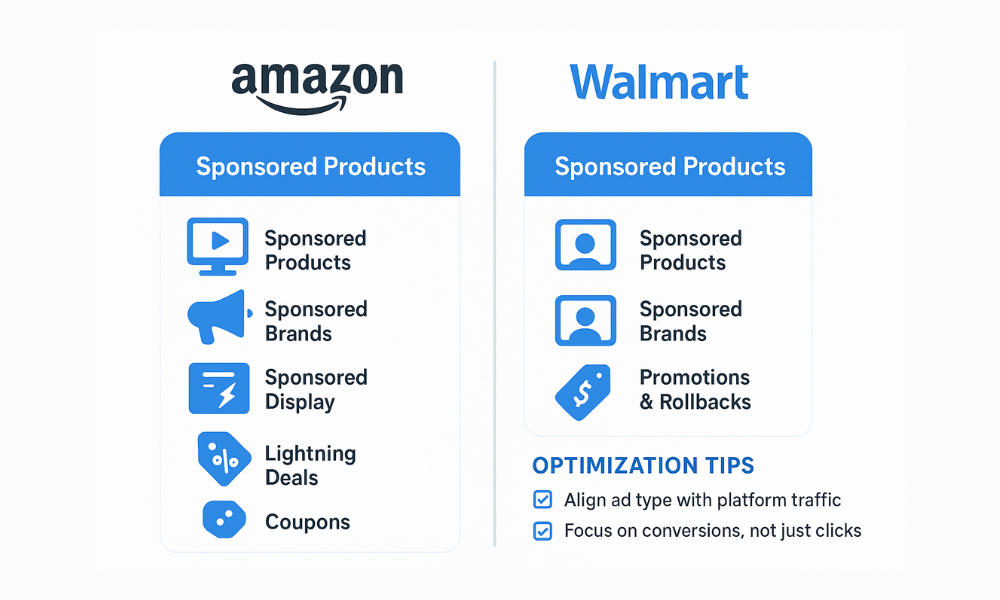
Amazon Ads:
- Sponsored Products: Promote individual listings in search results and product pages.
- Sponsored Brands: Showcase your brand and multiple products with a custom headline.
- Sponsored Display: Target audiences off-Amazon or retarget shoppers who viewed your products.
- Lightning Deals & Coupons: Limited-time discounts to increase conversions during high-traffic periods.
Walmart Ads:
- Sponsored Products: Boost individual product visibility in search and category pages.
- Sponsored Brands: Feature multiple products under a brand (available selectively).
- Promotions & Rollbacks: Offer temporary discounts to attract price-sensitive shoppers and increase conversions.
Align your ad type and spend with platform-specific traffic patterns and focus on conversion metrics rather than just impressions. Test campaigns regularly to see which combination drives the best ROI.
Reviews, Customer Feedback & Trust Signals
Customer feedback plays a pivotal role in building trust and driving conversions on both Amazon and Walmart.
Amazon: Reviews heavily influence search ranking and buying decisions. High ratings, detailed feedback, and quick responses to customer questions enhance credibility. Encourage customers to leave reviews ethically via Follow-Up Emails, Amazon Vine, or the “Request a Review” button.
Walmart: Reviews and Q&A are growing in importance. Shoppers trust detailed reviews and verified purchases. Promptly answering questions and monitoring ratings can improve your product visibility and customer confidence.
Best Practices:
- Respond quickly and professionally to reviews and questions.
- Encourage honest feedback without incentivizing ratings.
- Monitor competitor reviews for insights on product improvements.
- Use AI or analytics tools to track sentiment trends and identify common pain points.
Marketplace Pros & Cons — Which One Wins?
Both Amazon and Walmart have unique strengths and limitations. Choosing the right marketplace depends on your product, audience, and growth goals.
Amazon Pros:
- Massive global traffic and brand recognition.
- Access to Prime shoppers and FBA logistics.
- Advanced advertising tools and analytics.
Amazon Cons:
- Highly competitive with many sellers per category.
- Higher referral fees and fulfillment costs.
- Complex policies and stricter compliance requirements.
Walmart Pros:
- Lower competition in many categories.
- Growing eCommerce platform with loyal Walmart shoppers.
- WFS provides reliable fulfillment with 2-day shipping expectations.
Walmart Cons:
- Smaller audience compared to Amazon.
- Less mature advertising and analytics tools.
- Limited category options and stricter approval processes for some products.
Amazon works best for high-competition niches, global reach, and Prime-centric audiences. Walmart is ideal for sellers seeking lower competition, faster marketplace entry, and strong B2C opportunities.
How to Choose the Right Marketplace: Amazon vs. Walmart
Choosing between Amazon and Walmart isn’t just about fees or traffic — it’s about matching your product, audience, and business goals to the marketplace that will give you the best results. Here’s how to decide wisely:
- Understand Your Audience: Amazon attracts global, price-conscious, and Prime-loyal shoppers, while Walmart appeals to loyal U.S. customers looking for value and reliability.
- Analyze Competition: Amazon is highly competitive, especially in popular categories. Walmart often has lower competition, which can make it easier for new sellers to get visibility.
- Factor in Fulfillment: If fast, reliable shipping matters for your product, Amazon’s FBA and Walmart’s WFS are both strong options, but consider cost, storage limits, and logistics complexity.
- Consider Growth Goals: For long-term global expansion and advanced advertising options, Amazon leads. For a simpler, cost-effective start in the U.S., Walmart can be a better launchpad.
Don’t rush. Start by testing a few products on both platforms, analyze traffic, conversion, and profitability, then scale where your results are strongest.
FAQs — Choosing Between Amazon and Walmart
Q. Which marketplace is better for new sellers, Amazon or Walmart?
For beginners, Walmart can be easier due to lower competition and simpler category entry. Amazon offers more traffic and global reach, but is highly competitive and requires more optimization.
Q. Can I sell on both Amazon and Walmart at the same time?
Yes, many sellers operate on both marketplaces. Start with a few products, analyze performance, and scale on the platform that provides the best ROI while maintaining fulfillment and inventory efficiency.
Q. How do fees differ between Amazon and Walmart?
Amazon charges referral fees (6–45% depending on category), subscription plans ($39.99/month for Professional sellers), and fulfillment fees via FBA. Walmart charges referral fees (6–20%) and offers WFS for fulfillment with associated costs.
Q. Do product listings need to be optimized differently for each marketplace?
Yes. Amazon SEO relies on title keywords, bullets, backend search terms, and A+ content, while Walmart focuses on titles, item specifics, taxonomy, and description. Optimizing for each platform ensures better visibility and conversions.
Q. How important are reviews on Amazon vs Walmart?
Reviews heavily impact Amazon rankings and buyer trust. On Walmart, reviews are growing in influence, and responding to customer Q&A is increasingly important for visibility and credibility.
Q. Which marketplace offers better advertising opportunities?
Amazon provides advanced PPC campaigns, Lightning Deals, and Coupons. Walmart offers Sponsored Products, Promotions, and Rollbacks. Ad strategy should align with platform traffic patterns and seasonal trends.
Choosing the right marketplace can make a huge difference in your eCommerce success. Both Amazon and Walmart offer unique advantages, but the best fit depends on your product, target audience, and business goals.
How Ecomclips Helps You Succeed on Both Marketplaces
At Ecomclips, we help brands navigate the unique challenges of selling on Amazon and Walmart, turning marketplace complexity into growth opportunities. Our full-service approach ensures your products perform at their best on both platforms.
- Account & Catalog Management: We handle setup, variation management, and inventory syncing so your listings stay accurate and optimized across marketplaces.
- Marketplace-Specific Optimization: From Amazon SEO and A+ content to Walmart listing optimization, we tailor your titles, bullet points, images, and backend keywords for each platform’s search algorithm and shopper behavior.
- Advertising & Promotions: Our team manages Sponsored Products, Sponsored Brands, and Walmart Ads, plus coupons and deals, to drive qualified traffic and maximize ROI.
- Performance Monitoring & Analytics: Ecomclips tracks conversions, sales trends, and competitor activity, refining strategies for sustained growth on both marketplaces.
At Ecomclips, we’ve helped countless brands scale efficiently on Amazon and Walmart. Our experts handle every step, from listing optimization and advertising to performance analysis, so you can focus on growing your business.
Contact us today at info@ecomclips.com or book an appointment with our e-commerce experts to start selling smarter on both marketplaces.
Watch how we help new sellers launch successfully:
Your Amazon Listing Isn’t Selling?
Walmart’s ChatGPT Move Just Changed eCommerce Forever
Stop Losing Money! Run #Walmart Ads the Right Way
Rank #1 on Walmart and Boost sales in 2025
The Shady Truth About Amazon Basics
How to Start Selling on Walmart Marketplace in 2025
Ecomclips: Your Complete eCommerce Solution Under One Umbrella
At Ecomclips, we bring every eCommerce service you need under one roof — strategy, operations, design, marketing, and growth, all seamlessly connected to help your brand thrive across every marketplace.
Since 2012, we’ve been helping businesses of all sizes launch, scale, and dominate online. From Amazon, Walmart, eBay, and Etsy to Shopify and WooCommerce, our team of marketplace experts, designers, developers, and marketers works together to deliver measurable results.
Our services span the full eCommerce lifecycle:
- Account Setup & Product Listing Management: We handle registrations, compliance, and product data optimization across all marketplaces.
- Amazon Optimization Service: From keyword-rich titles and A+ content to PPC campaigns and storefront design, we craft listings that convert.
- Creative Design & Content Production: A+ visuals, infographics, brand stores, and product videos built to boost engagement.
- Advertising & PPC Management: Smart, data-driven ad strategies for Amazon, Walmart, and Google that maximize ROI.
- Web Development & Store Design: Shopify, WooCommerce, and Magento websites built for performance and conversion.
- Data Management & Automation: Streamlined product feeds, catalog syncing, and inventory control for effortless scalability.
- Customer Service & Order Fulfillment: End-to-end support that enhances customer satisfaction and builds long-term loyalty.
- Analytics & Growth Strategy: Real-time insights and ongoing optimization to ensure consistent, profitable growth.
Whether you’re launching a new store or managing multiple global marketplaces, Ecomclips acts as your single strategic partner, simplifying complexity and driving sustainable revenue growth.
Ready to Start Growing Your Brand?
Ecomclips’ Partners Achieve an Average 85% Profit Increase!