
If you’ve ever found yourself staring at your Shopify dashboard, wondering why the sales aren’t rolling in, you’re not alone.
Thousands of store owners face the same challenge every single day. The good news? Getting more orders on Shopify isn’t about luck or having a massive marketing budget. It’s about implementing proven strategies that improve user experience, build customer trust, and make buying from your store irresistible.
In this comprehensive guide, we’ll walk you through three powerful strategies to increase Shopify sales, lower bounce rates, and transform casual browsers into loyal customers. Whether you’re just starting out or looking to scale your existing store, these actionable tips will help you boost Shopify conversions and grow your revenue in 2026.
Understanding Why Your Shopify Store Isn’t Getting Orders
Before jumping into fixes, let’s deal with the obvious question no one likes asking.
Why aren’t people buying from your store?
The answer usually isn’t flattering, but it is fixable. Most Shopify stores struggle for the same few reasons. It’s rarely the product. It’s the experience around it.
Common issues we see over and over:
- The site looks outdated or unpolished, which quietly kills trust
- Navigation feels confusing, so visitors leave instead of exploring
- Checkout has too many steps and too much friction
- First-time visitors don’t feel confident enough to pull out their card
When people hesitate, they don’t complain. They just leave. And that’s what makes this frustrating.
The good news is this isn’t a talent problem or a tech problem. Shopify already gives you the tools. You don’t need to be a designer, a developer, or some ecommerce wizard.
You just need to understand one thing: what customers expect when they shop online and make your store meet that expectation.
Once you do that, buying becomes the natural next step instead of a risky decision.
Make An Amazing First Impression to Increase Shopify Sales
Imagine walking into a physical store where shelves are messy, products are scattered everywhere, lighting is terrible, and you can’t find what you’re looking for. What would you do? You’d walk right back out. That’s exactly what happens with your Shopify store when it looks messy, confusing, or boring. Visitors leave, and they leave fast.
Your store needs to look good, not just “okay” but actually good. That first impression is everything. Within seconds of landing on your site, visitors make snap judgments about your credibility, professionalism, and whether they want to do business with you.
Craft a Hero Section That Actually Sells

Your hero section is the first five seconds of judgment. People land on your site and instantly decide if they trust you or if they’re bouncing faster than bad Wi-Fi. Think of it like a storefront on a busy street. You either pull people in, or you don’t.
Start with a strong, simple headline that makes one thing clear: why this store exists and why it matters to them. No clever riddles. No vague brand poetry. Just value.
Then back it up with visuals that look like you know what you’re doing. Low-quality images don’t just look bad; they quietly tell visitors, “this brand might disappear tomorrow.”
Your hero section should include:
- A clear, benefit-driven headline (not a paragraph)
- High-quality product or lifestyle images with good lighting
- One obvious call to action, not five competing buttons
- Plenty of white space so it doesn’t feel crowded
For the CTA, keep it direct and familiar:
- Shop Now
- Get 20% Off Today
- Explore the Collection
That’s it. No essays. People are shopping, not studying for an exam.
Thinking About Hiring an Expert?
Ecomclips’ Partners Achieve an Average 85% Profit Increase!
Choose the Right Shopify Theme to Boost Conversions
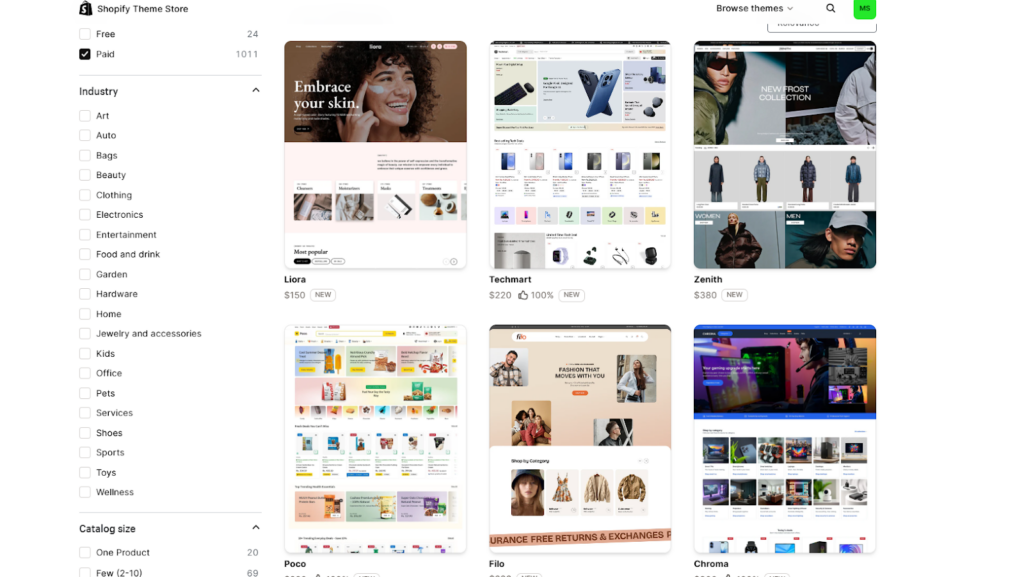
You don’t need to be a designer. Shopify already hired them for you. The Theme Store is full of professionally built themes, and many of them are free and surprisingly powerful.
The key is choosing a theme that fits your product and your audience, not just one that looks cool in the demo.
A clean jewelry brand and a hardcore outdoor gear store should not feel the same. If they do, something went wrong.
When picking a Shopify theme, focus on:
- A layout that matches your product type and brand vibe
- Clean navigation that makes shopping feel effortless
- Customizable colors and fonts for brand consistency
- Built-in mobile responsiveness (this is non-negotiable)
Most of your traffic will come from mobile. If your store looks awkward on a phone, you’re basically asking customers to leave. A good theme should feel smooth, fast, and natural on any screen size.
So the bottom line: pick a theme that makes your products shine, not one that distracts from them. Simple converts. Fancy just looks busy.
Optimize Site Navigation to Keep Visitors Browsing
Getting people to your site is hard. Watching them leave after one page hurts more than it should. Good navigation fixes that.
Your goal is simple: make it easy for visitors to move around without thinking. When people can explore naturally, they stay longer. When they stay longer, buying becomes more likely. That’s just how brains work.
Start by guiding shoppers toward what makes sense next instead of letting them hit a dead end.
Ways to keep visitors exploring:
- Add product carousels that show related or complementary items
- Use “You Might Also Like” sections on product pages
- Highlight best-selling or popular collections in your main menu
- Surface featured categories so customers don’t have to hunt
Good navigation doesn’t just help people find what they came for. It helps them discover things they didn’t even know they wanted.
Breadcrumb navigation is another underrated win. It quietly reassures visitors by showing them where they are and how to go back without frustration. Pair that with a strong search bar that includes autocomplete suggestions, and suddenly your store feels easy instead of overwhelming.
Strong navigation should:
- Reduce clicks, not add them
- Feel intuitive on both desktop and mobile
- Help users recover quickly if they take a wrong turn
- Remove friction at every step
Bottom line: treat your Shopify store like a high-end retail space. Clear paths, smart product placement, and zero confusion. Do that well, and you’re already operating at a level most stores never reach.
Bring Visitors Back With Smart Incentives to Boost Shopify Conversions
Here’s a scenario we’ve all experienced as consumers. You’re browsing an online store, you add something to your cart, and then you leave. Maybe you got distracted by a phone call, maybe you wanted to compare prices, or maybe you were just browsing without serious buying intent. Whatever the reason, you’re gone.
As a store owner, watching potential sales slip away is frustrating. But here’s the good news: you can bring those people back. The secret? Strategic incentives that give hesitant shoppers a compelling reason to complete their purchase.
Capture Emails with First-Time Discount Offers
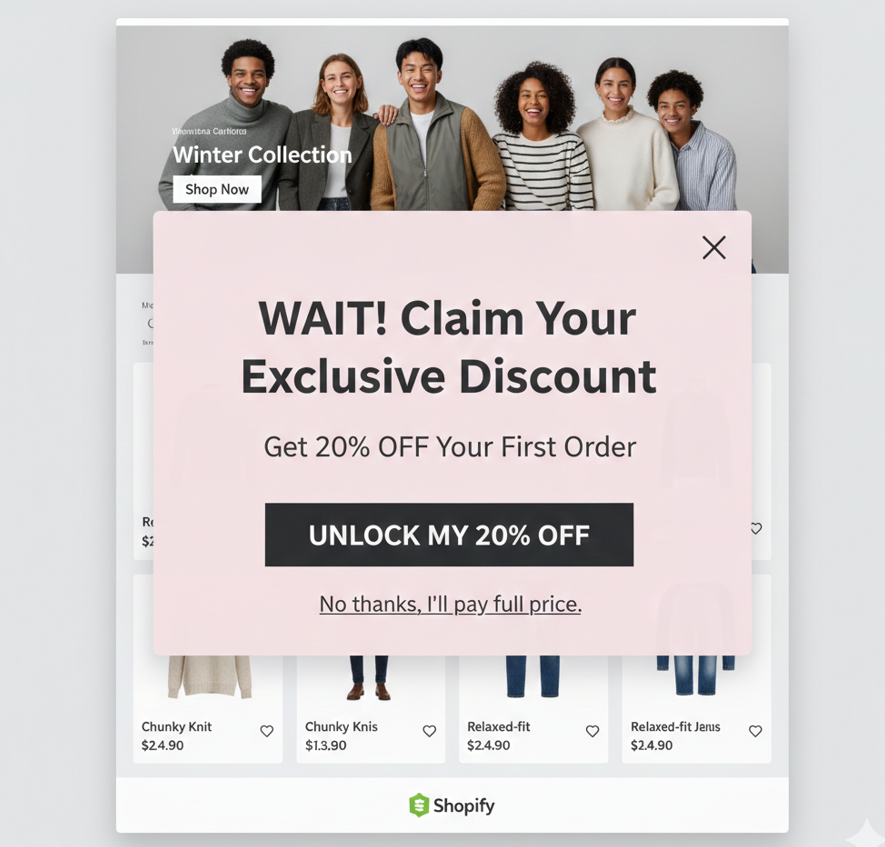
People don’t hate emails. They hate emails with no value. Give them a reason, and they’ll hand over their address without a fight.
If someone is about to leave your store without buying, that’s your moment. Offer a first-time discount or free shipping in exchange for their email. Simple trade. Everyone walks away happy.
From their side, they get instant savings.
From your side, you get a direct line to follow up later. That includes reminders, abandoned cart emails, new drops, and promotions that actually convert.
What works best:
- A clear first-time discount like 10–15% off
- Free shipping offers for hesitant buyers
- Short, friendly copy that feels human
- One simple form, not a mini survey
Exit-intent pop-ups are perfect here. They trigger when someone’s about to leave, not when they just arrived and are still figuring out what you sell.
Timing matters. Don’t ambush visitors the second they land.
Best practice timing:
- Wait 15–30 seconds before showing the pop-up
- Let them browse first so the offer feels helpful, not desperate
A simple message like “Get 10% off your first order before you go” can be the difference between a lost visitor and a future customer.
Optimize Your Checkout to Stop Losing Sales at the Finish Line
Checkout is where good stores quietly lose money. Not because the product is bad, but because the process feels annoying, slow, or slightly untrustworthy.
You’ve already done the hard work. Don’t sabotage yourself at the last step.
How to clean up your checkout:
- Reduce unnecessary steps and form fields
- Enable express checkout options like Shop Pay, Apple Pay, and Google Pay
- Offer multiple payment methods including PayPal and buy-now-pay-later options
- Make the checkout feel fast and secure
Different people pay differently. Limiting payment options is the fastest way to lose a sale you already earned.
Trust matters even more for first-time buyers.
Add trust signals like:
- SSL and secure checkout badges
- Money-back guarantees
- Clear refund and return policies
Small visuals can dramatically lower hesitation. When customers feel safe, they move faster.
Also, be honest about pricing. Nothing kills conversions like surprise shipping costs at the final step.
Smart moves here:
- Show shipping costs early
- Offer free shipping above a certain order value
- Be transparent, always
Recover Lost Sales with Abandoned Cart Emails
Even with a perfect checkout, some people will leave. That’s normal. Ignoring them is optional.
Abandoned cart emails bring back sales that would otherwise disappear forever. And once set up, they work quietly in the background while you focus on growing.
A simple, effective sequence:
- Email 1 (within 1 hour): Friendly reminder with product images and a direct cart link
- Email 2 (after 24 hours): Add a small incentive like free shipping or a light discount
- Email 3 (after 48–72 hours): Use reviews or testimonials to reduce hesitation
Keep the tone helpful, not pushy. You’re reminding, not begging.
The beauty of this system is leverage. Set it once, let automation do the work, and recover revenue while you’re busy doing literally anything else.
Build Trust With Customer Reviews to Boost Shopify Store Credibility
Let me ask you something: when you’re about to buy a product online, what’s one of the first things you do? You check the reviews, right? We all do it.
Reviews are social proof in its purest form. They tell new customers, “Hey, other people bought this and loved it, so you probably will too.” The more reviews you have, the more trust you build. And trust leads directly to more orders on Shopify.
Products with reviews convert at significantly higher rates than products without them. In fact, studies show that displaying reviews can increase conversion rates by up to 270%. That’s not a typo. Reviews are that powerful.
Choose the Right Review App for Your Store
Head to the Shopify App Store and search for review apps. You’ll find dozens of options with different features and pricing models. Popular choices include Judge.me, Loox, Yotpo, and Stamped.io.
Many offer free plans or free trials, so you can test them without financial commitment. Look for apps that allow photo reviews, where customers can upload images of themselves using your products. These visual testimonials are incredibly persuasive because they show real people enjoying real results.
Choose an app that integrates seamlessly with your theme and offers customization options to match your brand aesthetic. The review widget should look like a natural part of your store, not a clunky add-on.
Incentivize Customers to Leave Reviews
Here’s the truth: people are busy. They’re not going to leave a review just because you asked nicely. But if you offer them something in return—like a discount code for their next purchase or entry into a monthly giveaway—they’re much more likely to take five minutes to share their experience.
Set up automated email sequences that reach out to customers 7-14 days after their purchase. This timing is perfect because they’ve received their order and had time to use it, but the experience is still fresh enough to remember details.
Make the review process as frictionless as possible. Include a direct link that takes them straight to the review form with their purchase information pre-populated. The fewer steps required, the more reviews you’ll collect.
Consider implementing a tiered incentive system where customers who leave photo reviews or detailed written reviews receive better rewards than those who just leave star ratings. This encourages higher quality reviews that provide more value to future shoppers.
Showcase Reviews Throughout Your Marketing
Don’t just hide reviews on your product pages. Share them everywhere your audience spends time—Instagram, Facebook, TikTok, email newsletters, and even in your advertising campaigns.
Create social media graphics featuring glowing customer testimonials. Film video testimonials if customers are willing. These authentic endorsements are marketing gold because they come from real people, not your brand.
Feature your best reviews prominently on your homepage. Create a dedicated testimonials page that showcases customer success stories. The more visibility you give to positive reviews, the more new customers will trust your brand.
Reviews also provide valuable feedback for improving your products and customer service. Pay attention to recurring complaints or suggestions. Addressing these issues shows customers you’re listening and continuously improving, which builds even more trust and loyalty.
Leverage Shopify Apps to Streamline Your Store Operations
You don’t have to do everything manually. The Shopify App Store contains hundreds of applications designed to automate tasks, improve your marketing, and help you manage your store far more efficiently.
Some apps are completely free, while others operate on freemium models or require monthly subscriptions. The investment is often worth it when you consider the time saved and revenue generated.
Essential Shopify Apps for Increasing Sales
Shopify Email is perfect for email marketing campaigns without leaving the Shopify ecosystem. Create newsletters, promotional campaigns, and automated sequences that drive repeat purchases.
Privy excels at pop-ups and lead capture, helping you build your email list with sophisticated targeting and exit-intent technology.
Judge.me offers comprehensive product review functionality with photo reviews, review request automation, and beautiful display widgets.
Reconvert specializes in post-purchase upselling, presenting customers with relevant product recommendations immediately after they complete a purchase when they’re most receptive to buying more.
Kit automates marketing tasks like creating Facebook ads, sending abandoned cart emails, and posting to social media, essentially giving you a virtual marketing assistant.
Apps for Enhanced Customer Experience
Consider apps that add live chat functionality, allowing you to answer customer questions in real-time and overcome objections before they result in abandoned carts. Apps like Tidio or Gorgias integrate seamlessly with Shopify and can significantly improve conversion rates.
Inventory management apps help you avoid overselling products and keep stock levels accurate across multiple sales channels. This prevents the embarrassing situation of taking orders for products you can’t fulfill.
Bundle and discount apps allow you to create compelling offers like “buy two get one free” or product bundles at reduced prices. These promotions increase average order value and move inventory faster.
At Ecomclips, we help clients identify and implement the right combination of apps for their specific business needs, ensuring technology enhances rather than complicates their operations.
Advanced Strategies to Get More Orders on Shopify
Once you’ve mastered the fundamentals, consider these advanced tactics to take your Shopify store to the next level.
Implement Scarcity and Urgency Tactics
Humans are psychologically wired to want things that are scarce or time-limited. Use this to your advantage with countdown timers for limited-time offers, low stock notifications that appear when inventory is running low, and exclusive deals for email subscribers.
These tactics work because they trigger fear of missing out (FOMO), compelling people to make purchase decisions faster rather than endlessly deliberating. Just ensure your scarcity and urgency claims are genuine. Fake countdown timers that reset daily destroy trust and damage your brand reputation.
Optimize Product Descriptions for Conversions and SEO
Your product descriptions should do two things simultaneously: convince humans to buy and help search engines understand and rank your products.
Write compelling copy that focuses on benefits rather than just features. Instead of “stainless steel water bottle,” describe how it “keeps drinks ice-cold for 24 hours, perfect for long hikes or hot summer days.”
Include relevant keywords naturally throughout your descriptions to improve organic search visibility. Use your main keyword in the product title, at least once in the description, and in alt text for product images.
Break up text with bullet points highlighting key features and benefits. Most people scan rather than read word-for-word, so make it easy to quickly grasp why your product is worth buying.
Create a Content Marketing Strategy
Starting a blog on your Shopify store accomplishes multiple goals. It provides value to your audience through helpful content, improves your SEO performance by targeting relevant keywords, and positions you as an authority in your niche.
Write how-to guides, buying guides, product comparisons, and industry news related to your products. This content attracts organic traffic from people searching for information, then converts some percentage into customers.
Repurpose this content across social media, email newsletters, and video platforms to maximize its value. A single blog post can become an Instagram carousel, a YouTube video, an email series, and multiple social media posts.
Implement Retargeting Campaigns
Not everyone who visits your store will buy on their first visit. Retargeting allows you to show ads to people who’ve already interacted with your site, keeping your brand top-of-mind and bringing them back to complete their purchase.
Facebook and Instagram retargeting campaigns can be incredibly effective for Shopify stores. Show people ads featuring the exact products they viewed but didn’t purchase. Offer a small discount to incentivize their return.
Google Shopping ads work beautifully for retargeting as well, displaying your products to previous visitors as they browse other websites across the internet.
The key to successful retargeting is frequency capping—showing your ads enough to stay memorable without becoming annoying. Bombarding people with dozens of ads daily is counterproductive and wastes your ad budget.
Frequently Asked Questions About Getting More Shopify Orders
What is the time spent on boosting orders in Shopify?
It relies on your traffic, product, and your change of heart. Minor tweaks, such as optimization of the checkout, can give results within days, whereas SEO and trust-building typically take weeks. In the case of most stores, there is a noticeable improvement between 30 and 60 days provided the store works regularly.
How many conversions can be good in a Shopify store?
An average Shopify shop converts at approximately 1.4-2%. Good stores are typically placed between 3-5 percent, depending on the niche, and the quality of the traffic. Anything less than 1 percent is an indication that there is a broken or unintelligible thing to the customers.
Should I use paid advertising to acquire more Shopify orders?
Paid advertising will make you grow more rapidly, and it is not compulsory. Most of the stores grow using SEO, email, social media, and referrals. Advertisements are effective once your shop has been streamlined to sell.
What role does product photos play on Shopify sales?
Image of the product is a make-or-buy. Images are the basis of quality, size, and trust that customers are looking at, hence bad photos kill sales. Images taken in various angles in a clear and well lit image virtually always increase conversions.
Should I provide free shipping to make more orders?
Free shipping works better than most discounts in increasing conversions. One of them is to sell it at a minimum order value to defend margins. Shipping costs are quietly charged in price by many of the brands and the message of free shipping is marketed in the beginning.
What are the ways of minimizing cart abandonment in my Shopify store?
Make check out easy and open. Display shipping fees, enable guest check out, provide a variety of payment methods and send abandoned cart emails. Even tiny trust indications are able to restore a staggering number of lost orders.
How to get the customer reviews on a new Shopify store?
Begin with initial clients, friends or influencers who will be able to leave unbiased comments. Free gifts, offers, or discounts are effective when applied in an ethical manner. In case you have sold elsewhere previously, the importation of past reviews promotes an immediate trust.
Should I refresh my design of a Shopify store regularly?
Constant redesigns are not required. Performance review after every few months and strengthen weak areas. Complete redesigning after every 2-3 years is typically sufficient in case of regular optimization.
Conclusion: Your Action Plan for More Shopify Orders
And receiving more orders in Shopify is not a matter of making one magic trick or a loophole. It is about always implementing winning strategies that will enhance your customer experience thereby creating trust and eliminating friction in the process of buying products.
Begin with what you think in the first impression. Check with new eyes your home page and product pages. Is your store professional and trustworthy? Is navigation intuitive? Does your hero section make your value proposition clear? Create an appropriate design and user experience before you develop other parts since all other things are based on this.
Second, use intelligent incentives and streamline your check-in procedure. Automatically collect emails with first-time discount offers through exit-intent pop-ups. Make your check out as streamlined as possible.
Include money transfer and various payment methods. Establish the email sequences of abandoned carts so as to recapture lost sales by default.
Then continue to develop customer reviews as a way of building credibility. Install a review app, encourage your customers to leave feedback, and display the reviews in the course of your marketing. One of the strongest and the most powerful conversion tools is social proof, and it is very cheap to adopt.
Lastly, take a break and use the strength of Shopify applications to automate the most common work and improve the functionality of your store. There are preexisting solutions that have proven to work; thus there is no need to build something from nothing. The correct mix of the apps can save you a priceless amount of time as well as enhancing the customer experience and boosting the sales.
It should be remembered that e-commerce is a marathon game and not a sprint game. These are strategies to be systematically used, measure, and constantly improve on the data. Minor adjustments gain momentum to make bad stores profitable businesses.
It is not whether these strategies are effective, but they are in the case of thousands of thriving Shopify sellers. The issue is, do you implement them in the right number of occasions to achieve it. Use one approach today, and get it under control, and then set on to the next approach.
You will be glad your future self will be able to receive those order notifications as they come.
How Ecomclips Helps You Fix What’s Holding Your Store Back
When sales aren’t moving and conversion rates refuse to behave, guessing becomes expensive. One wrong tweak to your store can stall growth for months. That’s usually the moment store owners realize they don’t need more apps. They need a strategy.
That’s where Ecomclips comes in, not as a vendor, but as a long-term growth partner.
We’ve helped hundreds of Shopify stores increase conversions and revenue. Sometimes the fix is simple, like cleaning up a confusing product page. Other times it’s a full-scale overhaul across design, messaging, and marketing channels. We’ve done both, repeatedly, across nearly every niche you can think of.
What we actually help with:
- Turning confusing store layouts into clean, conversion-focused experiences
- Identifying which Shopify apps are worth the cost and which quietly drain profit
- Designing product pages that build trust and trigger buying decisions
- Aligning branding, UX, and marketing into one cohesive system
Most stores fail because they treat optimization like a checklist. We don’t. We look at your store as a connected ecosystem where design, copy, pricing, traffic, and trust signals all work together.
And we don’t disappear after setup.
Our ongoing approach includes:
- Continuous performance monitoring
- A/B testing to validate changes before scaling
- Data-driven decisions instead of opinions
- Monthly optimization based on real customer behavior
Whether you’re launching your first Shopify store or trying to push an existing brand toward seven figures, Ecomclips brings clarity to chaos. We help you understand what matters, what doesn’t, and how to unlock the full potential of the platform without wasting time or money.
No shortcuts. No guesswork. Just systems that actually move numbers.
Ecomclips: Your Complete eCommerce Solution Under One Umbrella
At Ecomclips, we bring every eCommerce service you need under one roof—strategy, operations, design, marketing, and growth, all seamlessly connected to help your brand thrive across every marketplace.
Since 2012, we’ve been helping businesses of all sizes launch, scale, and dominate online. From Amazon, Walmart, eBay, and Etsy to Shopify and WooCommerce, our team of marketplace experts, designers, developers, and marketers works together to deliver measurable results.
Our services span the full eCommerce lifecycle:
Account Setup & Product Listing Management: We handle registrations, compliance, and product data optimization across all marketplaces.
Amazon Optimization Service: From keyword-rich titles and A+ content to PPC campaigns and storefront design, we craft listings that convert.
Creative Design & Content Production: A+ visuals, infographics, brand stores, and product videos built to boost engagement.
Advertising & PPC Management: Smart, data-driven ad strategies for Amazon, Walmart, and Google that maximize ROI.
Web Development & Store Design: Shopify, WooCommerce, and Magento websites built for performance and conversion.
Data Management & Automation: Streamlined product feeds, catalog syncing, and inventory control for effortless scalability.
Customer Service & Order Fulfillment: End-to-end support that enhances customer satisfaction and builds long-term loyalty.
Analytics & Growth Strategy: Real-time insights and ongoing optimization to ensure consistent, profitable growth.
Whether you’re launching a new store or managing multiple global marketplaces, Ecomclips acts as your single strategic partner, simplifying complexity and driving sustainable revenue growth.
Ready to Start Growing Your Brand?
Ecomclips’ Partners Achieve an Average 85% Profit Increase!