

If you think your Amazon listing is the only thing Amazon checks before deciding whether to suppress, flag, or even shut down your product, you’re already at risk.
Because in 2026, Amazon’s AI doesn’t just read your listing, it scans your entire online footprint.
Your Shopify product page, your Facebook ads, your influencer posts, your brand website, even old PDFs or blog descriptions you forgot existed, Amazon’s AI is watching all of it.
And here’s the scary part:
If anything you publish online contradicts your Amazon listing, even by accident, Amazon assumes your website is the “real truth,” not your listing. That single mismatch can trigger:
- Automated listing suppressions
- Misleading claims flags
- Product detail change rejections
- Brand trust warnings
- In severe cases, account-level investigations
Most sellers get blindsided because they don’t even know what Amazon is comparing their listings against. They keep selling as usual until one morning, a top-selling ASIN is suddenly suppressed with a vague “product information conflict.”
So let’s break down how Amazon monitors your website and social pages, and what you must do right now to stay safe.
Table of Contents:
| 1. Why Amazon’s AI Reads Your Website & Social Pages |
| 2. How Amazon Uses Off-Amazon Data in Its Algorithm |
| 3. Off-Amazon Red Flags That Can Hurt Your Amazon Account |
| 4. What Amazon’s AI Considers “High-Risk Content” and Why It Flags Sellers |
| 5. Why Amazon’s AI Moves So Aggressively |
| 6. How Your Website Content Can Trigger Listing Suppressions |
| 7. How to Ensure Your Website and Amazon Listing Match |
| 8. What Sellers Should Do Immediately After Finding Inconsistencies |
| 9. Common Mistakes Sellers Make That Amazon AI Never Misses |
Why Amazon’s AI Reads Your Website & Social Pages
Amazon doesn’t scan your website out of curiosity; it does it to protect itself. In 2026, Amazon’s marketplace is powered by AI systems that rely on accurate, trustworthy product data. If sellers provide misleading, incomplete, or inconsistent information, Amazon takes the hit: customer complaints, returns, legal risk, and damaged trust.

So Amazon’s AI now verifies everything you publish online to ensure your Amazon listing is truthful.
Here’s why Amazon reads your off-platform content:
1. Amazon Needs Accurate Data for Search, Rufus, and Ads: Amazon’s AI models — including the Rufus shopping assistant — depend on reliable product details to answer customer questions.
If your Amazon listing says “water-resistant,” but your website says “waterproof,” the AI treats it as a potential compliance problem.
2. Inconsistencies Are Treated as Red Flags: Even small contradictions can trigger warnings:
- Different product dimensions
- Conlicting materials
- Claims allowed on your website, but not allowed on Amazon
- Different usage instructions or warnings
AI automatically flags these mismatches before humans ever touch the file.
3. Cross-Checking Is Now Standard in 2026: This isn’t a rare risk — it’s the new normal. Amazon’s systems routinely scan:
- Shopify and WooCommerce sites
- Social media pages
- Blog posts
- Influencer content
- Product PDFs
- Brand portals and landing pages
- Google-indexed product information
If Amazon finds conflict, the assumption is simple: Your website is your “most honest version” — so Amazon trusts it more.
How Amazon Uses Off-Amazon Data in Its Algorithm
Most sellers think Amazon judges them only by what happens inside Seller Central, but that is no longer true. Amazon’s AI scans your entire digital footprint, gathering information from your website, social posts, landing pages, and even ads you run outside the platform. Every piece of content you publish becomes a signal that influences your ranking, product visibility, and even your compliance risk.
If Amazon’s AI detects conflicting product details, unrealistic claims, outdated pricing, or any hint of policy violations on your external pages, it can quietly downgrade your listings. In severe cases, it may flag your ASIN for review or restrict your advertising without warning. The scary part is that most sellers never know this is happening. They simply see their ranking drop, their ads struggle to spend, and their sales decline week after week.
Amazon uses this external data to validate your listing accuracy, verify authenticity, and confirm product safety. If your off-Amazon content says one thing and your listing says another, the algorithm assumes the listing is untrustworthy and pushes you down the search results.
Amazon’s AI is not only reading your content, but it is also scoring you based on it. And those scores can either protect your business or quietly destroy your momentum.
Thinking About Hiring an Amazon Expert?
Ecomclips’ Partners Achieve an Average 85% Profit Increase!
Off-Amazon Red Flags That Can Hurt Your Amazon Account
Most sellers don’t realize the biggest threats to their Amazon business aren’t hiding inside Seller Central; they’re sitting quietly on their own website, social media posts, ads, and landing pages. Amazon’s AI constantly scans the internet, and when it finds contradictions or risky claims, it assumes your Amazon listing is untrustworthy.
One wrong sentence outside Amazon can cause listing suppression, ad throttling, or even an account-level review.
Here are the most dangerous off-Amazon red flags Amazon’s AI actively monitors:
1. Conflicting Product Details Across Platforms
If your website says one thing and your Amazon listing says another, Amazon assumes the listing is inaccurate.
- Impact: Lower ranking, suppressed variations, or forced listing edits.
2. Medical or Unsupported Claims
Statements like “treats,” “heals,” “guaranteed results,” “FDA approved,” or medical promises on social posts or landing pages are instant compliance triggers.
- Impact: AI flags the ASIN for violation, leading to restriction.
3. Price Mismatch Between Your Website & Amazon
If your website displays a price lower than Amazon’s, the system assumes price manipulation.
- Impact: Loss of the Buy Box and reduced visibility.
4. Misleading Marketing Claims
Influencer content, ads, or product videos that exaggerate benefits will be connected to your brand identity.
- Impact: Listing trust drops, and ads slow down.
5. Low-Quality or Inconsistent Product Images
If your off-Amazon images look cheaper, unclear, or different from your Amazon listing, AI may assume the product is misrepresented.
- Impact: Reduced ad impressions and lower search visibility.
6. Contradicting Safety Information
Ingredients, materials, or specs that differ between platforms raise safety concerns.
- Impact: Immediate safety review or ASIN suspension.
7. Negative External Customer Feedback
AI scans complaints on forums, social channels, and review sites.
- Impact: Your “product risk score” increases, affecting ads and ranking.
What Amazon’s AI Considers “High-Risk Content” and Why It Flags Sellers
Amazon’s AI isn’t just looking for mistakes; it is actively hunting for risk signals that suggest a product could mislead customers, violate policies, or harm buyers. In 2025, Amazon’s compliance algorithms are stricter, faster, and far more unforgiving than most sellers realize. Even a single risky claim on your website or social media can trigger an instant review, before you ever see a warning in Seller Central.
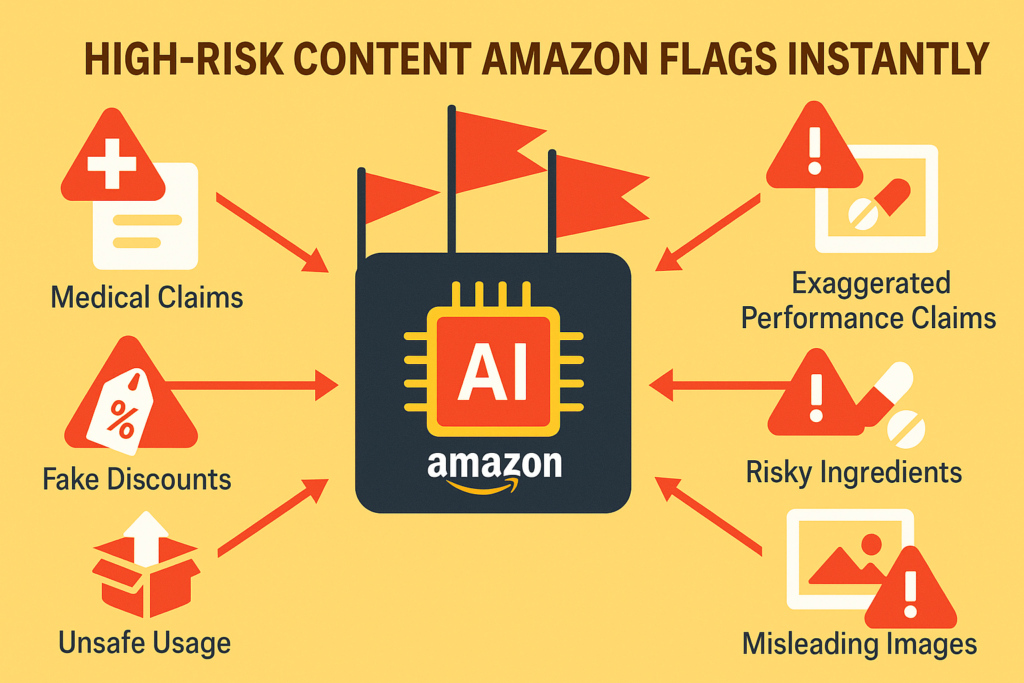
Here is the type of content Amazon’s AI classifies as high risk, and why it reacts so aggressively:
1. Medical, Health, or Curative Claims
Words like treats, cures, heals, prevents, reduces symptoms, FDA FDA-approved immediately raise red flags, even if the claims appear on Amazon.
- Why it’s flagged: AI assumes you are making unverified or illegal health claims, which threatens customer safety.
2. Unsupported Performance Guarantees
Statements such as 100 percent guaranteed, works instantly, fastest results, or lifetime protection are treated as misleading unless proven.
- Why it’s flagged: Amazon interprets these claims as exaggerations with no scientific evidence.
3. Overly Aggressive Marketing Language
Phrases like best in the world, #1 on the market, or clinically proven (without proof) make AI question your product accuracy.
- Why it’s flagged: AI considers this deceptive to customers unless backed by certifications.
4. High-Risk Ingredients or Materials
If your website lists ingredients or materials that are restricted in certain categories, Amazon flags the ASIN automatically.
- Why it’s flagged: AI must enforce global safety and compliance standards.
5. Safety Risks or Missing Warnings
If your website lacks mandatory warnings for categories like supplements, electronics, kids’ products, or cosmetics, Amazon sees it as a compliance gap.
- Why it’s flagged: Missing safety information is considered a threat to buyers.
6. Misleading Images or Visual Claims
Lifestyle images that show results that are too perfect, before/after comparisons, or unsafe product usage are high-risk.
- Why it’s flagged: AI scans visual content and compares it to Amazon’s strict image rules.
7. Unrealistic Discounts or Manipulative Pricing
“Was $199, now $29,” or fake discount banners on your website trigger pricing manipulation alerts.
- Why it’s flagged: Amazon assumes you are misleading customers on value or MSRP.
Why Amazon’s AI Moves So Aggressively
Amazon is legally responsible for protecting buyers. AI is faster at detecting inconsistencies than human moderators. Off-Amazon data is now treated as your “true” brand position.
If your external content is risky, Amazon assumes your listing is risky too. Even if the content lives on your own website or an influencer’s post, Amazon’s AI links it back to your brand — and punishes you inside Seller Central.
How Your Website Content Can Trigger Listing Suppressions
Most sellers think listing suppressions happen only because of something they changed inside Seller Central, but that hasn’t been true since Amazon’s 2024–2025 AI compliance update. Today, Amazon’s systems automatically cross-check your Amazon listing against your website, social media content, landing pages, and even ad creatives. If anything outside Amazon contradicts or violates Amazon’s policies, your ASIN can be suppressed instantly and without warning.
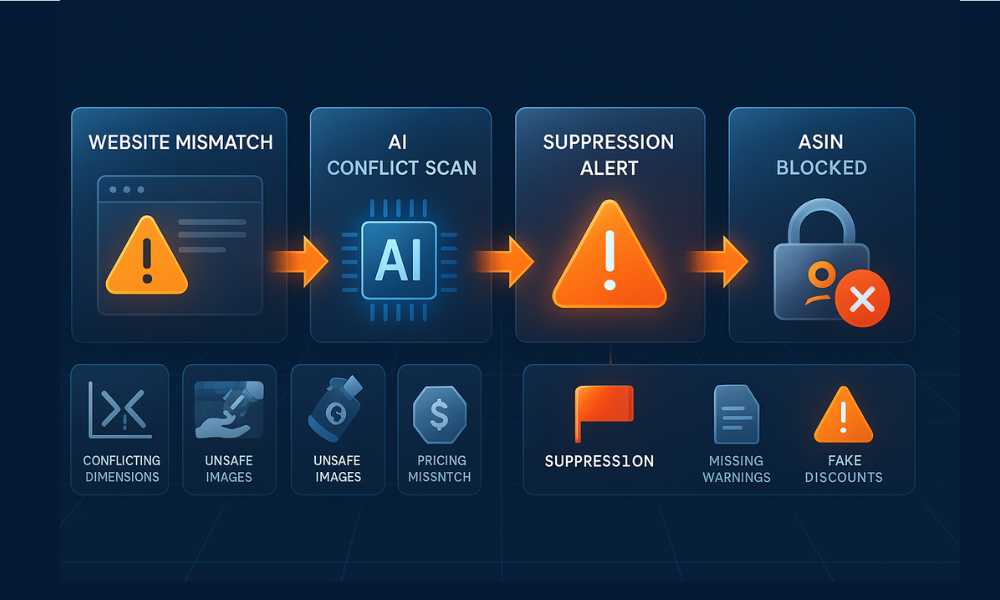
Here’s how your own website can quietly trigger a suppression — even when your Amazon listing is perfectly clean.
1. Your Website Contains Claims That Amazon Doesn’t Allow: If your site mentions things like:
- curing pain
- eliminating anxiety
- boosting immunity
- medical or therapeutic benefits
Amazon’s AI treats this as proof that your brand makes unverified or prohibited claims, even if your Amazon listing avoids them.
Result: Auto-suppression for “potentially harmful or unsubstantiated claims.”
2. Your Website Lists Different Specs, Sizes, or Materials: If the product dimensions, ingredients, materials, or usage instructions differ from your Amazon listing, the AI flags it as misrepresentation.
Example:
- Amazon listing says “BPA-free.”
- Your website says “BPA/Phthalate-free, FDA-grade materials.”
Result: Suppression for “inconsistent detail page information.”
3. Images on Your Website Violate Amazon’s Image Policies: Even if your Amazon images follow the rules, your website images might show:
- unsafe product usage
- results that look exaggerated
- before/after comparisons
- minors using adult products
- added graphics, stamps, or unapproved badges
Amazon’s AI scans your off-Amazon visuals and connects them to your ASIN.
Result: Suppression for “non-compliant imagery.”
4. Guarantees or Warranty Claims Don’t Match: If your website says “lifetime warranty” but your Amazon listing says “1-year warranty,” AI marks the product as misleading.
Result: Suppression for “inaccurate warranty or guarantee information.”
5. Pricing on Your Website Conflicts With Pricing on Amazon: Large differences between website price and Amazon price can trigger alerts for:
- pricing manipulation
- inflated value representation
- deceptive discounting
Result: Suppression for “high-risk pricing behavior.”
6. Aggressive Marketing Language Appears Only on Your Website: Words like “best,” “number one,” “fastest results,” or “clinically proven” without proof get attached to your product identity even if you never added them to Amazon.
Result: Suppression for “potential misinformation.”
7. Missing Safety Warnings or Required Disclosures: If your website lacks warnings required for your product category, even though your Amazon listing contains them, Amazon sees you as non-compliant.
Result: Suppression for “insufficient safety information.”
Amazon trusts your website more than your listing; your site now functions as the “source of truth.” If Amazon finds a single contradiction, the listing is suppressed first and investigated later.
How to Ensure Your Website and Amazon Listing Match
With Amazon’s AI scanning everything from your website to social media, consistency is no longer optional — it’s essential. Even small discrepancies can trigger listing suppressions, reduce visibility, or flag your account for review. Ensuring your website and Amazon listing match is now a critical part of staying compliant and competitive.
Here’s how to get it right:
1. Align Titles, Specs, and Product Benefits
Make sure your product title, specifications, and key benefits are identical on your Amazon listing and website. Avoid adding extra claims or exaggerated language on your site that isn’t in your Amazon listing.
2. Create a Single Source of Truth
Maintain a master document for all product information: dimensions, materials, claims, certifications, warranty, and safety warnings. Any updates should flow from this document to both your Amazon listing and website.
3. Sync Updates Quickly
Once you update your Amazon listing, update your website within 48 hours. If your content changes slowly or inconsistently, Amazon AI may catch mismatches during its next scan.
4. Standardize Images Across Platforms
Ensure product images, lifestyle shots, and infographics match your Amazon listing. Avoid using unauthorized edits, overlays, or claims in website images that differ from Amazon-approved visuals.
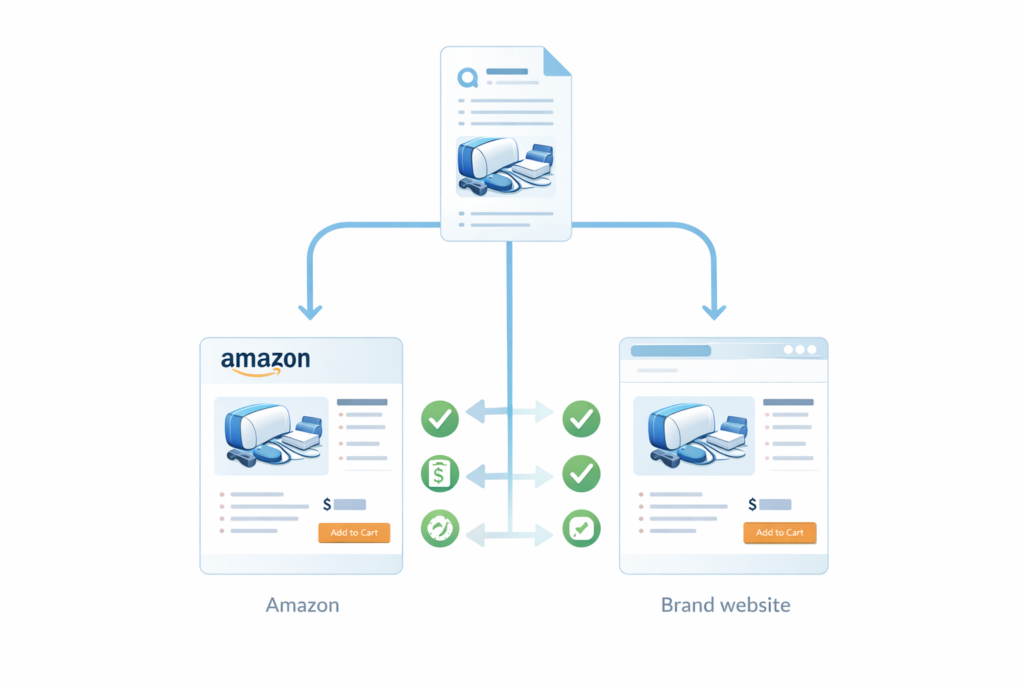
5. Check Compliance Language
Confirm that all warnings, disclaimers, and legal requirements are identical across both platforms.
Any missing information on your website can create an automatic red flag.
6. Maintain Consistent Pricing
Keep your website price aligned with your Amazon listing. Avoid fake discounts, misleading promotions, or mismatched pricing that could trigger AI alerts.
Checklist to Ensure Match:
- Titles and descriptions match
- Specs, materials, and dimensions match
- Images are identical or compliant
- Safety warnings and certifications match
- Pricing is consistent
- Updates propagate within 48 hours
Pro Tip: Think of your website as Amazon’s reference copy. If it doesn’t match your listing perfectly, GEO and AI scanning will penalize your product’s visibility and may even suppress it entirely.
What Sellers Should Do Immediately After Finding Inconsistencies
Once you discover discrepancies between your Amazon listing and your website, or any off-Amazon content, it’s critical to act fast. Amazon’s AI doesn’t wait, and even a small inconsistency can trigger listing suppression, reduce ranking, or flag your account. The sooner you fix issues, the lower your risk of penalties.
Here’s a step-by-step approach to handling inconsistencies efficiently:
1. Identify Conflicting Claims
- Audit your product titles, specifications, images, claims, and pricing across all channels.
- Look for mismatched dimensions, materials, guarantees, or safety warnings.
- Highlight anything that could contradict your Amazon listing.
2. Fix Your Website First
- Correct any conflicting information on your website, social media, and ads before updating Amazon.
- Make sure all updates are accurate, compliant, and match your listing exactly.
- Amazon treats your website as the “source of truth,” so start here to reduce AI penalties.
3. Update Your Amazon Listing
- After correcting your website, immediately adjust your Amazon listing to ensure it matches exactly.
- Update titles, bullet points, descriptions, images, warranties, and pricing.
4. Re-upload Compliant Images
- Replace any images on Amazon that don’t match the approved visuals on your website.
- Ensure lifestyle images and infographics are consistent and policy-compliant.
5. Monitor Changes and AI Scans
- After updating, keep an eye on your listing performance.
- Amazon AI may re-scan your website and listing, so confirm that changes propagate correctly.
- Track metrics like impressions, clicks, and Buy Box eligibility to ensure your listing is fully restored.
Treat this like a fire drill for your product data. The faster and more accurately you act, the lower the risk of suppression or account flags.
Common Mistakes Sellers Make That Amazon AI NEVER Misses
Even experienced sellers can fall into traps that Amazon’s AI notices immediately. These mistakes often seem minor but can have major consequences, from listing suppression to ad throttling or account warnings. Here are the most common pitfalls to avoid:
1. Copying SEO-Heavy Website Text Directly onto Amazon
Many sellers repurpose website content filled with keywords and marketing jargon. AI flags this when the text contains unsupported claims or exaggerated language.
Tip: Always ensure the copy is compliant and matches verified product specs.
2. Running Different Promotions or Claims Across Platforms
Offering “Buy One, Get One Free” on your website but not on Amazon, or making promises that differ between channels, raises red flags. Keep promotions, discounts, and claims consistent across all online touchpoints.
3. Using Outdated Product Specs
Dimensions, materials, ingredients, or certifications that differ from your current listing trigger automated compliance checks. Update your central source of truth regularly and propagate changes everywhere.
4. Inconsistent Packaging or Product Presentation
Packaging images on your website or social media that don’t match the actual product sent from Amazon can trigger trust alerts. Ensure that all visuals, including lifestyle and product images, are consistent and policy-compliant.
5. Ignoring Off-Amazon Content Audits
Many sellers focus only on Amazon listings and neglect websites, blogs, or influencer posts. AI monitors everything publicly visible online. One inconsistent page can cause suppression.
Even a single broken detail — a mismatched dimension, an exaggerated claim, or a pricing discrepancy — can trigger automated AI actions. Amazon never “forgets,” and AI acts faster than human moderators ever could.
Amazon’s AI doesn’t sleep. It monitors your listings, your website, social media, ads, and any online content related to your brand. Even small inconsistencies can silently suppress your listings, reduce ad performance, or put your account at risk. The reality is clear: compliance and consistency are no longer optional; they’re mandatory for success.
By aligning your Amazon listings with your website, social platforms, and marketing channels, you turn Amazon’s AI from a potential threat into a competitive advantage. A unified strategy ensures that your products remain visible, your ads perform efficiently, and your brand stays trusted by both Amazon and customers.
Frequently Asked Questions (FAQ)
Q. Can Amazon really monitor my website and social media?
Yes. Amazon’s AI now scans off-Amazon content, including websites, landing pages, ads, and social media posts. Inconsistencies between your Amazon listing and external content can trigger listing suppressions or account flags.
Q. How fast should I fix inconsistencies if discovered?
Immediately. Correct your website first, then update your Amazon listing and images. Ideally, all changes should propagate within 48 hours. Delays can lead to suppressed listings or lost sales.
Q. Can Generative AI Optimization (GEO) affect my Amazon ranking?
Absolutely. GEO analyzes consistency, credibility, and compliance across all your content. Misaligned or non-compliant content off-Amazon can negatively impact your indexing, ad performance, and search visibility.
Q. Do I need professional help to stay compliant?
While small sellers can manage manually, proactive auditing, GEO-compliant rewriting, and ongoing monitoring are complex and time-sensitive. Agencies like Ecomclips specialize in keeping sellers safe, consistent, and visible while preventing penalties.
Q. Will fixing off-Amazon issues restore suppressed listings?
Yes, but it requires accurate, synchronized updates. Amazon AI will re-scan your website and listing after corrections. If everything matches and is compliant, suppressed listings can be reinstated, and your ranking can recover.
How Ecomclips Helps Protect Sellers From AI Violations
Amazon’s AI is relentless, scanning your listings, website, social media, and other online content for inconsistencies, policy violations, and risky claims. One slip-up can lead to suppressed listings, limited ad performance, or account warnings. That’s where Ecomclips steps in — helping sellers stay compliant, visible, and profitable.
Here’s how we protect your brand:
- Cross-Platform Product Data Auditing: We audit your Amazon listings, website, social pages, and ad content to identify inconsistencies. Our team ensures all product specs, claims, pricing, and visuals are completely aligned with Amazon’s AI standards.
- GEO-Compliant Content Rewriting: Ecomclips rewrites your product descriptions, titles, bullet points, and website copy to comply with Generative AI Optimization (GEO) requirements. We remove risky claims, standardize terminology, and maintain a consistent brand voice across all platforms.
- Consistent Listing + Website Optimization: Every update to your Amazon listing is mirrored on your website and marketing channels. This prevents mismatches that trigger automated suppressions and ensures your content passes AI scans.
- Compliance Checks for Claims, Keywords, and Images: We monitor your listings for medical, health, exaggerated, or unverified claims. All images, graphics, and lifestyle photos are checked for policy compliance and consistency with your website. Pricing and promotions are aligned across all channels to avoid Buy Box penalties.
- Proactive Monitoring & Updates: Amazon’s AI is constantly evolving — so we continuously monitor your brand’s presence across platforms. Alerts are provided if any content deviates from compliance standards, allowing immediate corrections before Amazon flags your listings.
Contact us today at info@ecomclips.com or book an appointment with our e-commerce experts to start selling smarter on both marketplaces.
Watch how we help sellers to protect their Amazon Business:
STOP GUESSING! USE AMAZON DATA TO EXPLODE YOUR SALES in 2026
Amazon’s Rufus AI Prompts: The Future of Sponsored Products Optimization
Your Amazon Listing Is Losing Money
Amazon Brand Growth Secrets: Use Customer Data To Boost Sales Fast!
Amazon AI Update 2026: Why Sellers Are Losing Ranking Overnight
Amazon Listing Image Masterclass: How Top Sellers Boost CTR & Conversions
Ecomclips: Your Complete eCommerce Solution Under One Umbrella
At Ecomclips, we bring every eCommerce service you need under one roof — strategy, operations, design, marketing, and growth, all seamlessly connected to help your brand thrive across every marketplace.
Since 2012, we’ve been helping businesses of all sizes launch, scale, and dominate online. From Amazon, Walmart, eBay, and Etsy to Shopify and WooCommerce, our team of marketplace experts, designers, developers, and marketers works together to deliver measurable results.
Our services span the full eCommerce lifecycle:
- Account Setup & Product Listing Management: We handle registrations, compliance, and product data optimization across all marketplaces.
- Amazon Optimization Service: From keyword-rich titles and A+ content to PPC campaigns and storefront design, we craft listings that convert.
- Creative Design & Content Production: A+ visuals, infographics, brand stores, and product videos built to boost engagement.
- Advertising & PPC Management: Smart, data-driven ad strategies for Amazon, Walmart, and Google that maximize ROI.
- Web Development & Store Design: Shopify, WooCommerce, and Magento websites built for performance and conversion.
- Data Management & Automation: Streamlined product feeds, catalog syncing, and inventory control for effortless scalability.
- Customer Service & Order Fulfillment: End-to-end support that enhances customer satisfaction and builds long-term loyalty.
- Analytics & Growth Strategy: Real-time insights and ongoing optimization to ensure consistent, profitable growth.
Whether you’re launching a new store or managing multiple global marketplaces, Ecomclips acts as your single strategic partner, simplifying complexity and driving sustainable revenue growth.
Ready to Start Growing Your Brand?
Ecomclips’ Partners Achieve an Average 85% Profit Increase!