
What if one Amazon violation stops your sales overnight?
One warning can change everything. Your listing can be live today and restricted tomorrow. The cause may be an IP complaint, safety issue, authenticity concern, restricted claim, review violation, or missing document.
Sometimes, the product is not even the real problem. It could be one image. One word. One variation. One supplier document.
In this guide, we will break down the major Amazon compliance issues, show what triggers them, and explain how sellers can fix, appeal, and prevent them before they become bigger account problems.
What Does Amazon Compliance Mean?

Amazon compliance means making sure your products, listings, claims, documents, sourcing, customer communications, and selling practices follow Amazon policies and the laws of the marketplace where you sell.
A compliance issue can be as simple as incorrect brand information or as serious as a product-safety concern that puts an ASIN or account at risk.
A listing may be flagged for:
- Trademark or intellectual property issues
- Authenticity complaints
- Used, defective, expired, or incorrect products
- Product-safety concerns
- Invalid variations or catalog violations
- Prohibited health or product claims
- Review manipulation
- Missing regulatory documents
- Other Amazon policy violations
How an Environmental Claim Can Trigger a Restricted Product Violation
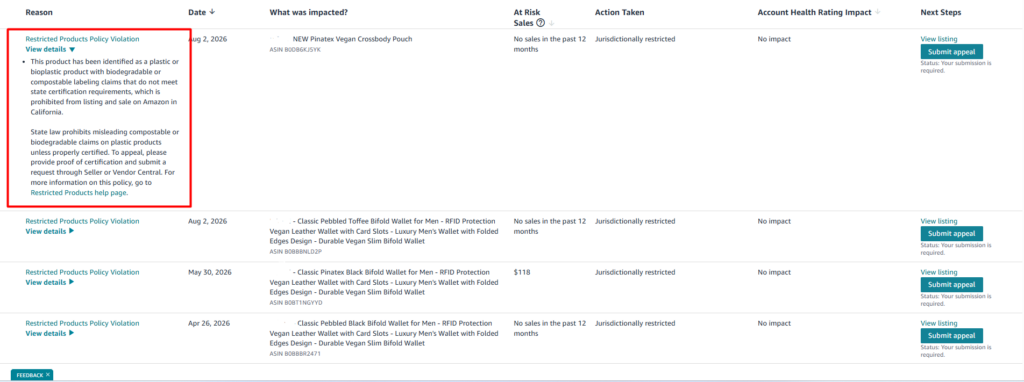
Imagine a plastic product listing that uses claims such as ‘biodegradable’ or ‘compostable.’
Those words may sound like simple marketing benefits, but they can trigger compliance requirements in certain jurisdictions. If the seller cannot provide the required certification, Amazon may restrict the product from sale in that location.
The product itself may be allowed. The unsupported environmental claim is what creates the compliance problem.
That is why sellers should verify claims before adding them to titles, bullets, images, packaging, or A+ Content.
Types of Amazon Compliance Issues Sellers Face
Amazon compliance is not just about avoiding warnings. It protects your listings, revenue, account health, and your ability to keep selling.
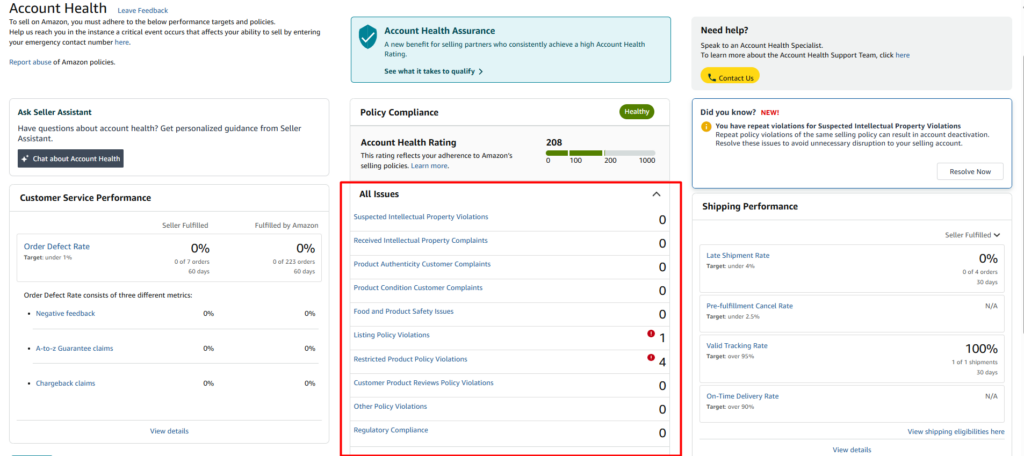
Most major issues appear here: Seller Central → Performance → Account Health → Policy Compliance
The main compliance issues sellers may face are:
- Suspected Intellectual Property Violations
- Received Intellectual Property Complaints
- Product Authenticity Customer Complaints
- Product Condition Customer Complaints
- Food and Product Safety Issues
- Listing Policy Violations
- Restricted Product Policy Violations
- Customer Product Reviews Policy Violations
- Other Policy Violations
- Regulatory Compliance
1. Suspected Intellectual Property Violations
A suspected IP violation means Amazon has identified possible misuse of intellectual property on a product detail page.
Unlike a received IP complaint, it is usually flagged by Amazon rather than submitted by a rights owner. That difference matters because the recovery path can be different.
Common Suspected IP Issues
Amazon has described suspected IP issues including:
1. Potential Trademark Misuse: A trademarked term may appear in listing content while the ASIN belongs to another brand.
2. Potential Trademark or Patent Misuse: Trademarked or patent-related material may appear in product text or imagery.
3. Potential Trademark Image or Logo Misuse: A protected brand logo or trademarked image appears in the listing.
4. Copyright Image Misuse: Amazon may believe one or more listing images use another rights owner’s protected work.
A Trademark Logo Can Trigger an IP Problem
Amazon removed a car cover listing for ‘Potential Trademark Logo Misuse under the registered protected brand.’
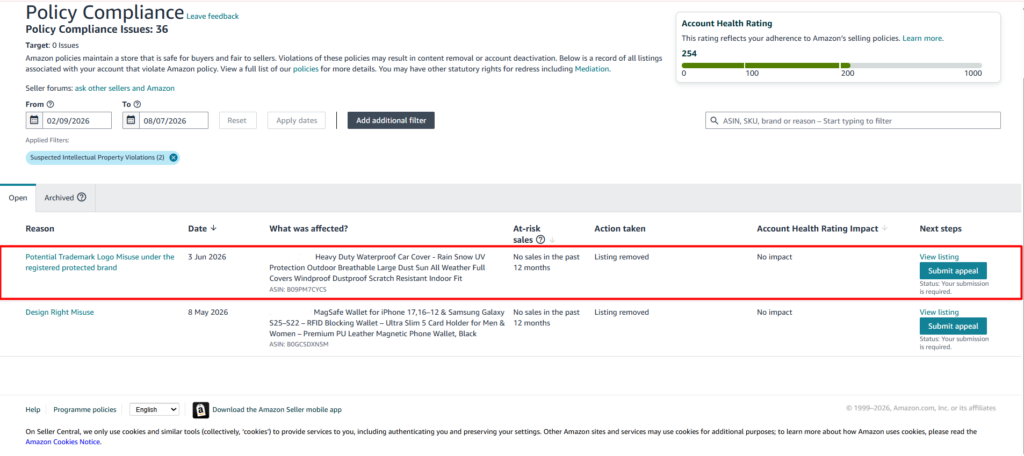
The product itself may have been allowed to sell. The problem was more likely connected to how another brand’s protected logo appeared in the listing, product imagery, packaging, or other content.
For example, a seller may offer a car cover that fits a particular vehicle brand. Mentioning compatibility can sometimes be appropriate, but displaying that brand’s logo in a way that suggests the product is officially made, licensed, or endorsed by that company can create an IP concern.
That is where the distinction matters.
Amazon needs to understand whether the protected brand is being used only to explain compatibility or whether the listing appears to claim brand ownership or affiliation.
How We Approach Suspected IP Issues at Ecomclips
Step 1: Identify What Amazon Flagged: We first check exactly what Amazon detected and where the protected trademark, logo, or design appears.
Step 2: Audit the Full Listing: We review the title, Item Highlight, bullets, images, A+ Content, packaging, compatibility language, and brand information to find the source of the issue.
Step 3: Correct the IP Misuse: If the trademark or logo is being used incorrectly, we remove or revise the problematic content before appealing.
Step 4: Obtain Brand Authorization if Needed: If the seller has a legitimate reason to use the protected brand, we can help them seek written permission from the rights owner through a Letter of Authorization (LOA) or licensing agreement.
Step 5: Prepare the Supporting Evidence: The authorization should clearly identify the brand owner, seller, approved intellectual property, scope of use, and authorization period.
Step 6: Submit the Appeal: Once everything is corrected and documented, we organize the evidence, match it to the affected ASIN, and submit it through Amazon’s appeal process.
2. Received Intellectual Property Complaints
A Received Intellectual Property Complaint means a rights owner has formally reported suspected infringement to Amazon.
These complaints can involve trademarks, copyrights, patents, or counterfeit claims, and Amazon may remove the affected listing while the issue is reviewed.
The screenshot below shows that Amazon recorded a ‘Counterfeit without a Test Buy’ complaint, removed the listing, and marked the Account Health Rating impact as High.
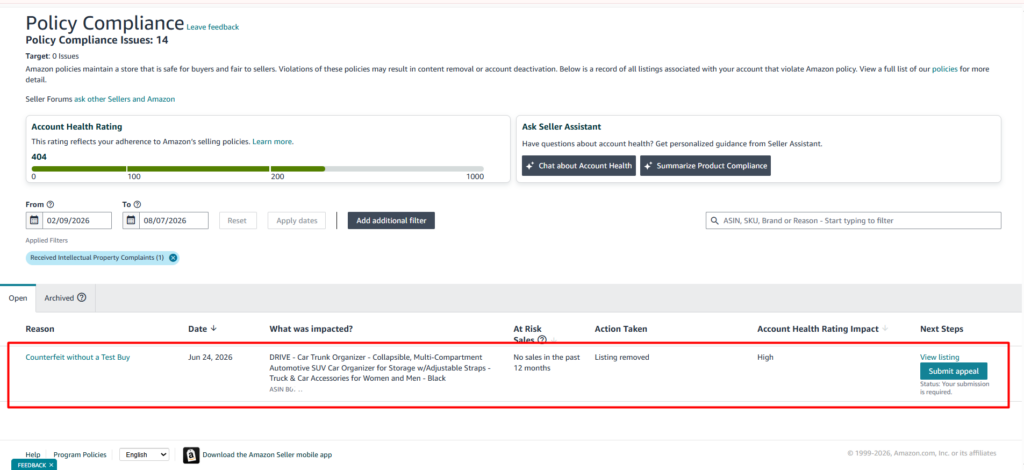
This is more serious than a suspected IP violation because the complaint has come from a rights owner rather than being detected only by Amazon’s systems.
Common Types of Received IP Complaints
1. Trademark complaints: Unauthorized logos, misleading brand references, incorrect brand attribution, or improper use of protected terms.
2. Copyright complaints: Copied product images, infographics, descriptions, videos, manuals, packaging graphics, or A+ Content.
3. Patent complaints: Concerns involving the product’s design, technology, or functionality.
4. Counterfeit complaints: Claims that the product may not be genuine or that the seller cannot prove legitimate sourcing.
How to Resolve a Received IP Complaint
Step 1: Review the Complaint: Open Account Health and identify the affected ASIN, complaint type, rights owner, and exact action Amazon requires.
Step 2: Check Whether the Complaint Is Valid: Review the listing, product, brand information, images, sourcing records, and any authorization to determine whether infringement actually occurred.
Step 3: Choose the Correct Resolution Path: Depending on the situation, the seller may need to correct the infringement, obtain a rights-owner retraction, or dispute the complaint with supporting evidence.
Step 4: Gather Strong Evidence: Relevant documents may include commercial invoices, supplier details, Letters of Authorization, licensing agreements, or other records proving legitimate sourcing or permission to use the intellectual property.
Step 5: Submit the Appeal: Use the resolution option shown in Account Health and provide a clear explanation supported by only the documents relevant to the complaint.
3. Product Authenticity Customer Complaints
A Product Authenticity Customer Complaint happens when a buyer tells Amazon they believe a product may not be genuine.
That does not always mean the inventory is counterfeit. Even authentic products can be flagged when packaging looks different, labels have changed, sourcing is unclear, or customers cannot easily recognize the product as genuine.
On Amazon, having authentic inventory and being able to prove it are two different things.
What Can Trigger an Authenticity Complaint?
Common triggers include changed packaging, unusual serial numbers, regional product differences, unclear supplier information, or inventory sourced through a distributor Amazon cannot easily verify.
Sometimes the product is genuine, but Amazon still requires evidence showing exactly where the inventory came from.
Why Do Supplier Invoices Matter?
For authenticity appeals, Amazon may ask for supplier invoices that clearly connect the affected ASIN to a legitimate supply chain.
According to Amazon’s guidance, the invoices should include:
- An issue date within the required 365-day period
- The requested ASINs clearly identified
- Sufficient quantity to support the seller’s sales volume
- Supplier name, address, phone number, and other contact information
Documents should be authentic, unaltered, and clearly readable. Pricing information may be removed, but the information Amazon needs to verify the product and supplier should remain visible.
How to Resolve a Product Authenticity Complaint
Step 1: Open the Appeal: Go to Seller Central → Performance → Account Health → Product Authenticity Customer Complaints and select Appeal beside the affected violation.
Step 2: Build the Supply-Chain Evidence: Connect the product clearly through: ASIN → Product → Packaging → Invoice → Supplier → Authorized Source. Gather the supplier invoices and any supporting sourcing or authorization records Amazon requests.
Step 3: Check the Documents Carefully: Make sure the affected ASINs are identifiable, supplier information is visible, quantities make sense, and the files have not been digitally altered. Amazon accepts supported image or PDF formats and requires documents to be clear enough for review.
Step 4: Submit the Appeal: Upload the required files, confirm that they meet Amazon’s document requirements, and submit the appeal through Account Health.
Step 5: Wait for Verification: Amazon may contact the supplier to verify the submitted information. If the evidence successfully proves authenticity, the affected listing can be reinstated.
4. Product Condition Customer Complaints
Product condition complaints happen when a customer receives an item that does not match the condition or product experience promised on the listing. The easiest way to separate this from authenticity is:
Authenticity asks: Is this product genuine?
Condition asks: Did the customer receive it in the condition they expected?
Amazon expects products listed as New to arrive brand new, unopened, and without signs of previous use. Open packaging, previous user data, scratches, dirt, or scuffs can trigger a Used Sold as New complaint.
1. Used Sold as New
This can happen when a return is accidentally placed back into sellable inventory, packaging has been opened, protective film is missing, accessories look unpacked, or the product shows visible wear.
For example, imagine an electronic device is returned by one customer and later sold to another. If the second buyer receives it with the previous setup data still inside, they may reasonably report it as used even though the seller originally sent new inventory.
2. Defective Product Complaints
Condition complaints can also happen when a product does not work as expected.
This may include products that arrive damaged, stop working, have missing components, fail to perform properly, or are incompatible with the advertised use.
In these cases, sellers should investigate whether the root cause came from manufacturing, packaging, shipping, supplier changes, quality control, or inaccurate listing expectations.
3. Wrong Product Complaints
A customer may also receive something different from what the detail page promised.
This can include the wrong size, color, model, quantity, variation, or even an incorrectly labeled SKU.
For FBA inventory, sellers should compare the physical product with the ASIN, SKU, FNSKU, UPC, and variation structure to find where the mismatch occurred.
4. Expired Product Complaints
For products with expiration dates, the issue may involve expired stock, insufficient remaining shelf life, incorrect date formatting, poor inventory rotation, or an older batch reaching the customer.
The seller should review the expiration date, lot or batch, FBA inventory age, supplier records, and customer comments before appealing.
How to Resolve a Product Condition Complaint
Step 1: Review the customer evidence: Check Voice of the Customer, returns, buyer messages, reviews, NCX comments, and complaint details.
Step 2: Inspect the inventory: Review packaging, product condition, FBA stock, SKU and FNSKU mapping, supplier batches, and recent shipments.
Step 3: Find the root cause: Determine whether the issue came from returns, manufacturing, packaging, fulfillment, incorrect labeling, or the detail page itself.
Step 4: Correct the problem: Affected inventory may need to be inspected, removed, relabeled, repackaged, or replaced. Listing content should also be corrected if it created the wrong customer expectation.
Step 5: Submit the appeal: Amazon may ask for a Plan of Action explaining the root cause, corrective actions, and preventive measures. Amazon’s guidance for condition complaints also emphasizes checking similar inventory and explaining how recurrence will be prevented.
5. Food and Product Safety Issues
Food and Product Safety Issues appear when Amazon needs to confirm that a product can be sold safely and meets the applicable safety requirements.
These issues can affect products such as: Chargers and batteries, electronics, toys, food items, cosmetics, household products, and other regulated goods.
Amazon may remove the listing or place it under review until the required information is provided.
Safety Documents Amazon May Require
The exact compliance documents depend on the product type, marketplace, and applicable regulations.
As shown in Amazon Seller Central, device batteries and chargers have their own dedicated compliance policy. Amazon requires sellers to follow applicable laws, regulations, standards, and Amazon policies before these products can remain eligible for sale.
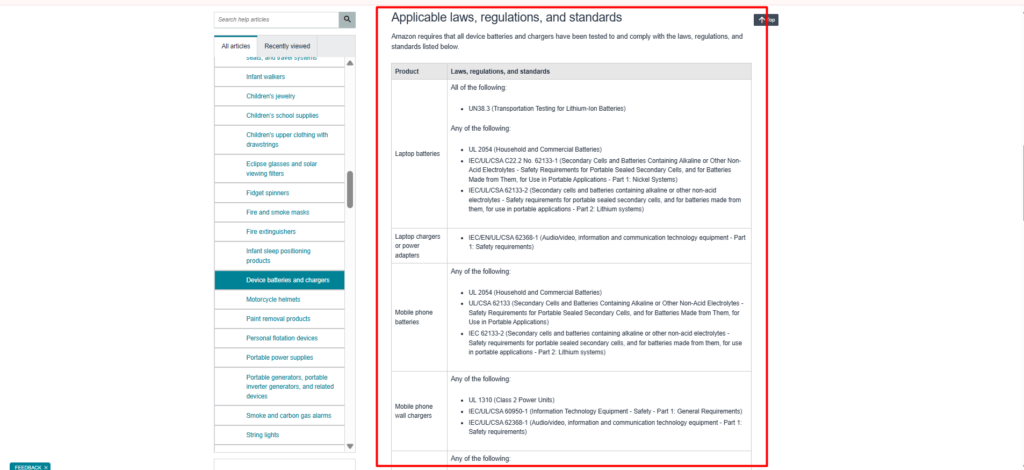
For products such as batteries, chargers, and power adapters, Amazon may request supporting information such as test reports, safety certificates, technical specifications, product images, packaging images, or other relevant compliance documents.
Ecomclips Case: Brand Approved, Listing Removed — Then Successfully Restored
We recently handled a case where a client already had Amazon approval to sell the brand, but a car power adapter listing was still removed under Food and Product Safety Issues.
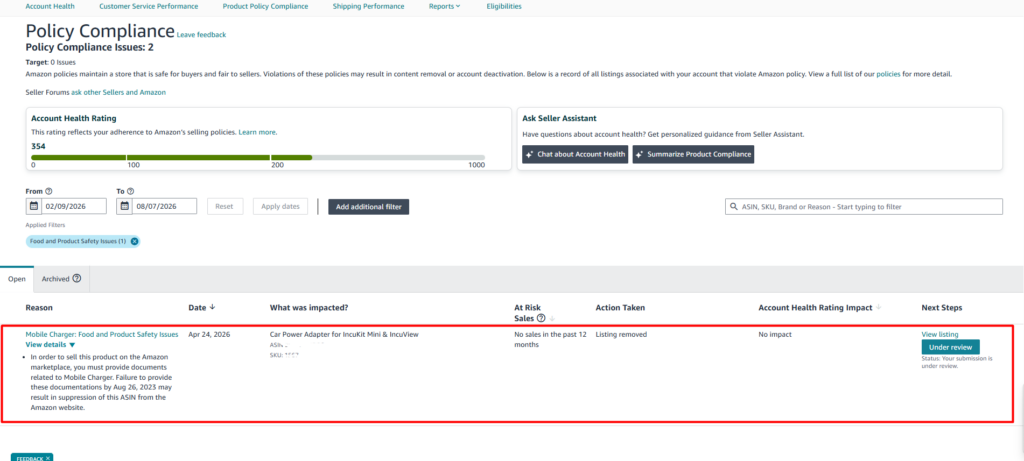
Amazon required additional compliance information for device batteries and chargers. At the same time, our discussion with Selling Partner Support revealed another issue: the Seller Central email being used did not have the correct Brand Registry selling rights for the approved brand.
So the problem was not simply missing brand approval.
How To Solve Food and Product Safety Issues
1. Verified the existing brand approval: We confirmed that the brand had already been approved and there was no need to apply again.
2. Investigated the actual restriction: We contacted Amazon Support and reviewed why the listing remained blocked despite the existing approval.
3. Identified the Brand Registry access issue: Amazon confirmed that the selling account email did not have the required rights for the approved brand.
4. Corrected the brand access and compliance requirements: We worked through the Brand Registry connection and completed the required product-compliance process for the charger.
5. Successfully restored the listing: After addressing both issues and completing Amazon’s required steps, the restriction was cleared and the listing went live again.
This case shows why Amazon compliance recovery is rarely about submitting one document or one appeal. Finding the real cause, fixing each layer of the problem, and following the correct Amazon workflow is what gets a listing back in business.
6. Listing Policy Violations
Listing Policy Violations happen when a product detail page does not follow Amazon’s catalog and listing rules.
Amazon’s catalog is shared, which means sellers cannot freely change an existing ASIN, variation family, brand, or product identity just to improve rankings, reviews, or conversions.
1. Invalid Variations
Variation abuse is one of the most common listing-policy problems. It can happen when sellers:
- Add products that are not genuine variations.
- Place unrelated products under the same parent.
- Combine ASINs mainly to share reviews.
- Use an unsupported variation theme.
- Change a parent so it no longer accurately represents its child ASINs.
2. Changing an Existing ASIN Into a Different Product
An existing ASIN should continue representing the same product.
For example:
Original: 500 ml stainless steel bottle
Changed to: 1 liter insulated sports flask
They may be similar products, but they are not the same item.
Rewriting an established ASIN into a materially different product can create a listing-policy violation because its reviews, sales history, and catalog identity belong to the original product.
The safer approach is to create a new ASIN for the new product.
3. Incorrect Brand Information
The brand shown on the detail page must accurately match the physical product.
Problems can arise when sellers:
- Change a Generic listing into a branded product.
- Attach an offer to a branded ASIN that does not match their inventory.
- Enter incorrect brand attributes.
- Use another brand’s identity to improve discoverability.
Brand mistakes can quickly spread into other compliance areas, including IP complaints, authenticity concerns, and wrong-product complaints.
How to Fix Listing Policy Violations
1. Identify the exact violation: Determine whether the issue involves variations, product identity, brand information, or catalog attributes.
2. Compare the listing with the product: Check the ASIN, SKU, packaging, brand, model, quantity, and variation structure.
3. Correct the catalog data: Separate invalid variations, fix incorrect attributes, and create a new ASIN when the product is materially different.
4. Submit the required correction or appeal: Follow the resolution path in Account Health and provide supporting evidence if Amazon requests it.
7. Restricted Product Policy Violations
A Restricted Product Policy Violation does not always mean the physical product is completely prohibited on Amazon.
Sometimes Amazon cannot verify whether the product complies with its restricted-product rules because important listing information, packaging details, ingredients, or supporting images are missing.
A restriction can relate to the product itself, its ingredients, intended use, marketplace rules, seller eligibility, or the claims made on the listing and packaging. That is why sellers should investigate the exact reason before changing the listing or submitting an appeal.
A Restricted Listing Caused by Missing Product Side Images
In one client case, Amazon removed a skincare listing under Restricted Products Policy Violations. The Account Health page showed the ASIN as Listing removed, with an appeal required.
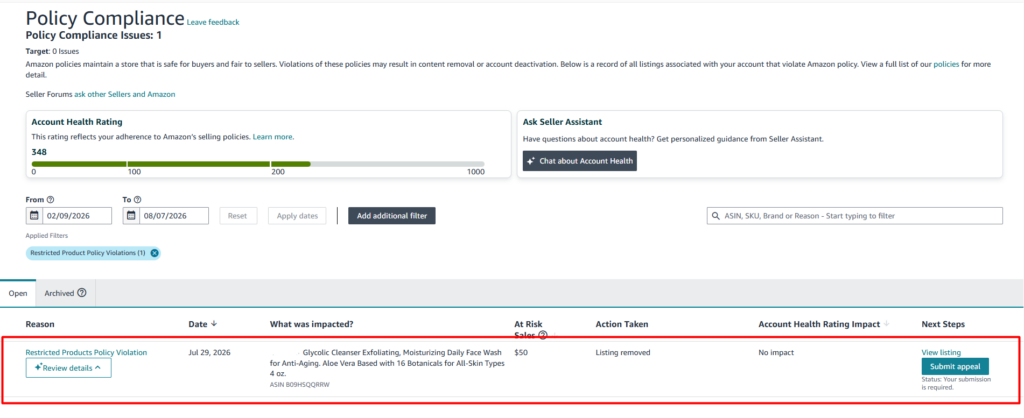
At first glance, this could easily look like a prohibited product or prohibited claim problem. But after we submitted the case for review, Amazon explained the actual blocker. Amazon stated: We cannot proceed with reinstatement because all-side images of the product are missing.
Amazon specifically asked for product-label images showing all sides of the packaging, including the ingredients list, before the listing could be reconsidered.
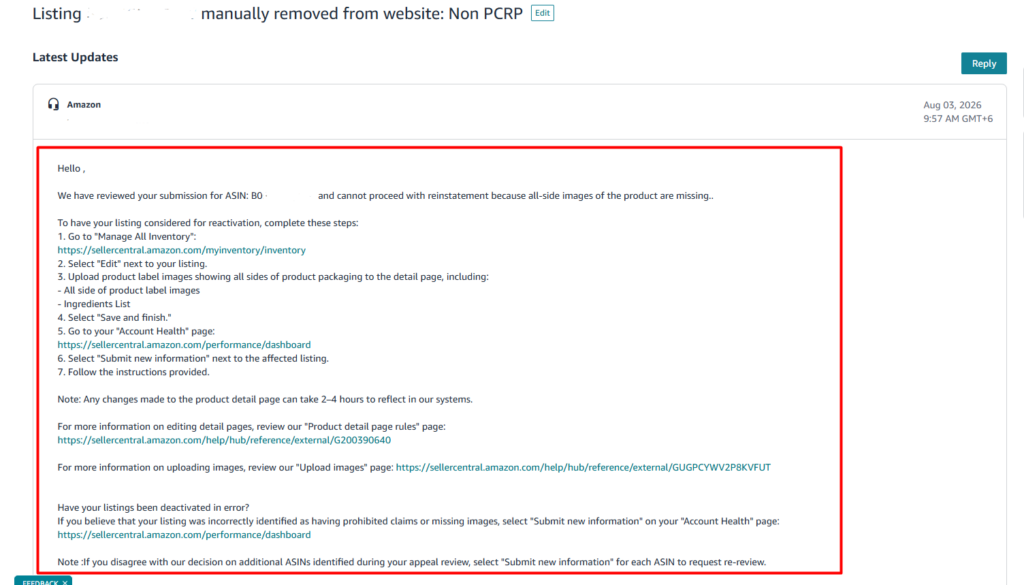
This is an important compliance lesson: sometimes Amazon needs to see the complete physical label before it can verify whether a product is allowed to sell.
How We Successfully Restored the Listing
Step 1: Reviewed the Restricted Product violation: We first checked the Account Health notice and the affected ASIN instead of assuming the product itself was prohibited.
Step 2: Submitted the case for review: Amazon’s response revealed that the compliance review could not move forward because the required product-side images were missing.
Step 3: Added complete product-label images: We updated the detail page with clear images showing every side of the product packaging, including the ingredients list Amazon requested.
Step 4: Submitted New Information: After the images were updated, we returned to Account Health and resubmitted the listing with the required information.
Step 5: Listing Successfully Restored: Once Amazon could review the complete product information, the compliance issue was resolved, and the listing was successfully brought back live.
8. Customer Product Reviews Policy Violations
Customer reviews directly influence shopper trust and conversion, which is exactly why Amazon closely monitors how sellers request and interact with them.
A Customer Product Reviews Policy Violation can happen when Amazon believes a seller, employee, agency, or third-party service has tried to influence customers to write, remove, or change reviews.
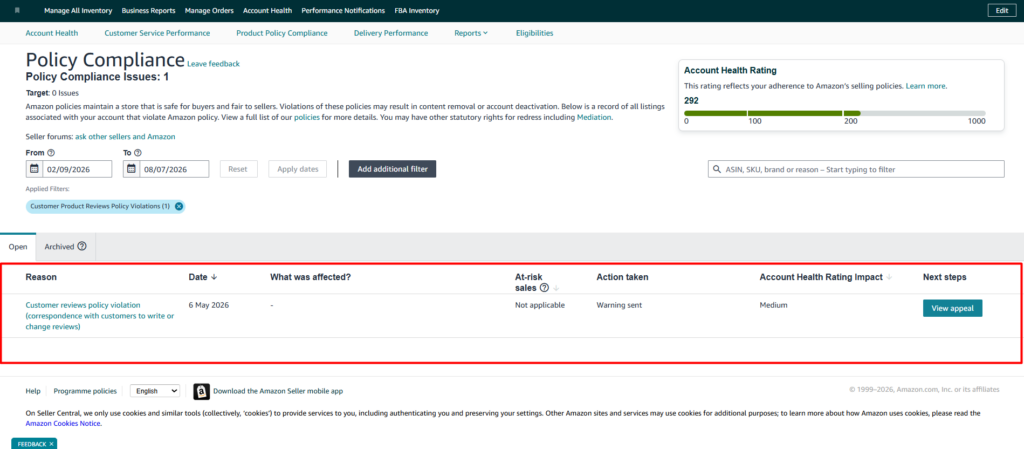
Amazon flagged this item as a Customer Product Reviews Policy violation (correspondence with customers to write or change reviews). The account received a warning, and the violation carried a Medium Account Health Rating impact.
This shows that even a customer message can become a compliance problem when it crosses the line from normal customer service into review influence.
Common Review Policy Violations
1. Incentivized reviews: Offering gift cards, refunds, discounts, free products, reimbursements, or other benefits in exchange for a review.
2. Asking only for positive reviews: For example: ‘If you loved your purchase, please leave us a five-star review.’ The problem is that the request is tied to customer satisfaction and a specific rating.
3. Asking customers to remove or change negative reviews: For example:
Customer: ‘The product stopped working.’
Seller: ‘We can refund you if you remove the review.’
Customer service should never be exchanged for a review change.
4. Review gating: This happens when happy customers are encouraged to leave public reviews while unhappy customers are redirected somewhere private.
For example:
Happy customer → Leave an Amazon review
Unhappy customer → Contact our support team
That can be seen as an attempt to filter negative experiences away from Amazon.
5. Product insert violations: Review-policy issues do not stop at Seller Central. Inserts, packaging, QR codes, flyers, or coupons can also create problems if they offer incentives or encourage only favorable reviews.
6. Third-party review manipulation: Hiring an agency or service does not remove the seller’s responsibility. If a third party uses prohibited methods on behalf of the account, the seller can still face the violation.
How We Appealed and Successfully Resolved the Review Policy Violation
For the above case, we first reviewed the violation and identified the customer communication that had triggered Amazon’s review-policy warning.
Step 1: Identified the Root Cause: We traced the issue back to the review-related customer correspondence and confirmed what needed to be corrected.
Step 2: Corrected the Process: The problematic messaging was removed, and the customer communication process was updated to follow Amazon’s review policies.
Step 3: Submitted a Clear Appeal: Through the View Appeal option in Account Health, we explained the root cause, the corrective actions already taken, and the preventive measures added to stop the issue from recurring.
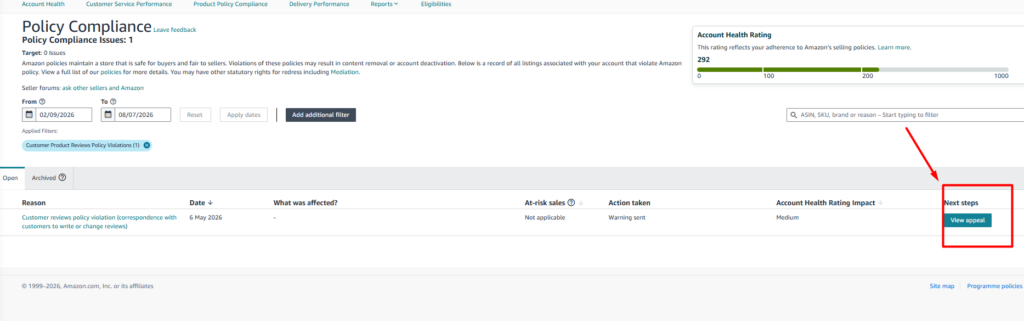
Step 4: Violation Successfully Resolved: Amazon accepted the appeal, and the review-policy violation was successfully cleared.
9. Other Policy Violations
Other Policy Violations cover Amazon selling-policy issues that do not fit neatly into categories such as intellectual property, product safety, customer reviews, or restricted products.
That is why sellers should never try to resolve an issue based only on the “Other Policy Violations” category name.
The first step is to open the violation and carefully read the Performance Notification. It should help identify the exact policy Amazon believes was violated, what part of the account or offer was affected, and what action is required.
Marketplace Fair Pricing Problems
Amazon allows sellers to set their own prices, but it also monitors product prices and shipping charges for pricing practices that may damage customer trust.
A pricing issue may involve misleading reference prices or an offer that Amazon considers significantly higher than recent or external prices.
Depending on the situation, Amazon may remove Featured Offer eligibility, remove the offer, restrict shipping options, or take other action against the seller’s selling privileges.
How to Handle a Marketplace Fair Pricing Issue
1. Identify the affected offer: Open the Performance Notification and determine which ASIN or offer Amazon has flagged.
2. Review the complete selling price: Check both the product price and any shipping charges connected to the offer.
3. Check recent and reference pricing: Review recent price changes, reference prices, automated repricing settings, and relevant external marketplace pricing to identify what may have triggered the warning.
4. Correct the pricing issue: Update the part of the offer that appears to be causing the problem rather than lowering the price randomly.
5. Follow Amazon’s required action: Complete the resolution process shown in Account Health or the Performance Notification and continue monitoring the affected offer.
Sales Rank and Marketplace Manipulation
Amazon also prohibits sellers from artificially influencing sales rank or marketplace performance.
For example, creating non-genuine orders or arranging transactions mainly to manipulate ranking can create serious policy problems.
Similar concerns can arise when a seller, employee, agency, or third-party service attempts to misuse Amazon services or bypass normal marketplace processes.
How to Handle a Sales Rank or Marketplace Manipulation Violation
- Review the exact violation: Open the Performance Notification and identify the activity Amazon believes violated its selling policies.
- Trace the source of the activity: Review internal processes, employees, agencies, third-party services, or other activities connected with the affected account.
- Stop the problematic activity: If any process is artificially influencing orders, rank, or marketplace activity, discontinue it immediately.
- Review related processes: Check whether the same activity is being used for other ASINs or elsewhere in the account so the problem does not continue.
- Prepare the required response: Address the specific issue Amazon identified and provide the information or explanation requested through Account Health.
- Add preventive controls: Make sure employees, agencies, and third-party providers understand which activities are not permitted so the violation does not recur.
Related Account Violations
Related Account Violations can become especially serious because a compliance problem in one seller account may affect another linked account.
When Amazon considers multiple seller accounts related, an unresolved policy problem in one account may lead to action against another associated account as well.
This means appealing the second account immediately may not solve the real problem. The recovery process usually needs to begin with the original account that caused the related-account issue.
How to Solve a Related Account Violation
Step 1: Identify the original affected account: Review Amazon’s notification and determine which seller account is connected to the violation.
Step 2: Find the underlying policy problem: Check what caused the original account to be restricted or deactivated.
Step 3: Resolve the original violation first: Follow the required appeal or resolution process for the account where the initial policy problem occurred.
Step 4: Obtain confirmation of reactivation: Once the underlying issue has been successfully resolved, keep the information showing that the original account has been reactivated.
Step 5: Appeal the related-account action: Use the original account’s successful reactivation information when responding to the related-account deactivation.
10. Regulatory Compliance
Regulatory Compliance is one of the broadest areas inside Amazon Account Health because requirements can change depending on the product, marketplace, ingredients, materials, intended use, and local laws.
A product that is compliant in the U.S. may need different documentation, labeling, or verification before it can be sold in another marketplace.
Here Seller Central shows 1 Regulatory Compliance issue while also displaying a Priority Action to ‘Review Your Account Information.’
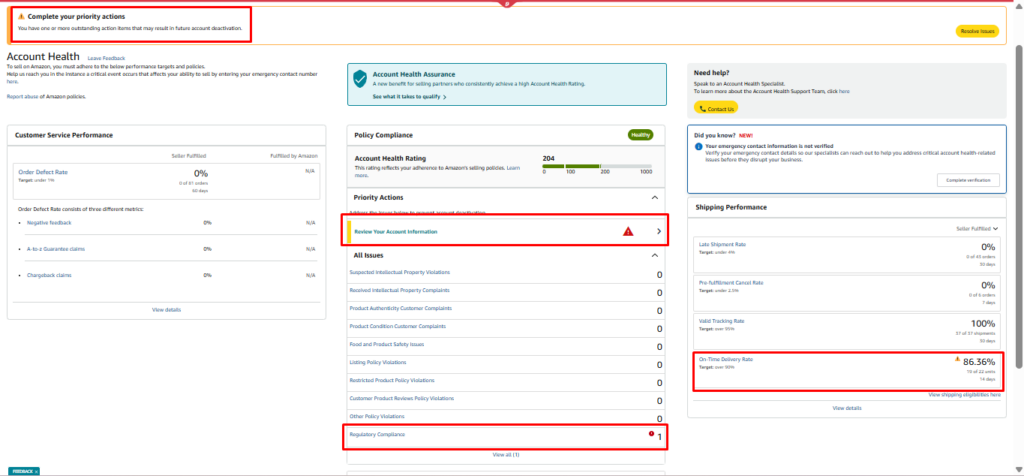
This is a useful example because regulatory compliance is not always limited to product certificates. Amazon may also require sellers to verify or update important account or business information before the issue is considered resolved.
First Identify What Type of Regulatory Issue You Have
Before gathering documents, determine whether the issue is mainly connected to the product or the selling account.
1. Product-Level Regulatory Requirements
Depending on the product category and marketplace, Amazon may require information related to:
- Children’s-product testing
- Electrical or electronic safety
- Food or cosmetic labelling
- Dietary supplements
- Medical devices
- Pesticides
- Batteries
- Hazardous materials
- Manufacturer or importer information
- Product labels and packaging
- Other marketplace-specific regulatory requirements
For example, a battery-powered product may require different safety information from a cosmetic, supplement, toy, or food product.
2. Account-Level Regulatory Requirements
Regulatory Compliance issues are not always tied directly to the physical product. Amazon may also require sellers to review or verify important business or account information. This can include a Priority Action such as: Review Your Account Information
When this appears, the seller should complete the requested account verification instead of assuming that additional product certificates are the only solution.
How to Handle a Regulatory Compliance Issue
Step 1: Open the exact violation: Review the affected ASIN, Amazon’s reason, and any Priority Actions.
Step 2: Identify the requirement: Determine whether Amazon is asking for product-level compliance documents or account-level verification.
Step 3: Gather the correct evidence: Submit only the documents or information that directly match Amazon’s request.
Step 4: Check the details: Make sure product, model, brand, manufacturer, and other required information are clear and consistent.
Step 5: Submit and monitor: Complete the workflow shown in Account Health and continue checking for additional requests.
Amazon Compliance FAQ
Q1. What is an Amazon compliance violation?
It means Amazon believes a product, listing, document, or seller activity does not meet its policies or regulatory requirements.
Q2. Where can sellers find Amazon policy violations?
Go to: Seller Central → Performance → Account Health → Policy Compliance
Q3. What is the difference between suspected and received IP violations?
A suspected IP issue is usually detected by Amazon. A received IP complaint is typically submitted by a rights owner.
Q4. Can Amazon remove an authentic product?
Yes. A genuine product can still be removed if Amazon cannot verify its authenticity or required compliance information.
Q5. Can Amazon compliance issues affect SEO?
Yes. Removed or restricted listings can lose visibility, traffic, sales, and ranking momentum.
Q6. Can deleting an ASIN clear a violation?
No. Deleting the listing does not automatically remove an unresolved Account Health violation.
Q7. What documents may Amazon request?
Amazon may request invoices, authorization letters, test reports, certificates, product images, or other supporting evidence.
Q8. Does every violation require a Plan of Action?
No. Some require a POA, while others need documents, listing corrections, questionnaires, or a rights-owner retraction.
Q9. What should sellers do first after receiving a violation?
Identify the affected ASIN, exact policy, root cause, deadline, and required action before appealing.
Q10. How often should sellers check Account Health?
Regularly. Do not wait for an email warning before reviewing it.
Protect Your Amazon Business Before Compliance Becomes a Crisis
Amazon compliance can become complicated quickly.
One ASIN may need a listing correction. Another may require sourcing documents, laboratory testing, IP evidence, or a deeper review of inventory and customer complaints.
The key is to act early. Understand the issue, gather the right evidence, and follow the correct resolution path before a single violation becomes a bigger account problem.
How Ecomclips Helps Sellers Resolve Amazon Compliance Issues
At Ecomclips, we focus on finding the real cause behind a compliance warning instead of submitting generic appeals. Our process combines account review, document verification, listing corrections, and issue-specific appeals to help sellers protect their listings and Account Health.
- Compliance Issue Diagnosis: We review Account Health, Performance Notifications, affected ASINs, and Amazon’s requested actions to identify the exact reason behind the violation.
- Listing & Catalog Review: Titles, images, A+ Content, brand information, claims, variations, and product attributes are checked for policy or catalog issues that may have triggered the restriction.
- Document & Supply-Chain Verification: We organize invoices, supplier details, authorization letters, test reports, certificates, product images, and other evidence required for authenticity, safety, IP, or regulatory cases.
- Issue Specific Appeals: Instead of using one appeal template, we build responses around the actual violation, covering the root cause, corrective action, supporting evidence, and preventive measures where required.
- Listing Restoration Support: For cases involving restricted products, counterfeit complaints, product-safety issues, and review-policy violations, we follow the correct Amazon workflow and work toward getting eligible listings reinstated.
- Preventive Compliance Audits: We also review related ASINs, supplier records, claims, packaging, and account processes to reduce the chance of the same issue appearing elsewhere in the catalog.
With Ecomclips, compliance support is not just about removing a warning. It is about understanding the issue, submitting the right evidence, restoring eligible listings, and protecting the account from repeat violations.
Need Help With an Amazon Compliance Issue?
If you are dealing with an IP complaint, authenticity concern, restricted-product violation, product-safety issue, review warning, or another Account Health problem, the Ecomclips team can help you review the case, identify the root cause, organize the right evidence, and prepare the appropriate response.
For more practical Amazon and ecommerce guidance, explore the Ecomclips Blog, visit the Ecomclips YouTube channel, or browse additional ecommerce resources on the Boostontime Blog.
Need direct support? Email us at info@ecomclips.com or book an appointment with our ecommerce experts to discuss your Amazon compliance issue and get your account back on track.