

Amazon just changed the rules on variation listings — and the clock is already running.
The Amazon Review Sharing Variation Update began rolling out on February 12, 2026, and enforcement concludes on May 31. After that, reviews will no longer pool across variations with meaningful functional differences.
Color options, size runs, and pack quantities still qualify. But if your parent ASIN has been grouping products that differ in formula, specifications, or performance, that structure is effectively over. Amazon will send a 30-day notice before changes hit your listings — yet by the time that email arrives, your strategy window may already be closing.
This isn’t a minor adjustment. It’s a structural shift that can impact your review count, conversion rate, organic ranking, and PPC efficiency all at once. Understanding what’s changing — and preparing before your reviews fragment — is now a competitive necessity.
What Is the Amazon Review Sharing Variation Update?
To understand what’s changing, you need to understand how the old system worked — and why Amazon built it that way in the first place.
Historically, Amazon allowed sellers to group multiple products under a parent ASIN using a parent-child variation structure. Reviews left on any child ASIN were aggregated and displayed across the entire listing family. Every shopper saw the combined review total, regardless of which specific variant they were viewing.
When used correctly, this made sense. A review for a red t-shirt is still relevant to someone buying the same shirt in blue. The product is functionally identical. The problem arose when sellers stretched this system. Different supplement formulas, upgraded electronics models, reformulated beauty products, and performance-different SKUs were grouped under one parent to share review counts. Customers often read reviews written for a different product than the one they were considering.
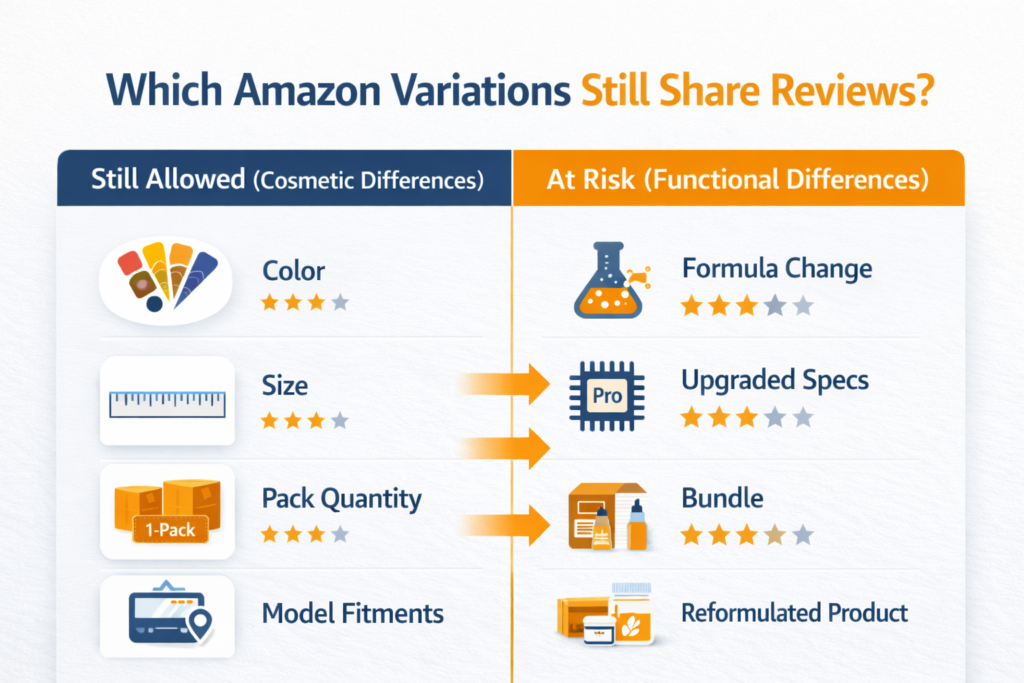
Under the new policy, Amazon will stop review sharing between child ASINs with functional differences. Reviews will remain attached only to the specific ASIN they were originally written for. A functional difference means the product performs differently, serves a different purpose, or delivers a materially different outcome. Cosmetic changes — such as color, pattern, size (same function), or quantity — can still share reviews.
This update reflects Amazon’s broader push toward catalog integrity and ASIN-level review accuracy. The infrastructure to enforce it is now fully in place.
Why Amazon Is Ending Review Pooling for Functional Variations
Amazon didn’t make this change casually. Several forces pushed it from optional enforcement to structural policy.
- Regulatory pressure. The FTC has intensified scrutiny around deceptive review practices. When thousands of reviews appear on a listing that represents multiple functionally different products, that can mislead customers. For a company of Amazon’s size, regulatory risk alone makes this unsustainable.
- Customer confusion and returns. Amazon’s internal data likely shows a pattern: when reviews reference a different version of the product, buyers get confused. Confusion leads to higher return rates and negative feedback — both of which hurt marketplace health.
- Algorithm accuracy. Amazon’s ranking system depends heavily on clean conversion data. When reviews inflate or distort buyer expectations, conversion signals become noisy. Separating reviews by specific ASIN improves the quality of data the algorithm uses to rank products.
- Part of a broader enforcement trend. This aligns with crackdowns on fake reviews, Vine restructuring, stricter Brand Registry verification, and AI-driven listing quality detection.
This update also aligns with broader enforcement trends: stricter review abuse crackdowns, Vine restructuring, tighter Brand Registry controls, and AI-driven listing audits. The direction is consistent. Amazon wants every listing to represent one specific product — not a loosely related product family.
This isn’t temporary. It’s structural.
Which Amazon Variations Still Share Reviews?
The good news is that the majority of legitimate variation setups are completely unaffected. Amazon was explicit about what continues to qualify for review sharing, and the list covers the vast majority of standard catalog architecture.
Variations that still share reviews (cosmetic differences only):
- Color — same product, different color option
- Pattern or design — same function, different aesthetic
- Size — as long as core function and performance are identical
- Pack quantity — 1-pack vs. 3-pack of the exact same product
- Secondary scent — where the formula and function are otherwise unchanged
- Model fitments — same item listed for compatibility with different vehicles or devices
A few edge cases worth addressing directly:
- Upgraded versions: If you sell v1 and v2 of a product under the same parent, Amazon will almost certainly treat this as a functional difference even if you market them as the same product line. Different specs mean different function.
- Bundles: Any listing that pairs a standalone product with a bundle that includes accessories or additional items is at risk. The bundle delivers a meaningfully different customer experience and cannot genuinely share reviews with the standalone.
- Reformulations: If your product’s formula or ingredients have changed — even if the change is minor — it is now a different functional product. Reviews left on the original formula are not relevant to the reformulated version.
- “New and improved” lines: If you’ve marketed a product update as an improvement, you’ve essentially declared it functionally different. Amazon is likely to treat it that way too.
One important clarification from Amazon: if your variation themes were miscategorized — for example, you used “size” as the theme when “color” was actually more accurate — correcting that theme proactively should restore review sharing for eligible products. This means that for some sellers, the fix is administrative rather than structural.
Who Will Be Hit the Hardest?
Some sellers will feel this change barely at all. Others are about to experience a genuinely painful disruption. The determining factor isn’t the size of your catalog or the age of your account — it’s whether your variation architecture was built around genuine product relationships or around the review pooling benefit.
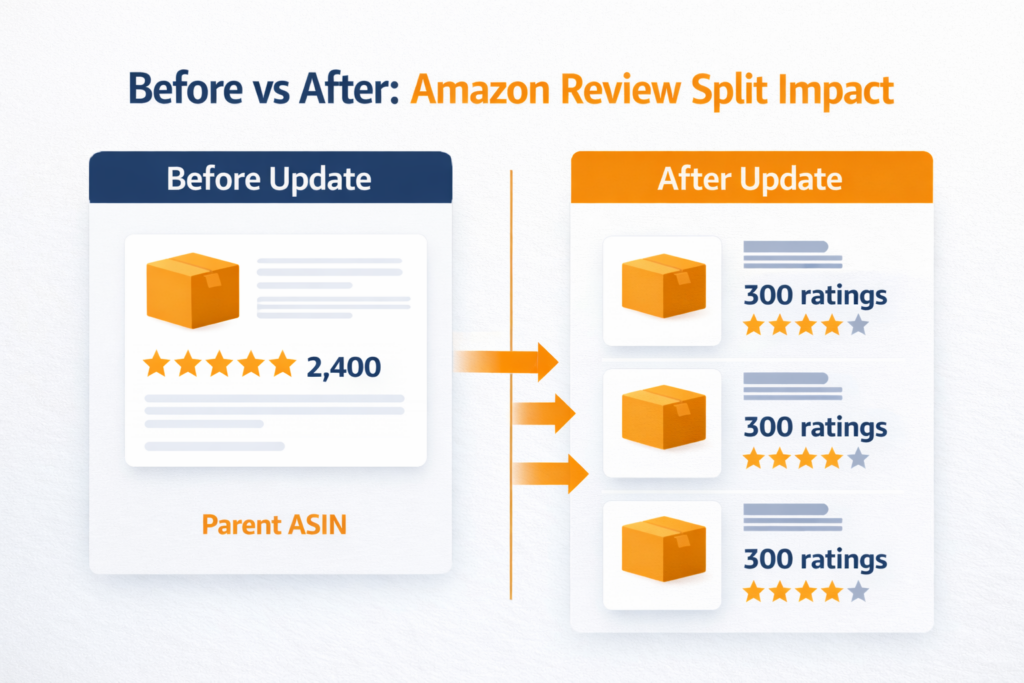
- Supplements and nutraceuticals are ground zero for this update. This category has some of the most widespread variation abuse on the platform. Sellers regularly group different formulas, different dosage strengths, different ingredient blends, and different delivery mechanisms under a single parent ASIN, using “flavor” or “scent” as the variation theme to maintain the appearance of compliance. A seller running a 500mg and 1000mg magnesium supplement as variations — with 2,400 pooled reviews between them — could realistically see each child ASIN fall to 300 or fewer reviews after attribution is separated.
- Electronics are high risk because spec differences are, almost by definition, functional differences. A speaker with Bluetooth 4.0 vs. 5.0, a charger with different wattage outputs, a camera with different megapixel counts — all of these involve functional performance differences that will trigger the new policy.
- Beauty and skincare face significant exposure due to the category’s endemic reformulation culture. If your moisturizer formula changed but you maintained the same listing and variation structure, you’ve been pooling reviews across two functionally different products.
- Bundled kits across all categories are at risk because bundles inherently deliver a different customer experience than standalone products, regardless of what the core item is.
- Private label sellers with copied variation architecture are particularly vulnerable. Many private label sellers built their listings by copying the variation structure of successful competitors — without understanding whether that structure was policy-compliant in the first place. Those sellers are now exposed for choices they may not even have understood they were making.
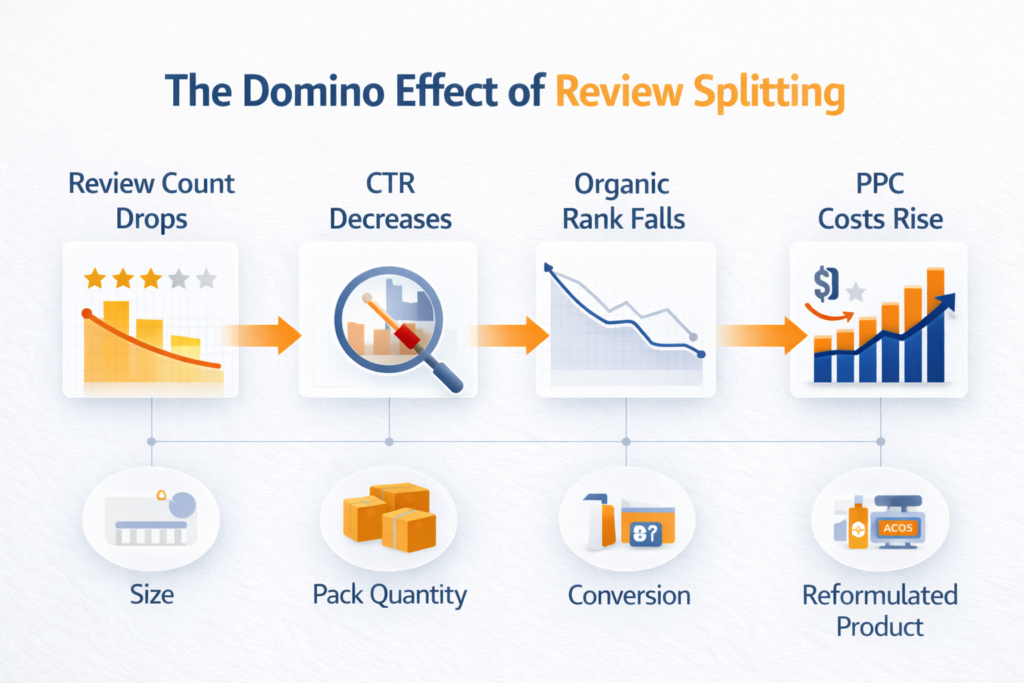
Here’s exactly what the domino effect looks like when it hits:
Your listing drops from 2,400 pooled reviews to 300 ASIN-specific reviews overnight. Shoppers browsing your category now see a listing with 300 reviews next to competitors with 1,800. Your click-through rate drops because social proof is the dominant trust signal in search results. Lower CTR tells Amazon’s algorithm your listing is less relevant, so your organic rank begins to slide. On the listing page, the reduced review count suppresses conversion — your unit session percentage falls. Amazon reads the lower conversion as further evidence of reduced relevance and continues to deprioritize your listing in search. To compensate for the organic rank loss, you increase PPC spend to maintain visibility. But now your advertising is working against weaker conversion metrics, so your ACOS spikes and your ROAS deteriorates. You’re spending more to generate fewer sales. One policy enforcement event, three compounding performance problems.
How This Impacts Amazon Ranking, Conversion & PPC
Most sellers think of reviews primarily as a customer trust signal. That understanding is correct but incomplete. Review count and quality are deeply integrated into how Amazon’s algorithm evaluates, ranks, and rewards listings — and the impact runs further than most sellers realize.
- Click-through rate (CTR) & search rank: Listings with higher review counts attract more clicks. When reviews drop, CTR falls. Lower CTR weakens relevance signals, which can reduce organic ranking.
- Conversion rate & unit session percentage: Fewer reviews often mean lower buyer confidence. If conversion drops, Amazon reassesses your listing’s quality and authority across keywords.
- Buy Box competitiveness: If multiple sellers share the Buy Box, stronger review metrics improve rotation and eligibility. A sudden review drop can reduce your share and slow sales velocity.
- PPC efficiency & ad relevancy: Amazon Ads factor in organic conversion performance. When conversion declines, ad efficiency drops. You may need higher bids to maintain placements, increasing ACOS and lowering ROAS.
- Algorithm authority signals (A9/A10): Review count and recency signal listing strength and customer satisfaction. A sharp drop reduces perceived authority, lowering visibility until performance stabilizes.
- Session share impact: Lower CTR reduces your share of category traffic. That drop in session percentage can create a feedback loop that’s harder to reverse without a structured recovery plan.
How to Audit Your Amazon Parent-Child Variation Structure
Before you can protect your listings, you need an honest picture of where you stand. This is not a five-minute exercise — do it carefully.
Step 1: Pull your full variation inventory
Go to Manage All Inventory in Seller Central and filter for parent ASINs. If you have a large catalog, export to a spreadsheet so you can work systematically. You need visibility into every parent-child relationship you’re running.
Step 2: Document the variation theme for each parent
Amazon assigns a variation theme at listing creation — color, size, scent, flavor, style, pack quantity, etc. Write down the stated variation theme for every parent ASIN. This is your starting point for compliance analysis.
Step 3: Apply the functional difference test to every child ASIN
For each child ASIN within a variation group, ask three questions: Does this product perform differently than its siblings? Would a customer who bought sibling A be genuinely satisfied if they received sibling B instead? Would the reviews written for sibling A be accurate and helpful to a customer considering sibling B? If any answer is no, you have a functional difference.
Step 4: Pull review distribution at the ASIN level
Look at how reviews are currently distributed across child ASINs. You’re looking for child ASINs that have very few individual reviews but display a large pooled count. These are your highest-risk ASINs — once the split happens, their displayed review count will fall most dramatically.
Step 5: Map sales dependency
For each at-risk ASIN, calculate what percentage of its conversion relies on the pooled review count to create the social proof that drives purchase. A product that sells well even at its individual review count is lower risk. A product whose sales velocity would collapse without the pooled count needs immediate attention.
Step 6: Check if theme correction is available
If the functional difference is real but the variation theme was always miscategorized, correcting the theme may restore compliant review sharing. This is an administrative fix worth investigating before considering structural changes.
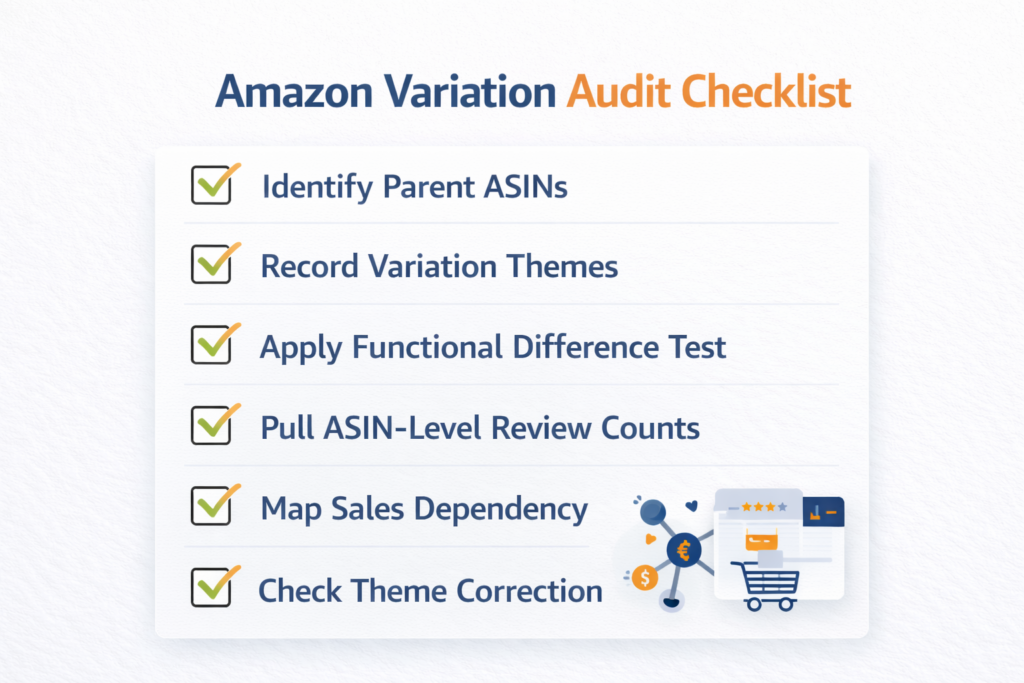
Audit checklist:
- All parent ASINs identified and documented
- Variation themes recorded for each parent
- Functional difference test applied to all child ASINs
- At-risk child ASINs flagged and prioritized
- Review distribution pulled at the individual ASIN level
- Sales dependency mapped for each at-risk ASIN
- Variation theme correction opportunities identified
- Timeline to enforcement estimated based on category rollout
How to Protect Your Review Equity Before the Split
The biggest mistake you can make right now is waiting for the 30-day notice email. By the time that email arrives, you have 30 days to act. Sellers who start now have months. The difference in outcome between those two groups will be significant.
1. Build review velocity on individual ASINs immediately: Every legitimate review you generate between now and May 31 is review equity that gets attributed at the ASIN level. Stop thinking about reviews at the parent level and start driving purchase and review requests at the child ASIN level for every variant that’s at risk.
2. Enroll in Amazon Vine right now: Vine is one of the fastest compliant mechanisms for generating ASIN-level reviews. Eligible ASINs can receive up to 30 high-quality Vine reviews, and those reviews will be specific to that child ASIN. If you’ve been sitting on Vine enrollment because your pooled review count made it feel unnecessary, that calculus just changed entirely.
3. Optimize every listing element that influences conversion: If your review count is going to drop, your listing needs to work harder on every other dimension to maintain conversion rate. That means auditing your main image, secondary images, title, bullet points, A+ content, and back-end search terms. A listing that converts at 18% without review support is far more resilient than one that converts at 10% and relies on social proof to compensate for everything else.
4. Activate compliant follow-up review requests on every order: Amazon’s native “Request a Review” button, as well as compliant third-party tools, allow you to send review request messages after purchase. These need to be running on every order, for every at-risk child ASIN, starting now. Not after your notice arrives.
5. Review your packaging and insert strategy: Physical product inserts can drive review generation if they comply with Amazon’s communication policies. No incentivized review requests, no directing customers specifically to leave positive reviews. A compliant insert that reminds customers they can leave feedback, and explains how, is permitted and effective. If your current inserts haven’t been reviewed for compliance recently, do that now — an insert that gets flagged during a compliance-sensitive period creates an entirely separate problem.
6. Don’t ignore monitoring your competitor:. As this rollout hits your category, watch how competitors’ listings change. If a competing listing suddenly loses significant review count, there’s a temporary window where their conversion rate drops and your relative efficiency improves. That’s a PPC opportunity worth capturing with adjusted spend.
Should You Break Up Your Variation Listings Now?
This is the question most sellers are wrestling with, and the honest answer is that there’s no universal right move. Here’s the framework for making the decision intelligently.
- Break up the listing now if: The functional difference between your child ASINs is unambiguous — different formulas, different specs, different performance outcomes. The child ASINs you’d be separating have enough individual reviews, sales history, and keyword ranking to survive as standalone listings. The pooled review benefit is masking genuinely weak independent performance that will eventually surface anyway, making a controlled separation now better than an enforced one later.
- Wait and build if: Your variation is genuinely borderline — you believe it may qualify as cosmetic rather than functional. You’re using the interim period to aggressively build ASIN-level review velocity, reducing your dependency on pooled reviews before any split occurs. You need time to understand the full implication of structural changes on your listing history and keyword rank before acting.
- What to avoid at all costs: Attempting to merge or restructure listings incorrectly, especially if you try to re-merge ASINs that Amazon has already separated during enforcement. Catalog manipulation that violates Amazon’s policies can trigger listing suppression, and in serious cases, account-level action. Don’t make structural changes without fully understanding Amazon’s current guidelines for listing merges and separations.
- The listing history reality: When you separate a child ASIN into its own standalone listing, it carries its individual review history and sales data — but loses the aggregated parent ASIN authority. That’s a real cost. For strong-performing ASINs with good individual history, it’s manageable. For weaker ASINs that have been carried by pooled reviews, it surfaces a vulnerability that was always there.
- One important nuance your competitor may not have mentioned: Amazon has confirmed that if you correct a miscategorized variation theme after the rollout, reviews can be re-shared for products that qualify under the corrected theme. This means that for some sellers, the right move is a theme correction, not a full structural separation. Check whether this applies before making irreversible changes.
What Happens If You Ignore the Amazon Review Sharing Variation Update?
Ignoring this update won’t trigger an immediate account suspension. But what it will trigger is a chain of performance consequences that compounds over time and becomes progressively harder to reverse.
When enforcement reaches your category, Amazon will re-attribute your pooled reviews to the specific ASINs they were written for. If your individual child ASINs don’t have enough reviews to sustain their own listings, your displayed review count collapses. Star ratings may shift in ways that are difficult to predict — if different variants received materially different ratings from customers, the pooled average was concealing that variance. The split reveals it.
Organic traffic drops as the algorithm re-evaluates your listing’s authority with weaker review signals. Conversion falls as social proof collapses. PPC becomes less efficient as conversion rate deterioration feeds back into ad relevancy scoring and forces higher bids. Competitors who prepared — who built ASIN-level review velocity and optimized their listings for conversion — gain ground during this period while you’re trying to recover.
Long-term brand trust is also at stake. Customers who notice a listing’s review count dropped dramatically, or who see star ratings shift, may develop skepticism about the brand’s reliability. That credibility question is harder to reverse than a review count drop.
The sellers who are already 6 months into a recovery narrative — because they waited — will tell you the same thing: the cost of acting now is far lower than the cost of recovering later.
The Bigger Trend: Where Amazon Marketplace Is Heading in 2026
Amazon’s review sharing update is not an isolated policy tweak — it’s part of a larger structural shift in how the marketplace operates. Understanding where Amazon is heading in 2026 helps sellers prepare not just for this change, but for the next wave of enforcement as well.
- Shift toward ASIN-level trust. Amazon is increasingly attributing reviews, ratings, return rates, and conversion data to individual products — not parent listings or brand accounts.
- Product-specific data precision. The infrastructure to track and enforce ASIN-level accuracy has matured, allowing Amazon to enforce catalog integrity at scale.
- AI-driven listing detection. Amazon now uses advanced systems to detect variation abuse, mismatched reviews, and catalog manipulation faster and more accurately than in previous years.
- Shrinking gray areas. Creative catalog architecture loopholes are disappearing as enforcement technology improves.
- Broader catalog integrity crackdown. Alongside variation enforcement, Amazon is tightening controls on keyword stuffing, false claims, ASIN hijacking, and black-hat review tactics.
- Trust over manufactured social proof. Brands that earn legitimate, product-specific reviews gain long-term advantage as artificial review strategies lose ground.
- Ongoing enforcement evolution. This update is part of a continuing direction — not a one-time event — and sellers who align with Amazon’s trust-focused model will be better positioned for future changes.
How Ecomclips Helps Amazon Sellers Adapt to the Review Split
At Ecomclips, we’ve been working with Amazon sellers through multiple rounds of policy shifts, algorithm updates, and enforcement waves. The Amazon Review Sharing Variation Update is one of the most operationally complex changes in recent years — not because it’s complicated to understand, but because responding to it correctly requires expertise across catalog management, listing optimization, review strategy, and PPC performance simultaneously. Getting any one of those wrong while trying to fix the others makes the situation worse.
Here’s how we help:
- Variation Audit: A full review of your parent-child variation structure, identifying every at-risk ASIN, assessing review dependency, and mapping the gap between your current pooled review count and your ASIN-level baseline. You’ll know exactly what you’re working with before anything changes.
- Catalog Restructuring: For listings that need to be separated or corrected, we handle the process in a way that protects listing history and keyword ranking wherever possible, minimizes disruption to sales velocity during the transition, and positions each ASIN for independent growth.
- Ranking Recovery Strategy: If enforcement has already hit your category, we build a recovery roadmap that addresses organic rank, conversion rate, and paid search performance together — because these problems have to be solved as a system, not in isolation.
- Review Growth Systems: Compliant, systematic review generation at the ASIN level — Vine enrollment, follow-up automation setup, packaging compliance review, and post-purchase experience optimization. The goal is to build sustainable review velocity before and after the split, not to chase a number.
- Full Listing Optimization: Because reviews are only one ranking factor, we ensure your titles, bullets, A+ content, images, and back-end terms are all performing at their maximum potential so your listings convert as efficiently as possible with whatever review count you have.
The window to act before May 31 is real and it is closing. If you want a catalog audit or want to talk through your specific situation, reach out to the Ecomclips team. We’re already working through this with multiple clients and know exactly what needs to happen.
Frequently Asked Questions
Q. What is the Amazon Review Sharing Variation Update?
It’s a 2026 Amazon policy change that stops review pooling between child ASINs that have functional differences. Each functionally distinct variant will display only the reviews written specifically for that product, rather than showing a combined total across all variations under the parent ASIN.
Q. When will Amazon split variation reviews?
The rollout started February 12, 2026 and runs through May 31, 2026. Amazon will send affected sellers a 30-day advance notice before enforcement hits their specific listings. The rollout is happening by category, not all at once.
Q. Will my reviews be deleted?
No. Reviews are not being deleted. They will be re-attributed to the specific ASIN each review was originally written for. Your total review count across all ASINs remains unchanged — what changes is whether those reviews display collectively or separately.
Q. How do I know if my variation is compliant?
Ask whether a customer’s review of one child ASIN would be accurate and relevant to another child ASIN in the same variation group. If the products differ in formula, specs, function, or performance — not just color, size, pattern, or quantity — you likely have a functional difference that will trigger enforcement.
Q. Does review count affect Amazon ranking?
Yes, significantly. Review count influences click-through rate in search results, conversion rate on the listing page, and how Amazon’s algorithm evaluates listing quality and relevance. A drop in review count can simultaneously reduce organic rank, suppress conversion, shift Buy Box share, and reduce PPC efficiency.
Q. Can I merge listings again to regain reviews?
Attempting to re-merge listings that Amazon has separated for policy compliance is high-risk and can trigger listing suppression or account-level action. The path forward is building ASIN-level reviews organically, not trying to restore pooled counts through structural manipulation.
Q. How can I legally increase Amazon reviews in 2026?
Use Amazon’s native “Request a Review” button or compliant third-party tools after every purchase. Enroll eligible ASINs in Amazon Vine for up to 30 high-quality ASIN-specific reviews. Use compliant packaging inserts. Focus on product quality and the post-purchase experience to earn organic reviews.
Q. Will this affect my star rating?
Potentially yes. If your current star rating reflects a pooled average that includes reviews for functionally different variants — and those variants received materially different ratings — the split will reveal that variance. Products that were masked by a favorable pooled average may surface a lower individual rating.
Q. Should I break up my variation listings?
Only if the functional difference is unambiguous. For borderline cases, use the interim period to build ASIN-level review velocity and check whether a variation theme correction could resolve the issue without a full structural change. Don’t make irreversible changes without understanding the full impact on listing history and keyword rank.
Q. What happens to my parent ASIN?
The parent ASIN continues to exist as the structural container for your variation family. However, it will only display reviews that are eligible for sharing under the new rules — meaning only reviews from cosmetically different variants of the same functional product.
Q. Can Amazon suspend me for variation abuse?
Yes. Deliberately maintaining variation structures to pool reviews in violation of Amazon’s policies can be treated as review manipulation, which falls under catalog abuse enforcement. Amazon has suspended sellers for this, and the enforcement sophistication is increasing. Proactive compliance is far less risky than waiting to be flagged.
Q. Is this change permanent?
All available evidence indicates yes. This update is part of Amazon’s long-term catalog integrity and review authenticity infrastructure build-out. It aligns with multiple simultaneous enforcement initiatives and reflects a consistent directional commitment. There is no indication of reversal or relaxation after the 2026 rollout completes.
Ecomclips: Your Complete eCommerce Solution Under One Umbrella
At Ecomclips, we bring every eCommerce service you need under one roof — strategy, operations, design, marketing, and growth, all seamlessly connected to help your brand thrive across every marketplace.
Since 2012, we’ve been helping businesses of all sizes launch, scale, and dominate online. From Amazon, Walmart, eBay, and Etsy to Shopify and WooCommerce, our team of marketplace experts, designers, developers, and marketers works together to deliver measurable results.
Our services span the full eCommerce lifecycle:
- Account Setup & Product Listing Management: We handle registrations, compliance, and product data optimization across all marketplaces.
- Amazon Optimization Service: From keyword-rich titles and A+ content to PPC campaigns and storefront design, we craft listings that convert.
- Creative Design & Content Production: A+ visuals, infographics, brand stores, and product videos built to boost engagement.
- Advertising & PPC Management: Smart, data-driven ad strategies for Amazon, Walmart, and Google that maximize ROI.
- Web Development & Store Design: Shopify, WooCommerce, and Magento websites built for performance and conversion.
- Data Management & Automation: Streamlined product feeds, catalog syncing, and inventory control for effortless scalability.
- Customer Service & Order Fulfillment: End-to-end support that enhances customer satisfaction and builds long-term loyalty.
- Analytics & Growth Strategy: Real-time insights and ongoing optimization to ensure consistent, profitable growth.
Whether you’re launching a new store or managing multiple global marketplaces, Ecomclips acts as your single strategic partner, simplifying complexity and driving sustainable revenue growth.