
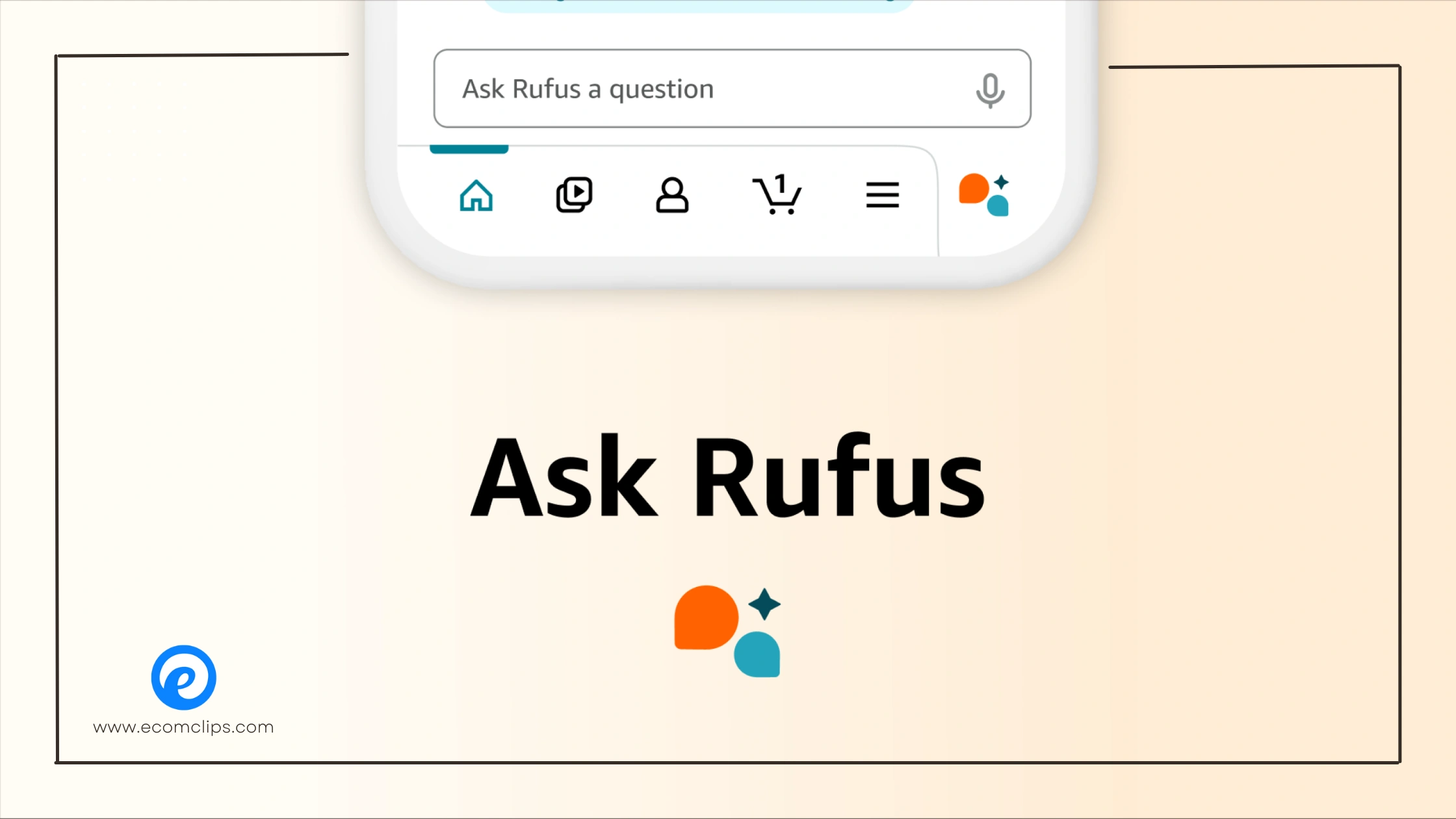
Let’s be honest. When Amazon launched Rufus, half the sellers panicked and the other half completely ignored it.
I get it. Every year, there’s a “new thing” that’s supposed to change everything. But here’s what’s different this time: Rufus isn’t going away. And while you don’t need to drop everything and rewrite your entire catalog today, you should understand what’s happening.
I spent weeks testing Rufus, reading the research, and talking to sellers. This guide is everything you need to know, minus the hype and the panic
What Exactly Is Amazon Rufus?
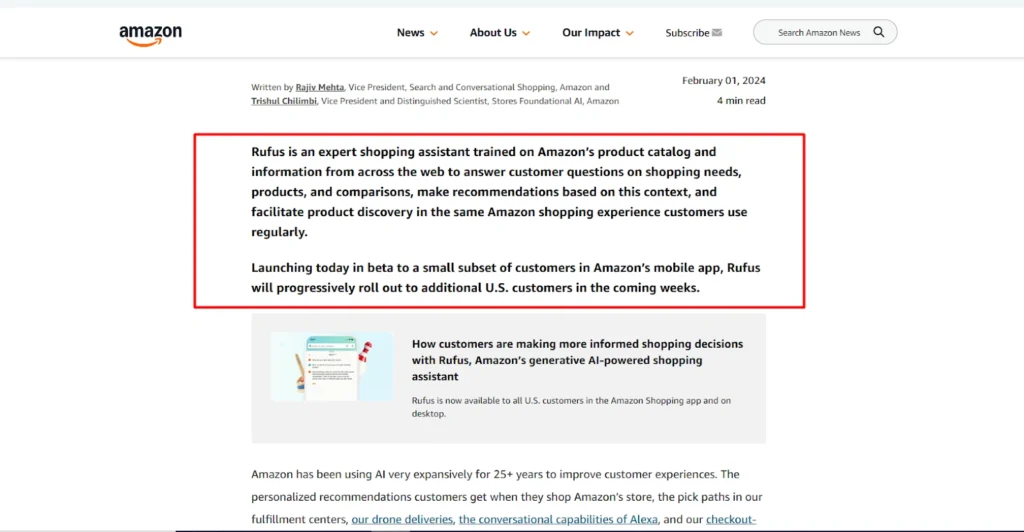
Rufus is Amazon’s AI shopping assistant. It launched in early 2024 and is basically a chatbot that helps customers shop smarter.
Instead of searching “running shoes for women,” customers can now ask Rufus specific questions like:
- “What’s the best running shoe for someone with flat feet?”
- “Show me waterproof backpacks under $50”
- “Which of these two coffee makers is easier to clean?”
Rufus answers by reading your product listings, images, customer reviews, and Amazon’s data. It’s like having a personal shopping assistant who knows everything about every product.
According to Amazon’s official announcement, Rufus was trained on Amazon’s product catalog, customer reviews, community Q&As, and information from across the web.
Should You Actually Care About This?
Here’s the reality check nobody’s telling you.
Right now? Rufus usage is super low. I’ve seen estimates that out of 100 purchases, maybe 2-3 involve Rufus. Most shoppers don’t even know it exists yet.
But here’s why this matters:
Amazon spent millions building this. They’re not going to abandon it. As Rufus gets better and more people use it, the sellers who optimized early will have a huge advantage.
Think of it like this: back in 2015, some sellers ignored mobile optimization because “most people shop on desktop anyway.” Those sellers are now scrambling to catch up.
The smart move? Start optimizing now, but don’t obsess over it. Spend maybe 5% of your time on Rufus prep while keeping your main focus on what already works.
Realistic timeline:
- 2025: Test and learn phase
- 2026: Adoption starts climbing
- 2027+: Rufus becomes standard behavior
You’re not late. But the clock is ticking.
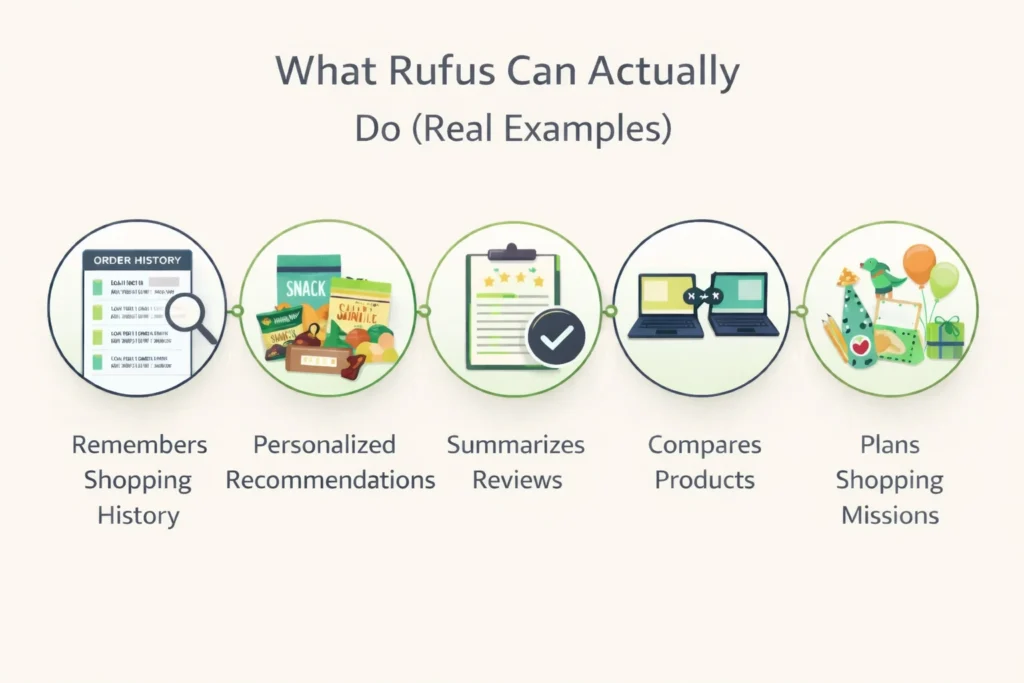
What Rufus Can Actually Do (Real Examples)
-I tested Rufus for hours. Here’s what it can handle right now.
1. It Remembers Your Shopping History
This one surprised me. I asked Rufus “How many phone chargers have I bought?”
It pulled up my entire order history: 8 chargers, dates for each order, and links to every product. That’s genuinely useful.
2. Personal Recommendations Based on Your Behavior
I asked “What snacks would I like based on my past orders?”
Rufus noticed I buy a lot of protein bars and trail mix. It suggested similar items I hadn’t tried yet. Some recommendations were actually good.laptop
This means Amazon is using your purchase history to personalize suggestions in real-time.
3. Quick Review Summaries
Instead of reading 500 reviews, you can ask Rufus “What do customers say about this blender’s noise level?”
It summarizes the common opinions. Saves time. Works surprisingly well.
4. Side-by-Side Product Comparisons
Ask Rufus “Compare these two laptops” and it lists specs, prices, and key differences in a clean format.
Way faster than opening multiple tabs and trying to compare yourself.
5. Shopping Mission Planning
This feature is wild. I asked Rufus to “Plan a birthday party for a 6-year-old who likes dinosaurs.”
It created a complete shopping list: decorations, party favors, plates, games, cake supplies. Even broke it down by priority and estimated total cost.
Is it perfect? No. But it’s genuinely helpful for complex shopping tasks.
The Big Change: Keywords Aren’t Dead, But They Work Differently Now
This is the most important thing to understand.
For years, Amazon SEO was simple: stuff your listing with keywords. The more times you wrote “kitchen knife set,” the better you ranked.
That’s changing.
Rufus doesn’t just look for exact keyword matches. It understands meaning.
According to research on semantic search technology, modern AI can recognize:
- Synonyms and related terms
- Context and intent
- Different ways of saying the same thing
- The actual problem someone’s trying to solve
Here’s a Real Example
Old way (keyword stuffing): “dog bed large dog bed washable dog bed orthopedic dog bed pet bed dog beds for large dogs”
New way (context and meaning): “Orthopedic dog bed for large breeds with joint pain, featuring washable memory foam that supports hip and spine health during sleep”
See the difference? The second version has fewer keyword repetitions but way more useful information.
Rufus understands that “joint pain,” “hip support,” and “orthopedic” are all related. You don’t need to say “orthopedic” 10 times.
This Changes Everything About How You Write Listings
The old fight was “SEO vs. good copy.” You had to choose: write for robots (keyword stuffing) or write for humans (actual good marketing).
Rufus kills that fight. Now the same content that helps humans also helps the AI.
The Noun-Phrase Strategy (Sounds Boring, Actually Important)
Amazon filed patents about how Rufus processes product information. Smart sellers are using this to structure their listings better.
The basic formula is:
[What it is] + [Who it’s for or key feature] + [Main benefit]
Kitchen Knife Example:
“Professional chef’s knife set (what) + with German stainless steel (feature) + for precision cutting and lasting sharpness (benefit)”
Yoga Mat Example:
“Extra thick yoga mat (what) + designed for sensitive joints (who) + with non-slip texture for safe practice (benefit)”
This isn’t complicated. You’re just being more specific and helpful instead of repeating the same keyword endlessly.
How to Actually Optimize Your Listings (Step by Step)
Okay, enough theory. Here’s exactly what to do.
Step 1: Talk to Rufus About Your Product
Go to Amazon. Find your product. Open Rufus and start asking questions:
- “What is this made of?”
- “Who is this best for?”
- “How does this compare to [competitor]?”
- “What problems does this solve?”
Write down every wrong answer or missing information. Those are your gaps.
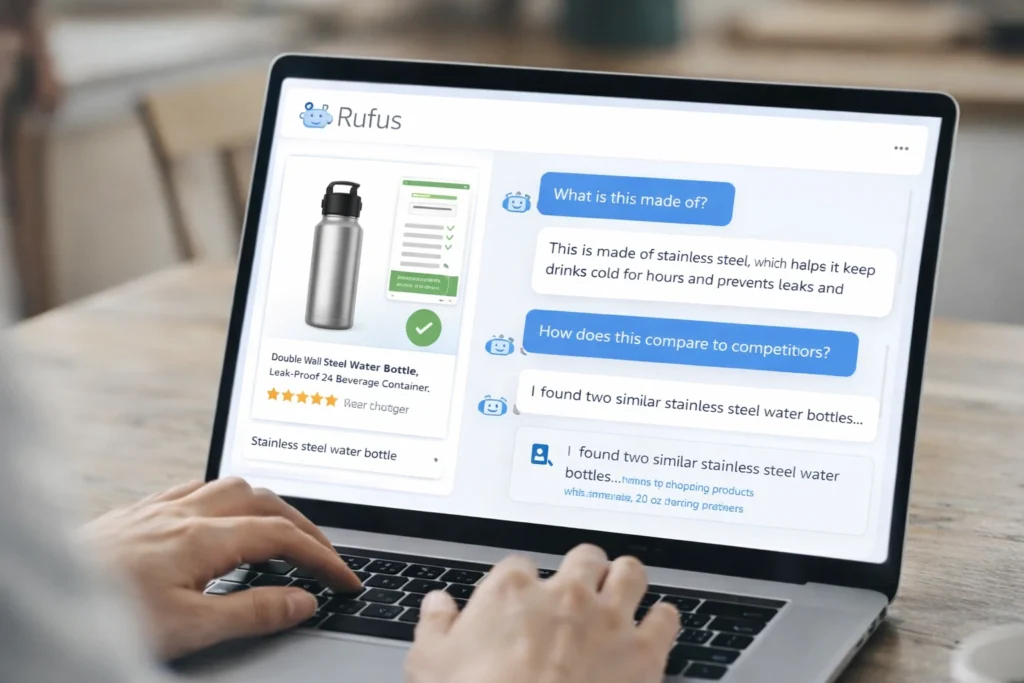
I did this for a client’s water bottle. Rufus said it was “plastic” when it’s actually stainless steel. That’s a $5 price point difference. We fixed the listing and sales jumped 18% in two weeks.
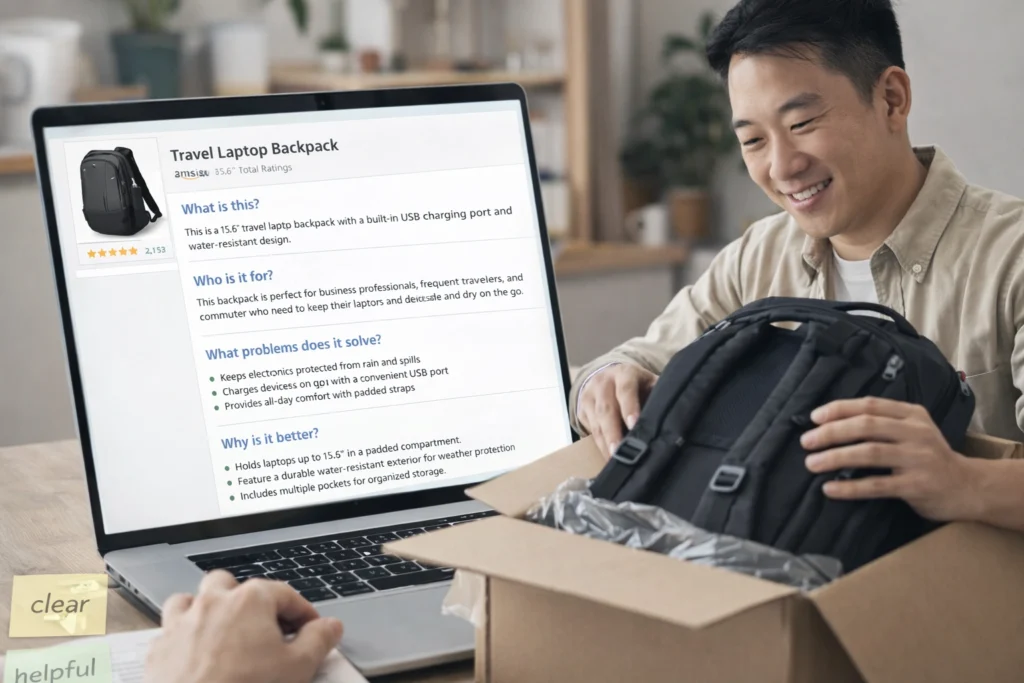
Step 2: Rewrite Your Title
Your title should answer three questions instantly:
- What is this?
- Who is it for?
- Why should they care?
Bad title: “Backpack Laptop Backpack Travel Backpack Computer Backpack USB Backpack Water Resistant”
Good title: “Travel Laptop Backpack for Business Professionals – Fits 15.6″ Computers with USB Charging Port and Water-Resistant Design”
Notice: fewer keywords, way more information, actually readable.
Step 3: Transform Your Bullet Points
Stop writing bullets like this: “✓ High quality materials” “✓ Durable construction” “✓ Easy to use”
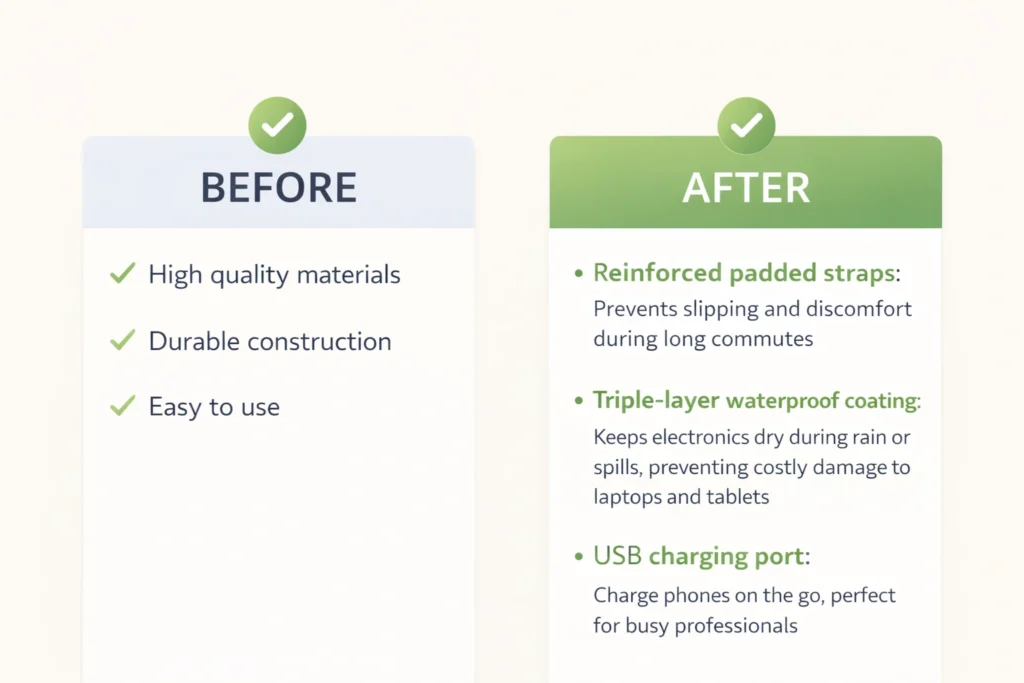
Instead, use this format: [Feature] + [Why it matters] + [Specific benefit]
Example: “Triple-layer waterproof coating keeps electronics dry during rain or spills, preventing costly damage to laptops and tablets worth hundreds of dollars”
See how that’s more compelling? You’re connecting features to real problems and outcomes.
Step 4: Check Your Images (This Is Critical)
Here’s something most sellers don’t know: Rufus reads your images.
The AI analyzes what’s in your photos.
One seller told me Amazon flagged their cat toy as an adult product because the image confused the AI. Their ads got restricted. They fixed the image, problem solved.
What to do:
- Log into Seller Central
- Use the AI image checker tool
- Upload each image separately
- Make sure Amazon recognizes your product correctly
Add text to your images when it helps clarify what something is. “Fits 15.6″ laptops” as an overlay is useful for both humans and AI.
According to Amazon’s image guidelines, images should clearly show the product and its key features. Now there’s an AI reason too.
Step 5: Write a Real Product Description
Stop writing for robots. Write like you’re explaining the product to a friend.
Bad description: “This product is made of high-quality materials and features durable construction for long-lasting use.”
Good description: “Ever bought a backpack that fell apart after three months? Frustrating, right? This one’s different. We reinforced every stress point where backpacks usually break: the zipper seams, shoulder strap anchors, and bottom corners. The result? A backpack that actually lasts through daily commutes, business trips, and weekend adventures.”
See how the second version tells a story, addresses a real problem, and explains the solution?
That’s what Rufus rewards. And humans love it too.
Step 6: Build a Proper FAQ Section
Rufus pulls information from your FAQ to answer customer questions. If your FAQ is empty, you’re leaving out a huge opportunity.
What to include:
- Material and size questions
- “Will this fit my…” questions
- Care and cleaning instructions
- Common comparison questions
- Compatibility concerns
I recommend 8-12 questions minimum. Answer them thoroughly.
Step 7: Monitor Your Reviews
Fake reviews can train Rufus incorrectly. If scam reviews say your product does something it doesn’t, Rufus might repeat that misinformation to customers.
Check your reviews regularly. Report obviously fake ones through Seller Central.
Thinking About Hiring an Amazon Expert?
Ecomclips’ Partners Achieve an Average 85% Profit Increase!
What Actually Works for Rufus (The Real Priorities)
After all my testing, here’s what matters most:
1. Clear, Conversational Writing
Talk like a human, not a keyword bot. Rufus understands natural language better than robotic repetition.
2. Connect Features to Benefits
Don’t just say “stainless steel.” Say “stainless steel construction prevents rust and keeps your tools working for years instead of months.”
3. Address Real Problems
What pain points does your product solve? Say it explicitly. Don’t assume the AI (or customers) will figure it out.
4. Natural Sentences Beat Keyword Lists
“Heavy-duty construction for professional use” beats “heavy duty professional construction professional grade heavy duty”
5. Consistent Info Everywhere
Your title, bullets, description, images, and FAQ should all tell the same story with the same facts.
What Rufus Can’t Do Yet (Important Limitations)
Let’s be realistic about what doesn’t work.
Missing features:
- No “add all to cart” button for multiple items
- Desktop interface is clunky and small
- Can’t save shopping lists easily
- Sometimes gives wrong information
Low adoption: Most Amazon customers haven’t even tried Rufus. Traditional search is still dominant.
Hype vs. reality: AI influencers on LinkedIn are making huge claims. The actual data doesn’t support massive changes yet.
According to conversations in seller communities, Rufus usage is estimated under 3% of total Amazon shopping sessions right now.
What You Should Actually Do in 2026
Here’s my honest recommendation.
Do these things now:
- Test your top 10 products with Rufus once a month
- Fix obvious mistakes (wrong materials, missing info, bad images)
- Rewrite titles to be more descriptive and natural
- Transform your bullets from feature lists to benefit statements
- Check your images with Amazon’s AI tool
- Build a comprehensive FAQ
Don’t do these things:
- Panic and rewrite your entire catalog overnight
- Remove all keywords thinking “natural language” means no keywords
- Ignore traditional SEO that still works
- Spend more time on Rufus than on your main image and ad campaigns
Time allocation guide:
- 75% of your effort: Traditional optimization (images, ads, keywords, reviews)
- 20% of your effort: Improving listing quality and copy
- 5% of your effort: Rufus-specific testing and updates
The fundamentals still matter most. Great main images, compelling copy, strong reviews, and smart PPC still drive 95% of your success.
Rufus is just one more reason to do those things well.
The Investment Question
“How much should I spend on this?”
Here’s a rule of thumb I use: invest in listing optimization equal to one month of your ad spend.
If you spend $2,000/month on PPC, invest $2,000 in professional listing overhauls (copy, design, A+ content, images).
A good listing works 24/7 for years. It’s the highest ROI investment you can make.
According to data from Jungle Scout, optimized listings can improve conversion rates by 30-50%. That compounds every single day.
Amazon’s Big Vision for Rufus
Amazon didn’t build Rufus just to answer basic questions. They have bigger plans.
The goal is to make Rufus:
- A voice-activated shopping assistant (like Alexa for Amazon shopping)
- A personalized recommendation engine that knows your preferences
- A tool that understands images, videos, and text together
- A conversational navigator across search, product pages, and checkout
According to Amazon’s investor materials, they’re investing heavily in generative AI across the shopping experience.
Is this vision reality yet? No. But it’s where things are heading.
When Rufus reaches mainstream adoption (and it will), sellers who optimized early will have years of performance data working in their favor.
The Simple Truth About Optimization
Here’s what nobody tells you:
The best content for AI is exactly the same as the best content for humans.
If your listing clearly explains:
- What the product actually is
- Who it’s designed for
- What problems it solves
- Why it’s better than alternatives
- How to use it effectively
Then you’re already optimized for Rufus.
You don’t need special “AI tricks.” You just need to be clear, honest, and helpful.
Rufus is just forcing sellers to do what they should have been doing all along: putting the customer first.
Your Action Plan (Simple Checklist)
Here’s exactly what to do this week:
☐ Ask Rufus 10 questions about your best-selling product
☐ Write down every wrong or missing answer
☐ Rewrite your title to be more descriptive
☐ Transform 3 bullets from features to benefits
☐ Run your main image through Amazon’s AI checker
☐ Add 5 questions to your FAQ section
☐ Read your description out loud (if it sounds robotic, rewrite it)
☐ Check reviews for obvious fakes
☐ Set a calendar reminder to test again in 30 days
☐ Keep doing what already works (ads, reviews, images)
Start small. Test one product. See what works. Then expand to your catalog.
Frequently Asked Questions (FAQ)
Q. Do I really need to optimize for Rufus right now, or can I wait another year?
Yes. While Rufus is still in its early stages, optimizing for it now gives you a head start. As Rufus adoption grows over the next few years, early optimizers will have an advantage. Starting early ensures your listings are already set for when it becomes mainstream in 2026-2027.
Q. I have 500+ products. Do I need to rewrite every single listing?
No. Start with your top 10 best-sellers first. These products are your biggest revenue drivers. Once you’ve optimized them and seen a boost in performance, you can expand to other listings. Prioritize based on sales potential.
Q. Will keyword stuffing hurt my rankings now that Rufus understands natural language?
Yes. Keyword stuffing doesn’t work with Rufus. It values clear, natural language that answers real customer questions. Focus on writing helpful, meaningful product descriptions that are both customer-friendly and AI-optimized.
Q. How do I know if Rufus is actually giving wrong information about my products?
Test your listings by asking Rufus specific questions like “What material is this product made of?” or “How does this compare to [competitor]?” If the answers are wrong or incomplete, your listings might need a refresh to fix the missing information.
Q. Should I hire someone to optimize my listings for Rufus or do it myself?
It depends on your skills and time. If you’re comfortable with copywriting and SEO, you can optimize your listings yourself. If not, hiring a professional can save time and ensure the best results. It’s a smart investment, especially if you’re managing a large catalog.
Q. How can I make sure my product images are optimized for Rufus?
Rufus reads your images, so make sure they are clear, high-quality, and directly relevant to your product. Use text overlays to highlight key features and make it easy for the AI to understand what’s in the picture. This ensures your product is recognized correctly by the system.
Q. What should I focus on in my FAQ section for Rufus optimization?
Include common customer questions about materials, size, compatibility, and usage. Make sure to answer thoroughly to help Rufus pull accurate data. Aim for 8-12 questions that cover the main concerns potential buyers have.
Q. How do I check if Rufus is actually using the right data from my listings?
Ask Rufus questions about your products and compare the answers to what’s in your listing. If there are discrepancies or missing details, it means your listing might need some improvements. This simple test can reveal gaps in your content.
Q. Can Rufus impact my product’s visibility on Amazon?
Yes, Rufus can impact your visibility. As it becomes more integrated into Amazon’s shopping experience, products that are well-optimized for Rufus will be more likely to appear in relevant recommendations and searches, improving your chances of being discovered.
Q. Will Rufus replace traditional SEO for Amazon sellers?
No, Rufus won’t completely replace traditional SEO. While it focuses on understanding context and meaning, traditional SEO (like using relevant keywords and good product images) still matters. The best strategy is to combine both approaches for maximum visibility.
How Ecomclips Can Help You Dominate Rufus (And Everything Else)
Look, I’m going to level with you.
You can absolutely optimize for Rufus yourself using this guide. But here’s what nobody tells you: most sellers don’t have the time, the team, or honestly, the patience to do this at scale.
You’re already managing inventory, running ads, dealing with customer service, fighting off competitors, and somehow trying to have a life outside of Amazon. Adding “comprehensive listing optimization for an AI shopping assistant” to that list? Yeah, good luck.
That’s where a team like Ecomclips actually makes sense.
What They Actually Do (The Stuff That Matters)
Ecomclips isn’t some random freelancer on Upwork who’ll rewrite your bullets and disappear. They’re a full-service Amazon agency with over 15 years in the game, and they handle the exact things Rufus cares about:
Listing Optimization That Actually Converts
They don’t just keyword-stuff your titles. They rewrite your entire listing structure — titles, bullets, descriptions, FAQs — using the noun-phrase strategy and benefit-driven copy that works for both traditional search AND Rufus. Real talk: most sellers write terrible copy. Ecomclips fixes that.
A+ Content and Brand Store Design
Remember how Rufus reads your images? Ecomclips creates professional A+ Content and brand stores that are visually clear, benefit-focused, and optimized for AI recognition. They use Adobe Photoshop, Illustrator, and other pro tools to make sure your visuals aren’t confusing the algorithm.
Image Optimization
They don’t just slap some text on a photo and call it done. They create infographics, feature images, lifestyle shots, and CGI renders that clearly show what your product is, who it’s for, and why it matters. All optimized for Amazon’s AI image checker so Rufus recognizes your product correctly.
PPC That Supports Your Listings
Here’s something smart: they run your sponsored ads using data from tools like Helium 10, Jungle Scout, and others to identify which keywords are actually driving conversions. Then they feed that data back into your listing optimization. It’s a loop that gets better over time.
Multichannel Management
If you’re selling on Amazon, Walmart, eBay, and other platforms through tools like ChannelAdvisor, Linnworks, or Sellbrite, they handle that too. Consistent listings across channels matter more now because Rufus pulls data from everywhere.
Why This Actually Matters for Rufus
Most agencies just optimize for traditional Amazon SEO and call it a day. Ecomclips gets that Rufus changes the game because they’ve been testing this stuff since Rufus launched in 2024.
They understand that Rufus rewards:
- Clear, conversational copy (not keyword soup)
- Benefit-driven explanations (not just features)
- Consistent information across all content (titles, bullets, images, FAQs)
- Professional visuals that the AI can actually parse
And they have an entire team dedicated to quality control. Every listing goes through project managers and senior managers before it goes live. That means fewer mistakes, faster turnarounds, and work that actually drives results.
The Real ROI
Here’s the math that matters.
If you spend $2,000/month on PPC, you should invest at least $2,000 in professional listing optimization. Why? Because a great listing works 24/7 for years. Your ad spend is gone the second you turn off the campaign.
Ecomclips clients typically see 30-50% conversion rate improvements after comprehensive optimization. For a product doing $10,000/month, that’s an extra $3,000-5,000 in monthly revenue. Your investment pays for itself in 30-60 days, then it’s pure profit.
One of their clients (Ronald Davis from Indiana Metal Craft) saw a 150% revenue increase over 18 months. Another client (Anjum Kaushik from Home City) called them “an extension of our own team.” That’s not hype. That’s what happens when you work with people who actually know what they’re doing.
When to Hire Them (Honest Advice)
You don’t need Ecomclips if:
- You’re doing under $5,000/month in sales (handle it yourself first)
- You have an in-house team with time and expertise
- You’re genuinely good at copywriting and design
You should consider Ecomclips if:
- You’re doing $10,000+/month and need to scale
- You’re stretched thin managing operations
- Your conversion rates are stuck or declining
- You’ve tried optimizing yourself and it’s not moving the needle
- You want to prepare for Rufus without abandoning what already works
How to Work With Them
It’s straightforward. They offer free consultations to assess your current listings and identify opportunities. No pressure, no BS. They’ll tell you what’s broken and what it’ll take to fix it.
From there, you can choose specific services (just listing optimization, just A+ Content, just PPC) or go full-service where they handle everything from product uploads to customer service to review management.
Most sellers start with optimizing their top 10-20 products, see the results, then expand from there. Smart approach.
Bottom Line
You can absolutely optimize for Rufus yourself. This article gives you everything you need to do that.
But if you’re serious about scaling, if you’re already stretched thin, or if you just want professionals handling this while you focus on sourcing and strategy, Ecomclips is worth a conversation.
They’ve been doing this since before Rufus existed. They’ll still be doing it long after the next “AI revolution” comes along.
And in the end, that’s what you want: a partner who adapts with the platform instead of chasing every shiny new trend.
Check them out at ecomclips.com or reach out via email (info@ecomclips.com).
No pressure. Just options.
Because at the end of the day, you’re not optimizing for Rufus. You’re optimizing for sustainable, long-term growth in a marketplace that never stops changing.
And having the right team on your side makes that a hell of a lot easier.
Watch how ecomclips help sellers to protect their Amazon Business:
STOP GUESSING! USE AMAZON DATA TO EXPLODE YOUR SALES in 2026
Amazon’s Rufus AI Prompts: The Future of Sponsored Products Optimization
Your Amazon Listing Is Losing Money
Amazon Brand Growth Secrets: Use Customer Data To Boost Sales Fast!
Amazon AI Update 2025: Why Sellers Are Losing Ranking Overnight
Amazon Listing Image Masterclass: How Top Sellers Boost CTR & Conversions
Final Thoughts
Rufus is real. It’s not going away. Eventually, it will change how millions of people shop on Amazon.
But that change is gradual, not overnight.
You don’t need to panic. You don’t need to ignore it either.
The smart play? Spend a few hours each month testing and improving. Focus most of your energy on fundamentals. And remember that clear, customer-focused content has always won.
Rufus just makes bad content impossible to hide behind keyword tricks anymore.
The sellers who win will be the ones who adapt thoughtfully without abandoning what already works. Who balance current priorities with future preparation.
And who remembers that at the end of the day, you’re not optimizing for an AI. You’re optimizing for real people trying to solve real problems.
Help them do that, and everything else takes care of itself.
Questions? Thoughts? Drop them in the comments. We read and respond to everything.
And if this helped you, share it with another seller who’s confused about this Rufus thing. Let’s help each other figure this out together.
Ready to Start Growing Your Brand?
Ecomclips’ Partners Achieve an Average 85% Profit Increase!