

For months, international trade has been a battlefield of uncertainty. Tariffs were shifting like sand, and sellers around the globe struggled to predict costs or plan long-term strategies. Profits bled away, and the future of cross-border commerce felt like walking blindfolded through a storm.
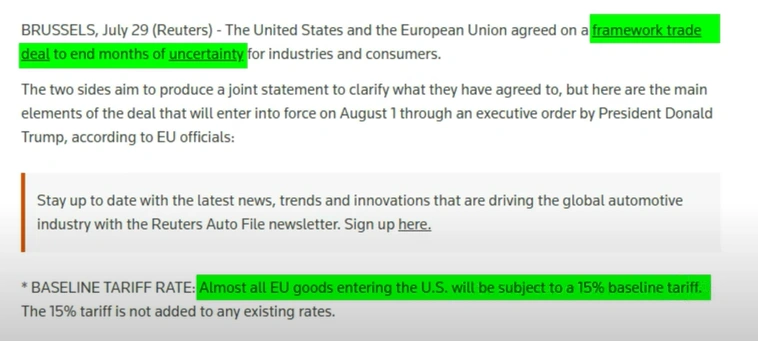
Now, a breakthrough has arrived: the United States and the European Union have struck a framework agreement that introduces a flat 15% tariff on most EU goods entering the American market. After years of chaos, this feels like a turning point. But is it the final chapter or just the beginning of another twist?
From Uncertainty to Stability
The greatest pain point of tariffs wasn’t always the percentage slapped on imports—it was the unpredictability. One month brought stability, and the next month delivered another “boom” with fresh regulations, rising duties, and a cascade of confusion.
The new deal changes that. Instead of stacking tariffs like Lego bricks, where one levy piles on top of another until cost sheets resemble a horror movie, the EU arrangement introduces a flat, predictable ceiling. The 15% tariff is the maximum. No hidden surcharges. No creeping additions.
For sellers, that predictability is golden. Pricing can now be set with confidence, financial planning becomes more reliable, and expansion strategies no longer carry the same fear of sudden disruption.
Beyond Finished Goods: The Raw Materials Factor
This isn’t just about consumer goods. The deal extends to natural resources and critical raw materials, the backbone of manufacturing. The United States has long depended on foreign nations for materials that power production, from rare earths to metals.
With consistent tariffs in place, importing these resources from Europe could provide the foundation for reshoring certain manufacturing sectors. Over the next few years, some industries may find it more cost-effective to move production closer to home while maintaining healthy profit margins.
Of course, not everything is covered. For example, steel and aluminum remain at steep tariffs of 50%, as the U.S. already produces significant quantities domestically. But for many other materials, the groundwork for renewed industrial strategy has been laid.
The Bigger Picture: Strategic Partnerships
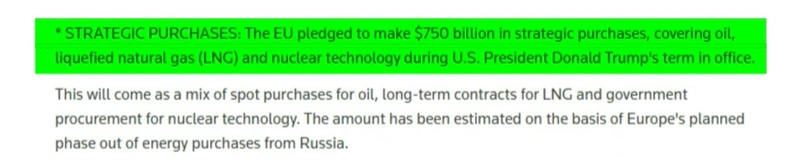
Behind the headlines about tariffs lies something bigger. The EU has already placed $750 billion in strategic purchases across vital sectors such as oil, gas, nuclear fuel, and semiconductors. This signals a new era of transatlantic cooperation, designed to balance against other global trade giants.
For everyday e-commerce businesses, this might not directly affect daily operations—few sellers are importing oil or nuclear fuel. But the ripple effect matters. Stability in trade relations between the U.S. and EU reduces the risk of sudden shocks. Less drama, less volatility, and far greater predictability.
Opportunities for E-Commerce Sellers
While the deal doesn’t magically solve every challenge, it opens interesting doors. Those considering global expansion into EU markets may find now is the perfect time to diversify. Even businesses manufacturing locally in the U.S. can benefit by exploring sales channels across Europe, using this new climate of stability as a hedge against future trade surprises elsewhere.
The European market may mirror the U.S. in some respects, but it offers fresh growth opportunities and a valuable balance for businesses looking to strengthen resilience.
Frequently Asked Questions (FAQ)
1. What is the new 15% tariff deal between the U.S. and EU?
The United States and the European Union have agreed on a flat 15% tariff for most EU goods entering the U.S. market. This replaces the unpredictable, layered tariffs of the past with a single, stable framework.
2. How does the 15% tariff affect e-commerce sellers?
For online sellers, the biggest benefit is predictability. With a clear tariff cap, businesses can price products more confidently, plan inventory, and expand globally without worrying about sudden cost spikes.
3. Are all goods included under the 15% tariff?
No. While many finished goods and raw materials fall under the 15% ceiling, certain items like steel and aluminum still face steep tariffs of up to 50%, as the U.S. has strong domestic production in those sectors.
4. Will this deal reduce product prices for consumers?
Not immediately. While costs may stabilize for sellers, retail prices depend on supply chains, competition, and market demand. However, over time, reduced volatility can lead to more competitive pricing.
5. How will this deal impact raw material imports and manufacturing?
The agreement extends to critical raw materials, which could encourage U.S. industries to reshore production by relying on stable European imports. This could strengthen domestic manufacturing over the long term.
6. Should e-commerce businesses expand into the EU now?
Yes, this is a favorable time to diversify. With transatlantic trade stabilizing, U.S. businesses can explore EU markets with greater confidence and use this agreement as a hedge against instability in other regions.
Conclusion: A Step Toward a New Chapter
The flat 15% tariff represents more than just a number—it symbolizes the shift from chaos to clarity. For the first time in years, there is a stable framework for cross-border trade between the U.S. and EU.
Will it last forever? History suggests nothing in global trade is permanent. But as long as the 15% cap remains locked in, e-commerce sellers and manufacturers alike can plan, price, and grow without the constant fear of shifting ground.
This deal may not be the happy ending, but it feels like the beginning of a much-needed new chapter.
At Ecomclips, we specialize in helping businesses adapt to changes like these—whether it’s managing cross-border listings, optimizing fulfillment, or creating strategies that thrive in evolving trade climates. Stability in tariffs means new opportunities, and we’re here to help you seize them.
Visit www.ecomclips.com or reach us at info@ecomclips.com to explore how we can support your global e-commerce growth.
Thanks for reading. Continue learning with more content from our resources…